1
CCoonntteennttss 
2
IInnttrroodduuccttiioonn 
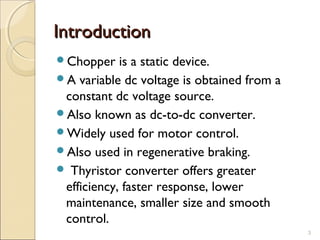
Chopper is a static device. 
A variable dc voltage is obtained from a 
constant dc voltage source. 
Also known as dc-to-dc converter. 
Widely used for motor control. 
Also used in regenerative braking. 
 Thyristor converter offers greater 
efficiency, faster response, lower 
maintenance, smaller size and smooth 
control. 
3
TTyyppeess ooff cchhooppppeerrss 
Buck(Step-down) choppers: 
· In step down chopper output voltage is 
less than input voltage. 
Boost(Step-up) choppers: 
· In step up chopper output voltage is 
more than input voltage. 
Buck-Boost chopper 
4
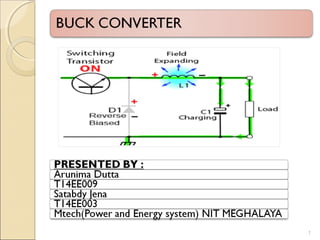
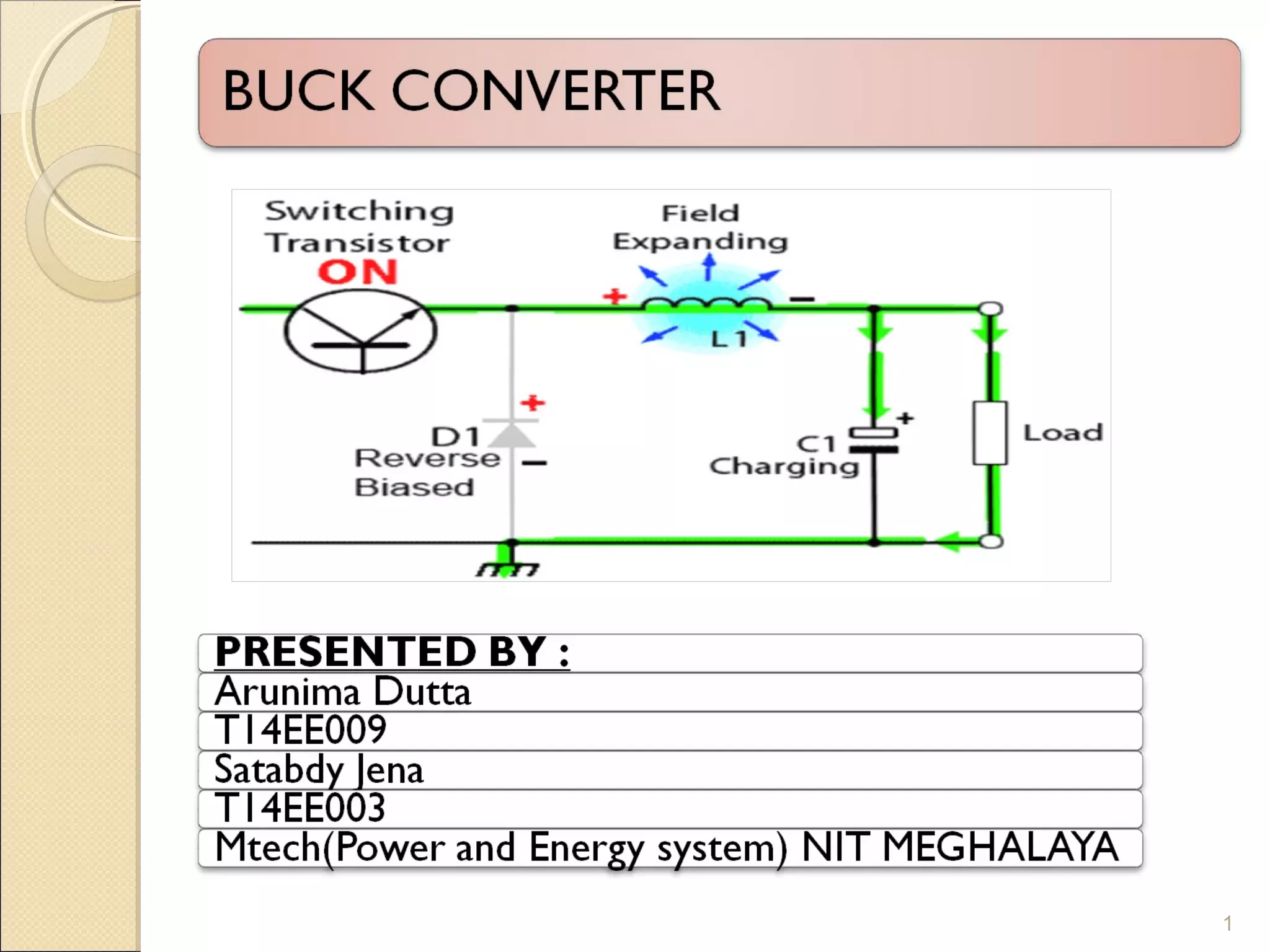
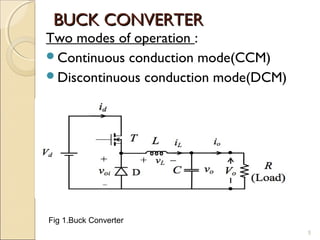
BBUUCCKK CCOONNVVEERRTTEERR 
Two modes of operation : 
Continuous conduction mode(CCM) 
Discontinuous conduction mode(DCM) 
5 
Fig 1.Buck Converter
II.. CCCCMM 
6
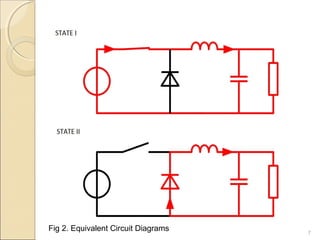
7 Fig 2. Equivalent Circuit Diagrams
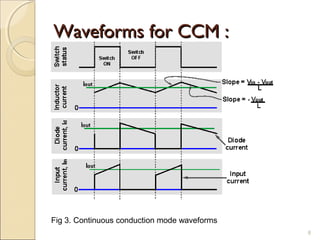
WWaavveeffoorrmmss ffoorr CCCCMM :: 
8 
Fig 3. Continuous conduction mode waveforms
9
10
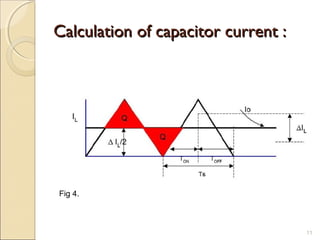
Calculation ooff ccaappaacciittoorr ccuurrrreenntt :: 
11 
Fig 4.
IIII..DDiissccoonnttiinnuuoouuss mmooddee ooff ccoonndduuccttiioonn 
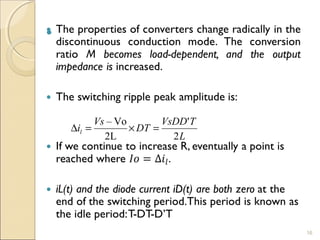
The discontinuous conduction mode arises 
when the switching ripple in an inductor current 
or capacitor voltage is large enough to cause the 
polarity of the applied switch current or voltage 
to reverse, such that the current- or voltage-unidirectional 
assumptions made in realizing the 
switch with semiconductor devices are violated. 
The DCM is commonly observed in dc-dc 
converters and rectifiers, and can also sometimes 
occur in inverters or in other converters 
containing two-quadrant switches. 
. 
12
The discontinuous conduction mode 
typically occurs with large inductor 
current ripple in a converter operating at 
light load and containing current-unidirectional 
switches. Some converters 
are purposely designed to operate in 
DCM for all loads. 
13
14
15 
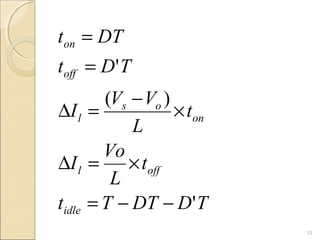
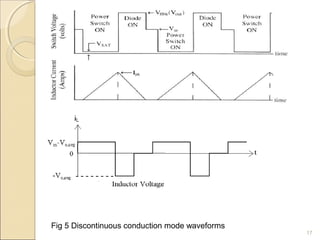
t DT 
on 
= 
t = 
D ' 
T 
I V V 
D = - ´ 
L 
t 
I Vo 
D = ´ 
l off 
L 
t 
t T DT D T 
idle 
on 
s o 
l 
off 
' 
( ) 
= - -
16 
i Vs DT VsDD ' 
T l 2 
L 
D = – Vo ´ = 
2L
17 
Fig 5 Discontinuous conduction mode waveforms
DD TVs 
< ' 
L 
DVo 
R 
2 
18 
(I) 
L < 
2 D' 
RT 
(II) 
crit (III) K < K 
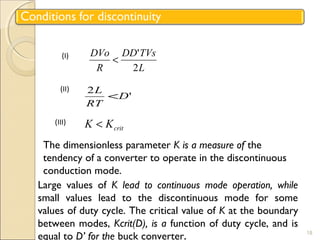
The dimensionless parameter K is a measure of the 
tendency of a converter to operate in the discontinuous 
conduction mode. 
Large values of K lead to continuous mode operation, while 
small values lead to the discontinuous mode for some 
values of duty cycle. The critical value of K at the boundary 
between modes, Kcrit(D), is a function of duty cycle, and is 
equal to D’ for the buck converter.
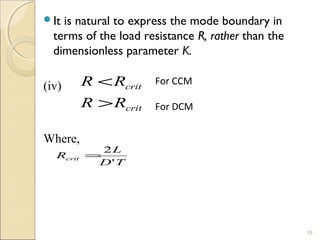
It is natural to express the mode boundary in 
terms of the load resistance R, rather than the 
dimensionless parameter K. 
(iv) 
Where, 
19 
R R 
> 
< For CCM 
crit 
R R 
crit 
For DCM 
R =2 
L crit ' 
D T
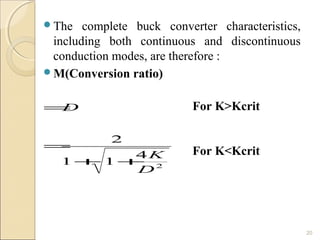
The complete buck converter characteristics, 
including both continuous and discontinuous 
conduction modes, are therefore : 
M(Conversion ratio) 
20 
= For K>Kcrit 
K 
2 
2 
1 1 4 
D 
D 
+ + 
= 
For K<Kcrit
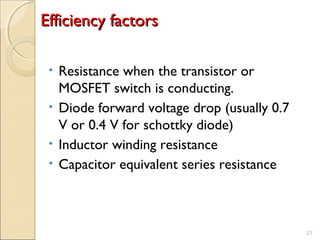
EEffffiicciieennccyy ffaaccttoorrss 
• Resistance when the transistor or 
MOSFET switch is conducting. 
• Diode forward voltage drop (usually 0.7 
V or 0.4 V for schottky diode) 
• Inductor winding resistance 
• Capacitor equivalent series resistance 
21
22
Power electronics by P. S. Bhimbhra 
Modern power electronics by Ned 
Mohan 
Buck Converter,Wikipedia 
DC DC Buck converter 
applications,International rectifier. 
23
24

BUCK CONVERTER

  • 1.
  • 2.
  • 3.
    IInnttrroodduuccttiioonn Chopper isa static device. A variable dc voltage is obtained from a constant dc voltage source. Also known as dc-to-dc converter. Widely used for motor control. Also used in regenerative braking.  Thyristor converter offers greater efficiency, faster response, lower maintenance, smaller size and smooth control. 3
  • 4.
    TTyyppeess ooff cchhooppppeerrss Buck(Step-down) choppers: · In step down chopper output voltage is less than input voltage. Boost(Step-up) choppers: · In step up chopper output voltage is more than input voltage. Buck-Boost chopper 4
  • 5.
    BBUUCCKK CCOONNVVEERRTTEERR Twomodes of operation : Continuous conduction mode(CCM) Discontinuous conduction mode(DCM) 5 Fig 1.Buck Converter
  • 6.
  • 7.
    7 Fig 2.Equivalent Circuit Diagrams
  • 8.
    WWaavveeffoorrmmss ffoorr CCCCMM:: 8 Fig 3. Continuous conduction mode waveforms
  • 9.
  • 10.
  • 11.
    Calculation ooff ccaappaacciittoorrccuurrrreenntt :: 11 Fig 4.
  • 12.
    IIII..DDiissccoonnttiinnuuoouuss mmooddee ooffccoonndduuccttiioonn The discontinuous conduction mode arises when the switching ripple in an inductor current or capacitor voltage is large enough to cause the polarity of the applied switch current or voltage to reverse, such that the current- or voltage-unidirectional assumptions made in realizing the switch with semiconductor devices are violated. The DCM is commonly observed in dc-dc converters and rectifiers, and can also sometimes occur in inverters or in other converters containing two-quadrant switches. . 12
  • 13.
    The discontinuous conductionmode typically occurs with large inductor current ripple in a converter operating at light load and containing current-unidirectional switches. Some converters are purposely designed to operate in DCM for all loads. 13
  • 14.
  • 15.
    15 t DT on = t = D ' T I V V D = - ´ L t I Vo D = ´ l off L t t T DT D T idle on s o l off ' ( ) = - -
  • 16.
    16 i VsDT VsDD ' T l 2 L D = – Vo ´ = 2L
  • 17.
    17 Fig 5Discontinuous conduction mode waveforms
  • 18.
    DD TVs <' L DVo R 2 18 (I) L < 2 D' RT (II) crit (III) K < K The dimensionless parameter K is a measure of the tendency of a converter to operate in the discontinuous conduction mode. Large values of K lead to continuous mode operation, while small values lead to the discontinuous mode for some values of duty cycle. The critical value of K at the boundary between modes, Kcrit(D), is a function of duty cycle, and is equal to D’ for the buck converter.
  • 19.
    It is naturalto express the mode boundary in terms of the load resistance R, rather than the dimensionless parameter K. (iv) Where, 19 R R > < For CCM crit R R crit For DCM R =2 L crit ' D T
  • 20.
    The complete buckconverter characteristics, including both continuous and discontinuous conduction modes, are therefore : M(Conversion ratio) 20 = For K>Kcrit K 2 2 1 1 4 D D + + = For K<Kcrit
  • 21.
    EEffffiicciieennccyy ffaaccttoorrss •Resistance when the transistor or MOSFET switch is conducting. • Diode forward voltage drop (usually 0.7 V or 0.4 V for schottky diode) • Inductor winding resistance • Capacitor equivalent series resistance 21
  • 22.
  • 23.
    Power electronics byP. S. Bhimbhra Modern power electronics by Ned Mohan Buck Converter,Wikipedia DC DC Buck converter applications,International rectifier. 23
  • 24.