DC-DC CONVERTERS
Avinash Maurya
Y.Prakash Reddy
Overview
What is DC-DC converter
Applications
Basic converters
a) Buck converter
b) Boost converter
c) Buck-Boost converter
 Methods of control
DC to DC converter is very much needed nowadays as many
industrial applications are dependent upon DC voltage source. The
performance of these applications will be improved if we use a
variable DC supply. It will help to improve controllability of the
equipment also.
Chopper is a basically static power electronics device which
converts fixed dc voltage/power to variable DC voltage or power. It
is nothing but a high speed switch which connects and disconnects
the load from source at a high rate to get variable or chopped voltage
at the output.
• Chopper can increase or decrease the dc voltage level at its
opposite side. So, chopper serves the same purpose in dc circuit
transfers in case of ac circuit. So it is also known as DC
transformer.
• Devices used in Chopper
• Low power application : GTO, IGBT, Power BJT, Power
MOSFET etc. High power application : Thyristor or SCR.
• These devices are represented as a switch in a dotted box for
simplicity. When it is closed current can flow in the direction of
arrow only.
Buck converter
5
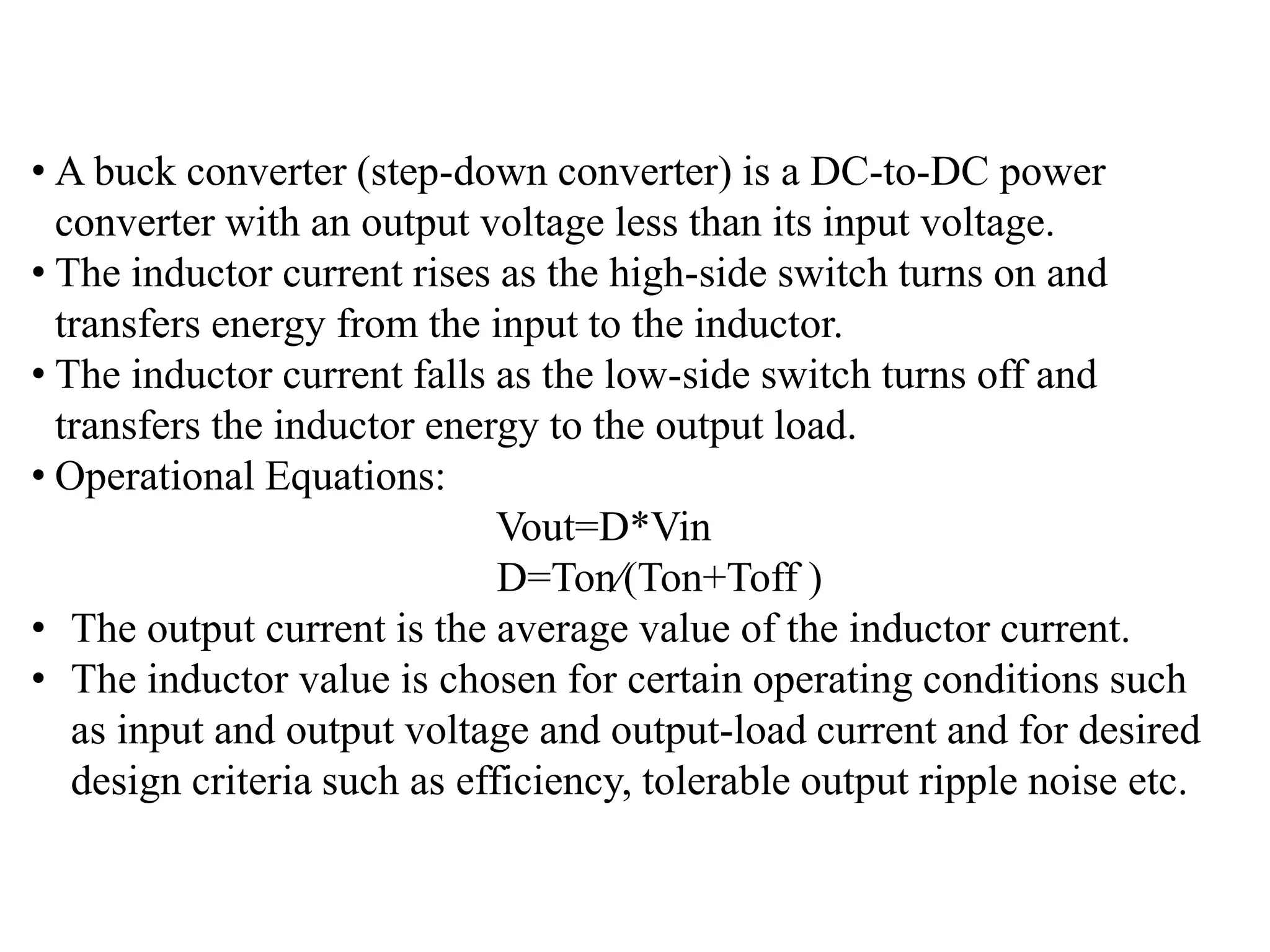
• A buck converter (step-down converter) is a DC-to-DC power
converter with an output voltage less than its input voltage.
• The inductor current rises as the high-side switch turns on and
transfers energy from the input to the inductor.
• The inductor current falls as the low-side switch turns off and
transfers the inductor energy to the output load.
• Operational Equations:
Vout=D*Vin
D=Ton⁄(Ton+Toff )
• The output current is the average value of the inductor current.
• The inductor value is chosen for certain operating conditions such
as input and output voltage and output-load current and for desired
design criteria such as efficiency, tolerable output ripple noise etc.
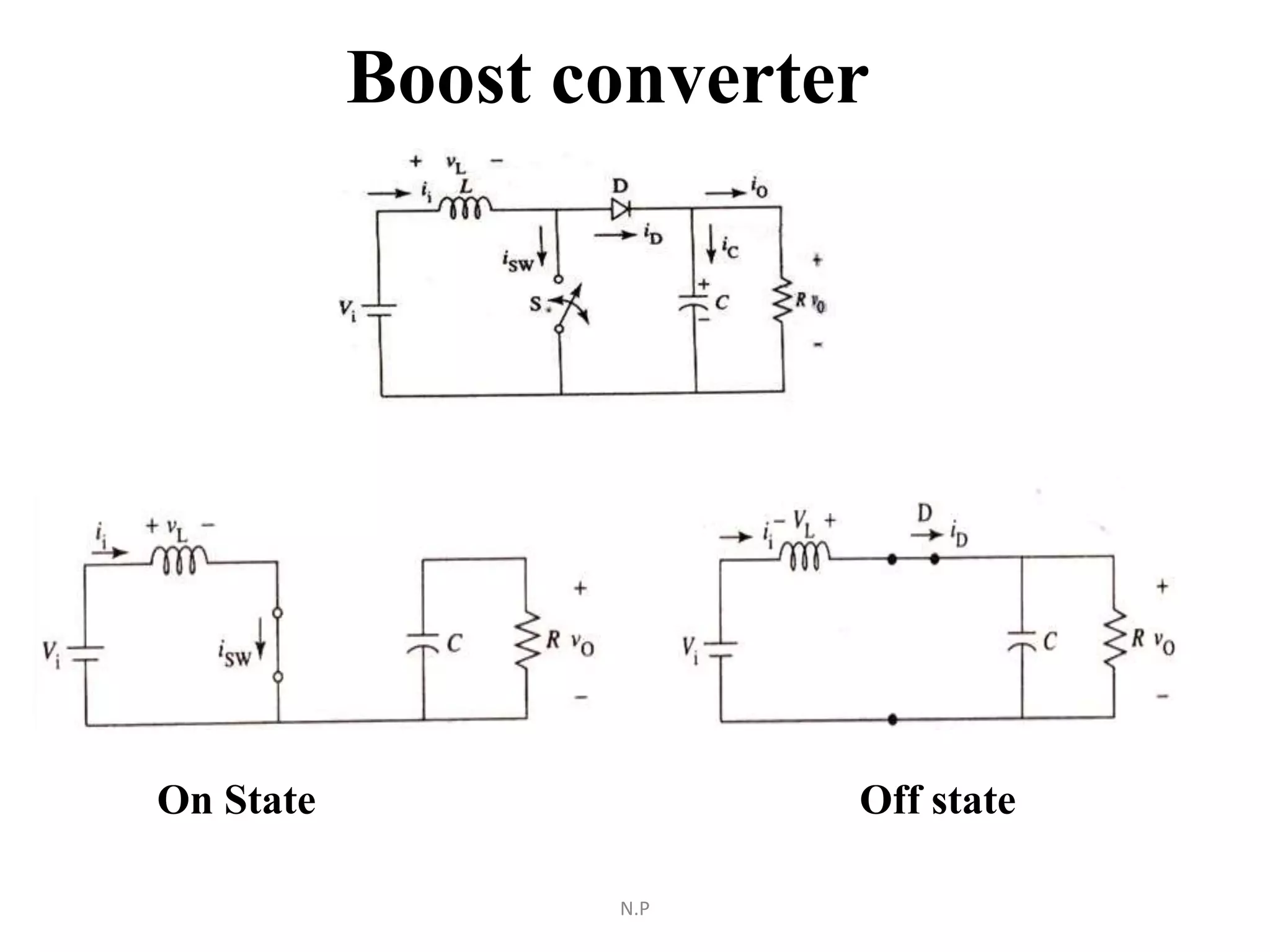
Boost converter
On State Off state
N.P
• A boost converter (step-up converter) is a DC-to-DC power
converter with an output voltage greater than its input voltage.
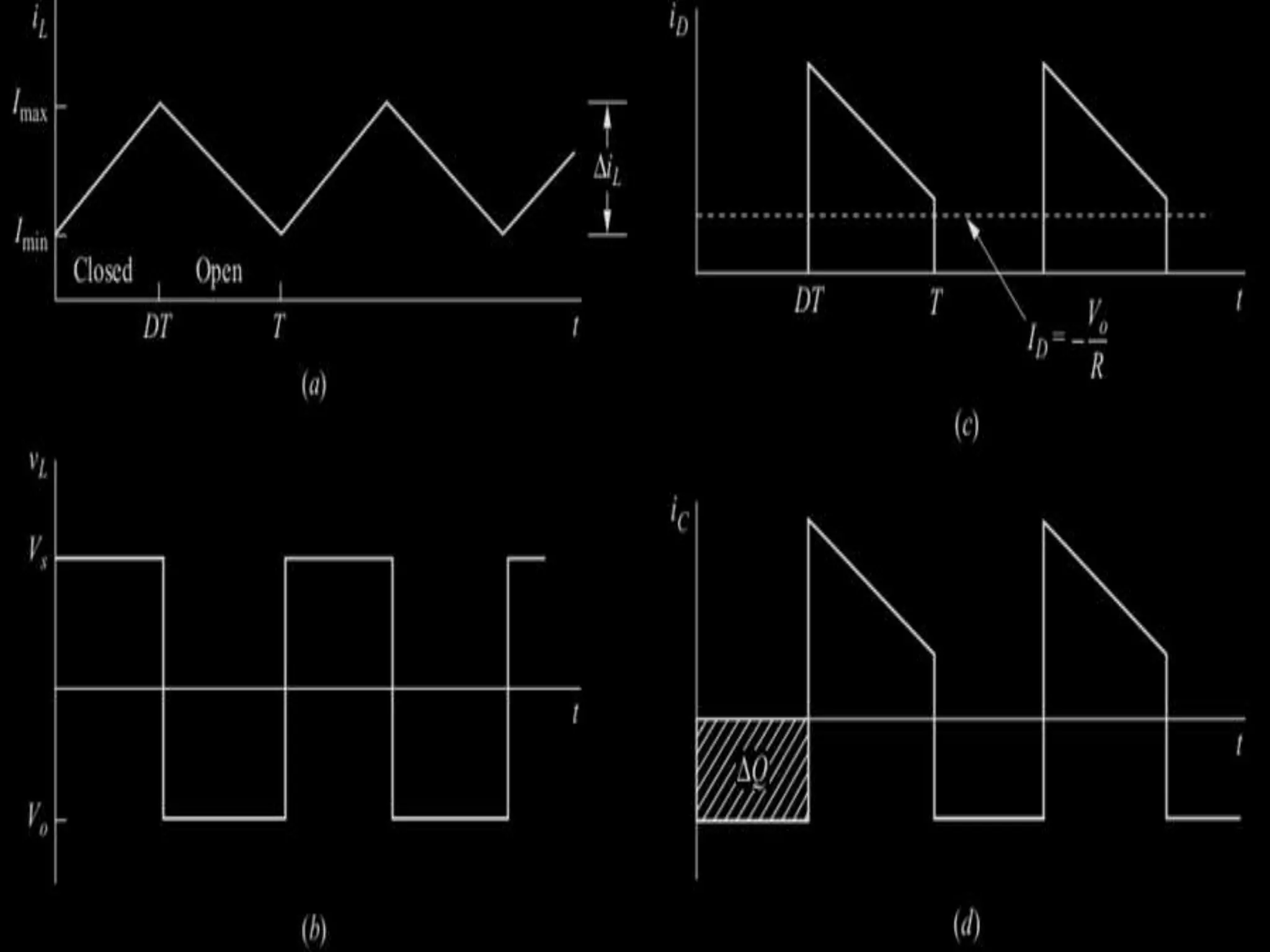
• Load current rises as the low-side switch turns on and transfers
energy from the input to the inductor and it falls as the high-side
switch turns off and transfers the inductor energy to the output load.
• Inductor provides continuous conduction.
• Operational equations :
Vout=V/(1-D)
Vind=Vin-Vout
di/dt=Vin/L
• For discontinuous mode, inductor current will decrease to zero
• Filters made of capacitors (sometimes in combination with
inductors) are normally added to the output of the converter to
reduce output voltage ripple.
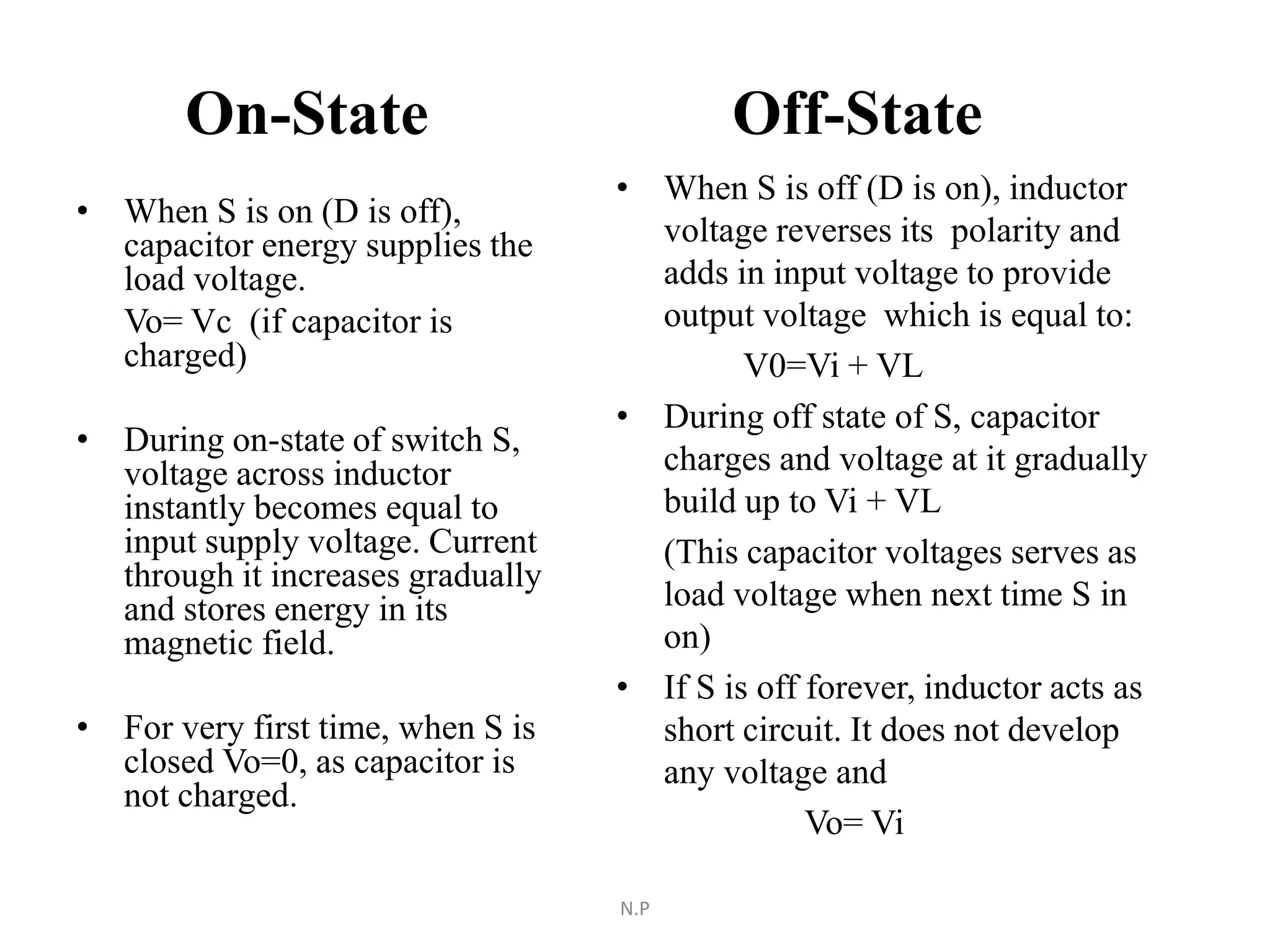
On-State
• When S is on (D is off),
capacitor energy supplies the
load voltage.
Vo= Vc (if capacitor is
charged)
• During on-state of switch S,
voltage across inductor
instantly becomes equal to
input supply voltage. Current
through it increases gradually
and stores energy in its
magnetic field.
• For very first time, when S is
closed Vo=0, as capacitor is
not charged.
Off-State
• When S is off (D is on), inductor
voltage reverses its polarity and
adds in input voltage to provide
output voltage which is equal to:
V0=Vi + VL
• During off state of S, capacitor
charges and voltage at it gradually
build up to Vi + VL
(This capacitor voltages serves as
load voltage when next time S in
on)
• If S is off forever, inductor acts as
short circuit. It does not develop
any voltage and
Vo= Vi
N.P
BUCK-BOOST CONVERTER
• The buck–boost converter is a type of DC-to-DC converter that
has an output voltage magnitude that is either greater than or less
than the input voltage magnitude.
• The output voltage is adjustable based on the duty cycle of the
switching transistor.
Vout= Vin*(D/1-D)
• If duty cycle is less than 0.5, output voltage is less than supply
voltage.
• If duty cycle is greater than 0.5,output voltage is greater than
supply voltage.
• The polarity of output voltage is reversed to that of input voltage
in buck-boost converters.
METHODS OF CONTROL:
The output dc voltage can be verified by the following methods.
• Constant Frequency Control or Pulse width modulation control
• Variable Frequency Control
PULSE WIDTH MODULATION
In Pulse width modulation the pulse width ton of the output waveform
is varied keeping chopping frequency ’f’ and hence chopping period ‘T’
constant. Therefore output voltage is varied by varying the ON time, ton .
Figure shows the output voltage waveform for different ON times.
VARIABLE FREQUENCY CONTROL
In this method of control, chopping frequency f is varied keeping
either ton or toff constant. This method is also known as frequency
modulation.
In frequency modulation to obtain full output voltage, range of
frequency has to be varied over a wide range. This method produces
harmonics in the output and for large toff load current may be
discontinuous.
V0
V
V
V0
t
t
tON
tON tOFF
tOFF
T
v0
V
V
v0
t
t
tON
tON
T
T
tOFF
tOFF
Thank you

Choppers ppt

  • 1.
  • 2.
    Overview What is DC-DCconverter Applications Basic converters a) Buck converter b) Boost converter c) Buck-Boost converter  Methods of control
  • 3.
    DC to DCconverter is very much needed nowadays as many industrial applications are dependent upon DC voltage source. The performance of these applications will be improved if we use a variable DC supply. It will help to improve controllability of the equipment also. Chopper is a basically static power electronics device which converts fixed dc voltage/power to variable DC voltage or power. It is nothing but a high speed switch which connects and disconnects the load from source at a high rate to get variable or chopped voltage at the output.
  • 4.
    • Chopper canincrease or decrease the dc voltage level at its opposite side. So, chopper serves the same purpose in dc circuit transfers in case of ac circuit. So it is also known as DC transformer. • Devices used in Chopper • Low power application : GTO, IGBT, Power BJT, Power MOSFET etc. High power application : Thyristor or SCR. • These devices are represented as a switch in a dotted box for simplicity. When it is closed current can flow in the direction of arrow only.
  • 5.
  • 7.
    • A buckconverter (step-down converter) is a DC-to-DC power converter with an output voltage less than its input voltage. • The inductor current rises as the high-side switch turns on and transfers energy from the input to the inductor. • The inductor current falls as the low-side switch turns off and transfers the inductor energy to the output load. • Operational Equations: Vout=D*Vin D=Ton⁄(Ton+Toff ) • The output current is the average value of the inductor current. • The inductor value is chosen for certain operating conditions such as input and output voltage and output-load current and for desired design criteria such as efficiency, tolerable output ripple noise etc.
  • 8.
  • 10.
    • A boostconverter (step-up converter) is a DC-to-DC power converter with an output voltage greater than its input voltage. • Load current rises as the low-side switch turns on and transfers energy from the input to the inductor and it falls as the high-side switch turns off and transfers the inductor energy to the output load. • Inductor provides continuous conduction. • Operational equations : Vout=V/(1-D) Vind=Vin-Vout di/dt=Vin/L • For discontinuous mode, inductor current will decrease to zero • Filters made of capacitors (sometimes in combination with inductors) are normally added to the output of the converter to reduce output voltage ripple.
  • 11.
    On-State • When Sis on (D is off), capacitor energy supplies the load voltage. Vo= Vc (if capacitor is charged) • During on-state of switch S, voltage across inductor instantly becomes equal to input supply voltage. Current through it increases gradually and stores energy in its magnetic field. • For very first time, when S is closed Vo=0, as capacitor is not charged. Off-State • When S is off (D is on), inductor voltage reverses its polarity and adds in input voltage to provide output voltage which is equal to: V0=Vi + VL • During off state of S, capacitor charges and voltage at it gradually build up to Vi + VL (This capacitor voltages serves as load voltage when next time S in on) • If S is off forever, inductor acts as short circuit. It does not develop any voltage and Vo= Vi N.P
  • 12.
  • 14.
    • The buck–boostconverter is a type of DC-to-DC converter that has an output voltage magnitude that is either greater than or less than the input voltage magnitude. • The output voltage is adjustable based on the duty cycle of the switching transistor. Vout= Vin*(D/1-D) • If duty cycle is less than 0.5, output voltage is less than supply voltage. • If duty cycle is greater than 0.5,output voltage is greater than supply voltage. • The polarity of output voltage is reversed to that of input voltage in buck-boost converters.
  • 15.
    METHODS OF CONTROL: Theoutput dc voltage can be verified by the following methods. • Constant Frequency Control or Pulse width modulation control • Variable Frequency Control PULSE WIDTH MODULATION In Pulse width modulation the pulse width ton of the output waveform is varied keeping chopping frequency ’f’ and hence chopping period ‘T’ constant. Therefore output voltage is varied by varying the ON time, ton . Figure shows the output voltage waveform for different ON times. VARIABLE FREQUENCY CONTROL In this method of control, chopping frequency f is varied keeping either ton or toff constant. This method is also known as frequency modulation. In frequency modulation to obtain full output voltage, range of frequency has to be varied over a wide range. This method produces harmonics in the output and for large toff load current may be discontinuous.
  • 16.
  • 17.
  • 19.