A TECHNICAL SEMINAR ON
MAXIMUM POWER POINT TRACKING
USING BUCK CONVERTER
1
PRESENTED BY
ANAS ALI USMANI (53)
RAHUL SINGH (44)
MD SHARIQUE AHMAD (69)
CONTENTS
 INTRODUCTION
 SOLAR CELL CHARACTERISTICS
 PHOTOVOLTAIC SYSTEM
 MAXIMUM POWER POINT TRACKING
 SWITCH MODE DC-DC BUCK CONVERTER
 PERFORMANCE COMPARISON OF BCIF AND FOBC TOPOLOGIES
 FOURTH ORDER BUCK CONVERTER
 STATE SPACE REPRESENTATION
 DISCUSSION OF SIMULATION AND EXPERIMENTAL RESULT
 EFFECT OF COUPLING
 CONCLUSION
 REFERENCE
2
INTRODUCTION
 India lies in a sunny tropical belt (High insolation). Total approximate potential annually over 5000
trillion kWh. Current cost of production is 12/KWh and expected cost is 6/KWh by 2020.
 Characteristics of dark and illuminated silicon pn junction is shown in Fig.1.goveren by this equation-
Dark:-
Illuminated:-
 PV cell operates to produce maximum power point(MPP) by
plotting hyperbola defined as V X I = constant as shown in Fig.2.
Dark
Illumination
V
I
𝑰 𝒕𝒐𝒕𝒂𝒍 = 𝑰 𝟎 𝒆
𝒒𝑽
𝒌𝑻 − 𝟏 − 𝑰 𝒔𝒄 . . .
𝟐
𝑰 𝒕𝒐𝒕𝒂𝒍 = 𝑰 𝟎 𝒆
𝒒𝑽
𝒌𝑻 − 𝟏 ...1
Fig.1 I-V characteristic
3
 One point at which it will produce maximum power under the incident
illumination level.
Fig.2. P-V & I-V characteristic
 An ideal cell would have a perfect
rectangular characteristics having
unity fill factor.
Fig.3. Equivalent circuit of solar PV array.
I= Isc – Io{exp[ q(V + RsI)/(nkTk) ]- 1} – (V+RsI)/Rsh
 For a practical cell the equation is
modified as:-
4
Solar cell Characteristics
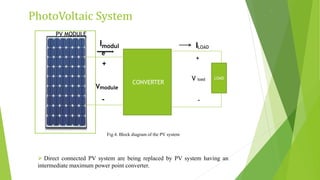
PhotoVoltaic System
5
CONVERTER
LOAD
+
-
Vmodule
modul
e
I
PV MODULE
+
-
ILOAD
V load
Fig.4. Block diagram of the PV system
 Direct connected PV system are being replaced by PV system having an
intermediate maximum power point converter.
Cont…
 Output power manly depend upon nature of load connected to it. Direct load connection to
the PVA system result in poor over all efficiency.
 Various switch mode DC-DC topologies used in MPPT application which track MP at all
solar isolation leading to an improved performance .
 Power tracking methods are:-
 Perturb and observe algorithm (P & O).
 Incremental conductance method (ICM).
 Voltage base method (VBM).
 Search based method (SBM).
6
 While selecting a tracking scheme is the accuracy and tracking speed requirement.
 Performance of a PV system depends on several factors such as:-
 Type of power converter used.
 Tracking methodology employed.
 Nature of filters employed.
 From the converter performance improvement point of view ripple reduction through
zero ripple filter is more popular in the DC-DC conversion.
 Zero ripple filter significantly reduces the input low and high frequency current ripples.
7
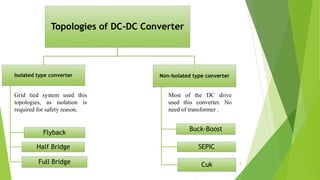
Topologies of DC-DC Converter
Isolated type converter
Flyback
Half Bridge
Full Bridge
Non-Isolated type converter
Buck-Boost
SEPIC
Cuk
Grid tied system used this
topologies, as isolation is
required for safety reason.
Most of the DC drive
used this converter. No
need of transformer .
8
 PVA modules are connected in series and parallel to realize required voltage and current
demands of power converter to extract maximum power and a load.
 Load may be:-
 Stand alone sink type
 Battery
 Up stream converter
 Combination above
 The PV module output voltage is a function of the photocurrent which is mainly
determined by load current depending on the solar radiation level during the operation.
9
 Buck topologies which will track MP at all solar isolation leading to an improvement
performance of BCIF.
 To reduce ripple current even more without using any additional passive component a
coupled inductance arrangement is used for FOBC.
 Buck converter are used in PV application-
 Front end step down applications.
 Battery charging.
 MPP
10
WHAT IS MPPT?
 The voltage at which PV module can produce maximum power is called ‘maximum power point’
(or peak power voltage).
 MPPT or Maximum Power Point Tracking is algorithm that included in charge controllers used
for extracting maximum available power from PV module under certain conditions.
 MPPT are used to ensure impedance match to improve the efficiency of the solar panel in
delivering its maximum power.
 MPPT (Maximum Power Point Tracker) is a electronic device which maximize PV module output
under varying operating condition.
 Typical solar panel can only convert 30% to 40% of the incident solar irradiation into electrical
energy..
11
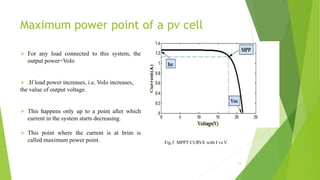
Maximum power point of a pv cell
 For any load connected to this system, the
output power=VoIo
 .If load power increases, i.e. VoIo increases,
the value of output voltage.
 This happens only up to a point after which
current in the system starts decreasing.
 This point where the current is at brim is
called maximum power point.
12
Fig.5 MPPT CURVE with I vs V
How to track this point?
 For tracking the mppt , we use dc-dc switch mode convertors.
 These convertors can control the output voltage by controlling
the duty ratio of the switch.
 Vo=f(D,Vi)
 Hence we can limit the output voltage to the limit where we get
the maximum output power.
13
Fig.6 MPPT CURVE with P vs V
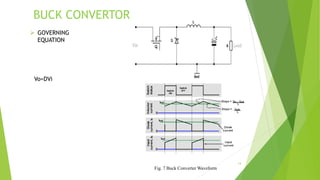
BUCK CONVERTOR
Vo=DVi
 GOVERNING
EQUATION
Fig. 7 Buck Converter Waveform
14
Drawbacks of normal
buck convertors
 Normal buck convertors are prone to high
amount of ripple currents , which lead to rippled
output power.
 ripple currents produce their respective power
losses thus decreasing efficiency.
 Source current of such a system is not continuous.
 To overcome such abnormalities we introduce
input filters which make the input current
continuous.
15
Fig.8 Buck topologies for PV power tracking scheme BCIF
based
Drawbacks using separate
input filters
 Input to solar cell or irradiance is not a constant quantity, so it
is difficult to design filters for every irradiance.
 Using a separate filter at input side increases resistance of the
system thus introducing more power loss.
 For a stable system output impedence of filter should be less
than input impedence of the convertor.
 Increases overall cost of the system.
16
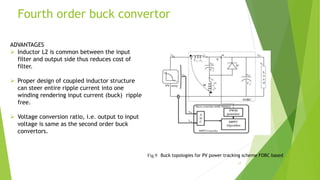
Fourth order buck convertor
ADVANTAGES
 Inductor L2 is common between the input
filter and output side thus reduces cost of
filter.
 Proper design of coupled inductor structure
can steer entire ripple current into one
winding rendering input current (buck) ripple
free.
 Voltage conversion ratio, i.e. output to input
voltage is same as the second order buck
convertors.
17
Fig.9 Buck topologies for PV power tracking scheme FOBC based
ANALYSIS OF FOURTH ORDER CONVERTORS
 .Applying kvl in outer loop, we get
VL1=Vi - Vo
And VL2 = VC1-Vo,
 Over the average cycle VL1 and VL2 are zero.
 Hence Vc1=Vi or the input filter transports average value of
input voltage at capacitor.
 To reduce the ripple currents to as low as 0.05%, inductors are
coupled together so that the total inductance increases.
18
STATE SPACE REPRESENTATION
 . If a state space model of the system is drawn,
ẋ = [A][x]+[B][u], Vo = [P][x]
where [A] and [B] are system and control matrices respectively.
. X =[iL1,Il2,Vc1,Vc2]
.On keeping the constraint that ripple currents are minimal and Vl1=Vl2
19
 The steady-state voltage gain expression of the FOBC are as
........(1)
where,
Va is average value PVA voltage,
Vo is the converter load voltage.
kD
Va
Vo

 )12)(1(1)21(2)21(2^ 

DDDrcDrrrDR
R
k
20
PERFORMANCE COMPARISON OF BCIF AND
FOBC TOPOLOGIES
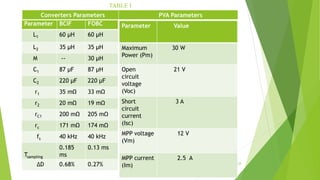
 An FOBC and a BCIF, parameters listed in table I were simulated using PSIM,
built and tested.
 The source ripple current is slightly higher in FOBC than BCIF.
 In both the Converter peak current/voltage stress on the switch and diode is
identical.
21
 The I2R-losses, contributed by the series resistance of the L1 and C1
elements, in both the converters are almost the same.
 Both BCIF and FOBC circuits show almost identical performance, from the
steady-state point of view.
 Their efficiencies are also of the same order.
22
DISCUSSION OF SIMULATION AND
EXPERIMENTAL RESULTS
 A simulation diagram involves a model development of:
1) PVA,
2) converter,
3) load, and
4) MPPT algorithm.
 The PVA simulation model is transformed into the PSIM platform with PV system
and converter parameter are listed in table I.
23
Parameter BCIF FOBC
L1 60 µH 60 µH
L2 35 µH 35 µH
M -- 30 µH
C1 87 µF 87 µH
C2 220 µF 220 µF
r1 35 mΩ 33 mΩ
r2 20 mΩ 19 mΩ
rC1 200 mΩ 205 mΩ
rc 171 mΩ 174 mΩ
fs 40 kHz 40 kHz
Tsampling
0.185
ms
0.13 ms
∆D 0.68% 0.27%
Parameter Value
Maximum
Power (Pm)
30 W
Open
circuit
voltage
(Voc)
21 V
Short
circuit
current
(Isc)
3 A
MPP voltage
(Vm)
12 V
MPP current
(Im)
2.5 A
Converters Parameters PVA Parameters
TABLE I
24
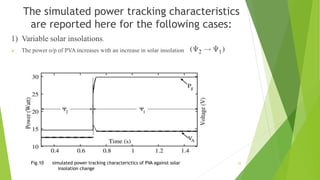
The simulated power tracking characteristics
are reported here for the following cases:
1) Variable solar insolations.
 The power o/p of PVA increases with an increase in solar insolation .
Fig.10 simulated power tracking characterictics of PVA against solar
insolation change
25
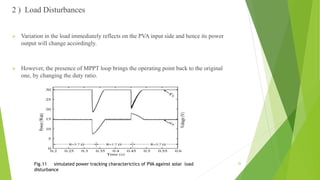
2 ) Load Disturbances
 Variation in the load immediately reflects on the PVA input side and hence its power
output will change accordingly.
 However, the presence of MPPT loop brings the operating point back to the original
one, by changing the duty ratio.
Fig.11 simulated power tracking characterictics of PVA against solar load
disturbance
26
3) With Battery Load
 The tracking capability of the converter supplying the battery loads are also verified.
.
 The resistance offered by the battery must be within the optimal range for which the
converter tracks MP.
Fig.12 simulated power tracking characterictics of PVA with
battery load
27
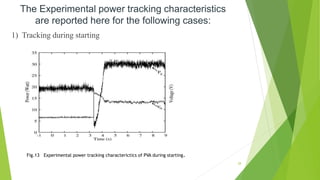
The Experimental power tracking characteristics
are reported here for the following cases:
1) Tracking during starting
Fig.13 Experimental power tracking characterictics of PVA during starting.
28
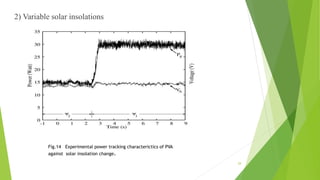
2) Variable solar insolations
Fig.14 Experimental power tracking characterictics of PVA
against solar insolation change.
29
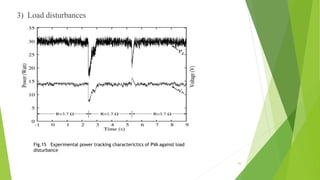
3) Load disturbances
Fig.15 Experimental power tracking characterictics of PVA against load
disturbance
30
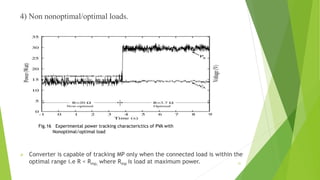
4) Non nonoptimal/optimal loads.
 Converter is capable of tracking MP only when the connected load is within the
optimal range i.e R < Rmp, where Rmp is load at maximum power.
Fig.16 Experimental power tracking characterictics of PVA with
Nonoptimal/optimal load
31
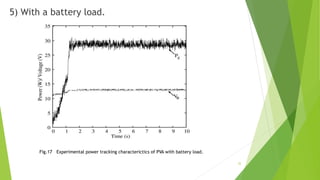
5) With a battery load.
Fig.17 Experimental power tracking characterictics of PVA with battery load.
32
Effect of Coupling
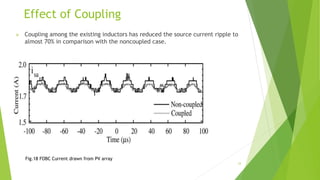
 Coupling among the existing inductors has reduced the source current ripple to
almost 70% in comparison with the noncoupled case.
Fig.18 FOBC Current drawn from PV array
33
CONCLUSION
 The measured MPPT efficiency, with the proposed converter, is ranging between 93-98 %.
 Use of FOBC reduced the source current ripple in comparison with other buck converter.
 The combined PV system was modelled in PSIM and then it’s performance simulated.
 Power tracking performance for FOBC are almost identical for both experimental and
simulation.
34
Reference
[1] MUMMADI VEERACHARY ” Fourth-Order Buck Converter for Maximum Power Point Tracking
Applications” IEEE TRANSACTIONS ON AEROSPACE AND ELECTRONIC SYSTEMS VOL. 47,
NO. 2 APRIL 2011
[2] Sandeep Anand, Rajesh Singh Farswan, Bhukya Mangu, B.G. Fernades, “Optimal charging of
Battery Using Solar PV in Standalone DC System,” Industrial Electronics Magazine , vol.7, no-3,pp.6 –
20, Sep 2013.
[3] Trishan Esram, and Patrick L. Chapman, “Comparison of Photovoltaic Array Maximum Power Point
Tracking Techniques,” IEEE Trans. on Energy Conversion, vol. 22, no. 2, June 2007.
[4] Enslin, J. H. R., Wolf, M. S., Snyman, D. B., and Swiegers, W. Integrated photovoltaic maximum
power point tracking converter. IEEE Transactions on Industrial Electronics, 44, 6 (1997), 769—773.
[5] Esram, T. and Chapman, P. L.Comparison of photovoltaic array maximum power point tracking
techniques.IEEE Transactions on Energy Conversion, 22, 2 (2007), 439—449.
[6] Dr. P.S Bimbhra: “Power electronics”, KHANNA PUBLISHERS, New Delhi,2010.
[7] Dr.B.H.Khan “Non-Conventional Energy Resourses”,TMH New Delhi, 2009.
35
36
THANKS FOR YOUR PATIENCE

POWER POINT TRACKING

  • 1.
    A TECHNICAL SEMINARON MAXIMUM POWER POINT TRACKING USING BUCK CONVERTER 1 PRESENTED BY ANAS ALI USMANI (53) RAHUL SINGH (44) MD SHARIQUE AHMAD (69)
  • 2.
    CONTENTS  INTRODUCTION  SOLARCELL CHARACTERISTICS  PHOTOVOLTAIC SYSTEM  MAXIMUM POWER POINT TRACKING  SWITCH MODE DC-DC BUCK CONVERTER  PERFORMANCE COMPARISON OF BCIF AND FOBC TOPOLOGIES  FOURTH ORDER BUCK CONVERTER  STATE SPACE REPRESENTATION  DISCUSSION OF SIMULATION AND EXPERIMENTAL RESULT  EFFECT OF COUPLING  CONCLUSION  REFERENCE 2
  • 3.
    INTRODUCTION  India liesin a sunny tropical belt (High insolation). Total approximate potential annually over 5000 trillion kWh. Current cost of production is 12/KWh and expected cost is 6/KWh by 2020.  Characteristics of dark and illuminated silicon pn junction is shown in Fig.1.goveren by this equation- Dark:- Illuminated:-  PV cell operates to produce maximum power point(MPP) by plotting hyperbola defined as V X I = constant as shown in Fig.2. Dark Illumination V I 𝑰 𝒕𝒐𝒕𝒂𝒍 = 𝑰 𝟎 𝒆 𝒒𝑽 𝒌𝑻 − 𝟏 − 𝑰 𝒔𝒄 . . . 𝟐 𝑰 𝒕𝒐𝒕𝒂𝒍 = 𝑰 𝟎 𝒆 𝒒𝑽 𝒌𝑻 − 𝟏 ...1 Fig.1 I-V characteristic 3
  • 4.
     One pointat which it will produce maximum power under the incident illumination level. Fig.2. P-V & I-V characteristic  An ideal cell would have a perfect rectangular characteristics having unity fill factor. Fig.3. Equivalent circuit of solar PV array. I= Isc – Io{exp[ q(V + RsI)/(nkTk) ]- 1} – (V+RsI)/Rsh  For a practical cell the equation is modified as:- 4 Solar cell Characteristics
  • 5.
    PhotoVoltaic System 5 CONVERTER LOAD + - Vmodule modul e I PV MODULE + - ILOAD Vload Fig.4. Block diagram of the PV system  Direct connected PV system are being replaced by PV system having an intermediate maximum power point converter.
  • 6.
    Cont…  Output powermanly depend upon nature of load connected to it. Direct load connection to the PVA system result in poor over all efficiency.  Various switch mode DC-DC topologies used in MPPT application which track MP at all solar isolation leading to an improved performance .  Power tracking methods are:-  Perturb and observe algorithm (P & O).  Incremental conductance method (ICM).  Voltage base method (VBM).  Search based method (SBM). 6
  • 7.
     While selectinga tracking scheme is the accuracy and tracking speed requirement.  Performance of a PV system depends on several factors such as:-  Type of power converter used.  Tracking methodology employed.  Nature of filters employed.  From the converter performance improvement point of view ripple reduction through zero ripple filter is more popular in the DC-DC conversion.  Zero ripple filter significantly reduces the input low and high frequency current ripples. 7
  • 8.
    Topologies of DC-DCConverter Isolated type converter Flyback Half Bridge Full Bridge Non-Isolated type converter Buck-Boost SEPIC Cuk Grid tied system used this topologies, as isolation is required for safety reason. Most of the DC drive used this converter. No need of transformer . 8
  • 9.
     PVA modulesare connected in series and parallel to realize required voltage and current demands of power converter to extract maximum power and a load.  Load may be:-  Stand alone sink type  Battery  Up stream converter  Combination above  The PV module output voltage is a function of the photocurrent which is mainly determined by load current depending on the solar radiation level during the operation. 9
  • 10.
     Buck topologieswhich will track MP at all solar isolation leading to an improvement performance of BCIF.  To reduce ripple current even more without using any additional passive component a coupled inductance arrangement is used for FOBC.  Buck converter are used in PV application-  Front end step down applications.  Battery charging.  MPP 10
  • 11.
    WHAT IS MPPT? The voltage at which PV module can produce maximum power is called ‘maximum power point’ (or peak power voltage).  MPPT or Maximum Power Point Tracking is algorithm that included in charge controllers used for extracting maximum available power from PV module under certain conditions.  MPPT are used to ensure impedance match to improve the efficiency of the solar panel in delivering its maximum power.  MPPT (Maximum Power Point Tracker) is a electronic device which maximize PV module output under varying operating condition.  Typical solar panel can only convert 30% to 40% of the incident solar irradiation into electrical energy.. 11
  • 12.
    Maximum power pointof a pv cell  For any load connected to this system, the output power=VoIo  .If load power increases, i.e. VoIo increases, the value of output voltage.  This happens only up to a point after which current in the system starts decreasing.  This point where the current is at brim is called maximum power point. 12 Fig.5 MPPT CURVE with I vs V
  • 13.
    How to trackthis point?  For tracking the mppt , we use dc-dc switch mode convertors.  These convertors can control the output voltage by controlling the duty ratio of the switch.  Vo=f(D,Vi)  Hence we can limit the output voltage to the limit where we get the maximum output power. 13 Fig.6 MPPT CURVE with P vs V
  • 14.
  • 15.
    Drawbacks of normal buckconvertors  Normal buck convertors are prone to high amount of ripple currents , which lead to rippled output power.  ripple currents produce their respective power losses thus decreasing efficiency.  Source current of such a system is not continuous.  To overcome such abnormalities we introduce input filters which make the input current continuous. 15 Fig.8 Buck topologies for PV power tracking scheme BCIF based
  • 16.
    Drawbacks using separate inputfilters  Input to solar cell or irradiance is not a constant quantity, so it is difficult to design filters for every irradiance.  Using a separate filter at input side increases resistance of the system thus introducing more power loss.  For a stable system output impedence of filter should be less than input impedence of the convertor.  Increases overall cost of the system. 16
  • 17.
    Fourth order buckconvertor ADVANTAGES  Inductor L2 is common between the input filter and output side thus reduces cost of filter.  Proper design of coupled inductor structure can steer entire ripple current into one winding rendering input current (buck) ripple free.  Voltage conversion ratio, i.e. output to input voltage is same as the second order buck convertors. 17 Fig.9 Buck topologies for PV power tracking scheme FOBC based
  • 18.
    ANALYSIS OF FOURTHORDER CONVERTORS  .Applying kvl in outer loop, we get VL1=Vi - Vo And VL2 = VC1-Vo,  Over the average cycle VL1 and VL2 are zero.  Hence Vc1=Vi or the input filter transports average value of input voltage at capacitor.  To reduce the ripple currents to as low as 0.05%, inductors are coupled together so that the total inductance increases. 18
  • 19.
    STATE SPACE REPRESENTATION . If a state space model of the system is drawn, ẋ = [A][x]+[B][u], Vo = [P][x] where [A] and [B] are system and control matrices respectively. . X =[iL1,Il2,Vc1,Vc2] .On keeping the constraint that ripple currents are minimal and Vl1=Vl2 19
  • 20.
     The steady-statevoltage gain expression of the FOBC are as ........(1) where, Va is average value PVA voltage, Vo is the converter load voltage. kD Va Vo   )12)(1(1)21(2)21(2^   DDDrcDrrrDR R k 20
  • 21.
    PERFORMANCE COMPARISON OFBCIF AND FOBC TOPOLOGIES  An FOBC and a BCIF, parameters listed in table I were simulated using PSIM, built and tested.  The source ripple current is slightly higher in FOBC than BCIF.  In both the Converter peak current/voltage stress on the switch and diode is identical. 21
  • 22.
     The I2R-losses,contributed by the series resistance of the L1 and C1 elements, in both the converters are almost the same.  Both BCIF and FOBC circuits show almost identical performance, from the steady-state point of view.  Their efficiencies are also of the same order. 22
  • 23.
    DISCUSSION OF SIMULATIONAND EXPERIMENTAL RESULTS  A simulation diagram involves a model development of: 1) PVA, 2) converter, 3) load, and 4) MPPT algorithm.  The PVA simulation model is transformed into the PSIM platform with PV system and converter parameter are listed in table I. 23
  • 24.
    Parameter BCIF FOBC L160 µH 60 µH L2 35 µH 35 µH M -- 30 µH C1 87 µF 87 µH C2 220 µF 220 µF r1 35 mΩ 33 mΩ r2 20 mΩ 19 mΩ rC1 200 mΩ 205 mΩ rc 171 mΩ 174 mΩ fs 40 kHz 40 kHz Tsampling 0.185 ms 0.13 ms ∆D 0.68% 0.27% Parameter Value Maximum Power (Pm) 30 W Open circuit voltage (Voc) 21 V Short circuit current (Isc) 3 A MPP voltage (Vm) 12 V MPP current (Im) 2.5 A Converters Parameters PVA Parameters TABLE I 24
  • 25.
    The simulated powertracking characteristics are reported here for the following cases: 1) Variable solar insolations.  The power o/p of PVA increases with an increase in solar insolation . Fig.10 simulated power tracking characterictics of PVA against solar insolation change 25
  • 26.
    2 ) LoadDisturbances  Variation in the load immediately reflects on the PVA input side and hence its power output will change accordingly.  However, the presence of MPPT loop brings the operating point back to the original one, by changing the duty ratio. Fig.11 simulated power tracking characterictics of PVA against solar load disturbance 26
  • 27.
    3) With BatteryLoad  The tracking capability of the converter supplying the battery loads are also verified. .  The resistance offered by the battery must be within the optimal range for which the converter tracks MP. Fig.12 simulated power tracking characterictics of PVA with battery load 27
  • 28.
    The Experimental powertracking characteristics are reported here for the following cases: 1) Tracking during starting Fig.13 Experimental power tracking characterictics of PVA during starting. 28
  • 29.
    2) Variable solarinsolations Fig.14 Experimental power tracking characterictics of PVA against solar insolation change. 29
  • 30.
    3) Load disturbances Fig.15Experimental power tracking characterictics of PVA against load disturbance 30
  • 31.
    4) Non nonoptimal/optimalloads.  Converter is capable of tracking MP only when the connected load is within the optimal range i.e R < Rmp, where Rmp is load at maximum power. Fig.16 Experimental power tracking characterictics of PVA with Nonoptimal/optimal load 31
  • 32.
    5) With abattery load. Fig.17 Experimental power tracking characterictics of PVA with battery load. 32
  • 33.
    Effect of Coupling Coupling among the existing inductors has reduced the source current ripple to almost 70% in comparison with the noncoupled case. Fig.18 FOBC Current drawn from PV array 33
  • 34.
    CONCLUSION  The measuredMPPT efficiency, with the proposed converter, is ranging between 93-98 %.  Use of FOBC reduced the source current ripple in comparison with other buck converter.  The combined PV system was modelled in PSIM and then it’s performance simulated.  Power tracking performance for FOBC are almost identical for both experimental and simulation. 34
  • 35.
    Reference [1] MUMMADI VEERACHARY” Fourth-Order Buck Converter for Maximum Power Point Tracking Applications” IEEE TRANSACTIONS ON AEROSPACE AND ELECTRONIC SYSTEMS VOL. 47, NO. 2 APRIL 2011 [2] Sandeep Anand, Rajesh Singh Farswan, Bhukya Mangu, B.G. Fernades, “Optimal charging of Battery Using Solar PV in Standalone DC System,” Industrial Electronics Magazine , vol.7, no-3,pp.6 – 20, Sep 2013. [3] Trishan Esram, and Patrick L. Chapman, “Comparison of Photovoltaic Array Maximum Power Point Tracking Techniques,” IEEE Trans. on Energy Conversion, vol. 22, no. 2, June 2007. [4] Enslin, J. H. R., Wolf, M. S., Snyman, D. B., and Swiegers, W. Integrated photovoltaic maximum power point tracking converter. IEEE Transactions on Industrial Electronics, 44, 6 (1997), 769—773. [5] Esram, T. and Chapman, P. L.Comparison of photovoltaic array maximum power point tracking techniques.IEEE Transactions on Energy Conversion, 22, 2 (2007), 439—449. [6] Dr. P.S Bimbhra: “Power electronics”, KHANNA PUBLISHERS, New Delhi,2010. [7] Dr.B.H.Khan “Non-Conventional Energy Resourses”,TMH New Delhi, 2009. 35
  • 36.