Introduction
 Load flow studies or Power flow studies is the analysis
of a power system in normal steady state condition.
 Load flow studies basically comprises of the
determination of
 Voltage
 Current
 Active Power
 Reactive Power
Importance
 Generation supplies demand(Load) plus losses.
 Bus voltage magnitude remain close to rated value.
 Generation operates within specified real and reactive
power limits.
 Transmission line and transformer are not overloaded.
Need of Load flow study
 Designing a power system.
 Planning a power system.
 Expansion of power system.
 Providing guide lines for optimum operation of power
system.
 Providing guide lines for various power system studies.
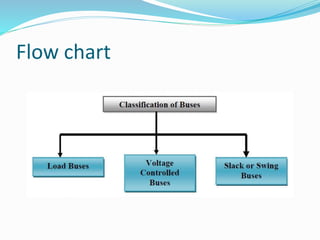
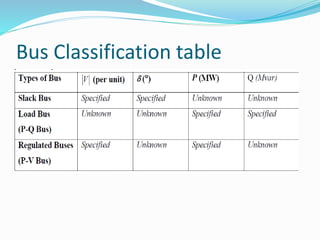
Bus Classification
 A bus is a node at which many Transmission lines, Loads
Generators are connected.
 It is not necessary that all of them be connected to every
bus.
 Bus is indicated by vertical line at which no. of
components are connected.
 In load flow study two out of four quantities specified
and other two quantities are to be determined by load
flow equation.
 Depending upon that bus are classified.
Flow chart
Load bus or PQ Bus
 A buss at which the Active power and reactive power
are specified.
 Magnitude(V) and phase angle(δ) of the voltage will
be calculated.
 This type of busses are most common, comprising
almost 80% of all the busses in given power system.
Generator bus or P-V bus
 A bus at which the magnitude(V) of the voltage and
active power(P) is defined.
 Reactive power(Q) and Phase angle(δ) are to be
determined through load flow equation.
 It is also known as P-V bus.
 This bus is always connected to generator.
 This type of bus is comprises about 10% of all the
buses in power system.
Slack Bus
 Voltage magnitude(V) and voltage phase angle(δ) are
specified and real(P) and reactive(Q) power are to be
obtained.
 Normally there is only one bus of this type is given in
power system.
 One generator bus is selected as the reference bus.
 In slack bus voltage angle and magnitude is normally
considered 1+j0 p.u.
Bus Classification table
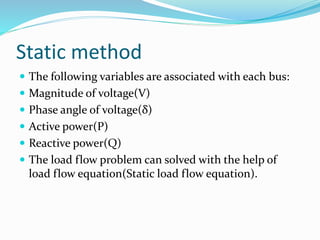
Static method
 The following variables are associated with each bus:
 Magnitude of voltage(V)
 Phase angle of voltage(δ)
 Active power(P)
 Reactive power(Q)
 The load flow problem can solved with the help of
load flow equation(Static load flow equation).
Continue
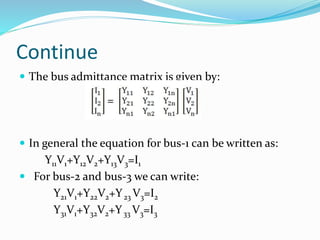
 The bus admittance matrix is given by:
 In general the equation for bus-1 can be written as:
Y11V1+Y12V2+Y13V3=I1
 For bus-2 and bus-3 we can write:
Y21V1+Y22V2+Y23 V3=I2
Y31V1+Y32V2+Y33 V3=I3
Continue
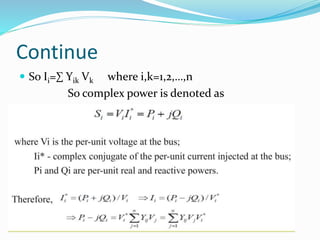
 So Ii=∑ Yik Vk where i,k=1,2,…,n
So complex power is denoted as
Continue
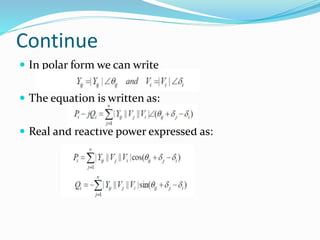
 In polar form we can write
 The equation is written as:
 Real and reactive power expressed as:
Approximate method
 A simple and approximate solution can be made by
following assumption:
1. Small line resistance are neglected which means
active power loss in line is zero i.e. θik ~ 90 ˚
2. Voltage magnitude at various must be within limits.
3. Active and reactive generator power at different
buses must be within the limits.
Continue
4. Total power generation must be equal to load plus
losses.
5. The system stability consideration impose a limit on
maximum values with δ.
6. All buses other than slack bus are PV buses. i.e. voltage
magnitude at all the buses, Including the slack bus, are
specified.
7. The angle δi so small that (sin(δi))= δi.
Continue
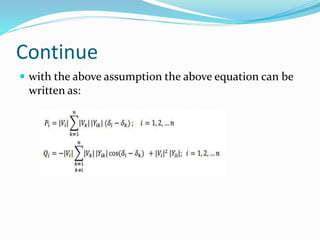
 with the above assumption the above equation can be
written as:
Load flow study

Load flow study

  • 2.
    Introduction  Load flowstudies or Power flow studies is the analysis of a power system in normal steady state condition.  Load flow studies basically comprises of the determination of  Voltage  Current  Active Power  Reactive Power
  • 3.
    Importance  Generation suppliesdemand(Load) plus losses.  Bus voltage magnitude remain close to rated value.  Generation operates within specified real and reactive power limits.  Transmission line and transformer are not overloaded.
  • 4.
    Need of Loadflow study  Designing a power system.  Planning a power system.  Expansion of power system.  Providing guide lines for optimum operation of power system.  Providing guide lines for various power system studies.
  • 5.
    Bus Classification  Abus is a node at which many Transmission lines, Loads Generators are connected.  It is not necessary that all of them be connected to every bus.  Bus is indicated by vertical line at which no. of components are connected.  In load flow study two out of four quantities specified and other two quantities are to be determined by load flow equation.  Depending upon that bus are classified.
  • 6.
  • 7.
    Load bus orPQ Bus  A buss at which the Active power and reactive power are specified.  Magnitude(V) and phase angle(δ) of the voltage will be calculated.  This type of busses are most common, comprising almost 80% of all the busses in given power system.
  • 8.
    Generator bus orP-V bus  A bus at which the magnitude(V) of the voltage and active power(P) is defined.  Reactive power(Q) and Phase angle(δ) are to be determined through load flow equation.  It is also known as P-V bus.  This bus is always connected to generator.  This type of bus is comprises about 10% of all the buses in power system.
  • 9.
    Slack Bus  Voltagemagnitude(V) and voltage phase angle(δ) are specified and real(P) and reactive(Q) power are to be obtained.  Normally there is only one bus of this type is given in power system.  One generator bus is selected as the reference bus.  In slack bus voltage angle and magnitude is normally considered 1+j0 p.u.
  • 10.
  • 11.
    Static method  Thefollowing variables are associated with each bus:  Magnitude of voltage(V)  Phase angle of voltage(δ)  Active power(P)  Reactive power(Q)  The load flow problem can solved with the help of load flow equation(Static load flow equation).
  • 12.
    Continue  The busadmittance matrix is given by:  In general the equation for bus-1 can be written as: Y11V1+Y12V2+Y13V3=I1  For bus-2 and bus-3 we can write: Y21V1+Y22V2+Y23 V3=I2 Y31V1+Y32V2+Y33 V3=I3
  • 13.
    Continue  So Ii=∑Yik Vk where i,k=1,2,…,n So complex power is denoted as
  • 14.
    Continue  In polarform we can write  The equation is written as:  Real and reactive power expressed as:
  • 15.
    Approximate method  Asimple and approximate solution can be made by following assumption: 1. Small line resistance are neglected which means active power loss in line is zero i.e. θik ~ 90 ˚ 2. Voltage magnitude at various must be within limits. 3. Active and reactive generator power at different buses must be within the limits.
  • 16.
    Continue 4. Total powergeneration must be equal to load plus losses. 5. The system stability consideration impose a limit on maximum values with δ. 6. All buses other than slack bus are PV buses. i.e. voltage magnitude at all the buses, Including the slack bus, are specified. 7. The angle δi so small that (sin(δi))= δi.
  • 17.
    Continue  with theabove assumption the above equation can be written as: