

An Application of PowerAn Application of Power
ElectronicsElectronics
An Application of PowerAn Application of Power
ElectronicsElectronics
CONTENTSCONTENTS
Power Electronic Systems
Modern Electrical Drive Systems
Power Electronic Converters in Electrical Drives
:: DC and AC Drives
Modeling and Control of Electrical Drives
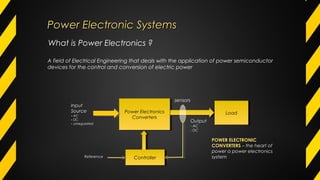
Power Electronic SystemsPower Electronic Systems
What is Power Electronics ?
A field of Electrical Engineering that deals with the application of power semiconductor
devices for the control and conversion of electric power
Power Electronics
Converters
Power Electronics
Converters
LoadLoad
ControllerController
Output
- AC
- DC
Input
Source
- AC
- DC
- unregulated
Reference
POWER ELECTRONIC
CONVERTERS – the heart of
power a power electronics
system
sensors
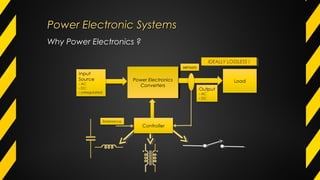
Why Power Electronics ?
Power Electronics
Converters
Power Electronics
Converters
IDEALLY LOSSLESS !IDEALLY LOSSLESS !
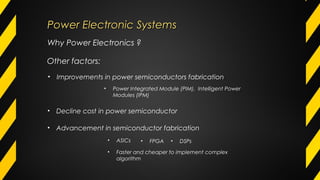
Power Electronic SystemsPower Electronic Systems
Why Power Electronics ?
Other factors:
• Improvements in power semiconductors fabrication
• Decline cost in power semiconductor
• Advancement in semiconductor fabrication
• ASICs • FPGA • DSPs
• Faster and cheaper to implement complex
algorithm
• Power Integrated Module (PIM), Intelligent Power
Modules (IPM)
Power Electronic SystemsPower Electronic Systems
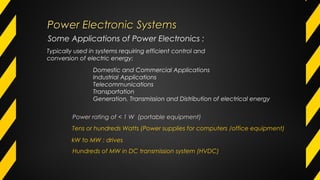
Some Applications of Power Electronics :
Power rating of < 1 W (portable equipment)
Tens or hundreds Watts (Power supplies for computers /office equipment)
Typically used in systems requiring efficient control and
conversion of electric energy:
Domestic and Commercial Applications
Industrial Applications
Telecommunications
Transportation
Generation, Transmission and Distribution of electrical energy
kW to MW : drives
Hundreds of MW in DC transmission system (HVDC)
Power Electronic SystemsPower Electronic Systems
Modern Electrical Drive SystemsModern Electrical Drive Systems
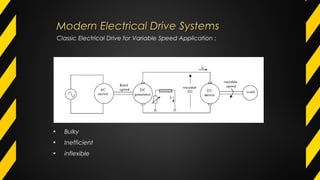
Classic Electrical Drive for Variable Speed Application :
• Bulky
• Inefficient
• inflexible
Power
Electronic
Converters
Power
Electronic
Converters
Reference
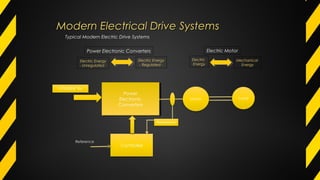
Typical Modern Electric Drive Systems
Power Electronic Converters
Electric Energy
- Unregulated -
Electric Energy
- Regulated -
Electric Motor
Electric
Energy
Mechanical
Energy
Modern Electrical Drive SystemsModern Electrical Drive Systems
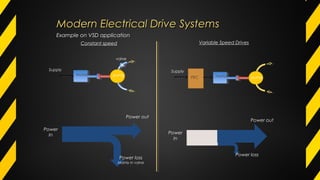
Example on VSD application
Power
In
Power loss
Mainly in valve
Power out
motor pump
valve
Supply
motorPEC pump
Supply
Constant speed Variable Speed Drives
Power
In
Power loss
Power out
Modern Electrical Drive SystemsModern Electrical Drive Systems
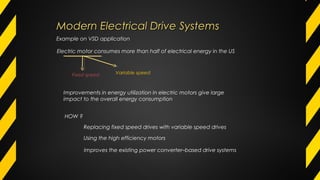
Electric motor consumes more than half of electrical energy in the US
Fixed speed Variable speed
HOW ?
Improvements in energy utilization in electric motors give large
impact to the overall energy consumption
Replacing fixed speed drives with variable speed drives
Using the high efficiency motors
Improves the existing power converter–based drive systems
Example on VSD application
Modern Electrical Drive SystemsModern Electrical Drive Systems
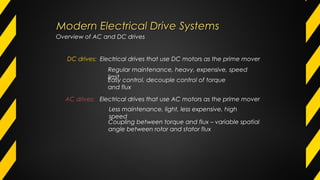
DC drives: Electrical drives that use DC motors as the prime mover
Regular maintenance, heavy, expensive, speed
limit
AC drives: Electrical drives that use AC motors as the prime mover
Less maintenance, light, less expensive, high
speed
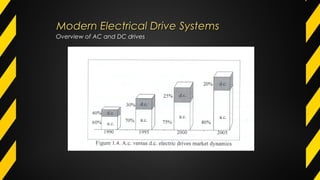
Overview of AC and DC drives
Easy control, decouple control of torque
and flux
Coupling between torque and flux – variable spatial
angle between rotor and stator flux
Modern Electrical Drive SystemsModern Electrical Drive Systems
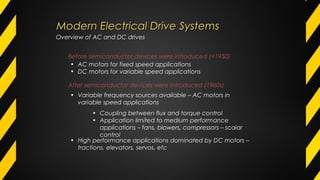
Before semiconductor devices were introduced (<1950)
• AC motors for fixed speed applications
• DC motors for variable speed applications
After semiconductor devices were introduced (1960s)
• Variable frequency sources available – AC motors in
variable speed applications
• Coupling between flux and torque control
• Application limited to medium performance
applications – fans, blowers, compressors – scalar
control
• High performance applications dominated by DC motors –
tractions, elevators, servos, etc
Overview of AC and DC drives
Modern Electrical Drive SystemsModern Electrical Drive Systems
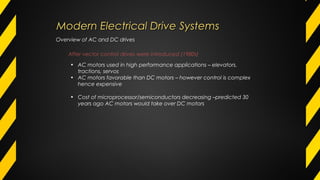
After vector control drives were introduced (1980s)
• AC motors used in high performance applications – elevators,
tractions, servos
• AC motors favorable than DC motors – however control is complex
hence expensive
• Cost of microprocessor/semiconductors decreasing –predicted 30
years ago AC motors would take over DC motors
Overview of AC and DC drives
Modern Electrical Drive SystemsModern Electrical Drive Systems
Overview of AC and DC drives
Modern Electrical Drive SystemsModern Electrical Drive Systems
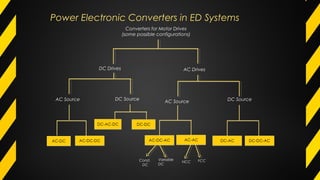
Power Electronic Converters in ED Systems
Converters for Motor Drives
(some possible configurations)
DC Drives AC Drives
DC SourceAC Source AC Source
Const.
DC
Variable
DC
NCC FCC
DC Source
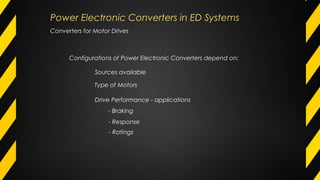
Converters for Motor Drives
Configurations of Power Electronic Converters depend on:
Sources available
Type of Motors
Drive Performance - applications
- Braking
- Response
- Ratings
Power Electronic Converters in ED Systems
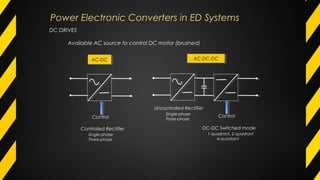
DC DRIVES
Available AC source to control DC motor (brushed)
AC-DC-DCAC-DC-DCAC-DCAC-DC
Controlled Rectifier
Single-phase
Three-phase
Uncontrolled Rectifier
Single-phase
Three-phase
DC-DC Switched mode
1-quadrant, 2-quadrant
4-quadrant
Control Control
Power Electronic Converters in ED Systems
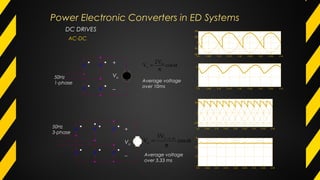
DC DRIVES
+
Vo
−
+
Vo
−
α
π
= cos
V2
V m
o
α
π
= −
cos
V3
V m,LL
o
Average voltage
over 10ms
Average voltage
over 3.33 ms
50Hz
1-phase
50Hz
3-phase
AC-DC
Power Electronic Converters in ED Systems
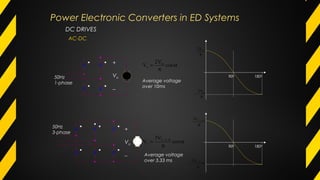
DC DRIVES
+
Vo
−
+
Vo
−
α
π
= cos
V2
V m
o
90o
180o
π
mV2
π
− mV2
90o
π
− m,LLV3
π
− − m,LLV3
α
π
= −
cos
V3
V m,LL
o
Average voltage
over 10ms
Average voltage
over 3.33 ms
50Hz
1-phase
50Hz
3-phase
180o
AC-DC
Power Electronic Converters in ED Systems
DC DRIVES
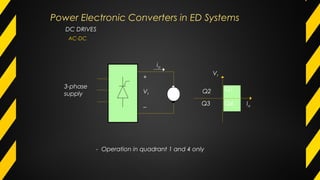
AC-DC
Ia
Q1Q2
Q3 Q4
Vt
3-phase
supply
+
Vt
−
ia
- Operation in quadrant 1 and 4 only
Power Electronic Converters in ED Systems
DC DRIVES
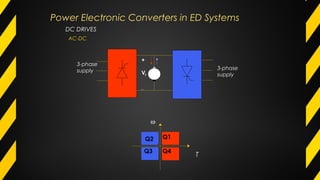
AC-DC
Q1Q2
Q3 Q4
ω
T
3-phase
supply
3-phase
supply
+
Vt
−
Power Electronic Converters in ED Systems
DC DRIVES
AC-DC
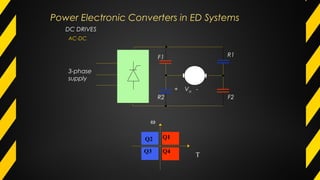
Q1Q2
Q3 Q4
ω
T
F1
F2
R1
R2
+ Va -
3-phase
supply
Power Electronic Converters in ED Systems
DC DRIVES
AC-DC
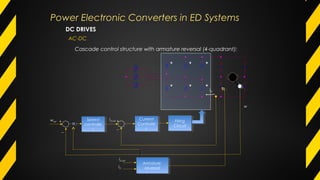
Cascade control structure with armature reversal (4-quadrant):
Speed
controlle
r
Speed
controlle
r
Current
Controlle
r
Current
Controlle
r
Firing
Circuit
Firing
Circuit
Armature
reversal
Armature
reversal
iD
iD,ref
iD,ref
iD,
w
wref + +
_
_
Power Electronic Converters in ED Systems
DC DRIVES
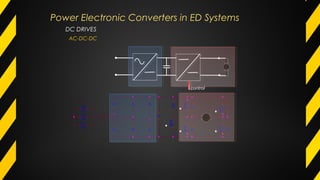
AC-DC-DC
control
Power Electronic Converters in ED Systems
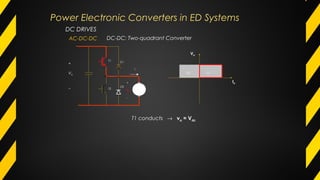
T1 conducts → va = Vdc
Q1Q2
Va
Ia
T1
T2
D1
+
Va
-
D2
ia
+
Vdc
−
DC DRIVES
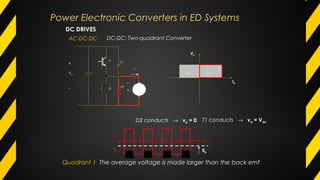
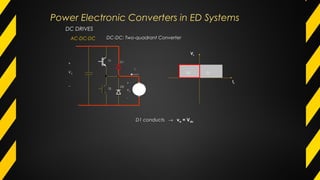
AC-DC-DC DC-DC: Two-quadrant Converter
Power Electronic Converters in ED Systems
Q1Q2
Va
Ia
T1
T2
D1
+
Va
-
D2
ia
+
Vdc
−
D2 conducts → va = 0
Va Eb
T1 conducts → va = Vdc
Quadrant 1 The average voltage is made larger than the back emf
DC DRIVES
AC-DC-DC DC-DC: Two-quadrant Converter
Power Electronic Converters in ED Systems
Q1Q2
Va
Ia
T1
T2
D1
+
Va
-
D2
ia
+
Vdc
−
D1 conducts → va = Vdc
DC DRIVES
AC-DC-DC DC-DC: Two-quadrant Converter
Power Electronic Converters in ED Systems
Q1Q2
Va
Ia
T1
T2
D1
+
Va
-
D2
ia
+
Vdc
−
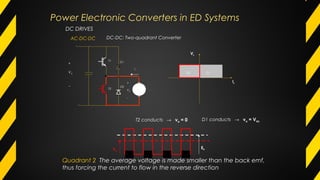
T2 conducts → va = 0
Va
Eb
D1 conducts → va = Vdc
Quadrant 2 The average voltage is made smaller than the back emf,
thus forcing the current to flow in the reverse direction
DC DRIVES
AC-DC-DC DC-DC: Two-quadrant Converter
Power Electronic Converters in ED Systems
DC DRIVES
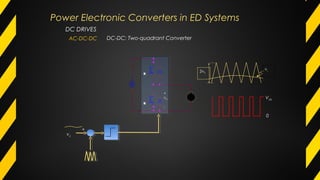
AC-DC-DC DC-DC: Two-quadrant Converter
+
vc
2vtri
vc
+
vA
-
Vdc
0
Power Electronic Converters in ED Systems
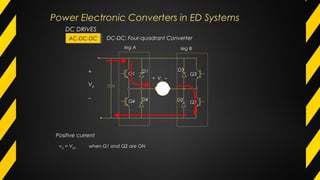
leg A leg B
+ Va −
Q1
Q4
Q3
Q2
D1 D3
D2D4
+
Vdc
−
va = Vdc when Q1 and Q2 are ON
Positive current
DC DRIVES
AC-DC-DCAC-DC-DC DC-DC: Four-quadrant Converter
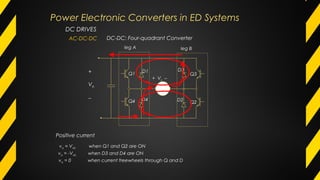
Power Electronic Converters in ED Systems
leg A leg B
+ Va −
Q1
Q4
Q3
Q2
D1 D3
D2D4
+
Vdc
−
va = -Vdc when D3 and D4 are ON
va = Vdc when Q1 and Q2 are ON
va = 0 when current freewheels through Q and D
Positive current
DC DRIVES
AC-DC-DC DC-DC: Four-quadrant Converter
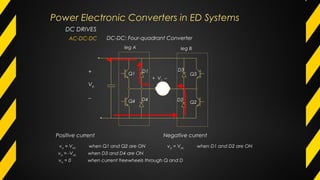
Power Electronic Converters in ED Systems
va = -Vdc when D3 and D4 are ON
va = Vdc when Q1 and Q2 are ON
va = 0 when current freewheels through Q and D
Positive current
va = Vdc when D1 and D2 are ON
Negative current
leg A leg B
+ Va −
Q1
Q4
Q3
Q2
D1 D3
D2D4
+
Vdc
−
DC DRIVES
AC-DC-DC DC-DC: Four-quadrant Converter
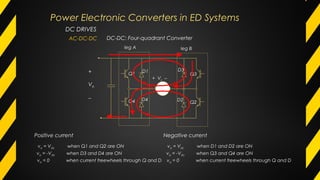
Power Electronic Converters in ED Systems
va = -Vdc when D3 and D4 are ON
va = Vdc when Q1 and Q2 are ON
va = 0 when current freewheels through Q and D
Positive current
va = -Vdc when Q3 and Q4 are ON
va = Vdc when D1 and D2 are ON
va = 0 when current freewheels through Q and D
Negative current
leg A leg B
+ Va −
Q1
Q4
Q3
Q2
D1 D3
D2D4
+
Vdc
−
DC DRIVES
AC-DC-DC DC-DC: Four-quadrant Converter
Power Electronic Converters in ED Systems
Skillcruise.com

application of power electronics

  • 1.
    An Application ofPowerAn Application of Power ElectronicsElectronics An Application of PowerAn Application of Power ElectronicsElectronics
  • 2.
    CONTENTSCONTENTS Power Electronic Systems ModernElectrical Drive Systems Power Electronic Converters in Electrical Drives :: DC and AC Drives Modeling and Control of Electrical Drives
  • 3.
    Power Electronic SystemsPowerElectronic Systems What is Power Electronics ? A field of Electrical Engineering that deals with the application of power semiconductor devices for the control and conversion of electric power Power Electronics Converters Power Electronics Converters LoadLoad ControllerController Output - AC - DC Input Source - AC - DC - unregulated Reference POWER ELECTRONIC CONVERTERS – the heart of power a power electronics system sensors
  • 4.
    Why Power Electronics? Power Electronics Converters Power Electronics Converters IDEALLY LOSSLESS !IDEALLY LOSSLESS ! Power Electronic SystemsPower Electronic Systems
  • 5.
    Why Power Electronics? Other factors: • Improvements in power semiconductors fabrication • Decline cost in power semiconductor • Advancement in semiconductor fabrication • ASICs • FPGA • DSPs • Faster and cheaper to implement complex algorithm • Power Integrated Module (PIM), Intelligent Power Modules (IPM) Power Electronic SystemsPower Electronic Systems
  • 6.
    Some Applications ofPower Electronics : Power rating of < 1 W (portable equipment) Tens or hundreds Watts (Power supplies for computers /office equipment) Typically used in systems requiring efficient control and conversion of electric energy: Domestic and Commercial Applications Industrial Applications Telecommunications Transportation Generation, Transmission and Distribution of electrical energy kW to MW : drives Hundreds of MW in DC transmission system (HVDC) Power Electronic SystemsPower Electronic Systems
  • 7.
    Modern Electrical DriveSystemsModern Electrical Drive Systems Classic Electrical Drive for Variable Speed Application : • Bulky • Inefficient • inflexible
  • 8.
    Power Electronic Converters Power Electronic Converters Reference Typical Modern ElectricDrive Systems Power Electronic Converters Electric Energy - Unregulated - Electric Energy - Regulated - Electric Motor Electric Energy Mechanical Energy Modern Electrical Drive SystemsModern Electrical Drive Systems
  • 9.
    Example on VSDapplication Power In Power loss Mainly in valve Power out motor pump valve Supply motorPEC pump Supply Constant speed Variable Speed Drives Power In Power loss Power out Modern Electrical Drive SystemsModern Electrical Drive Systems
  • 10.
    Electric motor consumesmore than half of electrical energy in the US Fixed speed Variable speed HOW ? Improvements in energy utilization in electric motors give large impact to the overall energy consumption Replacing fixed speed drives with variable speed drives Using the high efficiency motors Improves the existing power converter–based drive systems Example on VSD application Modern Electrical Drive SystemsModern Electrical Drive Systems
  • 11.
    DC drives: Electricaldrives that use DC motors as the prime mover Regular maintenance, heavy, expensive, speed limit AC drives: Electrical drives that use AC motors as the prime mover Less maintenance, light, less expensive, high speed Overview of AC and DC drives Easy control, decouple control of torque and flux Coupling between torque and flux – variable spatial angle between rotor and stator flux Modern Electrical Drive SystemsModern Electrical Drive Systems
  • 12.
    Before semiconductor deviceswere introduced (<1950) • AC motors for fixed speed applications • DC motors for variable speed applications After semiconductor devices were introduced (1960s) • Variable frequency sources available – AC motors in variable speed applications • Coupling between flux and torque control • Application limited to medium performance applications – fans, blowers, compressors – scalar control • High performance applications dominated by DC motors – tractions, elevators, servos, etc Overview of AC and DC drives Modern Electrical Drive SystemsModern Electrical Drive Systems
  • 13.
    After vector controldrives were introduced (1980s) • AC motors used in high performance applications – elevators, tractions, servos • AC motors favorable than DC motors – however control is complex hence expensive • Cost of microprocessor/semiconductors decreasing –predicted 30 years ago AC motors would take over DC motors Overview of AC and DC drives Modern Electrical Drive SystemsModern Electrical Drive Systems
  • 14.
    Overview of ACand DC drives Modern Electrical Drive SystemsModern Electrical Drive Systems
  • 15.
    Power Electronic Convertersin ED Systems Converters for Motor Drives (some possible configurations) DC Drives AC Drives DC SourceAC Source AC Source Const. DC Variable DC NCC FCC DC Source
  • 16.
    Converters for MotorDrives Configurations of Power Electronic Converters depend on: Sources available Type of Motors Drive Performance - applications - Braking - Response - Ratings Power Electronic Converters in ED Systems
  • 17.
    DC DRIVES Available ACsource to control DC motor (brushed) AC-DC-DCAC-DC-DCAC-DCAC-DC Controlled Rectifier Single-phase Three-phase Uncontrolled Rectifier Single-phase Three-phase DC-DC Switched mode 1-quadrant, 2-quadrant 4-quadrant Control Control Power Electronic Converters in ED Systems
  • 18.
    DC DRIVES + Vo − + Vo − α π = cos V2 Vm o α π = − cos V3 V m,LL o Average voltage over 10ms Average voltage over 3.33 ms 50Hz 1-phase 50Hz 3-phase AC-DC Power Electronic Converters in ED Systems
  • 19.
    DC DRIVES + Vo − + Vo − α π = cos V2 Vm o 90o 180o π mV2 π − mV2 90o π − m,LLV3 π − − m,LLV3 α π = − cos V3 V m,LL o Average voltage over 10ms Average voltage over 3.33 ms 50Hz 1-phase 50Hz 3-phase 180o AC-DC Power Electronic Converters in ED Systems
  • 20.
    DC DRIVES AC-DC Ia Q1Q2 Q3 Q4 Vt 3-phase supply + Vt − ia -Operation in quadrant 1 and 4 only Power Electronic Converters in ED Systems
  • 21.
  • 22.
    DC DRIVES AC-DC Q1Q2 Q3 Q4 ω T F1 F2 R1 R2 +Va - 3-phase supply Power Electronic Converters in ED Systems
  • 23.
    DC DRIVES AC-DC Cascade controlstructure with armature reversal (4-quadrant): Speed controlle r Speed controlle r Current Controlle r Current Controlle r Firing Circuit Firing Circuit Armature reversal Armature reversal iD iD,ref iD,ref iD, w wref + + _ _ Power Electronic Converters in ED Systems
  • 24.
  • 25.
    T1 conducts →va = Vdc Q1Q2 Va Ia T1 T2 D1 + Va - D2 ia + Vdc − DC DRIVES AC-DC-DC DC-DC: Two-quadrant Converter Power Electronic Converters in ED Systems
  • 26.
    Q1Q2 Va Ia T1 T2 D1 + Va - D2 ia + Vdc − D2 conducts →va = 0 Va Eb T1 conducts → va = Vdc Quadrant 1 The average voltage is made larger than the back emf DC DRIVES AC-DC-DC DC-DC: Two-quadrant Converter Power Electronic Converters in ED Systems
  • 27.
    Q1Q2 Va Ia T1 T2 D1 + Va - D2 ia + Vdc − D1 conducts →va = Vdc DC DRIVES AC-DC-DC DC-DC: Two-quadrant Converter Power Electronic Converters in ED Systems
  • 28.
    Q1Q2 Va Ia T1 T2 D1 + Va - D2 ia + Vdc − T2 conducts →va = 0 Va Eb D1 conducts → va = Vdc Quadrant 2 The average voltage is made smaller than the back emf, thus forcing the current to flow in the reverse direction DC DRIVES AC-DC-DC DC-DC: Two-quadrant Converter Power Electronic Converters in ED Systems
  • 29.
    DC DRIVES AC-DC-DC DC-DC:Two-quadrant Converter + vc 2vtri vc + vA - Vdc 0 Power Electronic Converters in ED Systems
  • 30.
    leg A legB + Va − Q1 Q4 Q3 Q2 D1 D3 D2D4 + Vdc − va = Vdc when Q1 and Q2 are ON Positive current DC DRIVES AC-DC-DCAC-DC-DC DC-DC: Four-quadrant Converter Power Electronic Converters in ED Systems
  • 31.
    leg A legB + Va − Q1 Q4 Q3 Q2 D1 D3 D2D4 + Vdc − va = -Vdc when D3 and D4 are ON va = Vdc when Q1 and Q2 are ON va = 0 when current freewheels through Q and D Positive current DC DRIVES AC-DC-DC DC-DC: Four-quadrant Converter Power Electronic Converters in ED Systems
  • 32.
    va = -Vdcwhen D3 and D4 are ON va = Vdc when Q1 and Q2 are ON va = 0 when current freewheels through Q and D Positive current va = Vdc when D1 and D2 are ON Negative current leg A leg B + Va − Q1 Q4 Q3 Q2 D1 D3 D2D4 + Vdc − DC DRIVES AC-DC-DC DC-DC: Four-quadrant Converter Power Electronic Converters in ED Systems
  • 33.
    va = -Vdcwhen D3 and D4 are ON va = Vdc when Q1 and Q2 are ON va = 0 when current freewheels through Q and D Positive current va = -Vdc when Q3 and Q4 are ON va = Vdc when D1 and D2 are ON va = 0 when current freewheels through Q and D Negative current leg A leg B + Va − Q1 Q4 Q3 Q2 D1 D3 D2D4 + Vdc − DC DRIVES AC-DC-DC DC-DC: Four-quadrant Converter Power Electronic Converters in ED Systems
  • 34.