Minor Project Presentation
MPPT Solar Charge
Controller
By
Shashank Narayan
07820902812
ECE-7th Sem
Objective
 The solar charge controller is a stand-alone off-the-grid photovoltaic (PV)
system that utilizes maximum power point tracking (MPPT) to obtain the most
efficiency. Due to the inherent losses that occur in photovoltaic systems, it is
essential that the maximum power should be extracted.
 The intent is to create an extremely efficient charge controller that would be
able to monitor the power generated by the photovoltaic array and deliver the
maximum amount to the battery bank during varying atmospheric conditions.
 The System is compatible to drive 500 Wattage AC – DC devices including
charging of batteries.
 Advance Controller make it an efficient system.
Basic Functions
 Automatic battery charging control
 Prevents Battery overcharging
 Blocks Reverse current
 Provide constant voltage
 Overcome whether conditions
 Maximum power tracking
Applications
 The Controller can be used as power source to drive any
AC/DC 500 wattage system or equipments.
 Microcontroller based MPPT algorithm is used to
extract the maximum power from PV cells.
 Can be used for battery charging or a portable charging
source.
 User friendly and a low cost system.
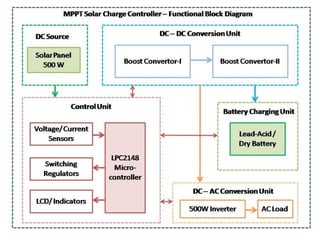
Block Diagram
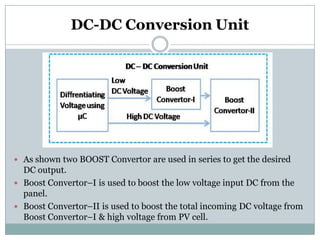
DC-DC Conversion Unit
 As shown two BOOST Convertor are used in series to get the desired
DC output.
 Boost Convertor–I is used to boost the low voltage input DC from the
panel.
 Boost Convertor–II is used to boost the total incoming DC voltage from
Boost Convertor–I & high voltage from PV cell.
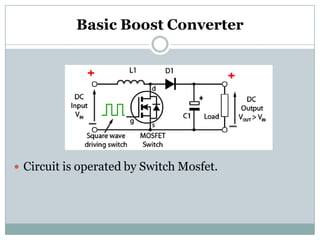
Basic Boost Converter
 Circuit is operated by Switch Mosfet.
Continue..
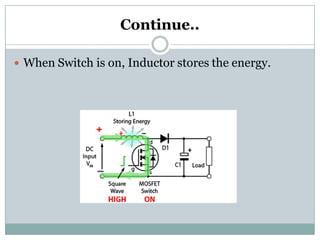
 When Switch is on, Inductor stores the energy.
Continue..
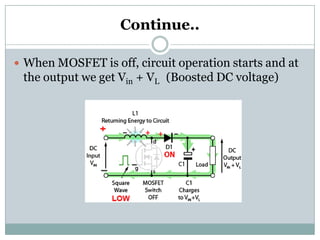
 When MOSFET is off, circuit operation starts and at
the output we get Vin + VL (Boosted DC voltage)
DC-AC Conversion Unit
 This is one of the advantage of my controller.
 Basic aim to insert DC- AC convertor or we can say
an inverter is to make the controller an portable AC
power source for driving the AC equipments
anywhere.
 The power inverter converts DC voltage into 220V ac
voltage and can drive AC load of 500W.
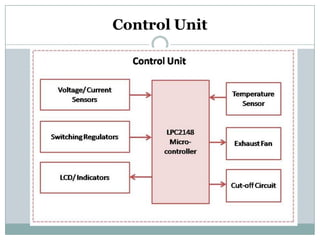
Control Unit
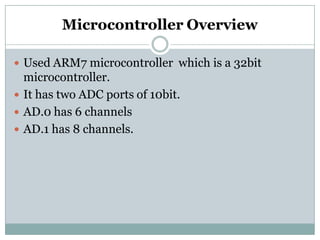
Microcontroller Overview
 Used ARM7 microcontroller which is a 32bit
microcontroller.
 It has two ADC ports of 10bit.
 AD.0 has 6 channels
 AD.1 has 8 channels.
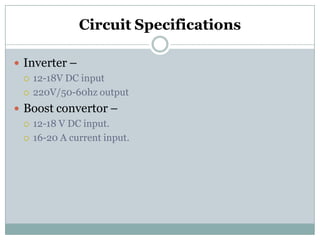
Circuit Specifications
 Inverter –
 12-18V DC input
 220V/50-60hz output
 Boost convertor –
 12-18 V DC input.
 16-20 A current input.
MPPT Solar Charge Controller

MPPT Solar Charge Controller

  • 1.
    Minor Project Presentation MPPTSolar Charge Controller By Shashank Narayan 07820902812 ECE-7th Sem
  • 2.
    Objective  The solarcharge controller is a stand-alone off-the-grid photovoltaic (PV) system that utilizes maximum power point tracking (MPPT) to obtain the most efficiency. Due to the inherent losses that occur in photovoltaic systems, it is essential that the maximum power should be extracted.  The intent is to create an extremely efficient charge controller that would be able to monitor the power generated by the photovoltaic array and deliver the maximum amount to the battery bank during varying atmospheric conditions.  The System is compatible to drive 500 Wattage AC – DC devices including charging of batteries.  Advance Controller make it an efficient system.
  • 3.
    Basic Functions  Automaticbattery charging control  Prevents Battery overcharging  Blocks Reverse current  Provide constant voltage  Overcome whether conditions  Maximum power tracking
  • 4.
    Applications  The Controllercan be used as power source to drive any AC/DC 500 wattage system or equipments.  Microcontroller based MPPT algorithm is used to extract the maximum power from PV cells.  Can be used for battery charging or a portable charging source.  User friendly and a low cost system.
  • 5.
  • 6.
    DC-DC Conversion Unit As shown two BOOST Convertor are used in series to get the desired DC output.  Boost Convertor–I is used to boost the low voltage input DC from the panel.  Boost Convertor–II is used to boost the total incoming DC voltage from Boost Convertor–I & high voltage from PV cell.
  • 7.
    Basic Boost Converter Circuit is operated by Switch Mosfet.
  • 8.
    Continue..  When Switchis on, Inductor stores the energy.
  • 9.
    Continue..  When MOSFETis off, circuit operation starts and at the output we get Vin + VL (Boosted DC voltage)
  • 10.
    DC-AC Conversion Unit This is one of the advantage of my controller.  Basic aim to insert DC- AC convertor or we can say an inverter is to make the controller an portable AC power source for driving the AC equipments anywhere.  The power inverter converts DC voltage into 220V ac voltage and can drive AC load of 500W.
  • 11.
  • 12.
    Microcontroller Overview  UsedARM7 microcontroller which is a 32bit microcontroller.  It has two ADC ports of 10bit.  AD.0 has 6 channels  AD.1 has 8 channels.
  • 13.
    Circuit Specifications  Inverter–  12-18V DC input  220V/50-60hz output  Boost convertor –  12-18 V DC input.  16-20 A current input.