SILICON
COTROLLED RECTIFIRE
Presented By – Om I. Barewar
Containts
 Introduction.
 Symbols and Terminology.
 SCR Characterestics.
 Types of SCR.
 SCR characterestics.
 Application of SCR.
 Advantages and Disadvantages.
 Result and Conclusion.
 References.
Introduction
 The name of Thyristor is derived from the Greek word
"hqnra" meaning "a door".
 A Thyristor is a bistable semiconductor device.
 It comprises three or more junctions and can be
switched from the off state to the on state or vice versa.
 Switchingfrom the off state to the on state is normally
initiated by a control signal.
 Switch off is normally caused by the current though
the Thyristor dropping below a critical level.
 In the 1960s, bidirectional Thyristors, called Triacs,
where introduced.
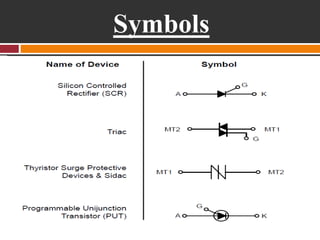
Symbols
Types of SCR
DIAC TRIAC SBS
SCR Characterestics
 In addition to their traditional role of power
control devices, SCRs are being used in a wide
variety of other applications in which the SCR’s
turn−off characteristics are important.
 example — reliable high frequency inverters
and converter designs (20 kHz) require a known
and controlled circuit−commutated turn−off time
(tq).
 Unfortunately, it is usually difficult to find the
turn−off time of a particular SCR for a given set
VI Characterestics
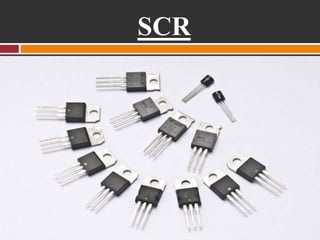
SCR
Applications of SCR
 It is uses for power control.
 It is uses for switching.
 For DC circuit breaker.
 Over voltage protection.
 Pulse circuits.
 Battery charging regulator.
 Zero voltage switching.
 AC power control with Solid relays.
 TRIAC zero point switch application.
Advantages
 It switches large levels of current using only a
small control current.
 It can switch high voltages.
 Able to control AC power.
 Much smaller in size compare to a transformer
(control AC device).
 Simple to control.
 Turn ON gain is very high.
 Low cost.
Disadvantage
 It Cannot be easily turned off.
 For this reason, not suitable for high-power DC
circuits.
 Though suitable for high-power AC circuits, ironically
it will convert the AC to DC. (Though sometimes this
is wanted.)
 In an AC circuit, needs to be turned on each cycle.
Result and Conclusion
 Hence the SCR is best for switching.
 Above characteristics make thyristors extremely
usefulin control applications.
 Compared to a mechanical switch,a thyristor
has a very long service life and very fast turn on
and turn off times.
 These devices will act as a crowbar when
overvoltage occurs and will divert the energy
away from circuit or device that is being
protected.
References
 Handbook Thyristor theory.
 Handbook of Thyristors - Theory, Parameters
and Applications written by Jurek Budek.
 Littlefuse site
 http://www.circuitstoday.com
 https://www.scribd.com
 http://onsemi.com
9960605387

SCR

  • 1.
  • 2.
    Containts  Introduction.  Symbolsand Terminology.  SCR Characterestics.  Types of SCR.  SCR characterestics.  Application of SCR.  Advantages and Disadvantages.  Result and Conclusion.  References.
  • 3.
    Introduction  The nameof Thyristor is derived from the Greek word "hqnra" meaning "a door".  A Thyristor is a bistable semiconductor device.  It comprises three or more junctions and can be switched from the off state to the on state or vice versa.  Switchingfrom the off state to the on state is normally initiated by a control signal.  Switch off is normally caused by the current though the Thyristor dropping below a critical level.  In the 1960s, bidirectional Thyristors, called Triacs, where introduced.
  • 4.
  • 5.
  • 6.
    SCR Characterestics  Inaddition to their traditional role of power control devices, SCRs are being used in a wide variety of other applications in which the SCR’s turn−off characteristics are important.  example — reliable high frequency inverters and converter designs (20 kHz) require a known and controlled circuit−commutated turn−off time (tq).  Unfortunately, it is usually difficult to find the turn−off time of a particular SCR for a given set
  • 7.
  • 8.
  • 9.
    Applications of SCR It is uses for power control.  It is uses for switching.  For DC circuit breaker.  Over voltage protection.  Pulse circuits.  Battery charging regulator.  Zero voltage switching.  AC power control with Solid relays.  TRIAC zero point switch application.
  • 10.
    Advantages  It switcheslarge levels of current using only a small control current.  It can switch high voltages.  Able to control AC power.  Much smaller in size compare to a transformer (control AC device).  Simple to control.  Turn ON gain is very high.  Low cost.
  • 11.
    Disadvantage  It Cannotbe easily turned off.  For this reason, not suitable for high-power DC circuits.  Though suitable for high-power AC circuits, ironically it will convert the AC to DC. (Though sometimes this is wanted.)  In an AC circuit, needs to be turned on each cycle.
  • 12.
    Result and Conclusion Hence the SCR is best for switching.  Above characteristics make thyristors extremely usefulin control applications.  Compared to a mechanical switch,a thyristor has a very long service life and very fast turn on and turn off times.  These devices will act as a crowbar when overvoltage occurs and will divert the energy away from circuit or device that is being protected.
  • 13.
    References  Handbook Thyristortheory.  Handbook of Thyristors - Theory, Parameters and Applications written by Jurek Budek.  Littlefuse site  http://www.circuitstoday.com  https://www.scribd.com  http://onsemi.com
  • 15.