Power Semiconductor Devices
Power Electronics Power Semiconductor Devices1
A brief survey of power semiconductor devices
Power Electronics Power Semiconductor Devices2
● Power diodes
● Power MOSFETs
● Insulated Gate Bipolar Transistors (IGBTs)
● Thyristors (SCR, GTO)
● On resistance vs. breakdown voltage vs.
switching times
● Minority carrier and majority carrier devices
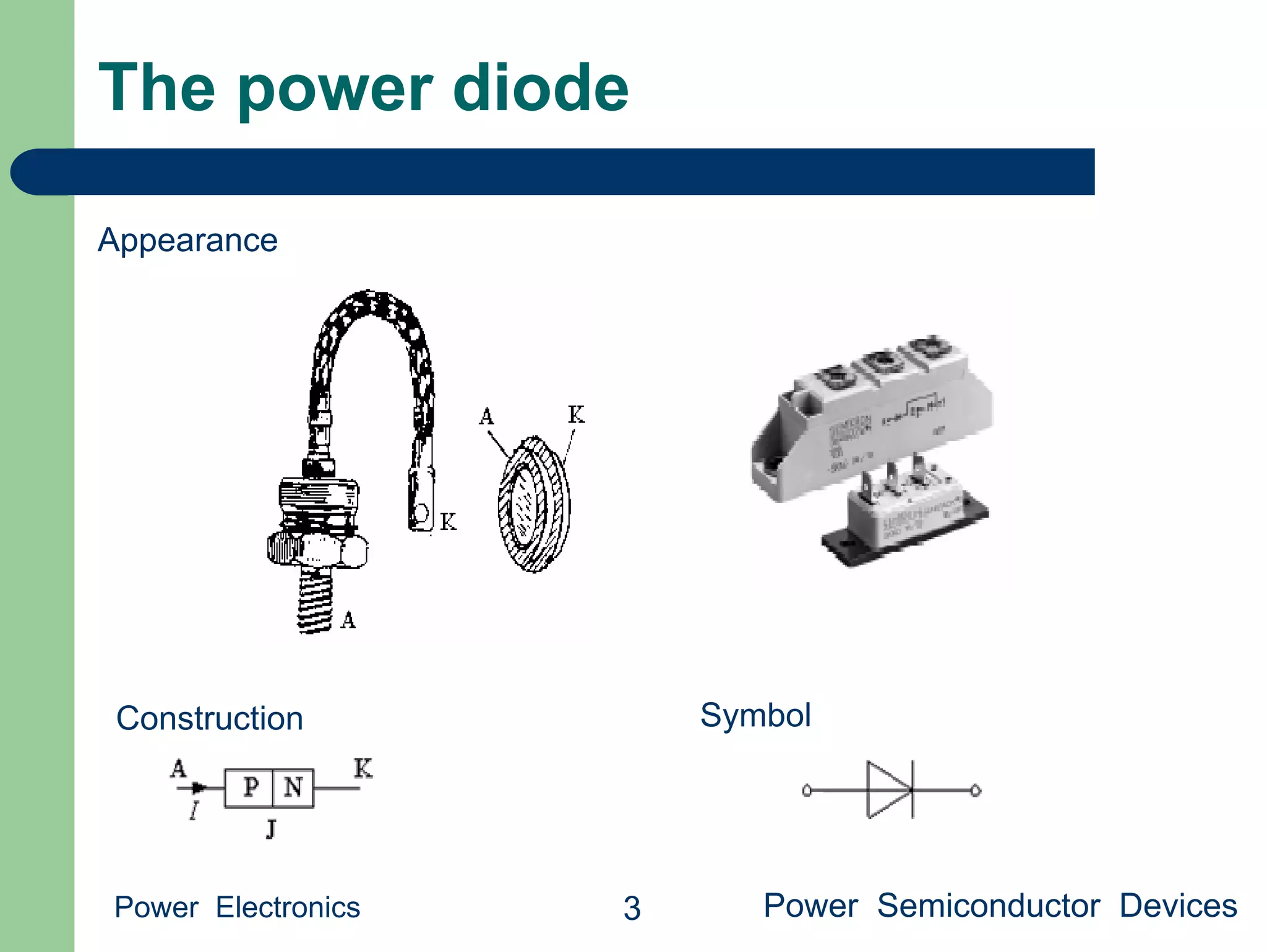
The power diode
Power Electronics Power Semiconductor Devices3
Appearance
Construction Symbol
Reverse-biased power diode
Power Electronics Power Semiconductor Devices4
Forward-biased power diode
Power Electronics Power Semiconductor Devices5
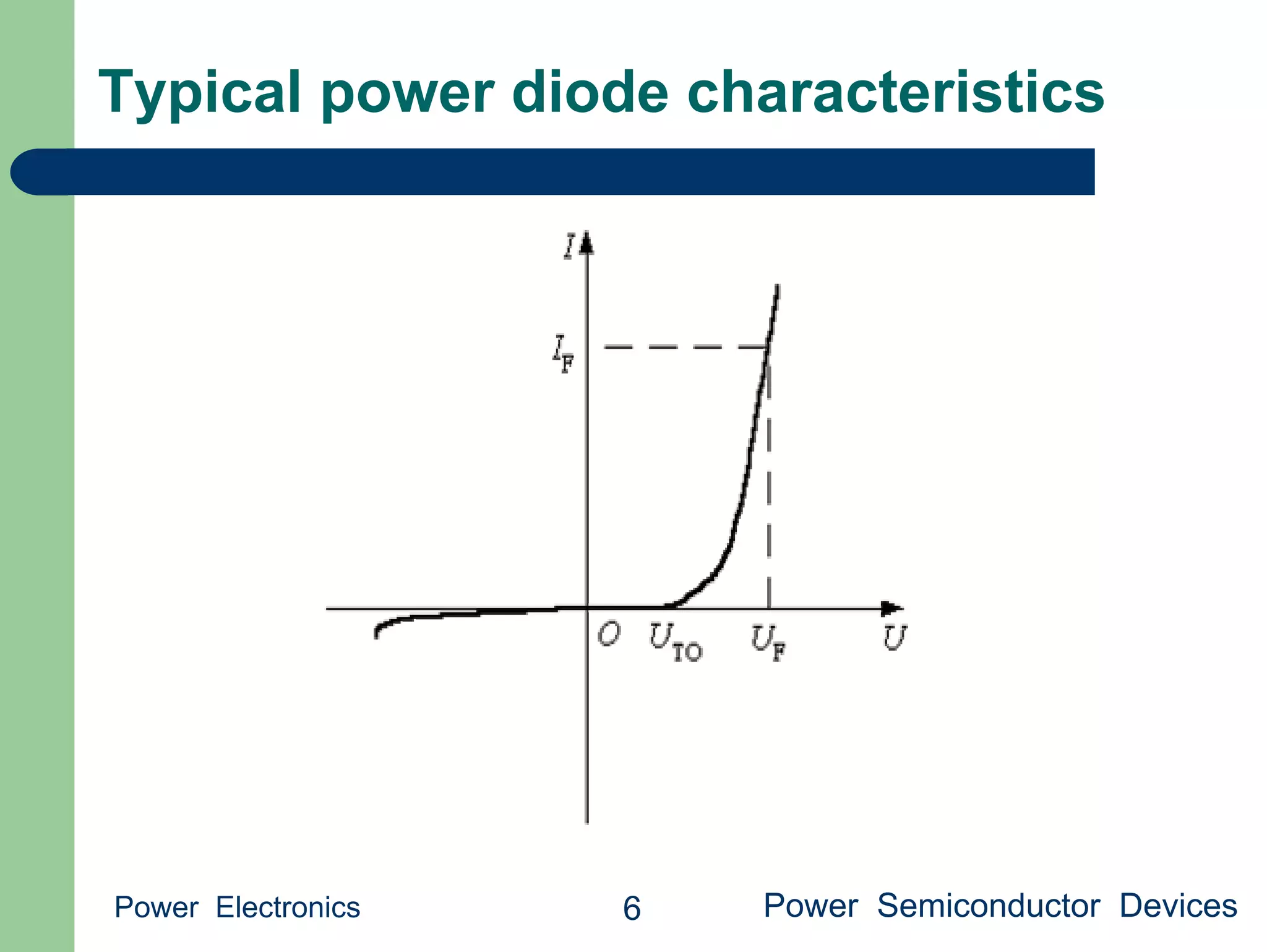
Typical power diode characteristics
Power Electronics Power Semiconductor Devices6
Typical diode switching waveforms
Power Electronics Power Semiconductor Devices7
Types of power diodes
Power Electronics Power Semiconductor Devices8
Standard recovery
Reverse recovery time not specified, intended for 50/60Hz
Fast recovery and ultra-fast recovery
Reverse recovery time and recovered charge specified
Intended for converter applications
Schottky diode
A majority carrier device
Essentially no recovered charge
Model with equilibrium i-v characteristic, in parallel with
depletion region capacitance
Restricted to low voltage (few devices can block 100V or
more)
Characteristics of several commercial power
rectifier diodes
Power Electronics Power Semiconductor Devices9
The power MOSFET
Power Electronics Power Semiconductor Devices10
Appearance
Symbol
n-channel p-channel
The construction of Power MOSFET
Power Electronics Power Semiconductor Devices11
MOSFET: Off state
Power Electronics Power Semiconductor Devices12
MOSFET: On state
Power Electronics Power Semiconductor Devices13
MOSFET body diode
Power Electronics Power Semiconductor Devices14
Typical MOSFET characteristics (1)
Power Electronics Power Semiconductor Devices15
Typical MOSFET characteristics (2)
Power Electronics Power Semiconductor Devices16
Power MOSFET switching waveform
Power Electronics Power Semiconductor Devices17
A simple MOSFET equivalent circuit
Power Electronics Power Semiconductor Devices18
Characteristics of several commercial
power MOSFETs
Power Electronics Power Semiconductor Devices19
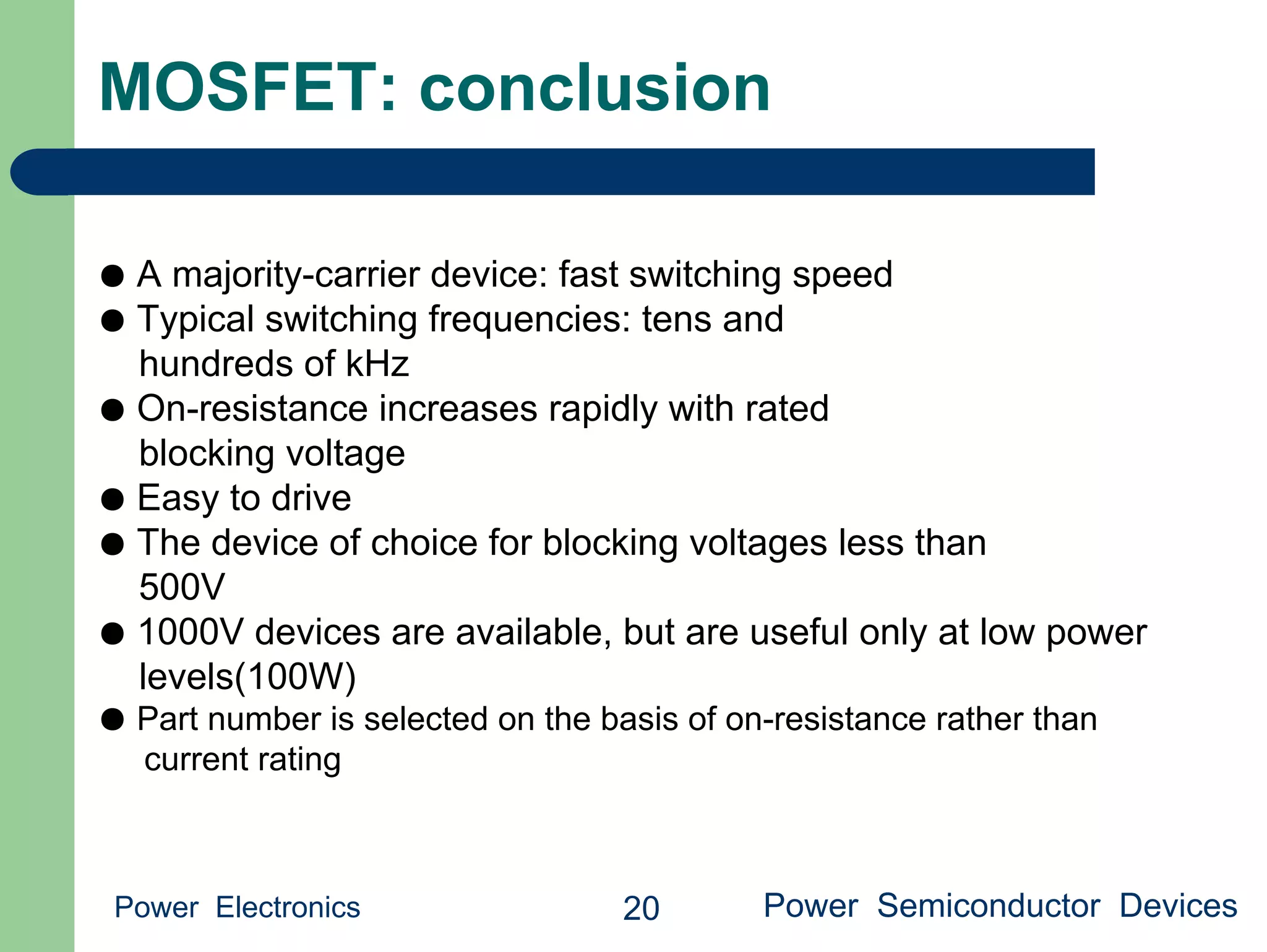
MOSFET: conclusion
Power Electronics Power Semiconductor Devices20
● A majority-carrier device: fast switching speed
● Typical switching frequencies: tens and
hundreds of kHz
● On-resistance increases rapidly with rated
blocking voltage
● Easy to drive
● The device of choice for blocking voltages less than
500V
● 1000V devices are available, but are useful only at low power
levels(100W)
● Part number is selected on the basis of on-resistance rather than
current rating
The Insulated Gate Bipolar Transistor (IGBT)
Power Electronics Power Semiconductor Devices21
Appearance Symbol
The construction of IGBT
Power Electronics Power Semiconductor Devices22
The equivalent circuit of IGBT
Power Electronics Power Semiconductor Devices23
Typical IGBT characteristics
Power Electronics Power Semiconductor Devices24
IGBT switching waveform
Power Electronics Power Semiconductor Devices25
Current tailing in IGBTs
Power Electronics Power Semiconductor Devices26
Characteristics of several
commercial devices
Power Electronics Power Semiconductor Devices27
Conclusions: IGBT
Power Electronics Power Semiconductor Devices28
● Becoming the device of choice in 500-1700V applications, at
power levels of 1-1000kW
● Positive temperature coefficient at high current —easy to
parallel and construct modules
● Forward voltage drop: diode in series with on-resistance.
2- 4V typical
● Easy to drive —similar to MOSFET
● Slower than MOSFET, but faster than Darlington, GTO, SCR
● Typical switching frequencies: 3-30kHz
● IGBT technology is rapidly advancing —next generation:
2500V
The Thyristor (silicon controlled rectifier, SCR)
Power Electronics Power Semiconductor Devices29
Appearance Symbol
The equivalent circuit and
construction of thyristor
Power Electronics Power Semiconductor Devices30
Typical thyristor characteristics
Power Electronics Power Semiconductor Devices31
Thyristor switching waveform
Power Electronics Power Semiconductor Devices32
Why the conventional SCR cannot be
turned off via gate control
Power Electronics Power Semiconductor Devices33
The Gate Turn-Off Thyristor (GTO)
Power Electronics Power Semiconductor Devices34
Summary: Thyristors
Power Electronics Power Semiconductor Devices35
● The thyristor family: double injection yields lowest forward
voltage drop in high voltage devices. More difficult to
parallel than MOSFETs and IGBTs
● The SCR: highest voltage and current ratings, low cost,
passive turn-off transition
● The GTO: intermediate ratings (less than SCR, somewhat
more than IGBT). Slower than IGBT. Slower than MCT.
Difficult to drive.
● The MCT: So far, ratings lower than IGBT. Slower than IGBT.
Easy to drive. Still emerging devices?
Summary of power semiconductor
devices
Power Electronics Power Semiconductor Devices36
1. Majority carrier devices, including the MOSFET and Schottky diode, exhibit
very fast switching times, controlled essentially by the charging of the
device capacitances. However, the forward voltage drops of these devices
increases quickly with increasing breakdown voltage.
2. Minority carrier devices, including the BJT, IGBT, and thyristor family, can
exhibit high breakdown voltages with relatively low forward voltage drop.
However, the switching times of these devices are longer, and are
controlled by the times needed to insert or remove stored minority charge.
3. Energy is lost during switching transitions, due to a variety of mechanisms.
The resulting average power loss, or switching loss, is equal to this energy
loss multiplied by the switching frequency. Switching loss imposes an
upper limit on the switching frequencies of practical converters.
Two classifications based on carriers
Power Electronics Power Semiconductor Devices37
Classification I Classification II

Power semiconductor devices

  • 1.
    Power Semiconductor Devices PowerElectronics Power Semiconductor Devices1
  • 2.
    A brief surveyof power semiconductor devices Power Electronics Power Semiconductor Devices2 ● Power diodes ● Power MOSFETs ● Insulated Gate Bipolar Transistors (IGBTs) ● Thyristors (SCR, GTO) ● On resistance vs. breakdown voltage vs. switching times ● Minority carrier and majority carrier devices
  • 3.
    The power diode PowerElectronics Power Semiconductor Devices3 Appearance Construction Symbol
  • 4.
    Reverse-biased power diode PowerElectronics Power Semiconductor Devices4
  • 5.
    Forward-biased power diode PowerElectronics Power Semiconductor Devices5
  • 6.
    Typical power diodecharacteristics Power Electronics Power Semiconductor Devices6
  • 7.
    Typical diode switchingwaveforms Power Electronics Power Semiconductor Devices7
  • 8.
    Types of powerdiodes Power Electronics Power Semiconductor Devices8 Standard recovery Reverse recovery time not specified, intended for 50/60Hz Fast recovery and ultra-fast recovery Reverse recovery time and recovered charge specified Intended for converter applications Schottky diode A majority carrier device Essentially no recovered charge Model with equilibrium i-v characteristic, in parallel with depletion region capacitance Restricted to low voltage (few devices can block 100V or more)
  • 9.
    Characteristics of severalcommercial power rectifier diodes Power Electronics Power Semiconductor Devices9
  • 10.
    The power MOSFET PowerElectronics Power Semiconductor Devices10 Appearance Symbol n-channel p-channel
  • 11.
    The construction ofPower MOSFET Power Electronics Power Semiconductor Devices11
  • 12.
    MOSFET: Off state PowerElectronics Power Semiconductor Devices12
  • 13.
    MOSFET: On state PowerElectronics Power Semiconductor Devices13
  • 14.
    MOSFET body diode PowerElectronics Power Semiconductor Devices14
  • 15.
    Typical MOSFET characteristics(1) Power Electronics Power Semiconductor Devices15
  • 16.
    Typical MOSFET characteristics(2) Power Electronics Power Semiconductor Devices16
  • 17.
    Power MOSFET switchingwaveform Power Electronics Power Semiconductor Devices17
  • 18.
    A simple MOSFETequivalent circuit Power Electronics Power Semiconductor Devices18
  • 19.
    Characteristics of severalcommercial power MOSFETs Power Electronics Power Semiconductor Devices19
  • 20.
    MOSFET: conclusion Power ElectronicsPower Semiconductor Devices20 ● A majority-carrier device: fast switching speed ● Typical switching frequencies: tens and hundreds of kHz ● On-resistance increases rapidly with rated blocking voltage ● Easy to drive ● The device of choice for blocking voltages less than 500V ● 1000V devices are available, but are useful only at low power levels(100W) ● Part number is selected on the basis of on-resistance rather than current rating
  • 21.
    The Insulated GateBipolar Transistor (IGBT) Power Electronics Power Semiconductor Devices21 Appearance Symbol
  • 22.
    The construction ofIGBT Power Electronics Power Semiconductor Devices22
  • 23.
    The equivalent circuitof IGBT Power Electronics Power Semiconductor Devices23
  • 24.
    Typical IGBT characteristics PowerElectronics Power Semiconductor Devices24
  • 25.
    IGBT switching waveform PowerElectronics Power Semiconductor Devices25
  • 26.
    Current tailing inIGBTs Power Electronics Power Semiconductor Devices26
  • 27.
    Characteristics of several commercialdevices Power Electronics Power Semiconductor Devices27
  • 28.
    Conclusions: IGBT Power ElectronicsPower Semiconductor Devices28 ● Becoming the device of choice in 500-1700V applications, at power levels of 1-1000kW ● Positive temperature coefficient at high current —easy to parallel and construct modules ● Forward voltage drop: diode in series with on-resistance. 2- 4V typical ● Easy to drive —similar to MOSFET ● Slower than MOSFET, but faster than Darlington, GTO, SCR ● Typical switching frequencies: 3-30kHz ● IGBT technology is rapidly advancing —next generation: 2500V
  • 29.
    The Thyristor (siliconcontrolled rectifier, SCR) Power Electronics Power Semiconductor Devices29 Appearance Symbol
  • 30.
    The equivalent circuitand construction of thyristor Power Electronics Power Semiconductor Devices30
  • 31.
    Typical thyristor characteristics PowerElectronics Power Semiconductor Devices31
  • 32.
    Thyristor switching waveform PowerElectronics Power Semiconductor Devices32
  • 33.
    Why the conventionalSCR cannot be turned off via gate control Power Electronics Power Semiconductor Devices33
  • 34.
    The Gate Turn-OffThyristor (GTO) Power Electronics Power Semiconductor Devices34
  • 35.
    Summary: Thyristors Power ElectronicsPower Semiconductor Devices35 ● The thyristor family: double injection yields lowest forward voltage drop in high voltage devices. More difficult to parallel than MOSFETs and IGBTs ● The SCR: highest voltage and current ratings, low cost, passive turn-off transition ● The GTO: intermediate ratings (less than SCR, somewhat more than IGBT). Slower than IGBT. Slower than MCT. Difficult to drive. ● The MCT: So far, ratings lower than IGBT. Slower than IGBT. Easy to drive. Still emerging devices?
  • 36.
    Summary of powersemiconductor devices Power Electronics Power Semiconductor Devices36 1. Majority carrier devices, including the MOSFET and Schottky diode, exhibit very fast switching times, controlled essentially by the charging of the device capacitances. However, the forward voltage drops of these devices increases quickly with increasing breakdown voltage. 2. Minority carrier devices, including the BJT, IGBT, and thyristor family, can exhibit high breakdown voltages with relatively low forward voltage drop. However, the switching times of these devices are longer, and are controlled by the times needed to insert or remove stored minority charge. 3. Energy is lost during switching transitions, due to a variety of mechanisms. The resulting average power loss, or switching loss, is equal to this energy loss multiplied by the switching frequency. Switching loss imposes an upper limit on the switching frequencies of practical converters.
  • 37.
    Two classifications basedon carriers Power Electronics Power Semiconductor Devices37 Classification I Classification II