INTRODUCTION TO
VIROLOGY
Introduction to Virology
• A virus is an obligate intracellular
parasite containing genetic material
surrounded by protein
• Virus particles can only be
observed by an electron
microscope
• Most viruses range in sizes from 20
– 250 nanometers 2
Viral Properties
• Viruses are obligate intracellular parasites
• Viruses are non-living entities
• Viruses cannot make energy or proteins independent
of a host cell (Depends on host cell for replication)
• Viral genome are either RNA or DNA but not both.
• Viruses have a naked capsid or envelope with
attached proteins
• Do not possess cellular organization
• Viruses do not have the genetic capability to multiply
by division.
• They are NOT cultiviable on ordinary media.
Cellular Acellular
Prokaryotes Eukaryotes Viruses
Bacteria and
archaea
Fungi,algae,protozoa,
helminths
Viruses and
bacteriophage
s
Types of Microbes
(b) VirusTypes
Bacterial virus
AIDS virus
Envelope
Capsid
Nucleic
acid
(a) Cell Types
Prokaryotic
Chromosome
Ribosomes
Flagellum
Cellwall Cell
membrane
Eukaryotic
Flagellum
Mitochondria
Ribosomes
Cell membrane
Nucleus
Copyright © The McGraw-Hill Companies, Inc. Permission required for reproduction or display.
5
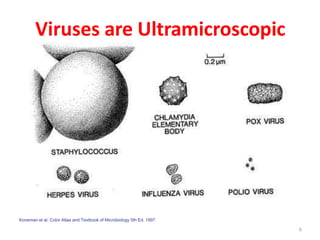
Morphology - Size
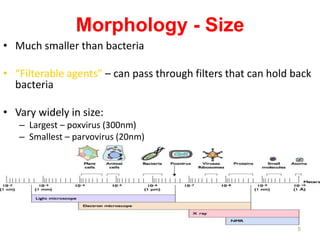
• Much smaller than bacteria
• “Filterable agents” – can pass through filters that can hold back
bacteria
• Vary widely in size:
– Largest – poxvirus (300nm)
– Smallest – parvovirus (20nm)
Viruses are Ultramicroscopic
Koneman et al. Color Atlas and Textbook of Microbiology 5th Ed. 1997
6
Shape of Viruses
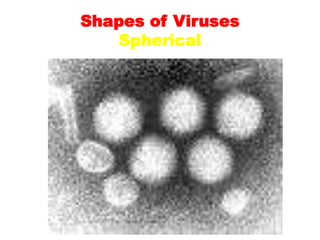
• Spherical
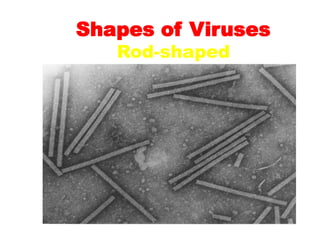
• Rod-shaped
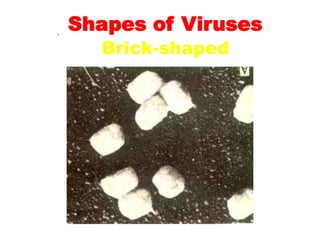
• Brick-shaped
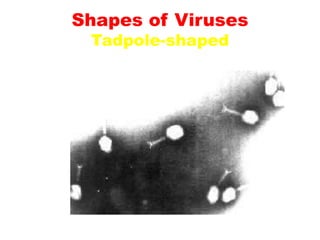
• Tadpole- shaped
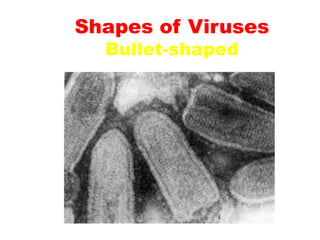
• Bullet-shaped
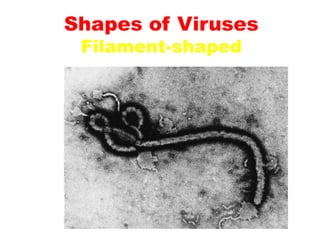
• Filament-shaped
Shapes of Viruses
Spherical
Shapes of Viruses
Rod-shaped
Shapes of Viruses
Brick-shaped
.
Shapes of Viruses
Tadpole-shaped
Shapes of Viruses
Bullet-shaped
Shapes of Viruses
Filament-shaped
14
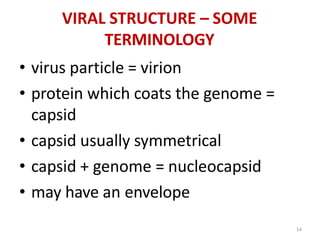
VIRAL STRUCTURE – SOME
TERMINOLOGY
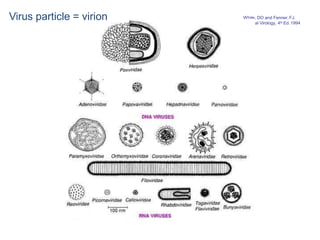
• virus particle = virion
• protein which coats the genome =
capsid
• capsid usually symmetrical
• capsid + genome = nucleocapsid
• may have an envelope
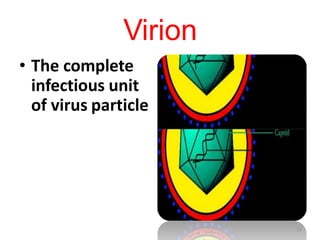
Virion
• The complete
infectious unit
of virus particle
15
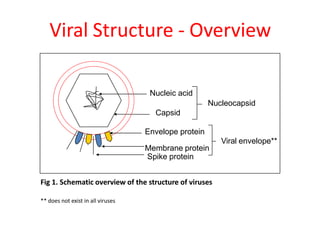
Viral Structure - Overview
Fig 1. Schematic overview of the structure of viruses
** does not exist in all viruses
Nucleic acid
Nucleocapsid
Capsid
Viral envelope**
Envelope protein
Membrane protein
Spike protein
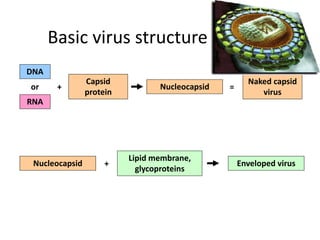
Basic virus structure
Capsid
protein
Nucleocapsid
Naked capsid
virus
DNA
RNA
or =
+
Nucleocapsid
Lipid membrane,
glycoproteins
Enveloped virus
+
Medic
White, DO and Fenner,FJ.
al Virology, 4th Ed. 1994
Virus particle = virion
Viral genome
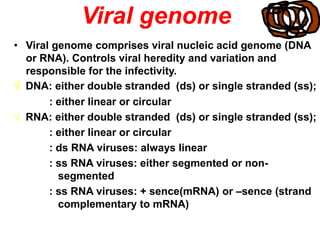
• Viral genome comprises viral nucleic acid genome (DNA
or RNA). Controls viral heredity and variation and
responsible for the infectivity.
√ DNA: either double stranded (ds) or single stranded (ss);
: either linear or circular
√ RNA: either double stranded (ds) or single stranded (ss);
: either linear or circular
: ds RNA viruses: always linear
: ss RNA viruses: either segmented or non-
segmented
: ss RNA viruses: + sence(mRNA) or –sence (strand
complementary to mRNA)
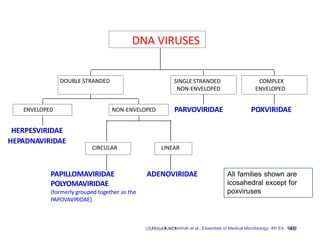
HERPESVIRIDAE
HEPADNAVIRIDAE
ENVELOPED
PAPILLOMAVIRIDAE
POLYOMAVIRIDAE
(formerly grouped together as the
PAPOVAVIRIDAE)
CIRCULAR
ADENOVIRIDAE
LINEAR
NON-ENVELOPED
DOUBLE STRANDED
PARVOVIRIDAE
SINGLESTRANDED
NON-ENVELOPED
POXVIRIDAE
COMPLEX
ENVELOPED
DNA VIRUSES
All families shown are
icosahedral except for
poxviruses
Dr
.
T
.
VM.RoadoifiMedDfromVolk et al., Essentials of Medical Microbiology, 4th Ed. 1
9
49
81
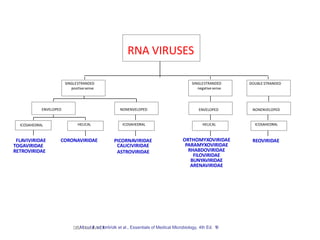
FLAVIVIRIDAE
TOGAVIRIDAE
RETROVIRIDAE
ICOSAHEDRAL
CORONAVIRIDAE
HELICAL
ENVELOPED
ICOSAHEDRAL
PICORNAVIRIDAE
CALICIVIRIDAE
ASTROVIRIDAE
NONENVELOPED
SINGLESTRANDED
positivesense
ORTHOMYXOVIRIDAE
PARAMYXOVIRIDAE
RHABDOVIRIDAE
FILOVIRIDAE
BUNYAVIRIDAE
ARENAVIRIDAE
SINGLESTRANDED
negativesense
REOVIRIDAE
DOUBLE STRANDED
RNA VIRUSES
ENVELOPED
HELICAL ICOSAHEDRAL
NONENVELOPED
Dr
.
T
.
VM.RoadoifiMedDfromVolk et al., Essentials of Medical Microbiology, 4th Ed. 1
9
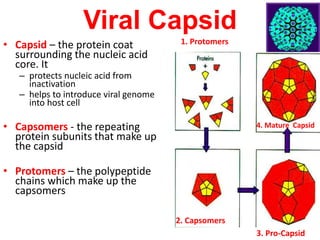
Viral Capsid
• Capsid – the protein coat
surrounding the nucleic acid
core. It
– protects nucleic acid from
inactivation
– helps to introduce viral genome
into host cell
• Capsomers - the repeating
protein subunits that make up
the capsid
• Protomers – the polypeptide
chains which make up the
capsomers
1. Protomers
2. Capsomers
3. Pro-Capsid
4. Mature Capsid
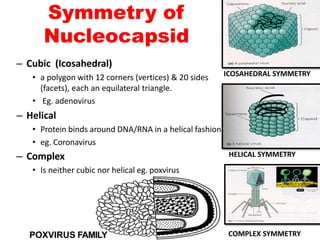
Symmetry of
Nucleocapsid
– Cubic (Icosahedral)
• a polygon with 12 corners (vertices) & 20 sides
(facets), each an equilateral triangle.
• Eg. adenovirus
– Helical
• Protein binds around DNA/RNA in a helical fashion
• eg. Coronavirus
– Complex
• Is neither cubic nor helical eg. poxvirus
ICOSAHEDRAL SYMMETRY
HELICAL SYMMETRY
COMPLEX SYMMETRY
POXVIRUS FAMILY
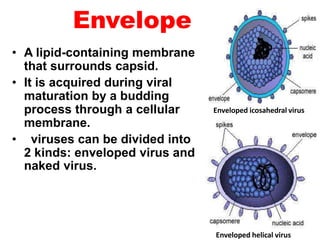
Envelope
• A lipid-containing membrane
that surrounds capsid.
• It is acquired during viral
maturation by a budding
process through a cellular
membrane.
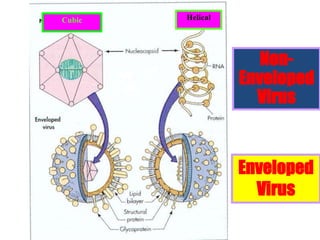
• viruses can be divided into
2 kinds: enveloped virus and
naked virus.
Enveloped icosahedral virus
Enveloped helical virus
Enveloped
Virus
Non-
Enveloped
Virus
Cubic Helical
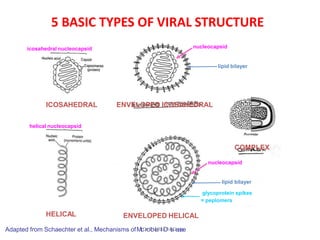
5 BASIC TYPES OF VIRAL STRUCTURE
HELICAL ENVELOPED HELICAL
ENVELOPED ICOSAHEDRAL
ICOSAHEDRAL
nucleocapsid
icosahedral nucleocapsid
helical nucleocapsid
lipid bilayer
COMPLEX
nucleocapsid
lipid bilayer
glycoprotein spikes
= peplomers
Adapted from Schaechter et al., Mechanisms ofMicD
rr
o.
T
b.
V
i.
aR
a
loDMisDease
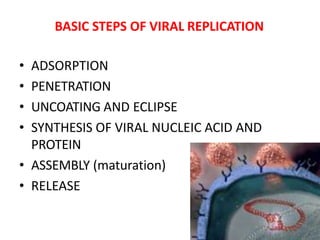
• ADSORPTION
• PENETRATION
• UNCOATING AND ECLIPSE
• SYNTHESIS OF VIRAL NUCLEIC ACID AND
PROTEIN
• ASSEMBLY (maturation)
• RELEASE
BASIC STEPS OF VIRAL REPLICATION
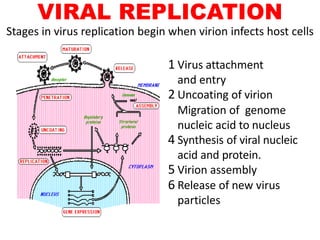
VIRAL REPLICATION
Stages in virus replication begin when virion infects host cells
1 Virus attachment
and entry
2 Uncoating of virion
Migration of genome
nucleic acid to nucleus
4 Synthesis of viral nucleic
acid and protein.
5 Virion assembly
6 Release of new virus
particles
Chemical Properties - Resistance
 Temperature:



Enveloped viruses are more heat-labile
Inactivated at 560C-30’ (exception- HBV) and few sec at 1000C.
Some may be preserved by lyophilization


 pH:


. stable between pH 5 and 9 Enteroviruses
– resistant to acidic conditions
 Radiation: UV and ionising radiation inactivates viruses
 Photodynamic Inactivation
 Vital dyes- Toluidene blue
 Disinfectants
 Most viruses are destroyed by oxidising agents such as
chlorine, iodine and hydrogen peroxide. However, majority of
viruses are resistant to phenol; chlorination does not always
inactivate enteroviruses or hepatitis viruses, particularly if
present with organic or faecal material.
Transmission of Viruses
• Respiratory transmission
– Influenza A virus
• Faecal-oral transmission
– Enterovirus
• Blood-borne transmission
– Hepatitis B virus
• Sexual Transmission
– HIV
• Animal or insect vectors
– Rabies virus
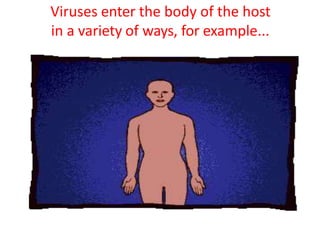
Viruses enter the body of the host
in a variety of ways, for example...
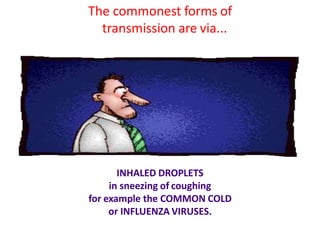
The commonest forms of
transmission are via...
INHALED DROPLETS
in sneezing of coughing
for example the COMMON COLD
or INFLUENZA VIRUSES.
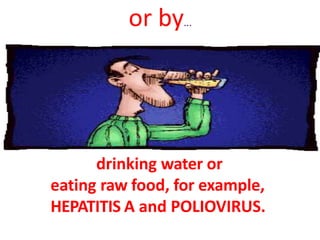
or by...
drinking water or
eating raw food, for example,
HEPATITIS A and POLIOVIRUS.
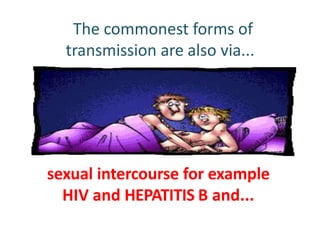
The commonest forms of
transmission are also via...
sexual intercourse for example
HIV and HEPATITIS B and...
also...
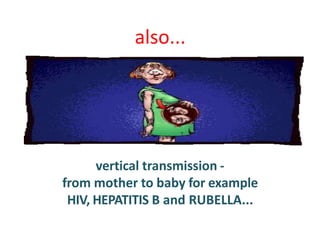
vertical transmission -
from mother to baby for example
HIV, HEPATITIS B and RUBELLA...
also...
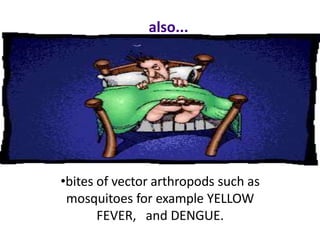
•bites of vector arthropods such as
mosquitoes for example YELLOW
FEVER, and DENGUE.
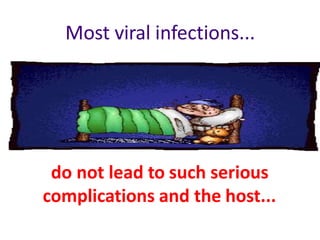
Most viral infections...
do not lead to such serious
complications and the host...
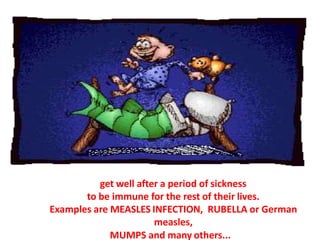
get well after a period of sickness
to be immune for the rest of their lives.
Examples are MEASLES INFECTION, RUBELLA or German
measles,
MUMPS and many others...
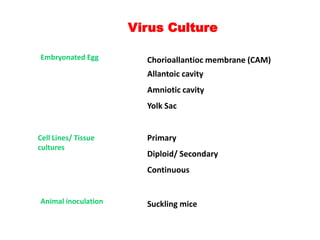
Embryonated Egg
Cell Lines/ Tissue
cultures
Animal inoculation
Chorioallantioc membrane (CAM)
Allantoic cavity
Amniotic cavity
Yolk Sac
Primary
Diploid/ Secondary
Continuous
Suckling mice
Virus Culture
Introduction to virology for Medical students

Introduction to virology for Medical students

  • 1.
  • 2.
    Introduction to Virology •A virus is an obligate intracellular parasite containing genetic material surrounded by protein • Virus particles can only be observed by an electron microscope • Most viruses range in sizes from 20 – 250 nanometers 2
  • 3.
    Viral Properties • Virusesare obligate intracellular parasites • Viruses are non-living entities • Viruses cannot make energy or proteins independent of a host cell (Depends on host cell for replication) • Viral genome are either RNA or DNA but not both. • Viruses have a naked capsid or envelope with attached proteins • Do not possess cellular organization • Viruses do not have the genetic capability to multiply by division. • They are NOT cultiviable on ordinary media.
  • 4.
    Cellular Acellular Prokaryotes EukaryotesViruses Bacteria and archaea Fungi,algae,protozoa, helminths Viruses and bacteriophage s Types of Microbes (b) VirusTypes Bacterial virus AIDS virus Envelope Capsid Nucleic acid (a) Cell Types Prokaryotic Chromosome Ribosomes Flagellum Cellwall Cell membrane Eukaryotic Flagellum Mitochondria Ribosomes Cell membrane Nucleus Copyright © The McGraw-Hill Companies, Inc. Permission required for reproduction or display.
  • 5.
    5 Morphology - Size •Much smaller than bacteria • “Filterable agents” – can pass through filters that can hold back bacteria • Vary widely in size: – Largest – poxvirus (300nm) – Smallest – parvovirus (20nm)
  • 6.
    Viruses are Ultramicroscopic Konemanet al. Color Atlas and Textbook of Microbiology 5th Ed. 1997 6
  • 7.
    Shape of Viruses •Spherical • Rod-shaped • Brick-shaped • Tadpole- shaped • Bullet-shaped • Filament-shaped
  • 8.
  • 9.
  • 10.
  • 11.
  • 12.
  • 13.
  • 14.
    14 VIRAL STRUCTURE –SOME TERMINOLOGY • virus particle = virion • protein which coats the genome = capsid • capsid usually symmetrical • capsid + genome = nucleocapsid • may have an envelope
  • 15.
    Virion • The complete infectiousunit of virus particle 15
  • 16.
    Viral Structure -Overview Fig 1. Schematic overview of the structure of viruses ** does not exist in all viruses Nucleic acid Nucleocapsid Capsid Viral envelope** Envelope protein Membrane protein Spike protein
  • 17.
    Basic virus structure Capsid protein Nucleocapsid Nakedcapsid virus DNA RNA or = + Nucleocapsid Lipid membrane, glycoproteins Enveloped virus +
  • 18.
    Medic White, DO andFenner,FJ. al Virology, 4th Ed. 1994 Virus particle = virion
  • 19.
    Viral genome • Viralgenome comprises viral nucleic acid genome (DNA or RNA). Controls viral heredity and variation and responsible for the infectivity. √ DNA: either double stranded (ds) or single stranded (ss); : either linear or circular √ RNA: either double stranded (ds) or single stranded (ss); : either linear or circular : ds RNA viruses: always linear : ss RNA viruses: either segmented or non- segmented : ss RNA viruses: + sence(mRNA) or –sence (strand complementary to mRNA)
  • 20.
    HERPESVIRIDAE HEPADNAVIRIDAE ENVELOPED PAPILLOMAVIRIDAE POLYOMAVIRIDAE (formerly grouped togetheras the PAPOVAVIRIDAE) CIRCULAR ADENOVIRIDAE LINEAR NON-ENVELOPED DOUBLE STRANDED PARVOVIRIDAE SINGLESTRANDED NON-ENVELOPED POXVIRIDAE COMPLEX ENVELOPED DNA VIRUSES All families shown are icosahedral except for poxviruses Dr . T . VM.RoadoifiMedDfromVolk et al., Essentials of Medical Microbiology, 4th Ed. 1 9 49 81
  • 21.
  • 22.
    Viral Capsid • Capsid– the protein coat surrounding the nucleic acid core. It – protects nucleic acid from inactivation – helps to introduce viral genome into host cell • Capsomers - the repeating protein subunits that make up the capsid • Protomers – the polypeptide chains which make up the capsomers 1. Protomers 2. Capsomers 3. Pro-Capsid 4. Mature Capsid
  • 23.
    Symmetry of Nucleocapsid – Cubic(Icosahedral) • a polygon with 12 corners (vertices) & 20 sides (facets), each an equilateral triangle. • Eg. adenovirus – Helical • Protein binds around DNA/RNA in a helical fashion • eg. Coronavirus – Complex • Is neither cubic nor helical eg. poxvirus ICOSAHEDRAL SYMMETRY HELICAL SYMMETRY COMPLEX SYMMETRY POXVIRUS FAMILY
  • 24.
    Envelope • A lipid-containingmembrane that surrounds capsid. • It is acquired during viral maturation by a budding process through a cellular membrane. • viruses can be divided into 2 kinds: enveloped virus and naked virus. Enveloped icosahedral virus Enveloped helical virus
  • 25.
  • 26.
    5 BASIC TYPESOF VIRAL STRUCTURE HELICAL ENVELOPED HELICAL ENVELOPED ICOSAHEDRAL ICOSAHEDRAL nucleocapsid icosahedral nucleocapsid helical nucleocapsid lipid bilayer COMPLEX nucleocapsid lipid bilayer glycoprotein spikes = peplomers Adapted from Schaechter et al., Mechanisms ofMicD rr o. T b. V i. aR a loDMisDease
  • 27.
    • ADSORPTION • PENETRATION •UNCOATING AND ECLIPSE • SYNTHESIS OF VIRAL NUCLEIC ACID AND PROTEIN • ASSEMBLY (maturation) • RELEASE BASIC STEPS OF VIRAL REPLICATION
  • 28.
    VIRAL REPLICATION Stages invirus replication begin when virion infects host cells 1 Virus attachment and entry 2 Uncoating of virion Migration of genome nucleic acid to nucleus 4 Synthesis of viral nucleic acid and protein. 5 Virion assembly 6 Release of new virus particles
  • 29.
    Chemical Properties -Resistance  Temperature:    Enveloped viruses are more heat-labile Inactivated at 560C-30’ (exception- HBV) and few sec at 1000C. Some may be preserved by lyophilization    pH:   . stable between pH 5 and 9 Enteroviruses – resistant to acidic conditions
  • 30.
     Radiation: UVand ionising radiation inactivates viruses  Photodynamic Inactivation  Vital dyes- Toluidene blue  Disinfectants  Most viruses are destroyed by oxidising agents such as chlorine, iodine and hydrogen peroxide. However, majority of viruses are resistant to phenol; chlorination does not always inactivate enteroviruses or hepatitis viruses, particularly if present with organic or faecal material.
  • 31.
    Transmission of Viruses •Respiratory transmission – Influenza A virus • Faecal-oral transmission – Enterovirus • Blood-borne transmission – Hepatitis B virus • Sexual Transmission – HIV • Animal or insect vectors – Rabies virus
  • 32.
    Viruses enter thebody of the host in a variety of ways, for example...
  • 33.
    The commonest formsof transmission are via... INHALED DROPLETS in sneezing of coughing for example the COMMON COLD or INFLUENZA VIRUSES.
  • 34.
    or by... drinking wateror eating raw food, for example, HEPATITIS A and POLIOVIRUS.
  • 35.
    The commonest formsof transmission are also via... sexual intercourse for example HIV and HEPATITIS B and...
  • 36.
    also... vertical transmission - frommother to baby for example HIV, HEPATITIS B and RUBELLA...
  • 37.
    also... •bites of vectorarthropods such as mosquitoes for example YELLOW FEVER, and DENGUE.
  • 38.
    Most viral infections... donot lead to such serious complications and the host...
  • 39.
    get well aftera period of sickness to be immune for the rest of their lives. Examples are MEASLES INFECTION, RUBELLA or German measles, MUMPS and many others...
  • 40.
    Embryonated Egg Cell Lines/Tissue cultures Animal inoculation Chorioallantioc membrane (CAM) Allantoic cavity Amniotic cavity Yolk Sac Primary Diploid/ Secondary Continuous Suckling mice Virus Culture

Editor's Notes

  • #5 Microbiology: A Systems Approach