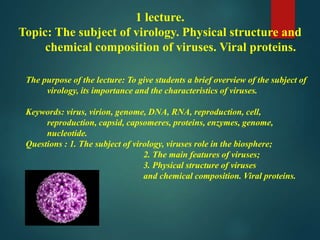
1 lecture.
Topic: The subject of virology. Physical structure and
chemical composition of viruses. Viral proteins.
The purpose of the lecture: To give students a brief overview of the subject of
virology, its importance and the characteristics of viruses.
Keywords: virus, virion, genome, DNA, RNA, reproduction, cell,
reproduction, capsid, capsomeres, proteins, enzymes, genome,
nucleotide.
Questions : 1. The subject of virology, viruses role in the biosphere;
2. The main features of viruses;
3. Physical structure of viruses
and chemical composition. Viral proteins.
 Virology is the scientific study of viruses –
submicroscopic, parasitic organisms of genetic material
contained in a protein coat – and virus-like agents. It focuses
on the following aspects of viruses: their structure,
classification and evolution, their ways to infect and exploit
host cells for reproduction, their interaction with host
organism physiology and immunity, the diseases they cause,
the techniques to isolate and culture them, and their use in
research and therapy.
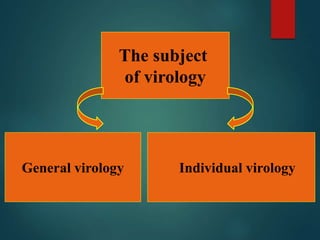
The subject
of virology
General virology Individual virology
GENERAL VIROLOGY studies:
 The nature and origin of viruses
 Principles of construction
 Chemical composition
 Classification
 Genetics of viruses
 Resistance of viruses in the environment
 Mechanisms of virus interaction with cells
 Antiviral immunity
Individual virology:
 Properties of individual representatives of
the kingdom of viruses;
 Features of viral diseases;
 Diagnosis, treatment and prevention of viral
diseases.
HISTORY OF THE DISCOVERY OF THE
WORLD OF VIRUSES
Louis Pasteur and Edward Jenner developed the
first vaccines to protect against viral infections, they did
not know that viruses existed. The first evidence of the
existence of viruses came from experiments with filters
that had pores small enough to retain bacteria. In
1892, Dmitri Ivanovsky used one of these filters to show
that sap from a diseased tobacco plant remained
infectious to healthy tobacco plants despite having
been filtered. Martinus Beijerinck called the filtered,
infectious substance a "virus" and this discovery is
considered to be the beginning of virology.
The subsequent discovery and partial
characterization of bacteriophages by Frederick
Twort and Herelle further catalyzed the field, and by the
early 20th century many viruses had been discovered. In
1926, Thomas Milton Rivers defined viruses as obligate
parasites. Viruses were demonstrated to be particles,
rather than a fluid, by Wendell Meredith Stanley, and the
invention of the electron microscope in 1931 allowed
their complex structures to be visualised.
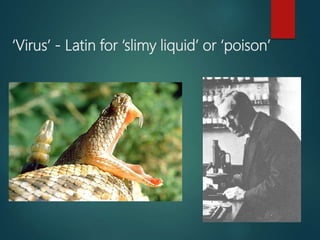
‘Virus’ - Latin for ‘slimy liquid’ or ‘poison’
 Currently, viruses are divided
into 4 groups:
 Plant virus,
 Animal and bird viruses,
 Human virus,
 Bacterial virus (bacteriophage)
Viruses are pathogens that cause infectious
(infectious) diseases of living things around the
world:
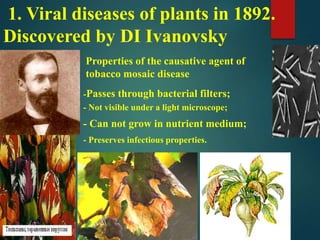
1. Viral diseases of plants in 1892.
Discovered by DI Ivanovsky
Properties of the causative agent of
tobacco mosaic disease
-Passes through bacterial filters;
- Not visible under a light microscope;
- Can not grow in nutrient medium;
- Preserves infectious properties.
2. Viral diseases of animals in
1898. Discovered by Forsh
and Leffler.
3. Viral diseases of humans in 1796. E.
Discovered by Jenner
4. Viral diseases of
bacteria in 1915. Tuort,
1917. and D. Erell
VIRUSES ARE THE THIRD KINGDOM
 Viruses "structure" (substance) (consists of
one type of nucleic acid or DNA or RNA,
without a metabolic process, multiplies in a
"disjunctive" (scattered) form);
 According to the function of viruses,
"substance" (multiplies, has racial,
hereditary, evolving properties)
CLASSIFICATION OF VIRUSES
Criteria for the classification of early viruses:
 Virus Classification
 • Older based on
 - Host, target organ or vector
 • Modern based on
 - Type of viral nucleic acid
 » RNA or DNA
 » Single stranded (SS) or double stranded (DS)
 » Replication strategy
 - Capsid symmety
 » Icosahedral or helical
 - Presence or absence of lipid envelope
 • Governed by International Committee on
 Taxonomy of Viruses
MAIN FEATURES OF VIRUSES:
Even though they can both make us sick, bacteria and viruses are very
different at the biological level. Bacteria are small and single-celled, but they
are living organisms that do not depend on a host cell to reproduce. Because
of these differences, bacterial and viral infections are treated very differently.
For instance, antibiotics are only helpful against bacteria, not viruses.
Bacteria are also much bigger than viruses. The diameter of a typical virus is
about 202020 - 300300300 text{nanometers}nanometers start text, n, a, n,
o, m, e, t, e, r, s, end text (111 text{nm}nmstart text, n, m, end text ==equals
10^text{-9}10 -910, start superscript, start text, negative, 9, end text, end
superscript text{m}mstart text, m, end text)^4
4 start superscript, 4, end superscript. This is considerably smaller than a
typical E. coli bacterium, which has a diameter of roughly 100010001000
text{nm}nmstart text, n, m, end text! Tens of millions of viruses could fit on
the head of a pin.
VIRUSS LIVE AT THE EXPENSE OF
LIVING CELLS (human, animal, plant)
PARASITES AT THE GENETIC LEVEL
The structure of a virus
 Virus Structure
 Viral nucleocapsids come in two basic shapes, although the overall
appearance of a virus can be altered by the presence of an envelope, if
present. Helical viruses have an elongated tube-like structure, with the
capsomers arranged helically around the coiled genome. Icosahedral
viruses have a spherical shape, with icosahedral symmetry consisting of
20 triangular faces. The simplest icosahedral capsid has 3 capsomers
per triangular face, resulting in 60 capsomers for the entire virus. Some
viruses do not neatly fit into either of the two previous categories
because they are so unusual in design or components, so there is a
third category known as complex viruses. Examples include the
poxvirus with a brick-shaped exterior and a complicated internal
structure, as well as bacteriophage with tail fibers attached to an
icosahedral head.
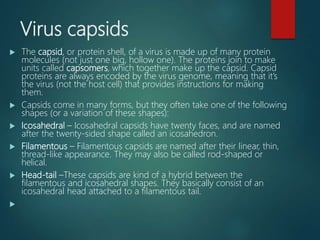
Virus capsids
 The capsid, or protein shell, of a virus is made up of many protein
molecules (not just one big, hollow one). The proteins join to make
units called capsomers, which together make up the capsid. Capsid
proteins are always encoded by the virus genome, meaning that it’s
the virus (not the host cell) that provides instructions for making
them.
 Capsids come in many forms, but they often take one of the following
shapes (or a variation of these shapes):
 Icosahedral – Icosahedral capsids have twenty faces, and are named
after the twenty-sided shape called an icosahedron.
 Filamentous – Filamentous capsids are named after their linear, thin,
thread-like appearance. They may also be called rod-shaped or
helical.
 Head-tail –These capsids are kind of a hybrid between the
filamentous and icosahedral shapes. They basically consist of an
icosahedral head attached to a filamentous tail.

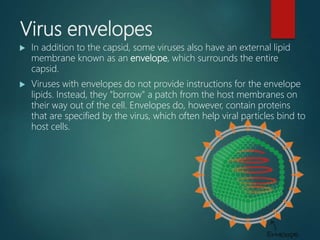
Virus envelopes
 In addition to the capsid, some viruses also have an external lipid
membrane known as an envelope, which surrounds the entire
capsid.
 Viruses with envelopes do not provide instructions for the envelope
lipids. Instead, they "borrow" a patch from the host membranes on
their way out of the cell. Envelopes do, however, contain proteins
that are specified by the virus, which often help viral particles bind to
host cells.
Virus genomes
 All viruses have genetic material (a genome) made of nucleic acid.
You, like all other cell-based life, use DNA as your genetic material.
Viruses, on the other hand, may use either RNA or DNA, both of
which are types of nucleic acid.
 We often think of DNA as double-stranded and RNA as single-
stranded, since that's typically the case in our own cells. However,
viruses can have all possible combos of strandedness and nucleic acid
type (double-stranded DNA, double-stranded RNA, single-stranded
DNA, or single-stranded RNA). Viral genomes also come in various
shapes, sizes, and varieties, though they are generally much smaller
than the genomes of cellular organisms. Notably, DNA and RNA
viruses always use the same genetic code as living cells. If they didn't,
they would have no way to reprogram their host cells!
 Chemical composition of viruses
 Viruses consist of 50-90% protein. The number of
virus proteins in the animal kingdom varies. For
example, calciviruses consist of 1 protein,
herpesviruses and poxviruses consist of 20 to 30
structural proteins.
 Structural proteins of viruses, like animal and plant
proteins, contain 20 amino acids, including 12
essential and 8 essential amino acids.
•Proteins
Structured
•Proteins
Unstructured
Viral proteins are divided into two
groups
Өзекше
белогі
Капсид белогі
Мембрана
белогі
Суперкапсид
белогі
Пепломерлер
белогі
Құрылымды белоктар
Unstructured proteins
Enzymatic
proteins
RNA polymerase
(reverse
transcriptase)
DNA
polymerase
Textbooks, manuals
Thank you !!!
2 Lecture.
Topic: Physical structure and chemical
composition of the virus. The chemical
composition of the nucleic acid of the virus

1 lecture virology 2021

  • 1.
    1 lecture. Topic: Thesubject of virology. Physical structure and chemical composition of viruses. Viral proteins. The purpose of the lecture: To give students a brief overview of the subject of virology, its importance and the characteristics of viruses. Keywords: virus, virion, genome, DNA, RNA, reproduction, cell, reproduction, capsid, capsomeres, proteins, enzymes, genome, nucleotide. Questions : 1. The subject of virology, viruses role in the biosphere; 2. The main features of viruses; 3. Physical structure of viruses and chemical composition. Viral proteins.
  • 2.
     Virology isthe scientific study of viruses – submicroscopic, parasitic organisms of genetic material contained in a protein coat – and virus-like agents. It focuses on the following aspects of viruses: their structure, classification and evolution, their ways to infect and exploit host cells for reproduction, their interaction with host organism physiology and immunity, the diseases they cause, the techniques to isolate and culture them, and their use in research and therapy.
  • 3.
    The subject of virology Generalvirology Individual virology
  • 4.
    GENERAL VIROLOGY studies: The nature and origin of viruses  Principles of construction  Chemical composition  Classification  Genetics of viruses  Resistance of viruses in the environment  Mechanisms of virus interaction with cells  Antiviral immunity
  • 5.
    Individual virology:  Propertiesof individual representatives of the kingdom of viruses;  Features of viral diseases;  Diagnosis, treatment and prevention of viral diseases.
  • 6.
    HISTORY OF THEDISCOVERY OF THE WORLD OF VIRUSES Louis Pasteur and Edward Jenner developed the first vaccines to protect against viral infections, they did not know that viruses existed. The first evidence of the existence of viruses came from experiments with filters that had pores small enough to retain bacteria. In 1892, Dmitri Ivanovsky used one of these filters to show that sap from a diseased tobacco plant remained infectious to healthy tobacco plants despite having been filtered. Martinus Beijerinck called the filtered, infectious substance a "virus" and this discovery is considered to be the beginning of virology. The subsequent discovery and partial characterization of bacteriophages by Frederick Twort and Herelle further catalyzed the field, and by the early 20th century many viruses had been discovered. In 1926, Thomas Milton Rivers defined viruses as obligate parasites. Viruses were demonstrated to be particles, rather than a fluid, by Wendell Meredith Stanley, and the invention of the electron microscope in 1931 allowed their complex structures to be visualised.
  • 7.
    ‘Virus’ - Latinfor ‘slimy liquid’ or ‘poison’
  • 8.
     Currently, virusesare divided into 4 groups:  Plant virus,  Animal and bird viruses,  Human virus,  Bacterial virus (bacteriophage) Viruses are pathogens that cause infectious (infectious) diseases of living things around the world:
  • 9.
    1. Viral diseasesof plants in 1892. Discovered by DI Ivanovsky Properties of the causative agent of tobacco mosaic disease -Passes through bacterial filters; - Not visible under a light microscope; - Can not grow in nutrient medium; - Preserves infectious properties.
  • 10.
    2. Viral diseasesof animals in 1898. Discovered by Forsh and Leffler.
  • 11.
    3. Viral diseasesof humans in 1796. E. Discovered by Jenner
  • 12.
    4. Viral diseasesof bacteria in 1915. Tuort, 1917. and D. Erell
  • 13.
    VIRUSES ARE THETHIRD KINGDOM  Viruses "structure" (substance) (consists of one type of nucleic acid or DNA or RNA, without a metabolic process, multiplies in a "disjunctive" (scattered) form);  According to the function of viruses, "substance" (multiplies, has racial, hereditary, evolving properties)
  • 14.
    CLASSIFICATION OF VIRUSES Criteriafor the classification of early viruses:  Virus Classification  • Older based on  - Host, target organ or vector  • Modern based on  - Type of viral nucleic acid  » RNA or DNA  » Single stranded (SS) or double stranded (DS)  » Replication strategy  - Capsid symmety  » Icosahedral or helical  - Presence or absence of lipid envelope  • Governed by International Committee on  Taxonomy of Viruses
  • 15.
    MAIN FEATURES OFVIRUSES: Even though they can both make us sick, bacteria and viruses are very different at the biological level. Bacteria are small and single-celled, but they are living organisms that do not depend on a host cell to reproduce. Because of these differences, bacterial and viral infections are treated very differently. For instance, antibiotics are only helpful against bacteria, not viruses. Bacteria are also much bigger than viruses. The diameter of a typical virus is about 202020 - 300300300 text{nanometers}nanometers start text, n, a, n, o, m, e, t, e, r, s, end text (111 text{nm}nmstart text, n, m, end text ==equals 10^text{-9}10 -910, start superscript, start text, negative, 9, end text, end superscript text{m}mstart text, m, end text)^4 4 start superscript, 4, end superscript. This is considerably smaller than a typical E. coli bacterium, which has a diameter of roughly 100010001000 text{nm}nmstart text, n, m, end text! Tens of millions of viruses could fit on the head of a pin.
  • 16.
    VIRUSS LIVE ATTHE EXPENSE OF LIVING CELLS (human, animal, plant) PARASITES AT THE GENETIC LEVEL
  • 17.
    The structure ofa virus  Virus Structure  Viral nucleocapsids come in two basic shapes, although the overall appearance of a virus can be altered by the presence of an envelope, if present. Helical viruses have an elongated tube-like structure, with the capsomers arranged helically around the coiled genome. Icosahedral viruses have a spherical shape, with icosahedral symmetry consisting of 20 triangular faces. The simplest icosahedral capsid has 3 capsomers per triangular face, resulting in 60 capsomers for the entire virus. Some viruses do not neatly fit into either of the two previous categories because they are so unusual in design or components, so there is a third category known as complex viruses. Examples include the poxvirus with a brick-shaped exterior and a complicated internal structure, as well as bacteriophage with tail fibers attached to an icosahedral head.
  • 19.
    Virus capsids  Thecapsid, or protein shell, of a virus is made up of many protein molecules (not just one big, hollow one). The proteins join to make units called capsomers, which together make up the capsid. Capsid proteins are always encoded by the virus genome, meaning that it’s the virus (not the host cell) that provides instructions for making them.  Capsids come in many forms, but they often take one of the following shapes (or a variation of these shapes):  Icosahedral – Icosahedral capsids have twenty faces, and are named after the twenty-sided shape called an icosahedron.  Filamentous – Filamentous capsids are named after their linear, thin, thread-like appearance. They may also be called rod-shaped or helical.  Head-tail –These capsids are kind of a hybrid between the filamentous and icosahedral shapes. They basically consist of an icosahedral head attached to a filamentous tail. 
  • 21.
    Virus envelopes  Inaddition to the capsid, some viruses also have an external lipid membrane known as an envelope, which surrounds the entire capsid.  Viruses with envelopes do not provide instructions for the envelope lipids. Instead, they "borrow" a patch from the host membranes on their way out of the cell. Envelopes do, however, contain proteins that are specified by the virus, which often help viral particles bind to host cells.
  • 22.
    Virus genomes  Allviruses have genetic material (a genome) made of nucleic acid. You, like all other cell-based life, use DNA as your genetic material. Viruses, on the other hand, may use either RNA or DNA, both of which are types of nucleic acid.  We often think of DNA as double-stranded and RNA as single- stranded, since that's typically the case in our own cells. However, viruses can have all possible combos of strandedness and nucleic acid type (double-stranded DNA, double-stranded RNA, single-stranded DNA, or single-stranded RNA). Viral genomes also come in various shapes, sizes, and varieties, though they are generally much smaller than the genomes of cellular organisms. Notably, DNA and RNA viruses always use the same genetic code as living cells. If they didn't, they would have no way to reprogram their host cells!
  • 23.
     Chemical compositionof viruses  Viruses consist of 50-90% protein. The number of virus proteins in the animal kingdom varies. For example, calciviruses consist of 1 protein, herpesviruses and poxviruses consist of 20 to 30 structural proteins.  Structural proteins of viruses, like animal and plant proteins, contain 20 amino acids, including 12 essential and 8 essential amino acids.
  • 24.
  • 25.
  • 26.
  • 27.
  • 28.
    Thank you !!! 2Lecture. Topic: Physical structure and chemical composition of the virus. The chemical composition of the nucleic acid of the virus