Dr.Riyaz Sheriff M.D ….
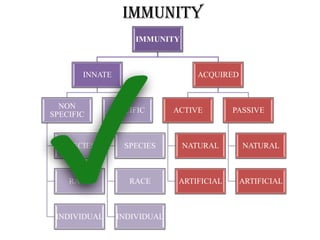
IMMUNITY
IMMUNITY
INNATE
NON
SPECIFIC
SPECIES
RACE
INDIVIDUAL
SPECIFIC
SPECIES
RACE
INDIVIDUAL
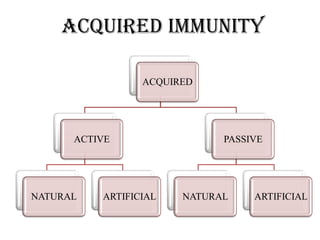
ACQUIRED
ACTIVE
NATURAL
ARTIFICIAL
PASSIVE
NATURAL
ARTIFICIAL
ACQUIRED IMMUNITY
• Immunity which a person acquired during his
lifetime
• Not related to innate immunity
Acquired IMMUNITY
ACQUIRED
ACTIVE
NATURAL ARTIFICIAL
PASSIVE
NATURAL ARTIFICIAL
Acquired active
IMMUNITY
ACQUIRED
ACTIVE
NATURAL ARTIFICIAL
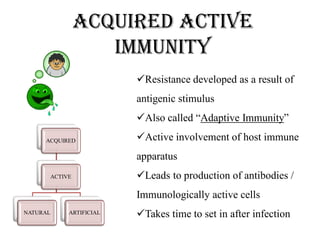
Resistance developed as a result of
antigenic stimulus
Also called “Adaptive Immunity”
Active involvement of host immune
apparatus
Leads to production of antibodies /
Immunologically active cells
Takes time to set in after infection
Acquired active
IMMUNITY
ACQUIRED
ACTIVE
NATURAL ARTIFICIAL
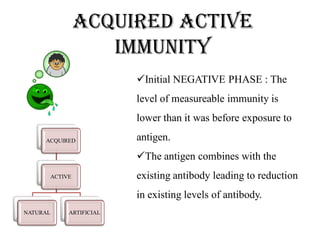
Initial NEGATIVE PHASE : The
level of measureable immunity is
lower than it was before exposure to
antigen.
The antigen combines with the
existing antibody leading to reduction
in existing levels of antibody.
Acquired active IMMUNITY
ACQUIRED
ACTIVE
NATURAL ARTIFICIAL
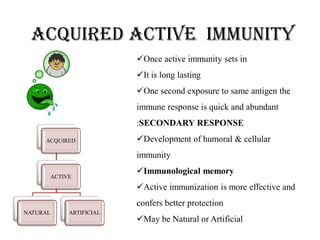
Once active immunity sets in
It is long lasting
One second exposure to same antigen the
immune response is quick and abundant
:SECONDARY RESPONSE
Development of humoral & cellular
immunity
Immunological memory
Active immunization is more effective and
confers better protection
May be Natural or Artificial
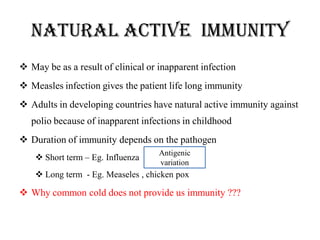
Natural active IMMUNITY
 May be as a result of clinical or inapparent infection
 Measles infection gives the patient life long immunity
 Adults in developing countries have natural active immunity against
polio because of inapparent infections in childhood
 Duration of immunity depends on the pathogen
 Short term – Eg. Influenza
 Long term - Eg. Measeles , chicken pox
 Why common cold does not provide us immunity ???
Antigenic
variation
natural active IMMUNITY
 Bacterial infections provide with less degree of
immunity
 PREMUNITION – Seen in syphilis . The immunity to
reinfections lasts only till the original infection is
active.
 Chancroid does not provide the person with any
immunity . Person may develop lesions following
reinfection even when original infection is active.
Artificial active immunity
• Resistance induced by vaccines
• Vaccines are preparations of live or killed
microorganisms or their products used for
immunization
• Bacterial vaccines
– Live : BCG vaccine
– Killed: Cholera vaccine
– Subunit : Typhoid Vi antigen
– Bacterial products: Tetanus toxoid
• Viral vaccines
– Live : OPV-Sabin
– Killed : IPV – Salk
– Subunit : Hepatitis B Vaccine
Vaccines
LIVE VACCINES
• Infection without disease
• Immunity lasts for several
years
• Booster doses MAY BE
needed
• Can be given orally or
parenterally
KILLED VACCINES
• No infective stage
• Less immunogenic
• Repeated doses needed
– Primary dose
– Booster dose
• Oral doses not effective
• Parenteral doses given with
adjuvant to increase
humoral immunity
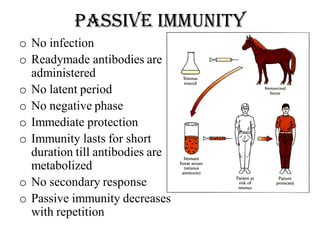
Passive immunity
o No infection
o Readymade antibodies are
administered
o No latent period
o No negative phase
o Immediate protection
o Immunity lasts for short
duration till antibodies are
metabolized
o No secondary response
o Passive immunity decreases
with repetition
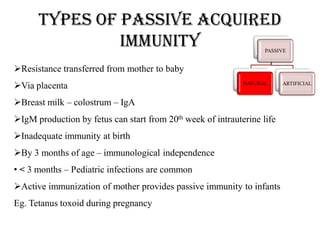
Types of passive acquired
immunity PASSIVE
NATURAL ARTIFICIAL
Resistance transferred from mother to baby
Via placenta
Breast milk – colostrum – IgA
IgM production by fetus can start from 20th week of intrauterine life
Inadequate immunity at birth
By 3 months of age – immunological independence
• < 3 months – Pediatric infections are common
Active immunization of mother provides passive immunity to infants
Eg. Tetanus toxoid during pregnancy
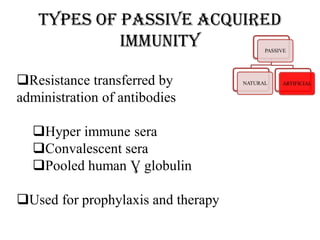
Types of passive acquired
immunity PASSIVE
NATURAL ARTIFICIALResistance transferred by
administration of antibodies
Hyper immune sera
Convalescent sera
Pooled human Ɣ globulin
Used for prophylaxis and therapy
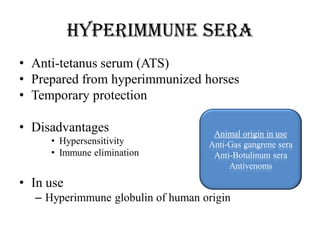
Hyperimmune sera
• Anti-tetanus serum (ATS)
• Prepared from hyperimmunized horses
• Temporary protection
• Disadvantages
• Hypersensitivity
• Immune elimination
• In use
– Hyperimmune globulin of human origin
Animal origin in use
Anti-Gas gangrene sera
Anti-Botulinum sera
Antivenoms
Convalescent sera
• Sera of patients recovering from disease
• Contain high levels of antibody specific to the disease
• Use – Viral infections like Hepatitis A
Pooled human Ɣ globulin
• Ɣ globulin from pooled sera of healthy adults
• Has antibodies to all pathogens prevalent in the area
• Use – Rx of patients with immunodeficiencies
Indications for passive
immunization
• Immediate and temporary protection of a
person at risk of developing infection
• To arrest overactive active immunity
Eg. Rh incompatibility
Combined immunization
• Combination of active and passive methods
• Passive immunization for immediate
protection
• Tetanus
• TIG in one arm + TT in other arm
• Followed by complete schedule of tetanus
vaccination
Adoptive immunity
• Special type of immunization
• Injection of immunologically competent
lymphocytes  TRANSFER FACTOR
• Tried in treatment of Lepromatous Leprosy
Local immunity
• Besredka
• Treatment of infections in a localized area
• Polio –
– Systemic immunity by IPV
• Does not prevent multiplication of virus in the gut
– This is achieved by OPV
• Influenza
– Killed vaccine brings about a humoral response
• Not enough to prevent infection
• Intra nasal live virus injection/ natural infection provides
local immunity
– IgA
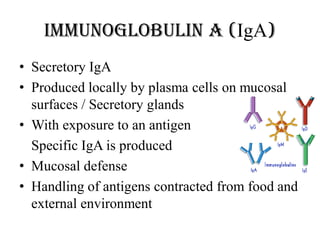
Immunoglobulin A (IgA)
• Secretory IgA
• Produced locally by plasma cells on mucosal
surfaces / Secretory glands
• With exposure to an antigen
Specific IgA is produced
• Mucosal defense
• Handling of antigens contracted from food and
external environment
Herd immunity
 Overall immunity in a community
 Useful in control of epidemics
• When LARGE NUMBER of people in a community are
immune to a specific pathogen Herd immunity is
SATISFACTORY
• Eradication of communicable disease lies in development of
good herd immunity rather than developing individual
immunity
Measurement of immunity
• Practically not possible to measure accurately
• Simple method is to demonstrate the presence of a
specific antibody
– Not reliable as one pathogen will illicit immune response to
multiple antigens
• Antibody demonstration
– Agglutination
– Precipitation
– Complement fixation
– Hemagglutination inhibition
– Neutralization
– ELISA
• If antigenic component is identified in-vitro or
in-vivo assays can be done.
• If immunity is associated with cell mediated
immunity
– Skin tests for delayed hypersensitivity
– In-vitro tests for Cell mediated immunity
Measurement of immunity
Acquired immunity

Acquired immunity

  • 1.
  • 2.
  • 3.
    ACQUIRED IMMUNITY • Immunitywhich a person acquired during his lifetime • Not related to innate immunity
  • 4.
  • 5.
    Acquired active IMMUNITY ACQUIRED ACTIVE NATURAL ARTIFICIAL Resistancedeveloped as a result of antigenic stimulus Also called “Adaptive Immunity” Active involvement of host immune apparatus Leads to production of antibodies / Immunologically active cells Takes time to set in after infection
  • 6.
    Acquired active IMMUNITY ACQUIRED ACTIVE NATURAL ARTIFICIAL InitialNEGATIVE PHASE : The level of measureable immunity is lower than it was before exposure to antigen. The antigen combines with the existing antibody leading to reduction in existing levels of antibody.
  • 7.
    Acquired active IMMUNITY ACQUIRED ACTIVE NATURALARTIFICIAL Once active immunity sets in It is long lasting One second exposure to same antigen the immune response is quick and abundant :SECONDARY RESPONSE Development of humoral & cellular immunity Immunological memory Active immunization is more effective and confers better protection May be Natural or Artificial
  • 8.
    Natural active IMMUNITY May be as a result of clinical or inapparent infection  Measles infection gives the patient life long immunity  Adults in developing countries have natural active immunity against polio because of inapparent infections in childhood  Duration of immunity depends on the pathogen  Short term – Eg. Influenza  Long term - Eg. Measeles , chicken pox  Why common cold does not provide us immunity ??? Antigenic variation
  • 9.
    natural active IMMUNITY Bacterial infections provide with less degree of immunity  PREMUNITION – Seen in syphilis . The immunity to reinfections lasts only till the original infection is active.  Chancroid does not provide the person with any immunity . Person may develop lesions following reinfection even when original infection is active.
  • 10.
    Artificial active immunity •Resistance induced by vaccines • Vaccines are preparations of live or killed microorganisms or their products used for immunization • Bacterial vaccines – Live : BCG vaccine – Killed: Cholera vaccine – Subunit : Typhoid Vi antigen – Bacterial products: Tetanus toxoid • Viral vaccines – Live : OPV-Sabin – Killed : IPV – Salk – Subunit : Hepatitis B Vaccine
  • 11.
    Vaccines LIVE VACCINES • Infectionwithout disease • Immunity lasts for several years • Booster doses MAY BE needed • Can be given orally or parenterally KILLED VACCINES • No infective stage • Less immunogenic • Repeated doses needed – Primary dose – Booster dose • Oral doses not effective • Parenteral doses given with adjuvant to increase humoral immunity
  • 12.
    Passive immunity o Noinfection o Readymade antibodies are administered o No latent period o No negative phase o Immediate protection o Immunity lasts for short duration till antibodies are metabolized o No secondary response o Passive immunity decreases with repetition
  • 13.
    Types of passiveacquired immunity PASSIVE NATURAL ARTIFICIAL Resistance transferred from mother to baby Via placenta Breast milk – colostrum – IgA IgM production by fetus can start from 20th week of intrauterine life Inadequate immunity at birth By 3 months of age – immunological independence • < 3 months – Pediatric infections are common Active immunization of mother provides passive immunity to infants Eg. Tetanus toxoid during pregnancy
  • 14.
    Types of passiveacquired immunity PASSIVE NATURAL ARTIFICIALResistance transferred by administration of antibodies Hyper immune sera Convalescent sera Pooled human Ɣ globulin Used for prophylaxis and therapy
  • 15.
    Hyperimmune sera • Anti-tetanusserum (ATS) • Prepared from hyperimmunized horses • Temporary protection • Disadvantages • Hypersensitivity • Immune elimination • In use – Hyperimmune globulin of human origin Animal origin in use Anti-Gas gangrene sera Anti-Botulinum sera Antivenoms
  • 16.
    Convalescent sera • Seraof patients recovering from disease • Contain high levels of antibody specific to the disease • Use – Viral infections like Hepatitis A Pooled human Ɣ globulin • Ɣ globulin from pooled sera of healthy adults • Has antibodies to all pathogens prevalent in the area • Use – Rx of patients with immunodeficiencies
  • 17.
    Indications for passive immunization •Immediate and temporary protection of a person at risk of developing infection • To arrest overactive active immunity Eg. Rh incompatibility
  • 18.
    Combined immunization • Combinationof active and passive methods • Passive immunization for immediate protection • Tetanus • TIG in one arm + TT in other arm • Followed by complete schedule of tetanus vaccination
  • 19.
    Adoptive immunity • Specialtype of immunization • Injection of immunologically competent lymphocytes  TRANSFER FACTOR • Tried in treatment of Lepromatous Leprosy
  • 20.
    Local immunity • Besredka •Treatment of infections in a localized area • Polio – – Systemic immunity by IPV • Does not prevent multiplication of virus in the gut – This is achieved by OPV • Influenza – Killed vaccine brings about a humoral response • Not enough to prevent infection • Intra nasal live virus injection/ natural infection provides local immunity – IgA
  • 21.
    Immunoglobulin A (IgA) •Secretory IgA • Produced locally by plasma cells on mucosal surfaces / Secretory glands • With exposure to an antigen Specific IgA is produced • Mucosal defense • Handling of antigens contracted from food and external environment
  • 22.
    Herd immunity  Overallimmunity in a community  Useful in control of epidemics • When LARGE NUMBER of people in a community are immune to a specific pathogen Herd immunity is SATISFACTORY • Eradication of communicable disease lies in development of good herd immunity rather than developing individual immunity
  • 23.
    Measurement of immunity •Practically not possible to measure accurately • Simple method is to demonstrate the presence of a specific antibody – Not reliable as one pathogen will illicit immune response to multiple antigens • Antibody demonstration – Agglutination – Precipitation – Complement fixation – Hemagglutination inhibition – Neutralization – ELISA
  • 24.
    • If antigeniccomponent is identified in-vitro or in-vivo assays can be done. • If immunity is associated with cell mediated immunity – Skin tests for delayed hypersensitivity – In-vitro tests for Cell mediated immunity Measurement of immunity