SEROLOGICAL
DIAGNOSIS OF VIRAL
INFECTIONS:
POSSIBILITIES OF
SEROLOGICAL DIAGNOSIS
TYPES OF SEROLOGICAL
REACTIONS
Presentation on
Presented By
Sulove Kumar Ghosh
Student ID: MS-190807
Plant Pathology
Agrotechnology Discipline
Khulna University
Introduction
Serological methods are diagnostic methods
that are used to identify antibodies and
antigens in patients sample which is serum and
plasma.
A serological diagnosis is prepared by
detecting the rising titres of antibody or
antigens
By serological methods most of the common
viral infections are diagonized.
Historical Development
1798 - First demonstration of vaccination smallpox
vaccination (Edward Jenner)
1890 - Demonstration of antibody activity against
diphtheria and tetanus toxins.
1900 - Antibody formation theory (Paul Ehrlich)
1938 - Antigen-Antibody binding hypothesis (John
Marrack)
1948 - antibody production in plasma B cells
Historical Development
1959 -1962 - Discovery of antibody structure
Enzyme Linked ImmunoSorbent Assay {ELISA}
1971 - Peter Perlmann and Eva Engvall at
Stockholm University invented ELISA
1975 - Generation of the first monoclonal
antibodies (George Kohler and Cesar Milstein)
1978- Used ELISA for plant virus identification
1985- Identification of immunoglobulin gens
SEROLOGICAL REACTIONSSEROLOGICAL REACTIONS
Ag-Ab reactions used for the detection
of unknown Ag or Ab, in vitro
In virology:
Viral (direct) diagnosis:
- detection of viral antigens
Serological (indirect) diagnosis:
- detection of specific antiviral antibodies
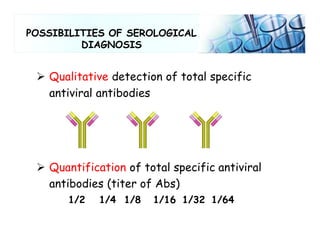
 Qualitative detection of total specific
antiviral antibodies
 Quantification of total specific antiviral
antibodies (titer of Abs)
1/2 1/4 1/8 1/16 1/32 1/64
POSSIBILITIES OF SEROLOGICAL
DIAGNOSIS
POSSIBILITIES OF SEROLOGICAL
DIAGNOSIS
Detection of Ab classes (qualitative and
quantitative)
POSSIBILITIES OF SEROLOGICAL
DIAGNOSIS
POSSIBILITIES OF SEROLOGICAL
DIAGNOSIS
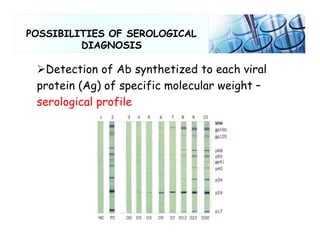
Detection of Ab synthetized to each viral
protein (Ag) of specific molecular weight –
serological profile
POSSIBILITIES OF SEROLOGICAL
DIAGNOSIS
POSSIBILITIES OF SEROLOGICAL
DIAGNOSIS
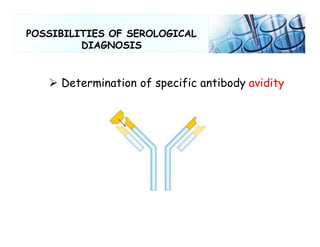
 Determination of specific antibody avidity
POSSIBILITIES OF SEROLOGICAL
DIAGNOSIS
POSSIBILITIES OF SEROLOGICAL
DIAGNOSIS
ClassicalModern
Types of serological reactionsTypes of serological reactions
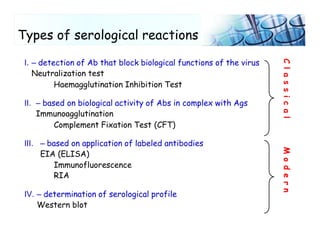
I. – detection of Ab that block biological functions of the virus
Neutralization test
Haemagglutination Inhibition Test
II. – based on biological activity of Abs in complex with Ags
Immunoagglutination
Complement Fixation Test (CFT)
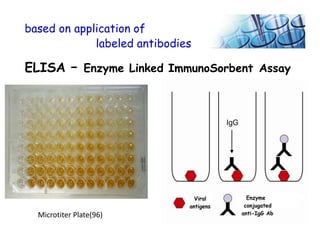
III. – based on application of labeled antibodies
EIA (ELISA)
Immunofluorescence
RIA
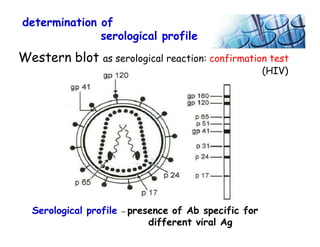
IV. – determination of serological profile
Western blot
based on application of
labeled antibodies
ELISA – Enzyme Linked ImmunoSorbent Assay
Microtiter Plate(96)
Different types of ELISA
ELISA
Advantages of ELISA
Reagents are relatively cheap & have a long
shelf life
ELISA is highly specific and sensitive
No radiation hazards occur during labelling or
disposal of waste.
Easy to perform and quick procedures
Equipment can be inexpensive and widely
available.
ELISA can be used to a variety of infections.
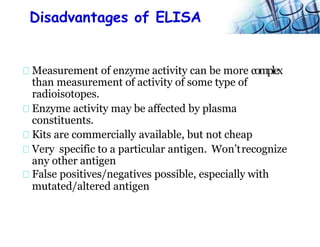
Disadvantages of ELISA
Measurement of enzyme activity can be more complex
than measurement of activity of some type of
radioisotopes.
Enzyme activity may be affected by plasma
constituents.
Kits are commercially available, but not cheap
Very specific to a particular antigen. Won’trecognize
any other antigen
False positives/negatives possible, especially with
mutated/altered antigen
Limitations
•Results may not be absolute
•Antibody must be available
•Concentration may be unclear
determination of
serological profile
Western blot as serological reaction: confirmation test
(HIV)
Serological profile – presence of Ab specific for
different viral Ag
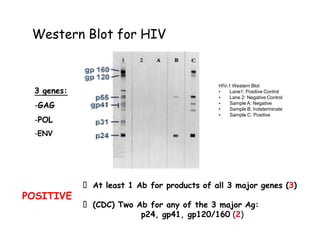
Western Blot for HIV
HIV-1 Western Blot
• Lane1: Positive Control
• Lane 2: Negative Control
• Sample A: Negative
• Sample B: Indeterminate
• Sample C: Positive
At least 1 Ab for products of all 3 major genes (3)
(CDC) Two Ab for any of the 3 major Ag:
p24, gp41, gp120/160 (2)
3 genes:
-GAG
-POL
-ENV
POSITIVE
THANKS TO ALL

Serological test for virus identification

  • 1.
    SEROLOGICAL DIAGNOSIS OF VIRAL INFECTIONS: POSSIBILITIESOF SEROLOGICAL DIAGNOSIS TYPES OF SEROLOGICAL REACTIONS Presentation on
  • 2.
    Presented By Sulove KumarGhosh Student ID: MS-190807 Plant Pathology Agrotechnology Discipline Khulna University
  • 3.
    Introduction Serological methods arediagnostic methods that are used to identify antibodies and antigens in patients sample which is serum and plasma. A serological diagnosis is prepared by detecting the rising titres of antibody or antigens By serological methods most of the common viral infections are diagonized.
  • 4.
    Historical Development 1798 -First demonstration of vaccination smallpox vaccination (Edward Jenner) 1890 - Demonstration of antibody activity against diphtheria and tetanus toxins. 1900 - Antibody formation theory (Paul Ehrlich) 1938 - Antigen-Antibody binding hypothesis (John Marrack) 1948 - antibody production in plasma B cells
  • 5.
    Historical Development 1959 -1962- Discovery of antibody structure Enzyme Linked ImmunoSorbent Assay {ELISA} 1971 - Peter Perlmann and Eva Engvall at Stockholm University invented ELISA 1975 - Generation of the first monoclonal antibodies (George Kohler and Cesar Milstein) 1978- Used ELISA for plant virus identification 1985- Identification of immunoglobulin gens
  • 6.
    SEROLOGICAL REACTIONSSEROLOGICAL REACTIONS Ag-Abreactions used for the detection of unknown Ag or Ab, in vitro In virology: Viral (direct) diagnosis: - detection of viral antigens Serological (indirect) diagnosis: - detection of specific antiviral antibodies
  • 7.
     Qualitative detectionof total specific antiviral antibodies  Quantification of total specific antiviral antibodies (titer of Abs) 1/2 1/4 1/8 1/16 1/32 1/64 POSSIBILITIES OF SEROLOGICAL DIAGNOSIS POSSIBILITIES OF SEROLOGICAL DIAGNOSIS
  • 8.
    Detection of Abclasses (qualitative and quantitative) POSSIBILITIES OF SEROLOGICAL DIAGNOSIS POSSIBILITIES OF SEROLOGICAL DIAGNOSIS
  • 9.
    Detection of Absynthetized to each viral protein (Ag) of specific molecular weight – serological profile POSSIBILITIES OF SEROLOGICAL DIAGNOSIS POSSIBILITIES OF SEROLOGICAL DIAGNOSIS
  • 10.
     Determination ofspecific antibody avidity POSSIBILITIES OF SEROLOGICAL DIAGNOSIS POSSIBILITIES OF SEROLOGICAL DIAGNOSIS
  • 11.
    ClassicalModern Types of serologicalreactionsTypes of serological reactions I. – detection of Ab that block biological functions of the virus Neutralization test Haemagglutination Inhibition Test II. – based on biological activity of Abs in complex with Ags Immunoagglutination Complement Fixation Test (CFT) III. – based on application of labeled antibodies EIA (ELISA) Immunofluorescence RIA IV. – determination of serological profile Western blot
  • 12.
    based on applicationof labeled antibodies ELISA – Enzyme Linked ImmunoSorbent Assay Microtiter Plate(96)
  • 13.
  • 14.
  • 15.
    Advantages of ELISA Reagentsare relatively cheap & have a long shelf life ELISA is highly specific and sensitive No radiation hazards occur during labelling or disposal of waste. Easy to perform and quick procedures Equipment can be inexpensive and widely available. ELISA can be used to a variety of infections.
  • 16.
    Disadvantages of ELISA Measurementof enzyme activity can be more complex than measurement of activity of some type of radioisotopes. Enzyme activity may be affected by plasma constituents. Kits are commercially available, but not cheap Very specific to a particular antigen. Won’trecognize any other antigen False positives/negatives possible, especially with mutated/altered antigen
  • 17.
    Limitations •Results may notbe absolute •Antibody must be available •Concentration may be unclear
  • 18.
    determination of serological profile Westernblot as serological reaction: confirmation test (HIV) Serological profile – presence of Ab specific for different viral Ag
  • 19.
    Western Blot forHIV HIV-1 Western Blot • Lane1: Positive Control • Lane 2: Negative Control • Sample A: Negative • Sample B: Indeterminate • Sample C: Positive At least 1 Ab for products of all 3 major genes (3) (CDC) Two Ab for any of the 3 major Ag: p24, gp41, gp120/160 (2) 3 genes: -GAG -POL -ENV POSITIVE
  • 20.