Viruses – Morphology & Classification
Prepared By : Ratnaparkhi Sanket Sanjay
S.Y.B.Pharm
Guided By : Mrs. S.D.Raysing Ma’am
Introduction to Viruses
• What are Viruses ?
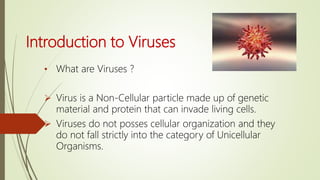
 Virus is a Non-Cellular particle made up of genetic
material and protein that can invade living cells.
 Viruses do not posses cellular organization and they
do not fall strictly into the category of Unicellular
Organisms.
Discovery of Viruses
• Dimitri Iwanowski :
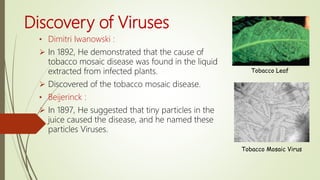
 In 1892, He demonstrated that the cause of
tobacco mosaic disease was found in the liquid
extracted from infected plants.
 Discovered of the tobacco mosaic disease.
• Beijerinck :
 In 1897, He suggested that tiny particles in the
juice caused the disease, and he named these
particles Viruses.
Tobacco Leaf
Tobacco Mosaic Virus
• Wendell Stanley
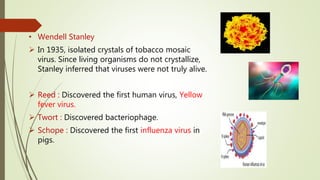
 In 1935, isolated crystals of tobacco mosaic
virus. Since living organisms do not crystallize,
Stanley inferred that viruses were not truly alive.
 Reed : Discovered the first human virus, Yellow
fever virus.
 Twort : Discovered bacteriophage.
 Schope : Discovered the first influenza virus in
pigs.
Properties of Viruses
• They do not have cellular organization.
• They contain only one type of nucleic acid either DNA or
RNA But never both.
• They are obligate intracellular parasites.
• They lack enzymes for protein synthesis.
• They multiply by complex process but not by binary
fission.
• They are unaffected by antibacterial antibiotics.
Morphology of Viruses
 Viruses are acellular that means they do not have cells as it has no nucleus,
cytoplasm or any organelles.
 They need living host to survive.
 Smallest infectious virus is 20 nm (Parvovirus) to 300 nm (Poxvirus).
 They may be single or double stranded.
 The nucleic acid is linear or circular and either segmented or non-
segmented.
 Viruses spread in many ways. Just as many viruses are very specific as to
which host species or tissue they attack.
 Plant viruses are often spread from plant to plant by insects and other
organisms, known as vectors.
 Viruses such as influenza are spread through the air by droplets of moisture
when people cough or sneeze.
 Antibiotics have no effect on viruses, but antiviral drugs have been developed to
treat life threatening infections.
 Dengue virus, are spread by blood-sucking insects.
 Rotavirus is often spread by direct contact with infected children.
 Vaccines that produce lifelong immunity can prevent some viral infections.
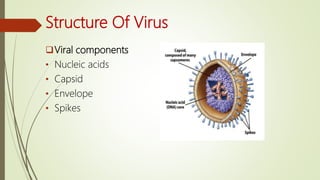
Structure Of Virus
Viral components
• Nucleic acids
• Capsid
• Envelope
• Spikes
Viral Nucleic Acid
 Viruses contain a single kind of nucleic acid either DNA or RNA
which encodes the genetic information necessary for replication
of the virus.
 The genome may be single stranded or double stranded, circular
or linear, segmented or non-segmented.
 According to nucleic acid present, viruses can be classified as –
o DNA viruses
o RNA viruses
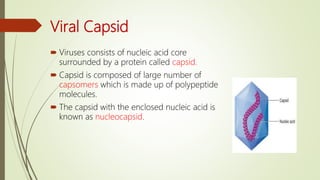
Viral Capsid
 Viruses consists of nucleic acid core
surrounded by a protein called capsid.
 Capsid is composed of large number of
capsomers which is made up of polypeptide
molecules.
 The capsid with the enclosed nucleic acid is
known as nucleocapsid.
 It serves as antigenic determinants.
 It induces antibody production.
 It provides the structural symmetry of the virus.
 It facilitates the assembly and packaging of viral genetic information.
 It serves as a vehicle of transmission from host to another.
 It protects the genetic materials.
Functions of Viral Capsid
• SPIKES - Carbohydrate-protein complexes (glycoproteins) that project
from the envelope.
 Can be used to attach to host cell.
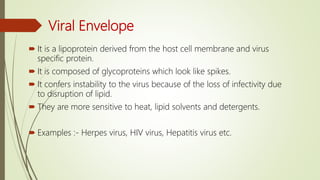
Viral Envelope
 It is a lipoprotein derived from the host cell membrane and virus
specific protein.
 It is composed of glycoproteins which look like spikes.
 It confers instability to the virus because of the loss of infectivity due
to disruption of lipid.
 They are more sensitive to heat, lipid solvents and detergents.
 Examples :- Herpes virus, HIV virus, Hepatitis virus etc.
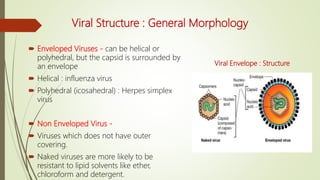
Viral Structure : General Morphology
 Enveloped Viruses - can be helical or
polyhedral, but the capsid is surrounded by
an envelope
 Helical : influenza virus
 Polyhedral (icosahedral) : Herpes simplex
virus
 Non Enveloped Virus -
 Viruses which does not have outer
covering.
 Naked viruses are more likely to be
resistant to lipid solvents like ether,
chloroform and detergent.
Viral Envelope : Structure
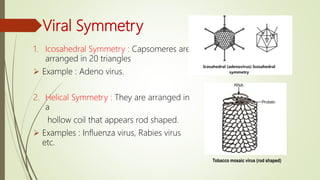
Viral Symmetry
1. Icosahedral Symmetry : Capsomeres are
arranged in 20 triangles
 Example : Adeno virus.
2. Helical Symmetry : They are arranged in
a
hollow coil that appears rod shaped.
 Examples : Influenza virus, Rabies virus
etc.
Tobacco mosaic virus (rod shaped)
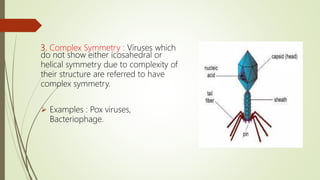
3. Complex Symmetry : Viruses which
do not show either icosahedral or
helical symmetry due to complexity of
their structure are referred to have
complex symmetry.
 Examples : Pox viruses,
Bacteriophage.
Classification Of Viruses
 Classification on the basis of nucleic acid
 Classification on the basis of Host
 Baltimore Classification
Classification on the basis of Host
• Animal viruses :
 Viruses of animal host.
 Examples : Rabies, Polio, Mumps, Chicken pox, Small pox, and
Influenza.
• Plant Viruses :
 Viruses which show their live characteristics when attached to
plants.
 Examples : Tobacco mosaic virus (TMV)
• Insect virus :
 Virus that infects insects.
 Examples : Baculovirus, Sacbrood virus, Granulosis virus.
 Bacterial Virus : Bacteriophages ( T1, T2, T3,
and T4.)
 Viruses that infect bacterial cells are called
bacteriophages (phages for short), which
‘bacteria eaters.’
 These are large, complex viruses, with a
characteristic head and tail structure
 The double-stranded, linear DNA genome
contains over 100 genes, and is contained
the icosahedral head.
Baltimore Classification
 7 groups were made.
 Its principles are fundamental to an understanding of virus classification and
genome replication.
 The Baltimore classification has + RNA as its central point.
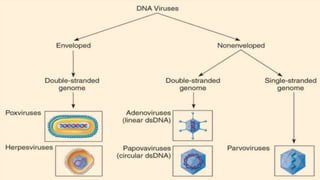
1. dsDNA viruses (e.g. Adenoviruses, Herpesviruses, Poxviruses)
2. ssDNA viruses (e.g. Parvoviruses)
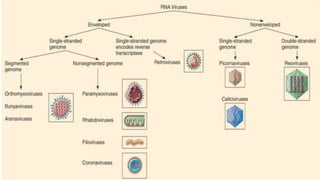
3. dsRNA viruses (e.g. Reoviruses)
4. (+)ssRNA viruses (+ strand or sense) RNA (e.g. Picornaviruses, Togaviruses)
5. (−)ssRNA viruses (− strand or antisense) RNA (e.g. Orthomyxoviruses,
Rhabdoviruses)
6. ssRNA viruses (+ strand or sense) RNA with DNA intermediate in life-cycle
(e.g.Retroviruses)
7. dsDNA viruses (e.g. Heptadnaviruses)
Viruses – Morphology & Classification.pptx

Viruses – Morphology & Classification.pptx

  • 1.
    Viruses – Morphology& Classification Prepared By : Ratnaparkhi Sanket Sanjay S.Y.B.Pharm Guided By : Mrs. S.D.Raysing Ma’am
  • 2.
    Introduction to Viruses •What are Viruses ?  Virus is a Non-Cellular particle made up of genetic material and protein that can invade living cells.  Viruses do not posses cellular organization and they do not fall strictly into the category of Unicellular Organisms.
  • 3.
    Discovery of Viruses •Dimitri Iwanowski :  In 1892, He demonstrated that the cause of tobacco mosaic disease was found in the liquid extracted from infected plants.  Discovered of the tobacco mosaic disease. • Beijerinck :  In 1897, He suggested that tiny particles in the juice caused the disease, and he named these particles Viruses. Tobacco Leaf Tobacco Mosaic Virus
  • 4.
    • Wendell Stanley In 1935, isolated crystals of tobacco mosaic virus. Since living organisms do not crystallize, Stanley inferred that viruses were not truly alive.  Reed : Discovered the first human virus, Yellow fever virus.  Twort : Discovered bacteriophage.  Schope : Discovered the first influenza virus in pigs.
  • 5.
    Properties of Viruses •They do not have cellular organization. • They contain only one type of nucleic acid either DNA or RNA But never both. • They are obligate intracellular parasites. • They lack enzymes for protein synthesis. • They multiply by complex process but not by binary fission. • They are unaffected by antibacterial antibiotics.
  • 6.
    Morphology of Viruses Viruses are acellular that means they do not have cells as it has no nucleus, cytoplasm or any organelles.  They need living host to survive.  Smallest infectious virus is 20 nm (Parvovirus) to 300 nm (Poxvirus).  They may be single or double stranded.  The nucleic acid is linear or circular and either segmented or non- segmented.  Viruses spread in many ways. Just as many viruses are very specific as to which host species or tissue they attack.  Plant viruses are often spread from plant to plant by insects and other organisms, known as vectors.
  • 7.
     Viruses suchas influenza are spread through the air by droplets of moisture when people cough or sneeze.  Antibiotics have no effect on viruses, but antiviral drugs have been developed to treat life threatening infections.  Dengue virus, are spread by blood-sucking insects.  Rotavirus is often spread by direct contact with infected children.  Vaccines that produce lifelong immunity can prevent some viral infections.
  • 8.
    Structure Of Virus Viralcomponents • Nucleic acids • Capsid • Envelope • Spikes
  • 9.
    Viral Nucleic Acid Viruses contain a single kind of nucleic acid either DNA or RNA which encodes the genetic information necessary for replication of the virus.  The genome may be single stranded or double stranded, circular or linear, segmented or non-segmented.  According to nucleic acid present, viruses can be classified as – o DNA viruses o RNA viruses
  • 10.
    Viral Capsid  Virusesconsists of nucleic acid core surrounded by a protein called capsid.  Capsid is composed of large number of capsomers which is made up of polypeptide molecules.  The capsid with the enclosed nucleic acid is known as nucleocapsid.
  • 11.
     It servesas antigenic determinants.  It induces antibody production.  It provides the structural symmetry of the virus.  It facilitates the assembly and packaging of viral genetic information.  It serves as a vehicle of transmission from host to another.  It protects the genetic materials. Functions of Viral Capsid • SPIKES - Carbohydrate-protein complexes (glycoproteins) that project from the envelope.  Can be used to attach to host cell.
  • 12.
    Viral Envelope  Itis a lipoprotein derived from the host cell membrane and virus specific protein.  It is composed of glycoproteins which look like spikes.  It confers instability to the virus because of the loss of infectivity due to disruption of lipid.  They are more sensitive to heat, lipid solvents and detergents.  Examples :- Herpes virus, HIV virus, Hepatitis virus etc.
  • 13.
    Viral Structure :General Morphology  Enveloped Viruses - can be helical or polyhedral, but the capsid is surrounded by an envelope  Helical : influenza virus  Polyhedral (icosahedral) : Herpes simplex virus  Non Enveloped Virus -  Viruses which does not have outer covering.  Naked viruses are more likely to be resistant to lipid solvents like ether, chloroform and detergent. Viral Envelope : Structure
  • 14.
    Viral Symmetry 1. IcosahedralSymmetry : Capsomeres are arranged in 20 triangles  Example : Adeno virus. 2. Helical Symmetry : They are arranged in a hollow coil that appears rod shaped.  Examples : Influenza virus, Rabies virus etc. Tobacco mosaic virus (rod shaped)
  • 15.
    3. Complex Symmetry: Viruses which do not show either icosahedral or helical symmetry due to complexity of their structure are referred to have complex symmetry.  Examples : Pox viruses, Bacteriophage.
  • 16.
    Classification Of Viruses Classification on the basis of nucleic acid  Classification on the basis of Host  Baltimore Classification
  • 19.
    Classification on thebasis of Host • Animal viruses :  Viruses of animal host.  Examples : Rabies, Polio, Mumps, Chicken pox, Small pox, and Influenza. • Plant Viruses :  Viruses which show their live characteristics when attached to plants.  Examples : Tobacco mosaic virus (TMV) • Insect virus :  Virus that infects insects.  Examples : Baculovirus, Sacbrood virus, Granulosis virus.
  • 20.
     Bacterial Virus: Bacteriophages ( T1, T2, T3, and T4.)  Viruses that infect bacterial cells are called bacteriophages (phages for short), which ‘bacteria eaters.’  These are large, complex viruses, with a characteristic head and tail structure  The double-stranded, linear DNA genome contains over 100 genes, and is contained the icosahedral head.
  • 21.
    Baltimore Classification  7groups were made.  Its principles are fundamental to an understanding of virus classification and genome replication.  The Baltimore classification has + RNA as its central point. 1. dsDNA viruses (e.g. Adenoviruses, Herpesviruses, Poxviruses) 2. ssDNA viruses (e.g. Parvoviruses) 3. dsRNA viruses (e.g. Reoviruses) 4. (+)ssRNA viruses (+ strand or sense) RNA (e.g. Picornaviruses, Togaviruses) 5. (−)ssRNA viruses (− strand or antisense) RNA (e.g. Orthomyxoviruses, Rhabdoviruses) 6. ssRNA viruses (+ strand or sense) RNA with DNA intermediate in life-cycle (e.g.Retroviruses) 7. dsDNA viruses (e.g. Heptadnaviruses)