It’s better to have a half-life than no life! Radioactive Decay Alpha, Beta, and Gamma Decay
What does it mean to be radioactive? Some atoms have nuclei that are unstable. These atoms spontaneously “decompose” to form different nuclei and produce/release one or more particles or photons.
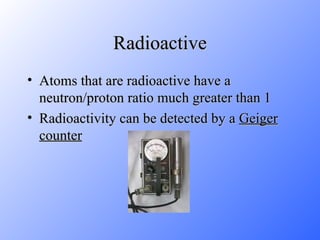
Radioactive Atoms that are radioactive have a neutron/proton ratio much greater than 1 Radioactivity can be detected by a  Geiger   counter
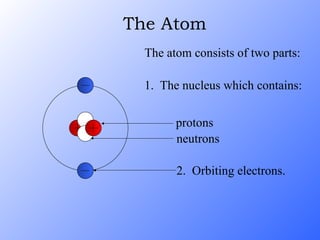
The Atom The atom consists of two parts: 1.  The nucleus which contains: 2.  Orbiting electrons. protons neutrons
All  matter  is made up of  elements  (e.g. carbon, hydrogen, etc.). The smallest part of an  element  is called an  atom . Atoms of different  elements  contain different numbers of  protons . The  mass  of an atom is almost entirely due to the number of  protons  and  neutrons . The Atom
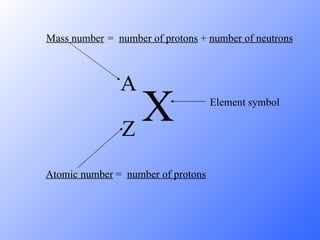
X A Z Mass number Atomic number Element symbol =  number of protons  +  number of neutrons =  number of protons
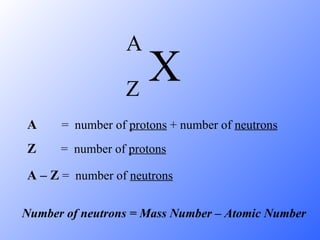
A   =  number of  protons  + number of  neutrons Z   =  number of  protons A – Z  =  number of  neutrons Number of neutrons = Mass Number – Atomic Number X A Z
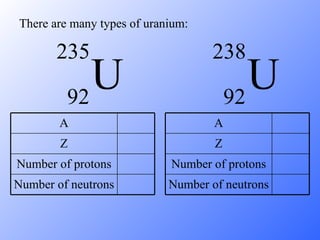
There are many types of uranium: U 235 92 U 238 92 Number of neutrons Number of protons Z A Number of neutrons Number of protons Z A
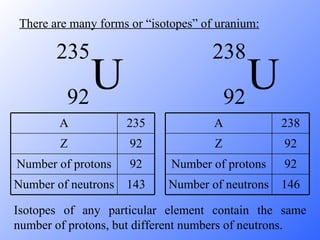
There are many forms or “isotopes” of uranium: Isotopes of any particular element contain the same number of protons, but different numbers of neutrons. U 235 92 U 238 92 143 Number of neutrons 92 Number of protons 92 Z 235 A 146 Number of neutrons 92 Number of protons 92 Z 238 A
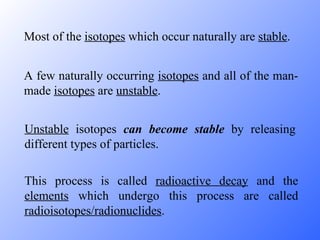
Most of the  isotopes  which occur naturally are  stable . A few naturally occurring  isotopes  and all of the man-made  isotopes  are  unstable . Unstable  isotopes  can become stable  by releasing different types of particles. This process is called  radioactive decay  and the  elements  which undergo this process are called  radioisotopes/radionuclides .
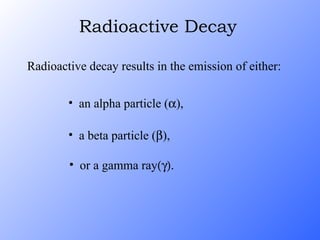
Radioactive decay results in the emission of either: an alpha particle (  ), a beta particle (  ), or a gamma ray  Radioactive Decay
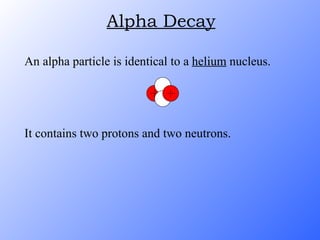
An alpha particle is identical to a  helium  nucleus. It contains two protons and two neutrons. Alpha Decay
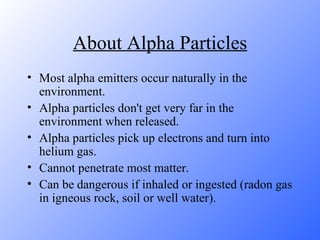
About Alpha Particles Most alpha emitters occur naturally in the environment.  Alpha particles don't get very far in the environment when released. Alpha particles pick up electrons and turn into helium gas. Cannot penetrate most matter. Can be dangerous if inhaled or ingested (radon gas in igneous rock, soil or well water).
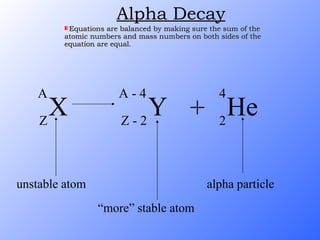
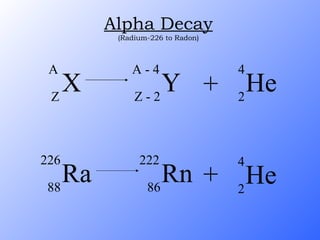
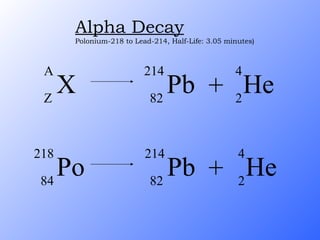
Alpha Decay Equations are balanced by making sure the sum of the atomic numbers and mass numbers on both sides of the equation are equal. unstable atom “ more” stable atom alpha particle X A Z Y A - 4 Z - 2 + He 4 2
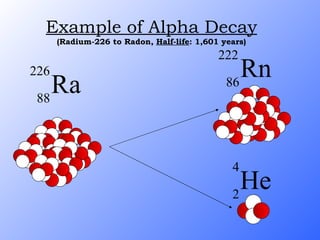
Example of Alpha Decay (Radium-226 to Radon,  Half-life : 1,601 years) Ra 226 88 Rn 222 86 He 4 2
Alpha Decay (Radium-226 to Radon) X A Z Y A - 4 Z - 2 + He 4 2 Ra 226 88 Rn 222 86 + He 4 2
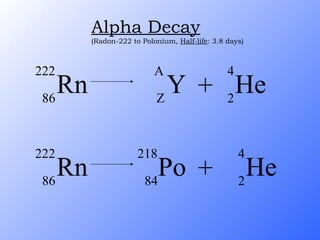
Alpha Decay (Radon-222 to Polonium,  Half-life : 3.8 days) Rn 222 86 He 4 2 + Po 218 84 He 4 2 Rn 222 86 + Y A Z He 4 2
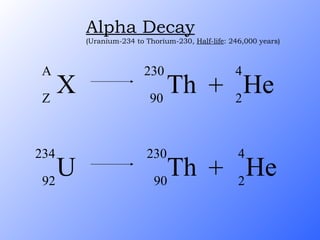
Alpha Decay (Uranium-234 to Thorium-230,  Half-life : 246,000 years) He 4 2 U 234 92 + Th 230 90 He 4 2 X A Z + Th 230  90 He 4 2
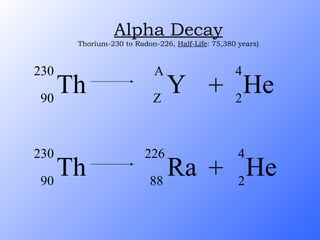
Alpha Decay Thorium-230 to Radon-226,  Half-Life : 75,380 years) Th 230 90 + Y A  Z He 4 2 He 4 2 + Ra 226 88 He 4 2 Th 230 90
Alpha Decay Polonium-218 to Lead-214, Half-Life: 3.05 minutes) X A Z + Pb 214  82 He 4 2 He 4 2 + Pb 214 82 He 4 2 Po 218 84
Human Use of Alpha Particle Emitters: Radium -226 may be used to treat cancer, by inserting tiny amounts of radium into the tumorous mass.  Polonium -210 serves as a static eliminator in paper mills and other industries.  Some smoke detectors use the alpha emissions from  Americium -241 to help create an electrical current.
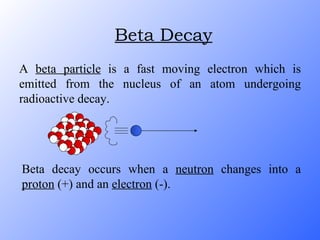
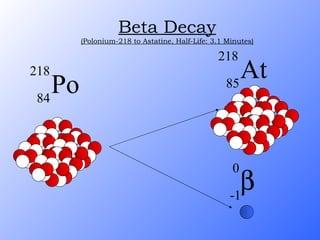
Beta Decay A  beta particle  is a fast moving electron which is emitted from the nucleus of an atom undergoing radioactive decay. Beta decay occurs when a  neutron  changes into a  proton  (+) and an  electron  (-).
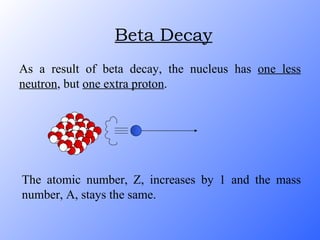
Beta Decay As a result of beta decay, the nucleus has  one less neutron , but  one extra proton . The atomic number, Z, increases by 1 and the mass number, A, stays the same.
Beta Decay (Polonium-218 to Astatine, Half-Life: 3.1 Minutes) Po 218 84  0 -1 At 218 85
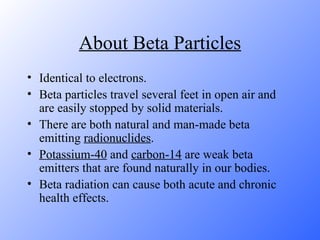
About Beta Particles Identical to electrons. Beta particles travel several feet in open air and are easily stopped by solid materials.  There are both natural and man-made beta emitting  radionuclides .  Potassium-40  and  carbon-14  are weak beta emitters that are found naturally in our bodies.  Beta radiation can cause both acute and chronic health effects.
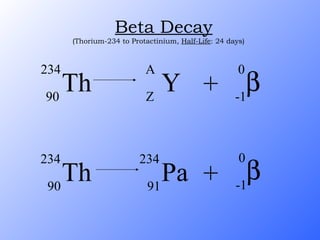
Beta Decay (Thorium-234 to Protactinium,  Half-Life : 24 days) Th 234 90 Y A Z +  0 -1 Th 234 90 Pa 234 91 +  0 -1
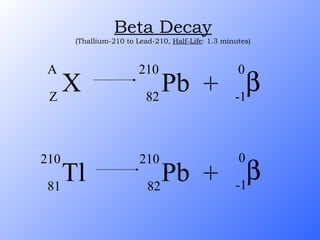
Beta Decay (Thallium-210 to Lead-210,  Half-Life : 1.3 minutes) X A Z Pb 210 82 +  0 -1 Tl 210 81 Pb 210 82 +  0 -1
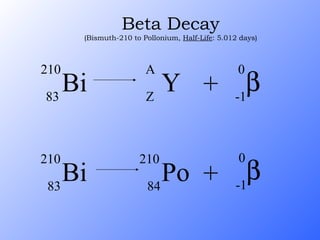
Beta Decay (Bismuth-210 to Pollonium,  Half-Life : 5.012 days) Bi 210 83 Y A Z +  0 -1 Bi 210 83 Po 210 84 +  0 -1
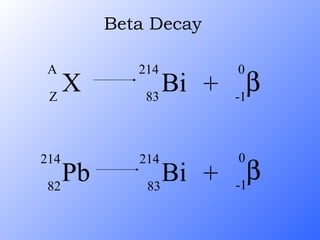
Beta Decay X A Z Bi 214 83 +  0 -1 Pb 214 82 Bi 214 83 +  0 -1
Human Use of Beta Particle Emitters Iodine -131 is used to treat thyroid disorders, such as cancer and graves disease (a type of hyperthyroidism) Phosphorus -32 is used in molecular biology and genetics research. Strontium -90 is used as a radioactive tracer in medical and agricultural studies. Tritium  is used for life science and drug metabolism studies to ensure the safety of potential new drugs. It is also used for luminous aircraft and commercial exit signs, for luminous dials, gauges and wrist watches. Carbon-14  is a very reliable tool in dating of organic matter up to 30,000 years old. Beta emitters are also used in a variety of industrial instruments, such as industrial thickness gauges, using their weak penetrating power to measure very thin materials.
Gamma Decay Gamma rays  are not charged particles like    and    particles.  They are  released with these particles . Gamma rays  are electromagnetic radiation with high frequency.  They have 10,000 times more energy than visible light. When  atoms  decay by emitting    or    particles to form a new atom, the nuclei of the new atom formed may still have too much energy to be completely stable. This  excess energy  is emitted as gamma rays (gamma ray photons have energies of ~ 1 x 10 -12  J).
Gamma photons have no mass and no electrical charge--they are pure electromagnetic energy.  Because of their high energy, gamma photons travel at the  speed of light  and can cover hundreds to thousands of meters in air before spending their energy.  They can pass through many kinds of materials,  including human tissue . Very dense materials, such as lead, are commonly used as shielding to slow or stop gamma photons.
Important Points The penetrating power of gamma photons has many applications.  Gamma rays penetrate many materials, but they  do not   make  the materials radioactive.
Uses for Gamma Rays: Cobalt-60: sterilize medical equipment in hospitals pasteurize certain foods and spices treat cancer gauge the thickness of metal in steel mills. Cesium-137: cancer treatment measure and control the flow of liquids in industrial processes investigate subterranean strata in oil wells measure soil density at construction sites ensure the proper fill level for packages of food, drugs and other products.
Human Exposure to Radiation Most people's primary source of gamma exposure is naturally occurring radionuclides (soil, water, processed meats, and high potassiuim foods like bananas) Nuclear Medicine/Medical Imaging (lung, bone, thyroid scans) Mining waste, weapons testing, accidents, etc.

Radioactive decay honors

  • 1.
    It’s better tohave a half-life than no life! Radioactive Decay Alpha, Beta, and Gamma Decay
  • 2.
    What does itmean to be radioactive? Some atoms have nuclei that are unstable. These atoms spontaneously “decompose” to form different nuclei and produce/release one or more particles or photons.
  • 3.
    Radioactive Atoms thatare radioactive have a neutron/proton ratio much greater than 1 Radioactivity can be detected by a Geiger counter
  • 4.
    The Atom Theatom consists of two parts: 1. The nucleus which contains: 2. Orbiting electrons. protons neutrons
  • 5.
    All matter is made up of elements (e.g. carbon, hydrogen, etc.). The smallest part of an element is called an atom . Atoms of different elements contain different numbers of protons . The mass of an atom is almost entirely due to the number of protons and neutrons . The Atom
  • 6.
    X A ZMass number Atomic number Element symbol = number of protons + number of neutrons = number of protons
  • 7.
    A = number of protons + number of neutrons Z = number of protons A – Z = number of neutrons Number of neutrons = Mass Number – Atomic Number X A Z
  • 8.
    There are manytypes of uranium: U 235 92 U 238 92 Number of neutrons Number of protons Z A Number of neutrons Number of protons Z A
  • 9.
    There are manyforms or “isotopes” of uranium: Isotopes of any particular element contain the same number of protons, but different numbers of neutrons. U 235 92 U 238 92 143 Number of neutrons 92 Number of protons 92 Z 235 A 146 Number of neutrons 92 Number of protons 92 Z 238 A
  • 10.
    Most of the isotopes which occur naturally are stable . A few naturally occurring isotopes and all of the man-made isotopes are unstable . Unstable isotopes can become stable by releasing different types of particles. This process is called radioactive decay and the elements which undergo this process are called radioisotopes/radionuclides .
  • 11.
    Radioactive decay resultsin the emission of either: an alpha particle (  ), a beta particle (  ), or a gamma ray  Radioactive Decay
  • 12.
    An alpha particleis identical to a helium nucleus. It contains two protons and two neutrons. Alpha Decay
  • 13.
    About Alpha ParticlesMost alpha emitters occur naturally in the environment. Alpha particles don't get very far in the environment when released. Alpha particles pick up electrons and turn into helium gas. Cannot penetrate most matter. Can be dangerous if inhaled or ingested (radon gas in igneous rock, soil or well water).
  • 14.
    Alpha Decay Equationsare balanced by making sure the sum of the atomic numbers and mass numbers on both sides of the equation are equal. unstable atom “ more” stable atom alpha particle X A Z Y A - 4 Z - 2 + He 4 2
  • 15.
    Example of AlphaDecay (Radium-226 to Radon, Half-life : 1,601 years) Ra 226 88 Rn 222 86 He 4 2
  • 16.
    Alpha Decay (Radium-226to Radon) X A Z Y A - 4 Z - 2 + He 4 2 Ra 226 88 Rn 222 86 + He 4 2
  • 17.
    Alpha Decay (Radon-222to Polonium, Half-life : 3.8 days) Rn 222 86 He 4 2 + Po 218 84 He 4 2 Rn 222 86 + Y A Z He 4 2
  • 18.
    Alpha Decay (Uranium-234to Thorium-230, Half-life : 246,000 years) He 4 2 U 234 92 + Th 230 90 He 4 2 X A Z + Th 230 90 He 4 2
  • 19.
    Alpha Decay Thorium-230to Radon-226, Half-Life : 75,380 years) Th 230 90 + Y A Z He 4 2 He 4 2 + Ra 226 88 He 4 2 Th 230 90
  • 20.
    Alpha Decay Polonium-218to Lead-214, Half-Life: 3.05 minutes) X A Z + Pb 214 82 He 4 2 He 4 2 + Pb 214 82 He 4 2 Po 218 84
  • 21.
    Human Use ofAlpha Particle Emitters: Radium -226 may be used to treat cancer, by inserting tiny amounts of radium into the tumorous mass. Polonium -210 serves as a static eliminator in paper mills and other industries. Some smoke detectors use the alpha emissions from Americium -241 to help create an electrical current.
  • 22.
    Beta Decay A beta particle is a fast moving electron which is emitted from the nucleus of an atom undergoing radioactive decay. Beta decay occurs when a neutron changes into a proton (+) and an electron (-).
  • 23.
    Beta Decay Asa result of beta decay, the nucleus has one less neutron , but one extra proton . The atomic number, Z, increases by 1 and the mass number, A, stays the same.
  • 24.
    Beta Decay (Polonium-218to Astatine, Half-Life: 3.1 Minutes) Po 218 84  0 -1 At 218 85
  • 25.
    About Beta ParticlesIdentical to electrons. Beta particles travel several feet in open air and are easily stopped by solid materials. There are both natural and man-made beta emitting radionuclides . Potassium-40 and carbon-14 are weak beta emitters that are found naturally in our bodies. Beta radiation can cause both acute and chronic health effects.
  • 26.
    Beta Decay (Thorium-234to Protactinium, Half-Life : 24 days) Th 234 90 Y A Z +  0 -1 Th 234 90 Pa 234 91 +  0 -1
  • 27.
    Beta Decay (Thallium-210to Lead-210, Half-Life : 1.3 minutes) X A Z Pb 210 82 +  0 -1 Tl 210 81 Pb 210 82 +  0 -1
  • 28.
    Beta Decay (Bismuth-210to Pollonium, Half-Life : 5.012 days) Bi 210 83 Y A Z +  0 -1 Bi 210 83 Po 210 84 +  0 -1
  • 29.
    Beta Decay XA Z Bi 214 83 +  0 -1 Pb 214 82 Bi 214 83 +  0 -1
  • 30.
    Human Use ofBeta Particle Emitters Iodine -131 is used to treat thyroid disorders, such as cancer and graves disease (a type of hyperthyroidism) Phosphorus -32 is used in molecular biology and genetics research. Strontium -90 is used as a radioactive tracer in medical and agricultural studies. Tritium  is used for life science and drug metabolism studies to ensure the safety of potential new drugs. It is also used for luminous aircraft and commercial exit signs, for luminous dials, gauges and wrist watches. Carbon-14 is a very reliable tool in dating of organic matter up to 30,000 years old. Beta emitters are also used in a variety of industrial instruments, such as industrial thickness gauges, using their weak penetrating power to measure very thin materials.
  • 31.
    Gamma Decay Gammarays are not charged particles like  and  particles. They are released with these particles . Gamma rays are electromagnetic radiation with high frequency. They have 10,000 times more energy than visible light. When atoms decay by emitting  or  particles to form a new atom, the nuclei of the new atom formed may still have too much energy to be completely stable. This excess energy is emitted as gamma rays (gamma ray photons have energies of ~ 1 x 10 -12 J).
  • 32.
    Gamma photons haveno mass and no electrical charge--they are pure electromagnetic energy. Because of their high energy, gamma photons travel at the speed of light and can cover hundreds to thousands of meters in air before spending their energy. They can pass through many kinds of materials, including human tissue . Very dense materials, such as lead, are commonly used as shielding to slow or stop gamma photons.
  • 33.
    Important Points Thepenetrating power of gamma photons has many applications. Gamma rays penetrate many materials, but they do not make the materials radioactive.
  • 34.
    Uses for GammaRays: Cobalt-60: sterilize medical equipment in hospitals pasteurize certain foods and spices treat cancer gauge the thickness of metal in steel mills. Cesium-137: cancer treatment measure and control the flow of liquids in industrial processes investigate subterranean strata in oil wells measure soil density at construction sites ensure the proper fill level for packages of food, drugs and other products.
  • 35.
    Human Exposure toRadiation Most people's primary source of gamma exposure is naturally occurring radionuclides (soil, water, processed meats, and high potassiuim foods like bananas) Nuclear Medicine/Medical Imaging (lung, bone, thyroid scans) Mining waste, weapons testing, accidents, etc.