Atomic and Nuclear Physics Topic 7. 2 Radioactive Decay
What is radiation? What does it do? Where does it come from? How can we use it?  Can we stop it? How do we protect ourselves? TOK
Radioactivity In 1896, Henri Becquerel discovered, almost by accident, that uranium can blacken a photographic plate, even in the dark. Uranium emits very energetic radiation ‑ it is radioactive.
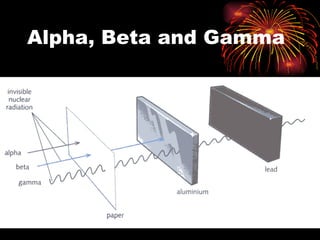
Then Marie and Pierre Curie discovered more radioactive elements including polonium and radium. Scientists soon realised that there were three different types of radiation.  These were called alpha ( α ), beta ( β ), and gamma ( γ ) rays from the first three letters of the Greek alphabet.
Alpha, Beta and Gamma
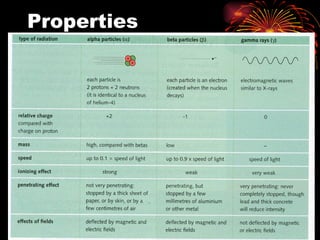
Properties
Properties 2 The diagram on the right shows how the different types are affected by a magnetic field. The alpha beam is a flow of positively (+) charged particles, so it is equivalent to an electric current. It is deflected in a direction given by Fleming's left‑hand rule ‑ the rule used for working out the direction of the force on a current‑carrying wire in a magnetic field.
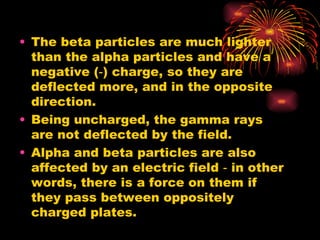
The beta particles are much lighter than the alpha particles and have a negative (‑) charge, so they are deflected more, and in the opposite direction. Being uncharged, the gamma rays are not deflected by the field. Alpha and beta particles are also affected by an electric field ‑ in other words, there is a force on them if they pass between oppositely charged plates.
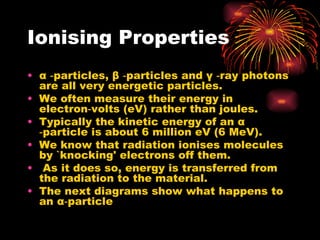
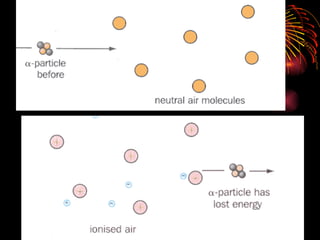
Ionising Properties α  ‑particles,  β  ‑particles and  γ  ‑ray photons are all very energetic particles. We often measure their energy in electron‑volts (eV) rather than joules. Typically the kinetic energy of an  α  ‑particle is about 6 million eV (6 MeV). We know that radiation ionises molecules by `knocking' electrons off them. As it does so, energy is transferred from the radiation to the material. The next   diagrams show what happens to an  α ‑particle
 
Why do the 3 types of radiation have different penetrations? Since the  α - particle  is a heavy, relatively slow‑moving particle with a charge of +2e, it interacts strongly with matter. It produces about 1 x 10 5  ion pairs per cm of its path in air. After passing through just a few cm of air it has lost its energy.
the  β ‑particle  is a much lighter particle than the  α  ‑particle and it travels much faster. Since it spends just a short time in the vicinity of each air molecule and has a charge of only ‑le, it causes less intense ionisation than the  α  ‑particle. The  β  ‑particle produces about 1 x 10 3  ion pairs per cm in air, and so it travels about 1 m before it is absorbed.
A  γ ‑ray photon  interacts weakly with matter because it is uncharged and therefore it is difficult to stop. A  γ  ‑ray photon often loses all its energy in one event. However, the chance of such an event is small and on average a  γ  ‑photon travels a long way before it is absorbed.
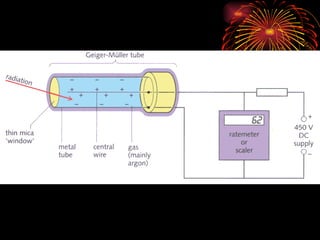
Detection of Radiation Geiger‑M u ller (GM) tube This can be used to detect alpha, beta, and gamma radiation. Its structure is shown in the next slide.
 
The `window' at the end is thin enough for alpha particles to pass through. If an alpha particle enters the tube, it ionizes the gas inside. This sets off a high‑voltage spark across the gas and a pulse of current in the circuit. A beta particle or burst of gamma radiation has the same effect.
The ionisation chamber is another detector which uses the ionising power of radiation. The chamber contains fixed electrodes, which attract electrons and ions produced by the passage through the chamber of high‑speed particles or rays.
When the electrodes detect ions or electrons, a circuit is activated and a pulse is sent to a recording device such as a light.
Cloud and Bubble Chambers Have you looked at the sky and seen a cloud trail behind a high flying aircraft? Water vapour in the air condenses on the ionised exhaust gases from the engine to form droplets that reveal the path of the plane. TOK
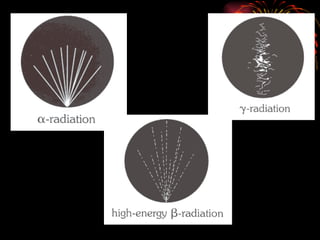
A  cloud chamber  produces a similar effect using alcohol vapour. Radiation from a radioactive source ionises the cold air inside the chamber. Alcohol condenses on the ions of air to form a trail of tiny white droplets along the path of the radiation. The diagrams below show some typical tracks:
 
The  α ‑radiation produces dense straight tracks showing intense ionisation. Notice that all the tracks are similar in length. The high‑energy  β ‑ray tracks are thinner and less intense. The tracks vary in length and most of the tracks are much longer than the  α  ‑ particle  tracks . The  γ ‑rays do not produce continuous tracks.
A  bubble chamber  also shows the tracks of ionising radiation. The radiation leaves a trail of vapour bubbles in a liquid (often liquid hydrogen).
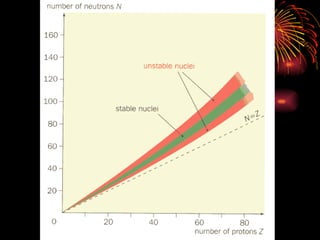
Stability If you plot the neutron number N against the proton number Z for all the known nuclides, you get the diagram shown here
 
Can you see that the stable nuclides of the lighter elements have approximately equal numbers of protons and neutrons? However, as Z increases the `stability line' curves upwards. Heavier nuclei need more and more neutrons to be stable. Can we explain why?
It is the strong nuclear force that holds the nucleons together, but this is a very short range force. The repulsive electric force between the protons is a longer range force. So in a large nucleus all the protons repel each other, but each nucleon attracts only its nearest neighbours.
More neutrons are needed to hold the nucleus together (although adding too many neutrons can also cause instability). There is an upper limit to the size of a stable nucleus, because all the nuclides with Z higher than 83 are unstable.
Transformations Examples
Alpha Decay An alpha‑particle is a helium nucleus and is written  4 2 He or  4 2 α . It consists of 2 protons and 2 neutrons. When an unstable nucleus decays by emitting an  α  ‑particle it loses 4 nucleons and so  its nucleon number decreases by 4. Also, since it loses 2 protons,  its proton number decreases by 2
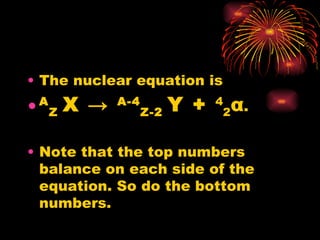
The nuclear equation is A Z  X  ->   A-4 Z-2  Y  +  4 2 α . Note that the top numbers balance on each side of the equation. So do the bottom numbers.
Beta Decay Beta decay Many radioactive nuclides (radio‑nuclides) decay by  β ‑emission. This is the emission of an electron  from the nucleus. But there are no electrons in the nucleus!
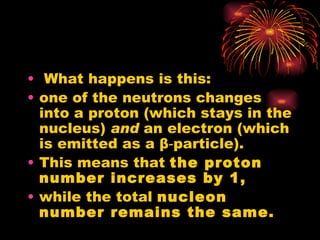
What happens is this: one of the neutrons changes into a proton (which stays in the nucleus)  and  an electron (which is emitted as a  β ‑particle). This means that  the proton number increases by 1, while the total  nucleon number remains the same.
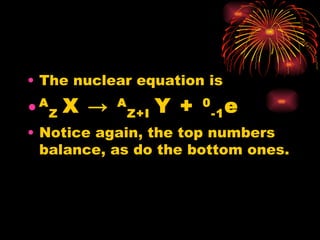
The nuclear equation is A Z  X  ->   A Z+I  Y  +  0 -1 e Notice again, the top numbers balance, as do the bottom ones.
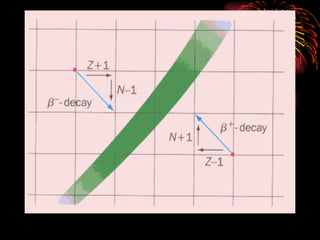
A radio‑nuclide  above  the stability line decays by  β ‑emission. Because it loses a neutron and gains a proton, it moves diagonally  towards  the stability line, as shown on this graph
 
Gamma Decay Gamma‑emission does not change the structure of the nucleus, but it does make the nucleus more stable  because it reduces the energy of the nucleus.
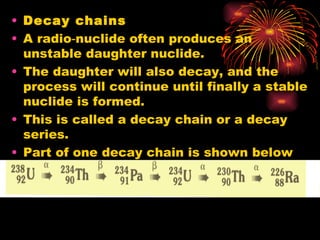
Decay chains A radio‑nuclide often produces an unstable daughter nuclide. The daughter will also decay, and the process will continue until finally a stable nuclide is formed. This is called a decay chain or a decay series. Part of one decay chain is shown below
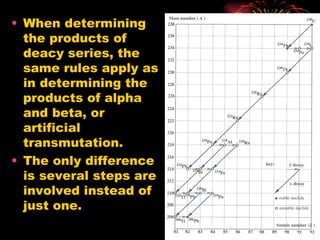
When determining the products of deacy series, the same rules apply as in determining the products of alpha and beta, or artificial transmutation. The only difference is several steps are involved instead of just one.
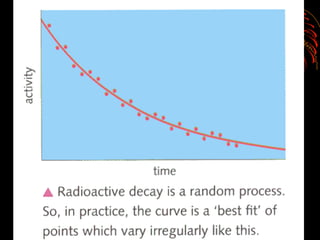
Half Life Suppose you have a sample of 100 identical nuclei. All the nuclei are equally likely to decay, but you can never predict which individual nucleus will be the next to decay. The decay process is completely  random. Also, there is nothing you can do to `persuade' one nucleus to decay at a certain time. The decay process is  spontaneous.
Does this mean that we can never know the rate of decay? No, because for any particular radio‑nuclide there is a certain  probability  that an individual nucleus will decay. This means that if we start with a large number of identical nuclei we can predict how many will decay in a certain time interval. TOK
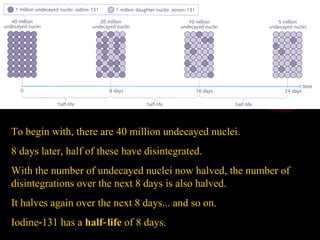
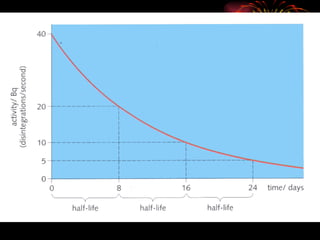
Iodine‑131 is a radioactive isotope of iodine. The chart on the next slide illustrates the decay of a sample of iodine‑131. On average, 1 nucleus disintegrates every second for every 1000 000 nuclei present.
To begin with, there are 40 million undecayed nuclei. 8 days later, half of these have disintegrated. With the number of undecayed nuclei now halved, the number of disintegrations over the next 8 days is also halved. It halves again over the next 8 days... and so on. Iodine‑131 has a  half‑life  of 8 days.
Definition The half‑life of a radioactive isotope is the time taken for half the nuclei present in any given sample to decay.
 
Activity and half‑life In a radioactive sample, the average number of disintegrations per second is  called the activity. The SI unit of activity is the  becquerel (Bq). An activity of, say, 100 Bq means that 100 nuclei are disintegrating per second.
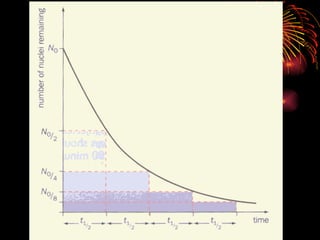
The graph on the next slide of the next page shows how, on average, the activity of a sample of iodine‑131 varies with time. As the activity is always proportional to the number of undecayed nuclei, it too halves every 8 days. So `half‑life' has another meaning as well:
 
 
Definition 2 The half‑life of a radioactive isotope is the time taken for the activity of any given sample to fall to half its original value.
Exponential Decay Any quantity that reduces by the same fraction in the same period of time is called an exponential decay curve. The half life can be calculated from decay curves Take several values and the take an average

7.2

  • 1.
    Atomic and NuclearPhysics Topic 7. 2 Radioactive Decay
  • 2.
    What is radiation?What does it do? Where does it come from? How can we use it? Can we stop it? How do we protect ourselves? TOK
  • 3.
    Radioactivity In 1896,Henri Becquerel discovered, almost by accident, that uranium can blacken a photographic plate, even in the dark. Uranium emits very energetic radiation ‑ it is radioactive.
  • 4.
    Then Marie andPierre Curie discovered more radioactive elements including polonium and radium. Scientists soon realised that there were three different types of radiation. These were called alpha ( α ), beta ( β ), and gamma ( γ ) rays from the first three letters of the Greek alphabet.
  • 5.
  • 6.
  • 7.
    Properties 2 Thediagram on the right shows how the different types are affected by a magnetic field. The alpha beam is a flow of positively (+) charged particles, so it is equivalent to an electric current. It is deflected in a direction given by Fleming's left‑hand rule ‑ the rule used for working out the direction of the force on a current‑carrying wire in a magnetic field.
  • 8.
    The beta particlesare much lighter than the alpha particles and have a negative (‑) charge, so they are deflected more, and in the opposite direction. Being uncharged, the gamma rays are not deflected by the field. Alpha and beta particles are also affected by an electric field ‑ in other words, there is a force on them if they pass between oppositely charged plates.
  • 9.
    Ionising Properties α ‑particles, β ‑particles and γ ‑ray photons are all very energetic particles. We often measure their energy in electron‑volts (eV) rather than joules. Typically the kinetic energy of an α ‑particle is about 6 million eV (6 MeV). We know that radiation ionises molecules by `knocking' electrons off them. As it does so, energy is transferred from the radiation to the material. The next diagrams show what happens to an α ‑particle
  • 10.
  • 11.
    Why do the3 types of radiation have different penetrations? Since the α - particle is a heavy, relatively slow‑moving particle with a charge of +2e, it interacts strongly with matter. It produces about 1 x 10 5 ion pairs per cm of its path in air. After passing through just a few cm of air it has lost its energy.
  • 12.
    the β‑particle is a much lighter particle than the α ‑particle and it travels much faster. Since it spends just a short time in the vicinity of each air molecule and has a charge of only ‑le, it causes less intense ionisation than the α ‑particle. The β ‑particle produces about 1 x 10 3 ion pairs per cm in air, and so it travels about 1 m before it is absorbed.
  • 13.
    A γ‑ray photon interacts weakly with matter because it is uncharged and therefore it is difficult to stop. A γ ‑ray photon often loses all its energy in one event. However, the chance of such an event is small and on average a γ ‑photon travels a long way before it is absorbed.
  • 14.
    Detection of RadiationGeiger‑M u ller (GM) tube This can be used to detect alpha, beta, and gamma radiation. Its structure is shown in the next slide.
  • 15.
  • 16.
    The `window' atthe end is thin enough for alpha particles to pass through. If an alpha particle enters the tube, it ionizes the gas inside. This sets off a high‑voltage spark across the gas and a pulse of current in the circuit. A beta particle or burst of gamma radiation has the same effect.
  • 17.
    The ionisation chamberis another detector which uses the ionising power of radiation. The chamber contains fixed electrodes, which attract electrons and ions produced by the passage through the chamber of high‑speed particles or rays.
  • 18.
    When the electrodesdetect ions or electrons, a circuit is activated and a pulse is sent to a recording device such as a light.
  • 19.
    Cloud and BubbleChambers Have you looked at the sky and seen a cloud trail behind a high flying aircraft? Water vapour in the air condenses on the ionised exhaust gases from the engine to form droplets that reveal the path of the plane. TOK
  • 20.
    A cloudchamber produces a similar effect using alcohol vapour. Radiation from a radioactive source ionises the cold air inside the chamber. Alcohol condenses on the ions of air to form a trail of tiny white droplets along the path of the radiation. The diagrams below show some typical tracks:
  • 21.
  • 22.
    The α‑radiation produces dense straight tracks showing intense ionisation. Notice that all the tracks are similar in length. The high‑energy β ‑ray tracks are thinner and less intense. The tracks vary in length and most of the tracks are much longer than the α ‑ particle tracks . The γ ‑rays do not produce continuous tracks.
  • 23.
    A bubblechamber also shows the tracks of ionising radiation. The radiation leaves a trail of vapour bubbles in a liquid (often liquid hydrogen).
  • 24.
    Stability If youplot the neutron number N against the proton number Z for all the known nuclides, you get the diagram shown here
  • 25.
  • 26.
    Can you seethat the stable nuclides of the lighter elements have approximately equal numbers of protons and neutrons? However, as Z increases the `stability line' curves upwards. Heavier nuclei need more and more neutrons to be stable. Can we explain why?
  • 27.
    It is thestrong nuclear force that holds the nucleons together, but this is a very short range force. The repulsive electric force between the protons is a longer range force. So in a large nucleus all the protons repel each other, but each nucleon attracts only its nearest neighbours.
  • 28.
    More neutrons areneeded to hold the nucleus together (although adding too many neutrons can also cause instability). There is an upper limit to the size of a stable nucleus, because all the nuclides with Z higher than 83 are unstable.
  • 29.
  • 30.
    Alpha Decay Analpha‑particle is a helium nucleus and is written 4 2 He or 4 2 α . It consists of 2 protons and 2 neutrons. When an unstable nucleus decays by emitting an α ‑particle it loses 4 nucleons and so its nucleon number decreases by 4. Also, since it loses 2 protons, its proton number decreases by 2
  • 31.
    The nuclear equationis A Z X -> A-4 Z-2 Y + 4 2 α . Note that the top numbers balance on each side of the equation. So do the bottom numbers.
  • 32.
    Beta Decay Betadecay Many radioactive nuclides (radio‑nuclides) decay by β ‑emission. This is the emission of an electron from the nucleus. But there are no electrons in the nucleus!
  • 33.
    What happens isthis: one of the neutrons changes into a proton (which stays in the nucleus) and an electron (which is emitted as a β ‑particle). This means that the proton number increases by 1, while the total nucleon number remains the same.
  • 34.
    The nuclear equationis A Z X -> A Z+I Y + 0 -1 e Notice again, the top numbers balance, as do the bottom ones.
  • 35.
    A radio‑nuclide above the stability line decays by β ‑emission. Because it loses a neutron and gains a proton, it moves diagonally towards the stability line, as shown on this graph
  • 36.
  • 37.
    Gamma Decay Gamma‑emissiondoes not change the structure of the nucleus, but it does make the nucleus more stable because it reduces the energy of the nucleus.
  • 38.
    Decay chains Aradio‑nuclide often produces an unstable daughter nuclide. The daughter will also decay, and the process will continue until finally a stable nuclide is formed. This is called a decay chain or a decay series. Part of one decay chain is shown below
  • 39.
    When determining theproducts of deacy series, the same rules apply as in determining the products of alpha and beta, or artificial transmutation. The only difference is several steps are involved instead of just one.
  • 40.
    Half Life Supposeyou have a sample of 100 identical nuclei. All the nuclei are equally likely to decay, but you can never predict which individual nucleus will be the next to decay. The decay process is completely random. Also, there is nothing you can do to `persuade' one nucleus to decay at a certain time. The decay process is spontaneous.
  • 41.
    Does this meanthat we can never know the rate of decay? No, because for any particular radio‑nuclide there is a certain probability that an individual nucleus will decay. This means that if we start with a large number of identical nuclei we can predict how many will decay in a certain time interval. TOK
  • 42.
    Iodine‑131 is aradioactive isotope of iodine. The chart on the next slide illustrates the decay of a sample of iodine‑131. On average, 1 nucleus disintegrates every second for every 1000 000 nuclei present.
  • 43.
    To begin with,there are 40 million undecayed nuclei. 8 days later, half of these have disintegrated. With the number of undecayed nuclei now halved, the number of disintegrations over the next 8 days is also halved. It halves again over the next 8 days... and so on. Iodine‑131 has a half‑life of 8 days.
  • 44.
    Definition The half‑lifeof a radioactive isotope is the time taken for half the nuclei present in any given sample to decay.
  • 45.
  • 46.
    Activity and half‑lifeIn a radioactive sample, the average number of disintegrations per second is called the activity. The SI unit of activity is the becquerel (Bq). An activity of, say, 100 Bq means that 100 nuclei are disintegrating per second.
  • 47.
    The graph onthe next slide of the next page shows how, on average, the activity of a sample of iodine‑131 varies with time. As the activity is always proportional to the number of undecayed nuclei, it too halves every 8 days. So `half‑life' has another meaning as well:
  • 48.
  • 49.
  • 50.
    Definition 2 Thehalf‑life of a radioactive isotope is the time taken for the activity of any given sample to fall to half its original value.
  • 51.
    Exponential Decay Anyquantity that reduces by the same fraction in the same period of time is called an exponential decay curve. The half life can be calculated from decay curves Take several values and the take an average