Tides
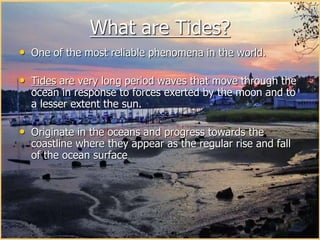
What are Tides? 
• One of the most reliable phenomena in the world. 
• Tides are very long period waves that move through the 
ocean in response to forces exerted by the moon and to 
a lesser extent the sun. 
• Originate in the oceans and progress towards the 
coastline where they appear as the regular rise and fall 
of the ocean surface
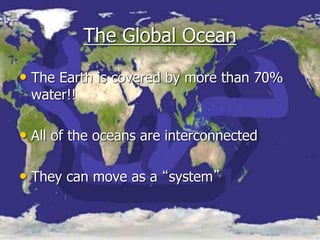
The Global Ocean 
• The Earth is covered by more than 70% 
water!! 
• All of the oceans are interconnected 
• They can move as a “system”
High and Low Tide 
• When the highest part, or the crest, of the 
wave reaches a particular location 
high tide occurs. 
• When the lowest part, or the trough, of 
the wave reaches a particular location 
low tide occurs. 
• Difference in height between high and low 
tide: tidal variation.
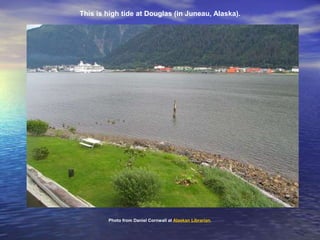
This is high tide at Douglas (in Juneau, Alaska). 
Photo from Daniel Cornwall at Alaskan Librarian.
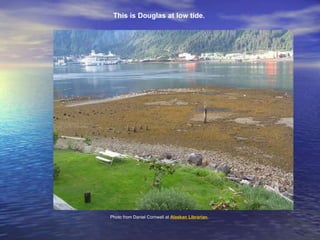
This is Douglas at low tide. 
Photo from Daniel Cornwall at Alaskan Librarian.
Ebb and Flood Currents 
• A horizontal movement of water often 
accompanies the rising and falling of the tide: 
tidal current 
• Incoming tides = flood current 
• Outgoing tides = ebb current 
• Strongest before or near the time of high/low 
tide 
• Weakest between high/low tide: slack tides
Where are tides strong or weak? 
• In the open ocean tidal currents are weak 
• Near estuary entrances, narrow straits and 
inlets the currents are strong and the 
tidal variation is high.
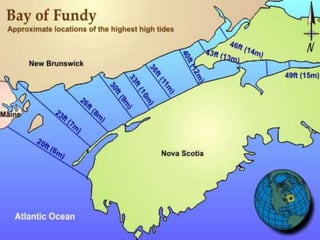
Greatest Tidal Variation in the 
World: Bay of Fundy, Nova Scotia
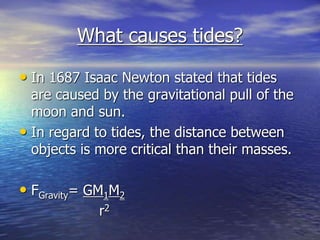
What causes tides? 
• In 1687 Isaac Newton stated that tides 
are caused by the gravitational pull of the 
moon and sun. 
• In regard to tides, the distance between 
objects is more critical than their masses. 
• FGravity= GM1M2 
r2
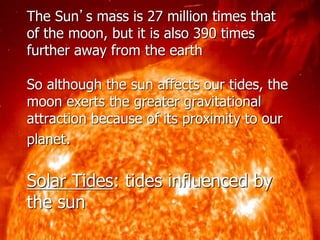
The Sun’s mass is 27 million times that 
of the moon, but it is also 390 times 
further away from the earth 
So although the sun affects our tides, the 
moon exerts the greater gravitational 
attraction because of its proximity to our 
planet. 
Solar Tides: tides influenced by 
the sun
The Main Culprit 
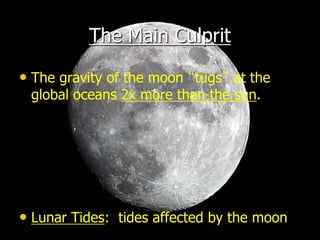
• The gravity of the moon “tugs” at the 
global oceans 2x more than the sun. 
• Lunar Tides: tides affected by the moon
Gravity, Inertia and Tidal Bulges 
• Inertia is the resistance of any physical 
object to a change in its state of motion or 
rest. 
• The gravitational attraction between the 
Earth and Moon is strongest on the side of 
the Earth facing the moon (it’s closer) 
• This causes water on the “near side” to be 
pulled towards the moon 
• Inertia attempts to keep the water in 
place, but gravity wins creating a bulge.
What about the Far Side? 
• On the opposite side of the earth the 
gravitational attraction is less, it is further 
away. 
• Here, inertia exceeds the gravitational 
force and the water “tries to keep going in 
a straight line” moving away from the 
Earth forming a bulge on the far side.
Tidal Variations 
Enhanced Solar Tides: Perihelion (1x per year) 
Enhanced Lunar Tides: Perigee (1x per month) 
Reduced Solar Tides: Aphelion (1x per year) 
Reduced Lunar Tides: Apogee (2x per month)
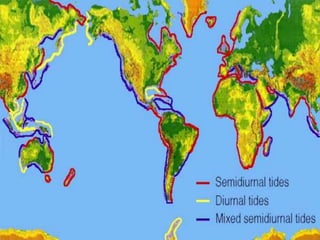
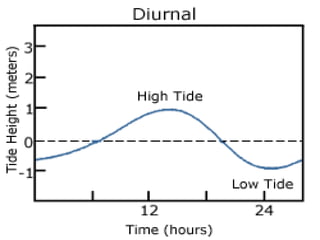
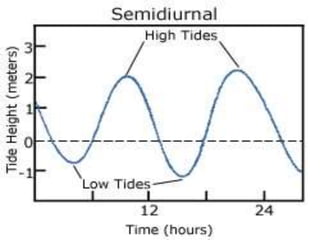
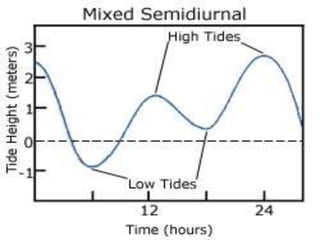
How many tides per day? 
• Semidiurnal: 2 high 
and 2 low tides every 
24 hours and 50 
minutes. 
• Diurnal: 1 high and 1 
low tide, caused by 
the a blockage of the 
tidal bulge by 
continents.
Spring Tide 
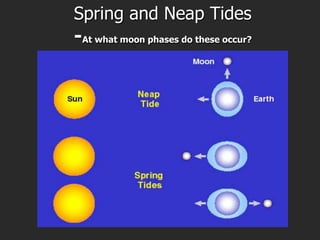
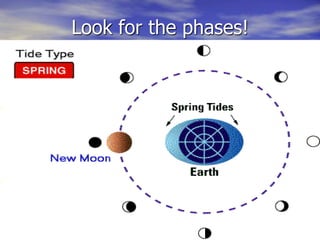
• When the Earth, moon and Sun are in line twice a month 
at new and full moons 
• Solar Tide pulls in the same direction as the Lunar Tide 
• Extremely High Tides and Extremely Low Tides (more 
extreme (about 20%) differences) 
• Hint: “S”pring tides = “S”traight line up
Neap Tide 
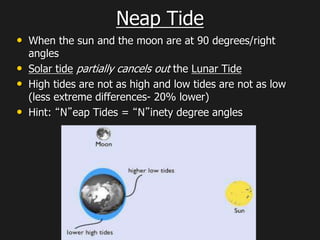
• When the sun and the moon are at 90 degrees/right 
angles 
• Solar tide partially cancels out the Lunar Tide 
• High tides are not as high and low tides are not as low 
(less extreme differences- 20% lower) 
• Hint: “N”eap Tides = “N”inety degree angles
Spring and Neap Tides 
-At what moon phases do these occur?
Look for the phases!

Tides (Coyle)

  • 1.
  • 2.
    What are Tides? • One of the most reliable phenomena in the world. • Tides are very long period waves that move through the ocean in response to forces exerted by the moon and to a lesser extent the sun. • Originate in the oceans and progress towards the coastline where they appear as the regular rise and fall of the ocean surface
  • 3.
    The Global Ocean • The Earth is covered by more than 70% water!! • All of the oceans are interconnected • They can move as a “system”
  • 4.
    High and LowTide • When the highest part, or the crest, of the wave reaches a particular location high tide occurs. • When the lowest part, or the trough, of the wave reaches a particular location low tide occurs. • Difference in height between high and low tide: tidal variation.
  • 5.
    This is hightide at Douglas (in Juneau, Alaska). Photo from Daniel Cornwall at Alaskan Librarian.
  • 6.
    This is Douglasat low tide. Photo from Daniel Cornwall at Alaskan Librarian.
  • 7.
    Ebb and FloodCurrents • A horizontal movement of water often accompanies the rising and falling of the tide: tidal current • Incoming tides = flood current • Outgoing tides = ebb current • Strongest before or near the time of high/low tide • Weakest between high/low tide: slack tides
  • 8.
    Where are tidesstrong or weak? • In the open ocean tidal currents are weak • Near estuary entrances, narrow straits and inlets the currents are strong and the tidal variation is high.
  • 9.
    Greatest Tidal Variationin the World: Bay of Fundy, Nova Scotia
  • 11.
    What causes tides? • In 1687 Isaac Newton stated that tides are caused by the gravitational pull of the moon and sun. • In regard to tides, the distance between objects is more critical than their masses. • FGravity= GM1M2 r2
  • 12.
    The Sun’s massis 27 million times that of the moon, but it is also 390 times further away from the earth So although the sun affects our tides, the moon exerts the greater gravitational attraction because of its proximity to our planet. Solar Tides: tides influenced by the sun
  • 13.
    The Main Culprit • The gravity of the moon “tugs” at the global oceans 2x more than the sun. • Lunar Tides: tides affected by the moon
  • 14.
    Gravity, Inertia andTidal Bulges • Inertia is the resistance of any physical object to a change in its state of motion or rest. • The gravitational attraction between the Earth and Moon is strongest on the side of the Earth facing the moon (it’s closer) • This causes water on the “near side” to be pulled towards the moon • Inertia attempts to keep the water in place, but gravity wins creating a bulge.
  • 15.
    What about theFar Side? • On the opposite side of the earth the gravitational attraction is less, it is further away. • Here, inertia exceeds the gravitational force and the water “tries to keep going in a straight line” moving away from the Earth forming a bulge on the far side.
  • 16.
    Tidal Variations EnhancedSolar Tides: Perihelion (1x per year) Enhanced Lunar Tides: Perigee (1x per month) Reduced Solar Tides: Aphelion (1x per year) Reduced Lunar Tides: Apogee (2x per month)
  • 17.
    How many tidesper day? • Semidiurnal: 2 high and 2 low tides every 24 hours and 50 minutes. • Diurnal: 1 high and 1 low tide, caused by the a blockage of the tidal bulge by continents.
  • 22.
    Spring Tide •When the Earth, moon and Sun are in line twice a month at new and full moons • Solar Tide pulls in the same direction as the Lunar Tide • Extremely High Tides and Extremely Low Tides (more extreme (about 20%) differences) • Hint: “S”pring tides = “S”traight line up
  • 23.
    Neap Tide •When the sun and the moon are at 90 degrees/right angles • Solar tide partially cancels out the Lunar Tide • High tides are not as high and low tides are not as low (less extreme differences- 20% lower) • Hint: “N”eap Tides = “N”inety degree angles
  • 24.
    Spring and NeapTides -At what moon phases do these occur?
  • 25.
    Look for thephases!