Nuclear Decay October 15 nd  & 16 th , 2009
The Atom- Review The atom consists of two parts: 1.  The nucleus which contains: 2.  Orbiting electrons. protons neutrons Atom of different elements contain different numbers of protons. The mass of an atom is due to the number of protons and neutrons.
X A Z Mass number Atomic number Element symbol =  number of protons + number of neutrons =  number of protons Isotope Symbol Review A   =  number of protons + number of neutrons Z   =  number of protons A – Z  =  number of neutrons **Number of neutrons = Mass Number – Atomic Number**
Fill in the chart for each isotope 235 92 92 143 92 92 238 146 Isotopes of any particular element contain the  same  number of protons, but  different   numbers of neutrons. U 235 92 U 238 92 A Z Number of protons Number of neutrons A Z Number of protons Number of neutrons
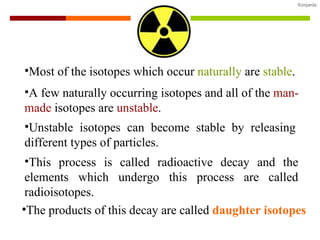
Most of the isotopes which occur  naturally  are  stable . A few naturally occurring isotopes and all of the  man-made  isotopes are  unstable . Unstable isotopes can become stable by releasing different types of particles. This process is called radioactive decay and the elements which undergo this process are called radioisotopes. The products of this decay are called  daughter isotopes
Radioactive decay results in the emission of either: an alpha particle (  ), a negative beta particle (electron) (   ), or a gamma ray   Radioactive Decay a positive beta particle (positron) (   ), In a nuclear reaction the  MASS  and  ATOMIC NUMBER  must be the  SAME  on both sides of the equations
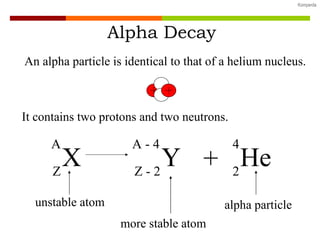
An alpha particle is identical to that of a helium nucleus. It contains two protons and two neutrons. Alpha Decay unstable atom more stable atom alpha particle X A Z Y A - 4 Z - 2 + He 4 2
Alpha Decay + Loss of 2 protons & 2 neutrons:  Atomic # decreases by 2 Mass # decreases by 4 Ra 226 88 Rn 222 86 He 4 2
Write your own Alpha Decay What is Y? X A Z Y A - 4 Z - 2 + He 4 2 Rn 222 86 + Y A Z He 4 2 Rn 222 86 He 4 2 + Po 218 84 He 4 2
Write the equation for the alpha  decay of Uranium-234  U 234 + He 4 2 U 234 92 + Th 230 90 He 4 2
Find the missing starting material X A Z + Pb 214  82 He 4 2 He 4 2 + Pb 214 82 He 4 2 Po 218 84
Beta Emission A beta particle is a fast moving electron which is emitted from the nucleus of an atom undergoing radioactive decay. Beta emission occurs when a  neutron changes into a proton and an electron . b eta particle  (electron) proton stays  in nucleus X A Z Y A Z + 1 + e 0 -1
Beta Emission + Neutron splits emitting negative particle leaving a proton. Atomic # increases by 1  Mass # stays the same (electrons have no mass) Po 218 84 e 0 -1 At 218 85
Write your own Beta Emission What is Y? X A Z Y A Z + 1 + e 0 -1 Th 234 90 Y A Z + e 0 -1 Th 234 90 Pa 234 91 + e 0 -1
Write the equation for the beta e mission of carbon-14 C 14 + C 14 N 14 7 + e 0 -1
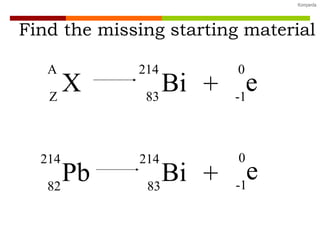
Find the missing starting material X A Z Bi 214 83 + e 0 -1 Pb 214 82 Bi 214 83 + e 0 -1
Electron Capture is the opposite of Beta Emission Electron Capture The capture of the electron allows a  proton to turn into a neutron X A Z e 0 -1 + Y A Z-1
Electron Capture + Capture negative particle, forming a neutron from a proton Atomic # decreases by 1  Mass # stays the same (electrons have no mass) Po 218 84 e 0 -1 At 218 85
Write your own Electron Capture What is Y? X A Z e 0 -1 + Y A Z-1 Ar 37 18 e 0 -1 + Y A Z-1 Ar 37 18 e 0 -1 + Cl 37 17
Write the equation for electron c apture of nickel-59 Ni 59 + Ni 59 28 e 0 -1 + Co 59 27
Find the missing starting material X A Z e 0 -1 + C 14 6 N 14 7 e 0 -1 + C 14 6
Positron Emission A positron is like an electron but it has a positive charge. During positron emission a  proton changes into a neutron  and the excess positive charge is emitted . positron mass stays  in nucleus X A Z Y A Z - 1 + e 0 +1
Positron Emission + Proton splits emitting positive particle leaving a neutron. Atomic # decreases by 1  Mass # stays the same (positrons, like electrons, have no mass) Po 218 84 e 0 +1 At 218 85
Write your own Positron Emission What is Y? X A Z Y A Z - 1 + e 0 +1 B 8 5 Y A Z + e 0 +1 B 8 5 Be 8 4 + e 0 +1
Write the equation for the positron e mission of oxygen-16 O 16 + O 16 N 16 7 + e 0 +1
Find the missing starting material X A Z Cu 66 29 + e 0 +1 Zn 66 30 Cu 66 29 + e 0 +1
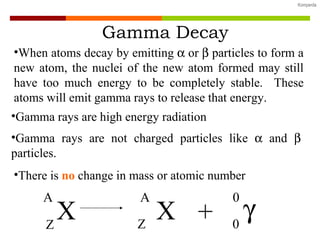
Gamma Decay Gamma rays are not charged particles like    and    particles. Gamma rays are high energy radiation When atoms decay by emitting    or    particles to form a new atom, the nuclei of the new atom formed may still have too much energy to be completely stable.  These atoms will emit gamma rays to release that energy. There is  no   change in mass or atomic number X A Z X A Z  +  0 0
Summary Reaction What happens? Mass # Atomic # Alpha Decay   Lose Helium Nucleus -4 -2 Beta Decay    - Lose electron from nucleus (neutron turns into proton) No change +1 Electron Capture Gain electron in nucleus (proton turns into neutron) No change -1 Positron Emission    Lose positron  (proton turns into neutron) No change -1 Gammy Decay   Emit high energy gamma ray No change No change
Nuclear Stability The strong nuclear force holds all nuclei together Otherwise protons would repel each other Neutrons space out protons and make nucleus stable Not all isotopes are radioactive Only  unstable   nuclei decay In smaller atoms stable isotopes have  equal  numbers of protons and neutrons In larger atoms stable isotopes will have  more  neutrons than protons Too many or too few neutrons makes the nucleus unstable
Nuclear Stability Graph Dark band =  stable nucleus Areas off line =  radioactive
Fission Fission is when a nucleus splits This is what happens in nuclear power plants Neutrons emitted during fission reactions can cause other fission reactions This is a  chain reaction In a nuclear reactor the chain reaction is controlled with control rods
Chain Reaction Each reaction allows multiple other reactions to occur Controlled vs Uncontrolled
Fusion When two or more elements fuse (combine) to form one new heavier element The energy released by the sun and all stars is due to fusion reactions in the core This process releases more energy than fission Fusion reactions are hard to contain because the reactants are a  plasma  and at very high temperatures, no solid material can contain a plasma
Fission Fusion Nuclei combine Nucleus splits End product is heavier than reactants End product is lighter than reactants Energy is released LOTS of energy released Can’t contain reaction Reaction can be harnessed Nuclear  Change

Nuclear Decay

  • 1.
    Nuclear Decay October15 nd & 16 th , 2009
  • 2.
    The Atom- ReviewThe atom consists of two parts: 1. The nucleus which contains: 2. Orbiting electrons. protons neutrons Atom of different elements contain different numbers of protons. The mass of an atom is due to the number of protons and neutrons.
  • 3.
    X A ZMass number Atomic number Element symbol = number of protons + number of neutrons = number of protons Isotope Symbol Review A = number of protons + number of neutrons Z = number of protons A – Z = number of neutrons **Number of neutrons = Mass Number – Atomic Number**
  • 4.
    Fill in thechart for each isotope 235 92 92 143 92 92 238 146 Isotopes of any particular element contain the same number of protons, but different numbers of neutrons. U 235 92 U 238 92 A Z Number of protons Number of neutrons A Z Number of protons Number of neutrons
  • 5.
    Most of theisotopes which occur naturally are stable . A few naturally occurring isotopes and all of the man-made isotopes are unstable . Unstable isotopes can become stable by releasing different types of particles. This process is called radioactive decay and the elements which undergo this process are called radioisotopes. The products of this decay are called daughter isotopes
  • 6.
    Radioactive decay resultsin the emission of either: an alpha particle (  ), a negative beta particle (electron) (   ), or a gamma ray  Radioactive Decay a positive beta particle (positron) (   ), In a nuclear reaction the MASS and ATOMIC NUMBER must be the SAME on both sides of the equations
  • 7.
    An alpha particleis identical to that of a helium nucleus. It contains two protons and two neutrons. Alpha Decay unstable atom more stable atom alpha particle X A Z Y A - 4 Z - 2 + He 4 2
  • 8.
    Alpha Decay +Loss of 2 protons & 2 neutrons: Atomic # decreases by 2 Mass # decreases by 4 Ra 226 88 Rn 222 86 He 4 2
  • 9.
    Write your ownAlpha Decay What is Y? X A Z Y A - 4 Z - 2 + He 4 2 Rn 222 86 + Y A Z He 4 2 Rn 222 86 He 4 2 + Po 218 84 He 4 2
  • 10.
    Write the equationfor the alpha decay of Uranium-234 U 234 + He 4 2 U 234 92 + Th 230 90 He 4 2
  • 11.
    Find the missingstarting material X A Z + Pb 214 82 He 4 2 He 4 2 + Pb 214 82 He 4 2 Po 218 84
  • 12.
    Beta Emission Abeta particle is a fast moving electron which is emitted from the nucleus of an atom undergoing radioactive decay. Beta emission occurs when a neutron changes into a proton and an electron . b eta particle (electron) proton stays in nucleus X A Z Y A Z + 1 + e 0 -1
  • 13.
    Beta Emission +Neutron splits emitting negative particle leaving a proton. Atomic # increases by 1 Mass # stays the same (electrons have no mass) Po 218 84 e 0 -1 At 218 85
  • 14.
    Write your ownBeta Emission What is Y? X A Z Y A Z + 1 + e 0 -1 Th 234 90 Y A Z + e 0 -1 Th 234 90 Pa 234 91 + e 0 -1
  • 15.
    Write the equationfor the beta e mission of carbon-14 C 14 + C 14 N 14 7 + e 0 -1
  • 16.
    Find the missingstarting material X A Z Bi 214 83 + e 0 -1 Pb 214 82 Bi 214 83 + e 0 -1
  • 17.
    Electron Capture isthe opposite of Beta Emission Electron Capture The capture of the electron allows a proton to turn into a neutron X A Z e 0 -1 + Y A Z-1
  • 18.
    Electron Capture +Capture negative particle, forming a neutron from a proton Atomic # decreases by 1 Mass # stays the same (electrons have no mass) Po 218 84 e 0 -1 At 218 85
  • 19.
    Write your ownElectron Capture What is Y? X A Z e 0 -1 + Y A Z-1 Ar 37 18 e 0 -1 + Y A Z-1 Ar 37 18 e 0 -1 + Cl 37 17
  • 20.
    Write the equationfor electron c apture of nickel-59 Ni 59 + Ni 59 28 e 0 -1 + Co 59 27
  • 21.
    Find the missingstarting material X A Z e 0 -1 + C 14 6 N 14 7 e 0 -1 + C 14 6
  • 22.
    Positron Emission Apositron is like an electron but it has a positive charge. During positron emission a proton changes into a neutron and the excess positive charge is emitted . positron mass stays in nucleus X A Z Y A Z - 1 + e 0 +1
  • 23.
    Positron Emission +Proton splits emitting positive particle leaving a neutron. Atomic # decreases by 1 Mass # stays the same (positrons, like electrons, have no mass) Po 218 84 e 0 +1 At 218 85
  • 24.
    Write your ownPositron Emission What is Y? X A Z Y A Z - 1 + e 0 +1 B 8 5 Y A Z + e 0 +1 B 8 5 Be 8 4 + e 0 +1
  • 25.
    Write the equationfor the positron e mission of oxygen-16 O 16 + O 16 N 16 7 + e 0 +1
  • 26.
    Find the missingstarting material X A Z Cu 66 29 + e 0 +1 Zn 66 30 Cu 66 29 + e 0 +1
  • 27.
    Gamma Decay Gammarays are not charged particles like  and  particles. Gamma rays are high energy radiation When atoms decay by emitting  or  particles to form a new atom, the nuclei of the new atom formed may still have too much energy to be completely stable. These atoms will emit gamma rays to release that energy. There is no change in mass or atomic number X A Z X A Z +  0 0
  • 28.
    Summary Reaction Whathappens? Mass # Atomic # Alpha Decay  Lose Helium Nucleus -4 -2 Beta Decay  - Lose electron from nucleus (neutron turns into proton) No change +1 Electron Capture Gain electron in nucleus (proton turns into neutron) No change -1 Positron Emission   Lose positron (proton turns into neutron) No change -1 Gammy Decay  Emit high energy gamma ray No change No change
  • 29.
    Nuclear Stability Thestrong nuclear force holds all nuclei together Otherwise protons would repel each other Neutrons space out protons and make nucleus stable Not all isotopes are radioactive Only unstable nuclei decay In smaller atoms stable isotopes have equal numbers of protons and neutrons In larger atoms stable isotopes will have more neutrons than protons Too many or too few neutrons makes the nucleus unstable
  • 30.
    Nuclear Stability GraphDark band = stable nucleus Areas off line = radioactive
  • 31.
    Fission Fission iswhen a nucleus splits This is what happens in nuclear power plants Neutrons emitted during fission reactions can cause other fission reactions This is a chain reaction In a nuclear reactor the chain reaction is controlled with control rods
  • 32.
    Chain Reaction Eachreaction allows multiple other reactions to occur Controlled vs Uncontrolled
  • 33.
    Fusion When twoor more elements fuse (combine) to form one new heavier element The energy released by the sun and all stars is due to fusion reactions in the core This process releases more energy than fission Fusion reactions are hard to contain because the reactants are a plasma and at very high temperatures, no solid material can contain a plasma
  • 34.
    Fission Fusion Nucleicombine Nucleus splits End product is heavier than reactants End product is lighter than reactants Energy is released LOTS of energy released Can’t contain reaction Reaction can be harnessed Nuclear Change