presents
a                  production


      Really
    Radioactive
           1
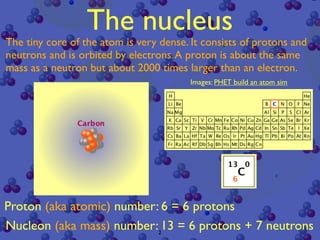
The nucleus
The tiny core of the atom is very dense. It consists of protons and
neutrons and is orbited by electrons. A proton is about the same
mass as a neutron but about 2000 times larger than an electron.
                                         Images: PHET build an atom sim


Proton (aka atomic) number: 6 = 6 protons
Nucleon (aka mass) number:213 = 6 protons + 7 neutrons
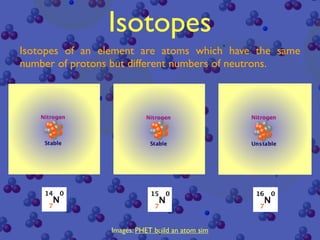
Isotopes
Isotopes of an element are atoms which have the same
number of protons but different numbers of neutrons.


                Images: PHET build an atom sim
                              3
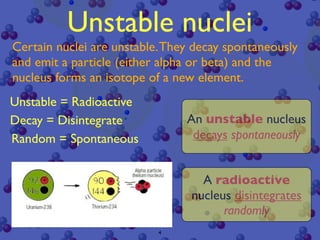
Unstable nuclei
Certain nuclei are unstable. They decay spontaneously
and emit a particle (either alpha or beta) and the
nucleus forms an isotope of a new element.
Unstable = Radioactive
Decay = Disintegrate            An unstable nucleus
Random = Spontaneous             decays spontaneously


                                   A radioactive
                                 nucleus disintegrates
                                       randomly
                           4
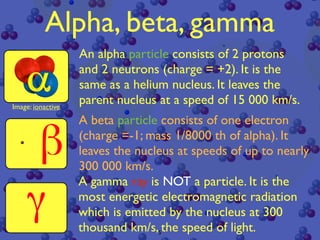
Alpha, beta, gamma
                   An alpha particle consists of 2 protons
                   and 2 neutrons (charge = +2). It is the
                   same as a helium nucleus. It leaves the
Image: ionactive
                   parent nucleus at a speed of 15 000 km/s.
                   A beta particle consists of one electron
                   (charge =-1; mass 1/8000 th of alpha). It
                   leaves the nucleus at speeds of up to nearly
                   300 000 km/s.
                   A gamma ray is NOT a particle. It is the
                   most energetic electromagnetic radiation
                   which is emitted by the nucleus at 300
                   thousand km/s,5the speed of light.
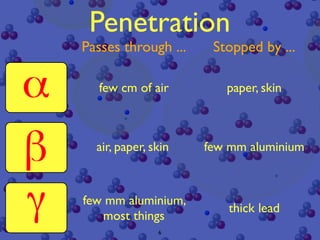
Penetration
Passes through ...    Stopped by ...

  few cm of air         paper, skin


  air, paper, skin   few mm aluminium


few mm aluminium,
                        thick lead
   most things
               6
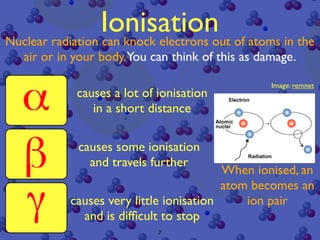
Ionisation of atoms in the
Nuclear radiation can knock electrons out
  air or in your body.You can think of this as damage.

                                                 Image: remnet
            causes a lot of ionisation
               in a short distance

            causes some ionisation
              and travels further
                                        When ionised, an
                                        atom becomes an
          causes very little ionisation     ion pair
            and is difficult to stop
                            7
Detecting radioactivity
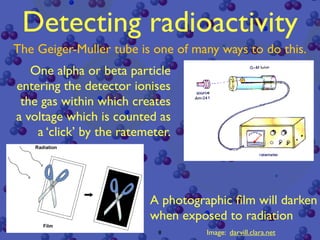
The Geiger-Muller tube is one of many ways to do this.
   One alpha or beta particle
entering the detector ionises
 the gas within which creates
a voltage which is counted as
    a ‘click’ by the ratemeter.


                          A photographic film will darken
                          when exposed to radiation
                            8       Image: darvill.clara.net
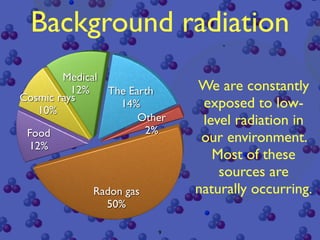
Background radiation
        Medical
          12%   The Earth     We are constantly
Cosmic rays
   10%
                  14%          exposed to low-
                      Other    level radiation in
 Food                  2%
                               our environment.
 12%
                                 Most of these
                                  sources are
             Radon gas        naturally occurring.
               50%

                         9
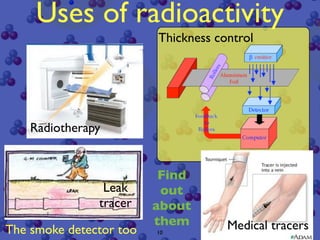
Uses of radioactivity
                         Thickness control


    Radiotherapy


                          Find
                Leak      out
               tracer    about
                         them        Medical tracers
The smoke detector too   10
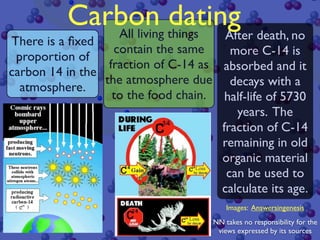
Carbon things After death, no
             All living
                        dating
There is a fixed
                   contain the same     more C-14 is
 proportion of
                  fraction of C-14 as absorbed and it
carbon 14 in the
                 the atmosphere due decays with a
  atmosphere.
                   to the food chain. half-life of 5730
                                         years. The
                                      fraction of C-14
                                      remaining in old
                                      organic material
                                       can be used to
                                      calculate its age.
                                          Images: Answersingenesis
                                      NN takes no responsibility for the
                           11          views expressed by its sources
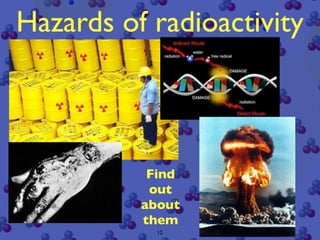
Hazards of radioactivity


           Find
           out
          about
          them
            12
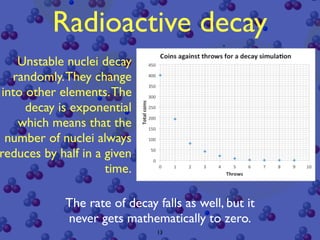
Radioactive decay
   Unstable nuclei decay
  randomly. They change
into other elements. The
     decay is exponential
   which means that the
 number of nuclei always
reduces by half in a given
                     time.

            The rate of decay falls as well, but it
            never gets mathematically to zero.
                              13
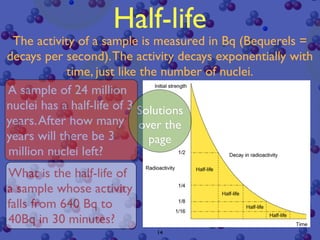
Half-life
 The activity of a sample is measured in Bq (Bequerels =
decays per second). The activity decays exponentially with
            time, just like the number of nuclei.
A sample of 24 million
nuclei has a half-life of 3 Solutions
years. After how many over the
years will there be 3         page
million nuclei left?
What is the half-life of
a sample whose activity
falls from 640 Bq to
40Bq in 30 minutes?
                            14
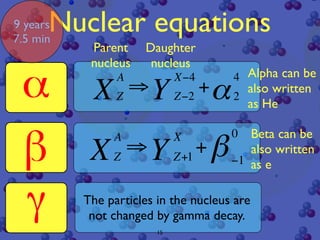
Nuclear equations
9 years
7.5 min
           Parent    Daughter
           nucleus    nucleus
                A            X−4      4 Alpha can be
            XZ ⇒ Y Z−2 + α 2              also written
                                          as He

               A             X        0  Beta can be
           XZ ⇒ Y Z+1 + β                also written
                                      −1 as e


          The particles in the nucleus are
           not changed by gamma decay.
                        15
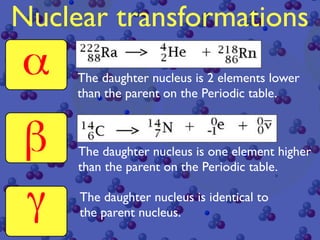
Nuclear transformations
     The daughter nucleus is 2 elements lower
     than the parent on the Periodic table.


     The daughter nucleus is one element higher
     than the parent on the Periodic table.

     The daughter nucleus is identical to
     the parent nucleus.

Really radioactive - igcse physics

  • 1.
    presents a production Really Radioactive 1
  • 2.
    The nucleus The tinycore of the atom is very dense. It consists of protons and neutrons and is orbited by electrons. A proton is about the same mass as a neutron but about 2000 times larger than an electron. Images: PHET build an atom sim Proton (aka atomic) number: 6 = 6 protons Nucleon (aka mass) number:213 = 6 protons + 7 neutrons
  • 3.
    Isotopes Isotopes of anelement are atoms which have the same number of protons but different numbers of neutrons. Images: PHET build an atom sim 3
  • 4.
    Unstable nuclei Certain nucleiare unstable. They decay spontaneously and emit a particle (either alpha or beta) and the nucleus forms an isotope of a new element. Unstable = Radioactive Decay = Disintegrate An unstable nucleus Random = Spontaneous decays spontaneously A radioactive nucleus disintegrates randomly 4
  • 5.
    Alpha, beta, gamma An alpha particle consists of 2 protons and 2 neutrons (charge = +2). It is the same as a helium nucleus. It leaves the Image: ionactive parent nucleus at a speed of 15 000 km/s. A beta particle consists of one electron (charge =-1; mass 1/8000 th of alpha). It leaves the nucleus at speeds of up to nearly 300 000 km/s. A gamma ray is NOT a particle. It is the most energetic electromagnetic radiation which is emitted by the nucleus at 300 thousand km/s,5the speed of light.
  • 6.
    Penetration Passes through ... Stopped by ... few cm of air paper, skin air, paper, skin few mm aluminium few mm aluminium, thick lead most things 6
  • 7.
    Ionisation of atomsin the Nuclear radiation can knock electrons out air or in your body.You can think of this as damage. Image: remnet causes a lot of ionisation in a short distance causes some ionisation and travels further When ionised, an atom becomes an causes very little ionisation ion pair and is difficult to stop 7
  • 8.
    Detecting radioactivity The Geiger-Mullertube is one of many ways to do this. One alpha or beta particle entering the detector ionises the gas within which creates a voltage which is counted as a ‘click’ by the ratemeter. A photographic film will darken when exposed to radiation 8 Image: darvill.clara.net
  • 9.
    Background radiation Medical 12% The Earth We are constantly Cosmic rays 10% 14% exposed to low- Other level radiation in Food 2% our environment. 12% Most of these sources are Radon gas naturally occurring. 50% 9
  • 10.
    Uses of radioactivity Thickness control Radiotherapy Find Leak out tracer about them Medical tracers The smoke detector too 10
  • 11.
    Carbon things Afterdeath, no All living dating There is a fixed contain the same more C-14 is proportion of fraction of C-14 as absorbed and it carbon 14 in the the atmosphere due decays with a atmosphere. to the food chain. half-life of 5730 years. The fraction of C-14 remaining in old organic material can be used to calculate its age. Images: Answersingenesis NN takes no responsibility for the 11 views expressed by its sources
  • 12.
    Hazards of radioactivity Find out about them 12
  • 13.
    Radioactive decay Unstable nuclei decay randomly. They change into other elements. The decay is exponential which means that the number of nuclei always reduces by half in a given time. The rate of decay falls as well, but it never gets mathematically to zero. 13
  • 14.
    Half-life The activityof a sample is measured in Bq (Bequerels = decays per second). The activity decays exponentially with time, just like the number of nuclei. A sample of 24 million nuclei has a half-life of 3 Solutions years. After how many over the years will there be 3 page million nuclei left? What is the half-life of a sample whose activity falls from 640 Bq to 40Bq in 30 minutes? 14
  • 15.
    Nuclear equations 9 years 7.5min Parent Daughter nucleus nucleus A X−4 4 Alpha can be XZ ⇒ Y Z−2 + α 2 also written as He A X 0 Beta can be XZ ⇒ Y Z+1 + β also written −1 as e The particles in the nucleus are not changed by gamma decay. 15
  • 16.
    Nuclear transformations The daughter nucleus is 2 elements lower than the parent on the Periodic table. The daughter nucleus is one element higher than the parent on the Periodic table. The daughter nucleus is identical to the parent nucleus.