The Geological Time
       Scale
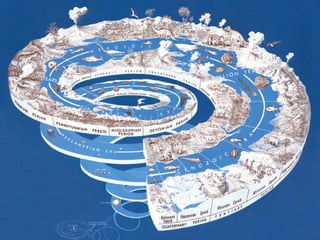
  4.6 Years of Earth History
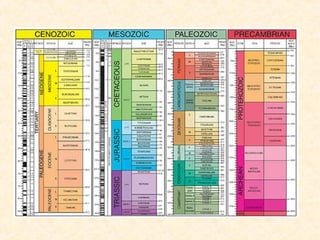
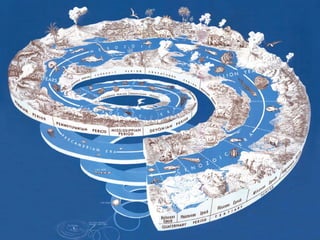
What is the Earth’s time scale?

• The Geological time scale is a record of
  the life forms and geological events in
  Earth’s history.
• Scientists developed the time scale by
  studying rock layers and fossils world
  wide.
• Radioactive dating helped determine the
  absolute divisions in the time scale.
Divisions of Geologic Time
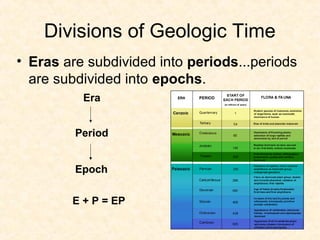
• Eras are subdivided into periods...periods
  are subdivided into epochs.
          Era


         Period


         Epoch

        E + P = EP
Divisions of Geologic Time
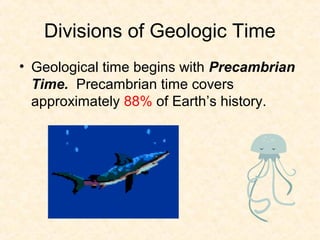
• Geological time begins with Precambrian
  Time. Precambrian time covers
  approximately 88% of Earth’s history.
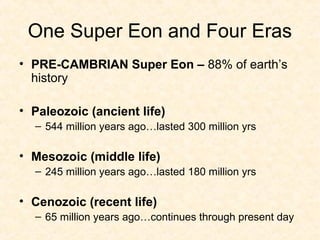
One Super Eon and Four Eras
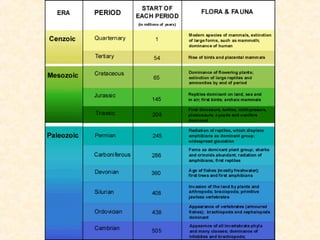
• PRE-CAMBRIAN Super Eon – 88% of earth’s
  history

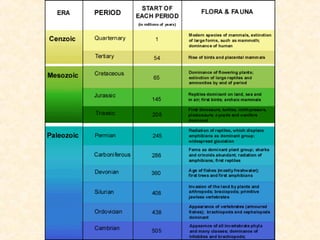
• Paleozoic (ancient life)
  – 544 million years ago…lasted 300 million yrs

• Mesozoic (middle life)
  – 245 million years ago…lasted 180 million yrs

• Cenozoic (recent life)
  – 65 million years ago…continues through present day
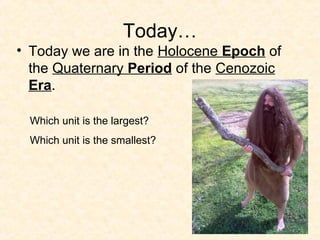
Today…
• Today we are in the Holocene Epoch of
  the Quaternary Period of the Cenozoic
  Era.

 Which unit is the largest?
 Which unit is the smallest?
Paleozoic Era (Ancient Life)
• The Cambrian period is the 1st period of the Paleozoic
  Era. “Age of the Trilobites” or the “Age of Fish”
• Explosion of life in the oceans began during this era.
• Most of the continents were covered in warm, shallow
  seas.
  – Invertebrates were dominant - Trilobites
  – Fish emerged during this time
  – Fish led to the arrival of amphibians
     • The end of the Paleozoic era is called the “Age of Amphibians”
  – Early land plants including mosses, ferns and cone-bearing
    plants.
  – The early coal forming forests were also formed during this
    time (Carboniferous Period)
Paleozoic Era
• Much of the limestone quarried for building and
  industrial purposes, as well as the coal deposits
  of western Europe and the eastern United
  States, were formed during the Paleozoic.

• The Cambrian (beginning) opened with the
  breakup of the world-continent Rodinia and
  closed with the formation of Pangaea, as the
  Earth's continents came together once again.
   – This event is thought to have caused the
     climate changes that led to mass extinction
     event.
• The Appalachian mountains were formed during
  this time.
Paleozoic Era
• At the end of the Paleozoic, the largest mass
  extinction in history wiped out approximately
  90% of all marine animal species and 70% of
  land animals.
  – Possible causes of this Mass Extinction Event
     • Lowering of sea levels when the continents were
       rejoined as Pangaea (convergent boundary)
     • Increased volcanic activity (ash and dust)
     • Climate changes – cooler climate
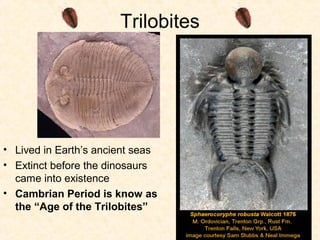
Trilobites


• Lived in Earth’s ancient seas
• Extinct before the dinosaurs
  came into existence
• Cambrian Period is know as
  the “Age of the Trilobites”
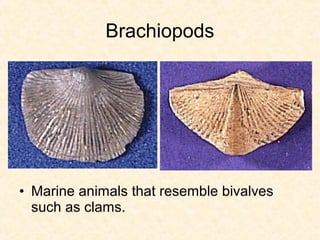
Brachiopods


• Marine animals that resemble bivalves
  such as clams.
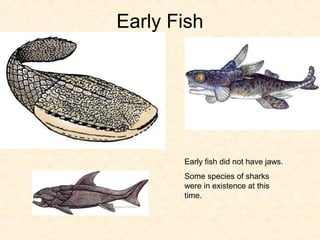
Early Fish


       Early fish did not have jaws.
       Some species of sharks
       were in existence at this
       time.
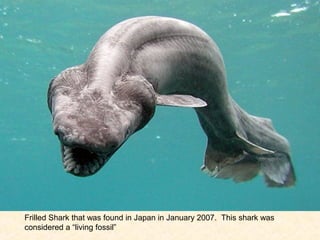
Frilled Shark that was found in Japan in January 2007. This shark was
considered a “living fossil”
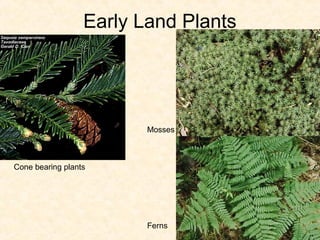
Early Land Plants


                         Mosses


Cone bearing plants


                         Ferns
Mesozoic Era – Middle Life
• At the beginning of this era the continents
  were joined as Pangaea.
• Pangaea broke up around the middle of
  this era.
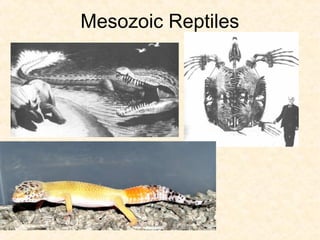
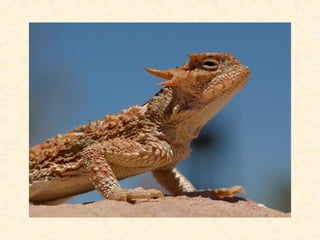
• Reptiles became the most abundant
  animals because of their ability to adapt to
  the drier climate of the Mesozoic Era.
  – Skin maintains body fluids
  – Embryos live in shells
Mesozoic Era
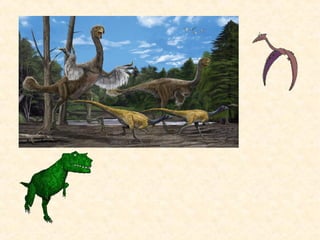
• Dinosaurs were also very active in this
  era.
  – First small dinosaurs appeared in the Triassic
    Period.
  – Larger and more abundant dinosaurs
    appeared in the Jurassic Period.
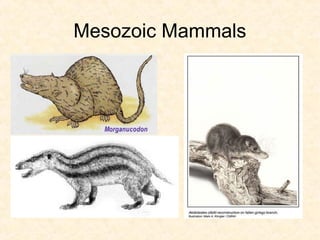
• Small mammals and birds also
  appeared during this era.
  – The mammals were small, warm-blooded
    animals. Hair covering their bodies.
     • These characteristics help them survive in
       changing environments.
Mesozoic Era
• The main plant life of this time were
  Gymnosperms or plants that produce seeds,
  but no flowers.
  – Pine Trees


• Flowering plants appeared during the END of
  this era.
Mesozoic Era
• This era ended with a mass extinction event
  about 65 million years ago.
  – Many groups of animals, including the dinosaurs
    disappeared suddenly at this time.


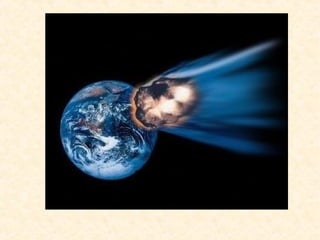
• Meteorite Impact Hypothesis
Mesozoic Era – Mass Extinction
              Event
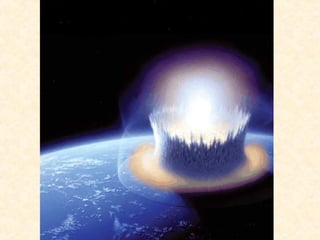
• Asteroid or Comet collides with Earth.

  –   Huge cloud of smoke and dust fills the air
  –   Blocks out sunlight
  –   Plants die
  –   Animals that eat plants die
  –   Animals that eat plant-eaters die.

• However, not all forms of life died during this
  event. Many animals that you see today are
  descendants from the survivors of this extinction
  event.
Mesozoic Reptiles
Mesozoic Mammals
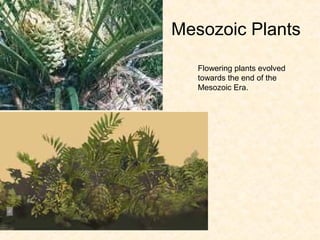
Mesozoic Plants

   Flowering plants evolved
   towards the end of the
   Mesozoic Era.
Cenozoic Era – Recent Life
• Began about 65 million years ago and continues
  today!!!!!
  – Climate was warm and mild.
  – Marine animals such as whales and dolphins evolved.

• Mammals began to increase and evolve adaptations
  that allowed them to live in many different
  environments – land, air and the sea.
  – Grasses increased and provided a food source for grazing
    animals

• Many mountain ranges formed during the Cenozoic
  Era
  – Alps in Europe and Himalayas in India; Rocky Mountains in
    the USA
Cenozoic Era
• Growth of these mountains may have helped to
  cool down the climate
  – Ice Ages occurred late in the Cenozoic Era
    (Quaternary Period).


• As the climate changed, the animals had to
  adapt to the rise and fall of the oceans caused
  by melting glaciers.

• This era is sometimes called the “Age of
  Mammals”
Cenozoic Era
• Marine animal examples:
  – Algae, Mollusks, Fish and Mammals


• Land animal examples:
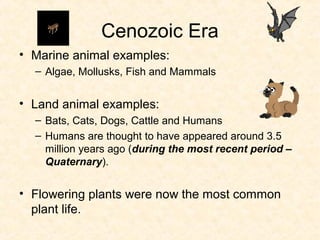
  – Bats, Cats, Dogs, Cattle and Humans
  – Humans are thought to have appeared around 3.5
    million years ago (during the most recent period –
    Quaternary).


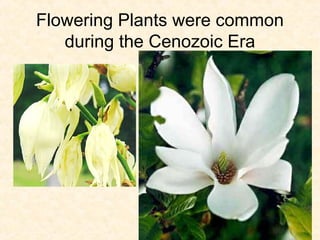
• Flowering plants were now the most common
  plant life.
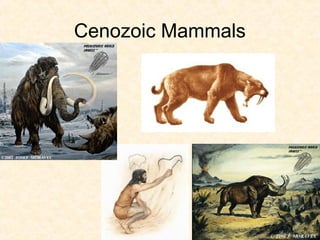
Cenozoic Mammals
Flowering Plants were common
   during the Cenozoic Era

The geological time scale

  • 1.
    The Geological Time Scale 4.6 Years of Earth History
  • 4.
    What is theEarth’s time scale? • The Geological time scale is a record of the life forms and geological events in Earth’s history. • Scientists developed the time scale by studying rock layers and fossils world wide. • Radioactive dating helped determine the absolute divisions in the time scale.
  • 6.
    Divisions of GeologicTime • Eras are subdivided into periods...periods are subdivided into epochs. Era Period Epoch E + P = EP
  • 7.
    Divisions of GeologicTime • Geological time begins with Precambrian Time. Precambrian time covers approximately 88% of Earth’s history.
  • 9.
    One Super Eonand Four Eras • PRE-CAMBRIAN Super Eon – 88% of earth’s history • Paleozoic (ancient life) – 544 million years ago…lasted 300 million yrs • Mesozoic (middle life) – 245 million years ago…lasted 180 million yrs • Cenozoic (recent life) – 65 million years ago…continues through present day
  • 10.
    Today… • Today weare in the Holocene Epoch of the Quaternary Period of the Cenozoic Era. Which unit is the largest? Which unit is the smallest?
  • 12.
    Paleozoic Era (AncientLife) • The Cambrian period is the 1st period of the Paleozoic Era. “Age of the Trilobites” or the “Age of Fish” • Explosion of life in the oceans began during this era. • Most of the continents were covered in warm, shallow seas. – Invertebrates were dominant - Trilobites – Fish emerged during this time – Fish led to the arrival of amphibians • The end of the Paleozoic era is called the “Age of Amphibians” – Early land plants including mosses, ferns and cone-bearing plants. – The early coal forming forests were also formed during this time (Carboniferous Period)
  • 13.
    Paleozoic Era • Muchof the limestone quarried for building and industrial purposes, as well as the coal deposits of western Europe and the eastern United States, were formed during the Paleozoic. • The Cambrian (beginning) opened with the breakup of the world-continent Rodinia and closed with the formation of Pangaea, as the Earth's continents came together once again. – This event is thought to have caused the climate changes that led to mass extinction event. • The Appalachian mountains were formed during this time.
  • 14.
    Paleozoic Era • Atthe end of the Paleozoic, the largest mass extinction in history wiped out approximately 90% of all marine animal species and 70% of land animals. – Possible causes of this Mass Extinction Event • Lowering of sea levels when the continents were rejoined as Pangaea (convergent boundary) • Increased volcanic activity (ash and dust) • Climate changes – cooler climate
  • 15.
    Trilobites • Lived inEarth’s ancient seas • Extinct before the dinosaurs came into existence • Cambrian Period is know as the “Age of the Trilobites”
  • 16.
    Brachiopods • Marine animalsthat resemble bivalves such as clams.
  • 17.
    Early Fish Early fish did not have jaws. Some species of sharks were in existence at this time.
  • 18.
    Frilled Shark thatwas found in Japan in January 2007. This shark was considered a “living fossil”
  • 19.
    Early Land Plants Mosses Cone bearing plants Ferns
  • 20.
    Mesozoic Era –Middle Life • At the beginning of this era the continents were joined as Pangaea. • Pangaea broke up around the middle of this era. • Reptiles became the most abundant animals because of their ability to adapt to the drier climate of the Mesozoic Era. – Skin maintains body fluids – Embryos live in shells
  • 21.
    Mesozoic Era • Dinosaurswere also very active in this era. – First small dinosaurs appeared in the Triassic Period. – Larger and more abundant dinosaurs appeared in the Jurassic Period. • Small mammals and birds also appeared during this era. – The mammals were small, warm-blooded animals. Hair covering their bodies. • These characteristics help them survive in changing environments.
  • 23.
    Mesozoic Era • Themain plant life of this time were Gymnosperms or plants that produce seeds, but no flowers. – Pine Trees • Flowering plants appeared during the END of this era.
  • 24.
    Mesozoic Era • Thisera ended with a mass extinction event about 65 million years ago. – Many groups of animals, including the dinosaurs disappeared suddenly at this time. • Meteorite Impact Hypothesis
  • 27.
    Mesozoic Era –Mass Extinction Event • Asteroid or Comet collides with Earth. – Huge cloud of smoke and dust fills the air – Blocks out sunlight – Plants die – Animals that eat plants die – Animals that eat plant-eaters die. • However, not all forms of life died during this event. Many animals that you see today are descendants from the survivors of this extinction event.
  • 28.
  • 29.
  • 31.
    Mesozoic Plants Flowering plants evolved towards the end of the Mesozoic Era.
  • 32.
    Cenozoic Era –Recent Life • Began about 65 million years ago and continues today!!!!! – Climate was warm and mild. – Marine animals such as whales and dolphins evolved. • Mammals began to increase and evolve adaptations that allowed them to live in many different environments – land, air and the sea. – Grasses increased and provided a food source for grazing animals • Many mountain ranges formed during the Cenozoic Era – Alps in Europe and Himalayas in India; Rocky Mountains in the USA
  • 33.
    Cenozoic Era • Growthof these mountains may have helped to cool down the climate – Ice Ages occurred late in the Cenozoic Era (Quaternary Period). • As the climate changed, the animals had to adapt to the rise and fall of the oceans caused by melting glaciers. • This era is sometimes called the “Age of Mammals”
  • 34.
    Cenozoic Era • Marineanimal examples: – Algae, Mollusks, Fish and Mammals • Land animal examples: – Bats, Cats, Dogs, Cattle and Humans – Humans are thought to have appeared around 3.5 million years ago (during the most recent period – Quaternary). • Flowering plants were now the most common plant life.
  • 35.
  • 36.
    Flowering Plants werecommon during the Cenozoic Era