Basic Nuclear Physics and
Radioactivity
By
Lawal Fatai A.
TRAINING FOR RADIATION SAFETY OFFICERS
Content
• Radiation and Radiation Sources
• Atomic structure, Z, A, isotopes
• Radioactivity
• X-ray production
• Properties of radiation: range, penetration
• Radioactive decay and half-life
• Radiation energy, eV,
• Summary
Radiation and Man
 Transfer (propagation) of energy from a source into space.
 A fact of life with ever growing applications
 We are exposed to radiation in our everyday life
• Solar radiation: Energy from the sun over 91m miles to sustain life on
Earth
• Infrared Radiations: Remote controls for TV, ACs, automobiles, etc.
• Microwave Radiations : Radar Communication and Cooking
Applications
• Radio-frequency Radiations: Radio (GSM etc.) and TV Broadcasting,
Navigation,
• X and Gamma Radiations: Medical Diagnostics and Therapeutics
Industrial Applications
i. Non-Destructive Testing (NDT) Radiography
Types of radiation
• Ionizing radiation: This type of radiation has enough energy
to remove electrons from atoms or molecules and causes
changes at the atomic level when interacting with matter
including living organisms.
• Non-ionizing radiation: This radiation has lower energy that is
not energetic enough to remove electrons from atoms or
molecules, whether in matter or living organisms.
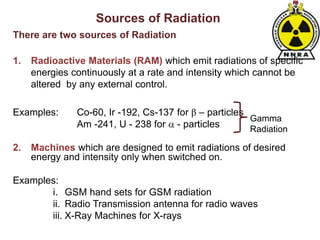
Sources of Radiation
There are two sources of Radiation
1. Radioactive Materials (RAM) which emit radiations of specific
energies continuously at a rate and intensity which cannot be
altered by any external control.
Examples: Co-60, Ir -192, Cs-137 for β – particles
Am -241, U - 238 for  - particles
2. Machines which are designed to emit radiations of desired
energy and intensity only when switched on.
Examples:
i. GSM hand sets for GSM radiation
ii. Radio Transmission antenna for radio waves
iii. X-Ray Machines for X-rays
Gamma
Radiation
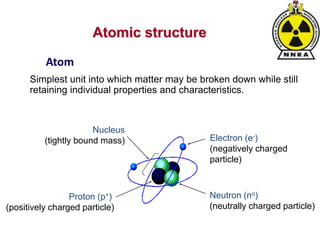
Atom
Nucleus
(tightly bound mass)
Proton (p+)
(positively charged particle)
Electron (e-)
(negatively charged
particle)
Neutron (no)
(neutrally charged particle)
Simplest unit into which matter may be broken down while still
retaining individual properties and characteristics.
Atomic structure
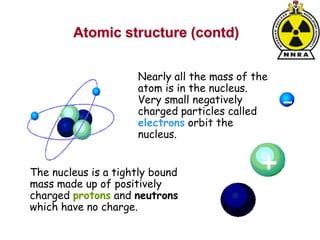
Nearly all the mass of the
atom is in the nucleus.
Very small negatively
charged particles called
electrons orbit the
nucleus.
The nucleus is a tightly bound
mass made up of positively
charged protons and neutrons
which have no charge.
Atomic structure (contd)
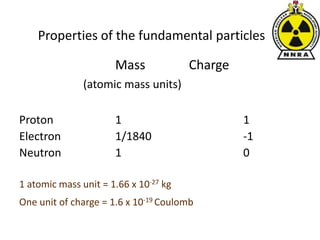
Properties of the fundamental particles
Mass Charge
(atomic mass units)
Proton 1 1
Electron 1/1840 -1
Neutron 1 0
1 atomic mass unit = 1.66 x 10⁻²⁷ kg
One unit of charge = 1.6 x 10⁻¹⁹ Coulomb
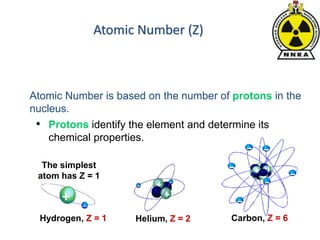
Atomic Number (Z)
The simplest
atom has Z = 1
Hydrogen, Z = 1 Helium, Z = 2 Carbon, Z = 6
Atomic Number is based on the number of protons in the
nucleus.
• Protons identify the element and determine its
chemical properties.
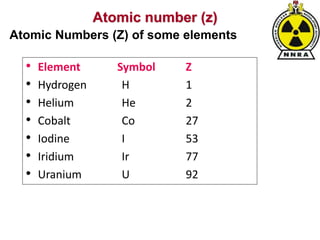
• Element Symbol Z
• Hydrogen H 1
• Helium He 2
• Cobalt Co 27
• Iodine I 53
• Iridium Ir 77
• Uranium U 92
Atomic Numbers (Z) of some elements
Atomic number (z)
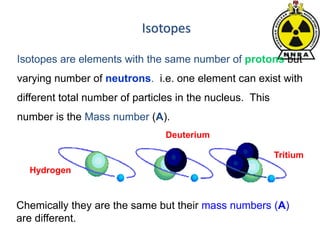
Isotopes
Chemically they are the same but their mass numbers (A)
are different.
Hydrogen
Deuterium
Tritium
Isotopes are elements with the same number of protons but
varying number of neutrons. i.e. one element can exist with
different total number of particles in the nucleus. This
number is the Mass number (A).
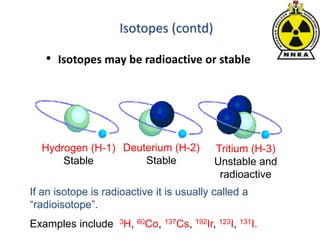
• Isotopes may be radioactive or stable
Hydrogen (H-1)
Stable
Deuterium (H-2)
Stable
Tritium (H-3)
Unstable and
radioactive
If an isotope is radioactive it is usually called a
“radioisotope”.
Examples include 3H, 60Co, 137Cs, 192Ir, 123I, 131I.
Isotopes (contd)
There is a particular ratio of the number of
neutrons N to the number of protons Z which a
nucleus must have in order to be stable
Radioactivity results from an atom with too many
or too few neutrons in the nucleus.
• Unstable atoms become stable by emitting
energy as radiation
• Different radioisotopes may emit different
types of ionizing radiation.
Radioactivity
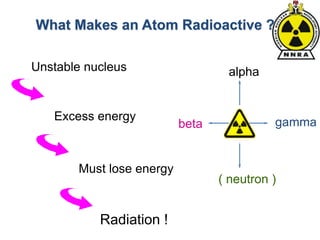
What Makes an Atom Radioactive ?
Unstable nucleus
Excess energy
Must lose energy
Radiation !
gamma
alpha
beta
( neutron )
Radiation
• .
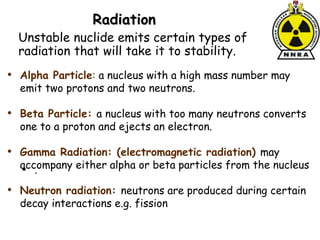
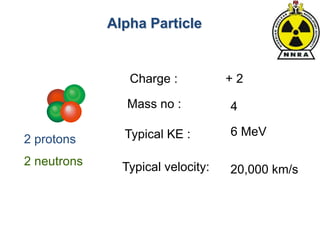
• Alpha Particle: a nucleus with a high mass number may
emit two protons and two neutrons.
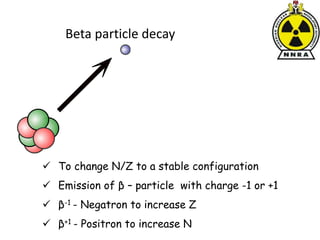
• Beta Particle: a nucleus with too many neutrons converts
one to a proton and ejects an electron.
• Gamma Radiation: (electromagnetic radiation) may
accompany either alpha or beta particles from the nucleus
• Neutron radiation: neutrons are produced during certain
decay interactions e.g. fission
Unstable nuclide emits certain types of
radiation that will take it to stability.
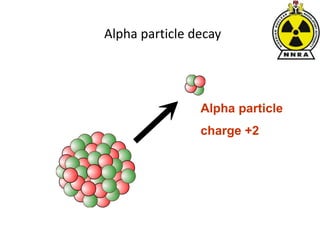
Alpha particle decay
Alpha particle
charge +2
Charge :
Mass no :
Typical KE :
Typical velocity:
2 protons
2 neutrons
+ 2
4
6 MeV
20,000 km/s
Alpha Particle
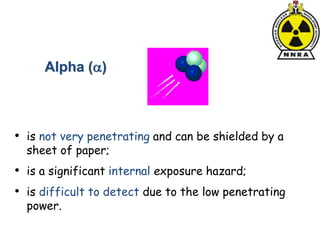
• is not very penetrating and can be shielded by a
sheet of paper;
• is a significant internal exposure hazard;
• is difficult to detect due to the low penetrating
power.
Alpha ()
 To change N/Z to a stable configuration
 Emission of β – particle with charge -1 or +1
 β-1 - Negatron to increase Z
 β+1 - Positron to increase N
Beta particle decay
• in most cases are negatively charged
electrons;
• is more penetrating than alpha but still can be
shielded by a thin sheet of metal;
• is an external eye and skin exposure hazard;
• is an internal exposure hazard;
Detection depends on the energy of the beta
particles.
Beta ()
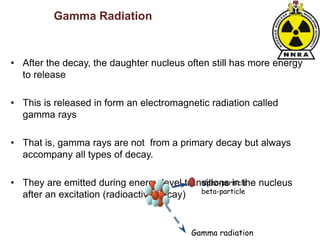
Gamma Radiation
• After the decay, the daughter nucleus often still has more energy
to release
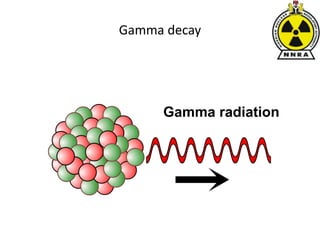
• This is released in form an electromagnetic radiation called
gamma rays
• That is, gamma rays are not from a primary decay but always
accompany all types of decay.
• They are emitted during energy level transitions in the nucleus
after an excitation (radioactive decay)
alpha-particle
beta-particle
Gamma radiation
Gamma decay
Gamma radiation
Radioactive Decay and Half-life (T½)
Radioactive emissions result from the decay (or
transformation) of unstable nuclei.
 The rate of decay of a radioisotope is
characteristic of the particular radionuclide.
 The time it takes for half of the atoms to decay
is called the half-life (T½).
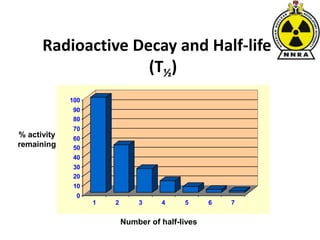
 After one half-life the activity within the
material will be half its original value;
 After two half-lives the activity will be one
quarter.
Radioactive Decay and Half-life
(T½)
Number of half-lives
0
10
20
30
40
50
60
70
80
90
100
1 2 3 4 5 6 7
% activity
remaining
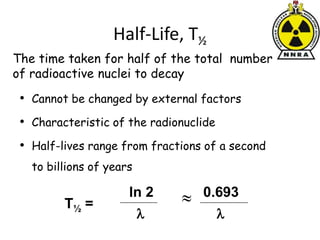
Half-Life, T½
• Cannot be changed by external factors
• Characteristic of the radionuclide
• Half-lives range from fractions of a second
to billions of years
The time taken for half of the total number
of radioactive nuclei to decay
T½ =
ln 2

0.693


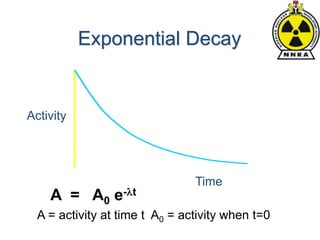
Activity
Time
A = A0 e-t
A = activity at time t A0 = activity when t=0
Exponential Decay
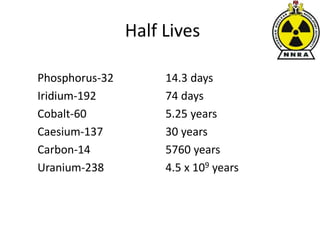
Half Lives
Phosphorus-32 14.3 days
Iridium-192 74 days
Cobalt-60 5.25 years
Caesium-137 30 years
Carbon-14 5760 years
Uranium-238 4.5 x 10⁹ years
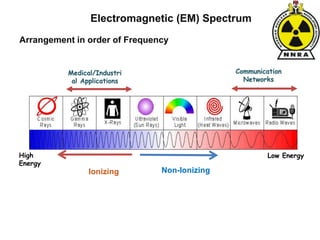
High
Energy
Electromagnetic (EM) Spectrum
Ionizing Non-Ionizing
Low Energy
Communication
Networks
Medical/Industri
al Applications
Arrangement in order of Frequency
• has no mass and no charge but can be extremely
penetrating;
• must be shielded by heavy or massive material
such as steel and lead, or concrete;
• is both an external and internal exposure hazard;
• may be readily detected.
Gamma () radiation
Gamma () radiation:
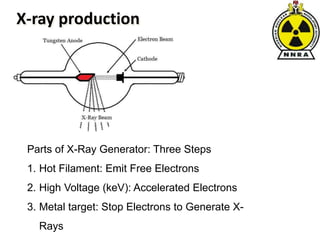
X-ray production
Parts of X-Ray Generator: Three Steps
1. Hot Filament: Emit Free Electrons
2. High Voltage (keV): Accelerated Electrons
3. Metal target: Stop Electrons to Generate X-
Rays
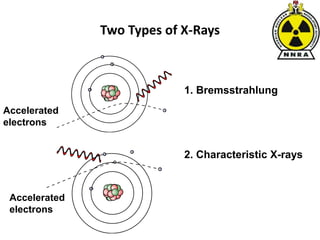
Two Types of X-Rays
1. Bremsstrahlung
2. Characteristic X-rays
Accelerated
electrons
Accelerated
electrons
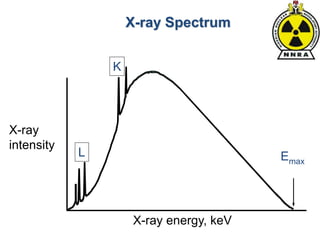
Emax
X-ray Spectrum
X-ray
intensity
X-ray energy, keV
K
L
Output from X-ray Sources
The output of an x-ray set is given for any type of
set (voltage, filtration, etc).
The dose rate is proportional to the tube current:
double the current double the dose rate
halve the current halve the dose rate
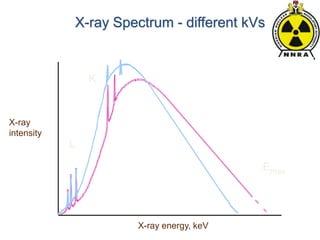
X-ray Spectrum - different kVs
X-ray
intensity
X-ray energy, keV
K
L
Emax
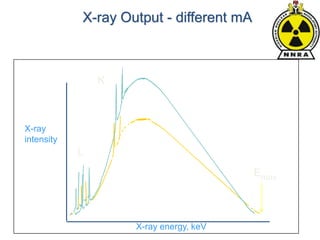
X-ray Output - different mA
X-ray
intensity
K
L
X-ray energy, keV
Emax
• are artificially generated electrically, although
some originate from the decay of radioactive
material;
• have properties that can be considered to be
almost identical to gamma rays, except that they
usually have lower energies and longer wavelengths.
X-rays
Properties of X-rays:
• Free neutrons can exist as a type of radiation.
• Uncharged themselves, they may be absorbed by
other nuclei rendering such nuclei unstable and
therefore radioactive.
• This process is called activation.
• Neutrons are very penetrating and can cause
significant biological damage.
Neutron (n)
Neutron (n)
• Particulate radiation
• No electrical charge
• Classified according to energy
• Effective shielding (absorption) by hydrogen
rich material
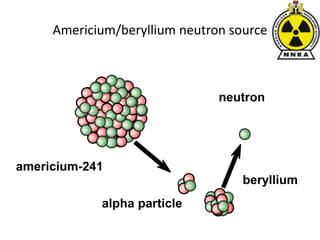
Americium/beryllium neutron source
americium-241
neutron
beryllium
alpha particle
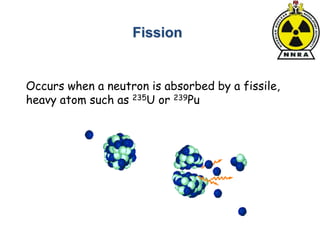
Fission
Occurs when a neutron is absorbed by a fissile,
heavy atom such as 235U or 239Pu
1. The energy or ‘strength’ of the radiation
indicates the penetrating power of that
radiation.
2. It is expressed in electron volts (eV).
3. 1 eV is the energy gained by an electron when it
is accelerated through a potential difference of
1 volt
4. More convenient units are generally used:
• keV - kilo-electron volt i.e. 103 eV)
• MeV - Mega-electron volt i.e. 106 eV)
Radiation Energy
Radiation Energy
• 60Co emits gamma radiation with two discrete
energies - 1.17 and 1.33 MeV (in a given ratio)
• 137Cs emits gamma radiation with one discrete
energy – 0.662 MeV
• 14C emits beta particles (only) with a maximum
energy of 0.156 MeV
Each radioisotope emits a characteristic
spectrum of radiation energies as it decays.
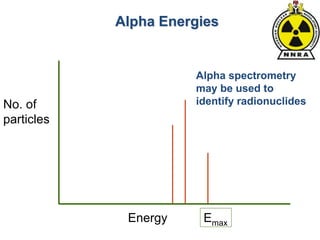
Alpha Energies
No. of
particles
Energy Emax
Alpha spectrometry
may be used to
identify radionuclides
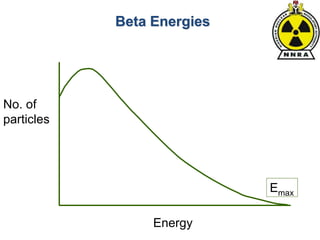
Beta Energies
No. of
particles
Energy
Emax
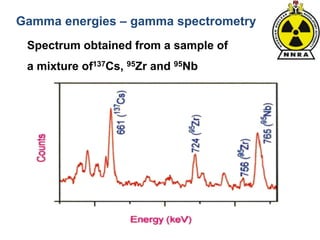
Spectrum obtained from a sample of
a mixture of137Cs, 95Zr and 95Nb
Gamma energies – gamma spectrometry
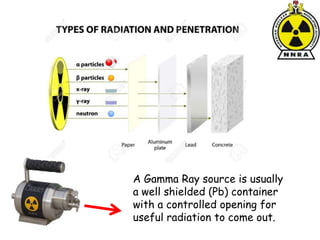
A Gamma Ray source is usually
a well shielded (Pb) container
with a controlled opening for
useful radiation to come out.
Summary
• Atomic structure, Z, A, isotopes
• Alpha, beta, gamma, x-ray, ionization
• Radioactive decay, half-life, equilibrium
• Radiation energy, eV,
• Properties of radiation: range, penetration and
shielding
Thank You
for your attention

3-Basic Nuclear Physics and Radioactivity new (2).ppt

  • 1.
    Basic Nuclear Physicsand Radioactivity By Lawal Fatai A. TRAINING FOR RADIATION SAFETY OFFICERS
  • 2.
    Content • Radiation andRadiation Sources • Atomic structure, Z, A, isotopes • Radioactivity • X-ray production • Properties of radiation: range, penetration • Radioactive decay and half-life • Radiation energy, eV, • Summary
  • 3.
    Radiation and Man Transfer (propagation) of energy from a source into space.  A fact of life with ever growing applications  We are exposed to radiation in our everyday life • Solar radiation: Energy from the sun over 91m miles to sustain life on Earth • Infrared Radiations: Remote controls for TV, ACs, automobiles, etc. • Microwave Radiations : Radar Communication and Cooking Applications • Radio-frequency Radiations: Radio (GSM etc.) and TV Broadcasting, Navigation, • X and Gamma Radiations: Medical Diagnostics and Therapeutics Industrial Applications i. Non-Destructive Testing (NDT) Radiography
  • 4.
    Types of radiation •Ionizing radiation: This type of radiation has enough energy to remove electrons from atoms or molecules and causes changes at the atomic level when interacting with matter including living organisms. • Non-ionizing radiation: This radiation has lower energy that is not energetic enough to remove electrons from atoms or molecules, whether in matter or living organisms.
  • 5.
    Sources of Radiation Thereare two sources of Radiation 1. Radioactive Materials (RAM) which emit radiations of specific energies continuously at a rate and intensity which cannot be altered by any external control. Examples: Co-60, Ir -192, Cs-137 for β – particles Am -241, U - 238 for  - particles 2. Machines which are designed to emit radiations of desired energy and intensity only when switched on. Examples: i. GSM hand sets for GSM radiation ii. Radio Transmission antenna for radio waves iii. X-Ray Machines for X-rays Gamma Radiation
  • 6.
    Atom Nucleus (tightly bound mass) Proton(p+) (positively charged particle) Electron (e-) (negatively charged particle) Neutron (no) (neutrally charged particle) Simplest unit into which matter may be broken down while still retaining individual properties and characteristics. Atomic structure
  • 7.
    Nearly all themass of the atom is in the nucleus. Very small negatively charged particles called electrons orbit the nucleus. The nucleus is a tightly bound mass made up of positively charged protons and neutrons which have no charge. Atomic structure (contd)
  • 8.
    Properties of thefundamental particles Mass Charge (atomic mass units) Proton 1 1 Electron 1/1840 -1 Neutron 1 0 1 atomic mass unit = 1.66 x 10⁻²⁷ kg One unit of charge = 1.6 x 10⁻¹⁹ Coulomb
  • 9.
    Atomic Number (Z) Thesimplest atom has Z = 1 Hydrogen, Z = 1 Helium, Z = 2 Carbon, Z = 6 Atomic Number is based on the number of protons in the nucleus. • Protons identify the element and determine its chemical properties.
  • 10.
    • Element SymbolZ • Hydrogen H 1 • Helium He 2 • Cobalt Co 27 • Iodine I 53 • Iridium Ir 77 • Uranium U 92 Atomic Numbers (Z) of some elements Atomic number (z)
  • 11.
    Isotopes Chemically they arethe same but their mass numbers (A) are different. Hydrogen Deuterium Tritium Isotopes are elements with the same number of protons but varying number of neutrons. i.e. one element can exist with different total number of particles in the nucleus. This number is the Mass number (A).
  • 12.
    • Isotopes maybe radioactive or stable Hydrogen (H-1) Stable Deuterium (H-2) Stable Tritium (H-3) Unstable and radioactive If an isotope is radioactive it is usually called a “radioisotope”. Examples include 3H, 60Co, 137Cs, 192Ir, 123I, 131I. Isotopes (contd)
  • 13.
    There is aparticular ratio of the number of neutrons N to the number of protons Z which a nucleus must have in order to be stable Radioactivity results from an atom with too many or too few neutrons in the nucleus. • Unstable atoms become stable by emitting energy as radiation • Different radioisotopes may emit different types of ionizing radiation. Radioactivity
  • 14.
    What Makes anAtom Radioactive ? Unstable nucleus Excess energy Must lose energy Radiation ! gamma alpha beta ( neutron )
  • 15.
    Radiation • . • AlphaParticle: a nucleus with a high mass number may emit two protons and two neutrons. • Beta Particle: a nucleus with too many neutrons converts one to a proton and ejects an electron. • Gamma Radiation: (electromagnetic radiation) may accompany either alpha or beta particles from the nucleus • Neutron radiation: neutrons are produced during certain decay interactions e.g. fission Unstable nuclide emits certain types of radiation that will take it to stability.
  • 16.
    Alpha particle decay Alphaparticle charge +2
  • 17.
    Charge : Mass no: Typical KE : Typical velocity: 2 protons 2 neutrons + 2 4 6 MeV 20,000 km/s Alpha Particle
  • 18.
    • is notvery penetrating and can be shielded by a sheet of paper; • is a significant internal exposure hazard; • is difficult to detect due to the low penetrating power. Alpha ()
  • 19.
     To changeN/Z to a stable configuration  Emission of β – particle with charge -1 or +1  β-1 - Negatron to increase Z  β+1 - Positron to increase N Beta particle decay
  • 20.
    • in mostcases are negatively charged electrons; • is more penetrating than alpha but still can be shielded by a thin sheet of metal; • is an external eye and skin exposure hazard; • is an internal exposure hazard; Detection depends on the energy of the beta particles. Beta ()
  • 21.
    Gamma Radiation • Afterthe decay, the daughter nucleus often still has more energy to release • This is released in form an electromagnetic radiation called gamma rays • That is, gamma rays are not from a primary decay but always accompany all types of decay. • They are emitted during energy level transitions in the nucleus after an excitation (radioactive decay) alpha-particle beta-particle Gamma radiation
  • 22.
  • 23.
    Radioactive Decay andHalf-life (T½) Radioactive emissions result from the decay (or transformation) of unstable nuclei.  The rate of decay of a radioisotope is characteristic of the particular radionuclide.  The time it takes for half of the atoms to decay is called the half-life (T½).  After one half-life the activity within the material will be half its original value;  After two half-lives the activity will be one quarter.
  • 24.
    Radioactive Decay andHalf-life (T½) Number of half-lives 0 10 20 30 40 50 60 70 80 90 100 1 2 3 4 5 6 7 % activity remaining
  • 25.
    Half-Life, T½ • Cannotbe changed by external factors • Characteristic of the radionuclide • Half-lives range from fractions of a second to billions of years The time taken for half of the total number of radioactive nuclei to decay T½ = ln 2  0.693  
  • 26.
    Activity Time A = A0e-t A = activity at time t A0 = activity when t=0 Exponential Decay
  • 27.
    Half Lives Phosphorus-32 14.3days Iridium-192 74 days Cobalt-60 5.25 years Caesium-137 30 years Carbon-14 5760 years Uranium-238 4.5 x 10⁹ years
  • 28.
    High Energy Electromagnetic (EM) Spectrum IonizingNon-Ionizing Low Energy Communication Networks Medical/Industri al Applications Arrangement in order of Frequency
  • 29.
    • has nomass and no charge but can be extremely penetrating; • must be shielded by heavy or massive material such as steel and lead, or concrete; • is both an external and internal exposure hazard; • may be readily detected. Gamma () radiation Gamma () radiation:
  • 30.
    X-ray production Parts ofX-Ray Generator: Three Steps 1. Hot Filament: Emit Free Electrons 2. High Voltage (keV): Accelerated Electrons 3. Metal target: Stop Electrons to Generate X- Rays
  • 31.
    Two Types ofX-Rays 1. Bremsstrahlung 2. Characteristic X-rays Accelerated electrons Accelerated electrons
  • 32.
  • 33.
    Output from X-raySources The output of an x-ray set is given for any type of set (voltage, filtration, etc). The dose rate is proportional to the tube current: double the current double the dose rate halve the current halve the dose rate
  • 34.
    X-ray Spectrum -different kVs X-ray intensity X-ray energy, keV K L Emax
  • 35.
    X-ray Output -different mA X-ray intensity K L X-ray energy, keV Emax
  • 36.
    • are artificiallygenerated electrically, although some originate from the decay of radioactive material; • have properties that can be considered to be almost identical to gamma rays, except that they usually have lower energies and longer wavelengths. X-rays Properties of X-rays:
  • 37.
    • Free neutronscan exist as a type of radiation. • Uncharged themselves, they may be absorbed by other nuclei rendering such nuclei unstable and therefore radioactive. • This process is called activation. • Neutrons are very penetrating and can cause significant biological damage. Neutron (n)
  • 38.
    Neutron (n) • Particulateradiation • No electrical charge • Classified according to energy • Effective shielding (absorption) by hydrogen rich material
  • 39.
  • 40.
    Fission Occurs when aneutron is absorbed by a fissile, heavy atom such as 235U or 239Pu
  • 41.
    1. The energyor ‘strength’ of the radiation indicates the penetrating power of that radiation. 2. It is expressed in electron volts (eV). 3. 1 eV is the energy gained by an electron when it is accelerated through a potential difference of 1 volt 4. More convenient units are generally used: • keV - kilo-electron volt i.e. 103 eV) • MeV - Mega-electron volt i.e. 106 eV) Radiation Energy
  • 42.
    Radiation Energy • 60Coemits gamma radiation with two discrete energies - 1.17 and 1.33 MeV (in a given ratio) • 137Cs emits gamma radiation with one discrete energy – 0.662 MeV • 14C emits beta particles (only) with a maximum energy of 0.156 MeV Each radioisotope emits a characteristic spectrum of radiation energies as it decays.
  • 43.
    Alpha Energies No. of particles EnergyEmax Alpha spectrometry may be used to identify radionuclides
  • 44.
  • 45.
    Spectrum obtained froma sample of a mixture of137Cs, 95Zr and 95Nb Gamma energies – gamma spectrometry
  • 46.
    A Gamma Raysource is usually a well shielded (Pb) container with a controlled opening for useful radiation to come out.
  • 47.
    Summary • Atomic structure,Z, A, isotopes • Alpha, beta, gamma, x-ray, ionization • Radioactive decay, half-life, equilibrium • Radiation energy, eV, • Properties of radiation: range, penetration and shielding
  • 48.