Radioactivity
   Medical Physics
Unit 20 strand 1 (part)
To achieve a pass grade the   To achieve a merit grade the
evidence must show that the   evidence must show that, in
learner is able to:           addition to the pass criteria,
                              the learner is able to:


P1 describe radioactivity,    M1 explain the random
including atomic structure    nature of decay and how it
                              relates to half-life
What is radiation?
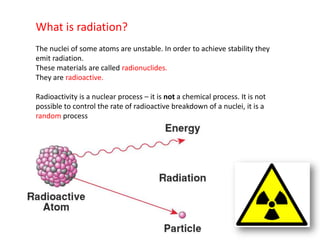
The nuclei of some atoms are unstable. In order to achieve stability they
emit radiation.
These materials are called radionuclides.
They are radioactive.

Radioactivity is a nuclear process – it is not a chemical process. It is not
possible to control the rate of radioactive breakdown of a nuclei, it is a
random process


     Radioactivity: industrial applications
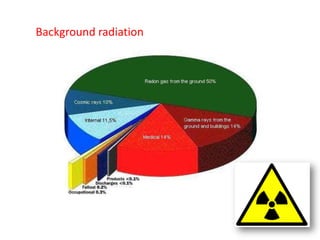
Background radiation
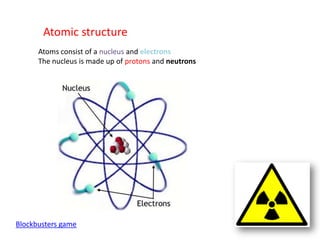
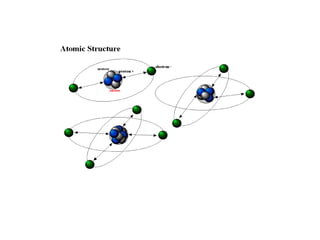
Atomic structure
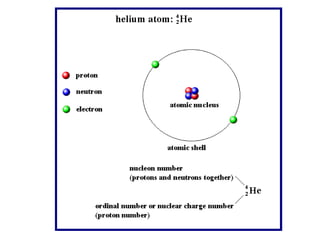
      Atoms consist of a nucleus and electrons
      The nucleus is made up of protons and neutrons


Blockbusters game
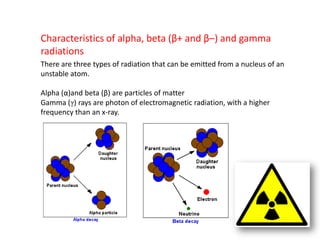
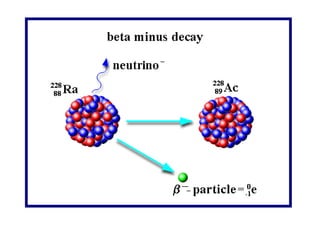
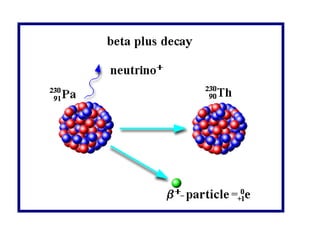
Characteristics of alpha, beta (β+ and β–) and gamma
radiations
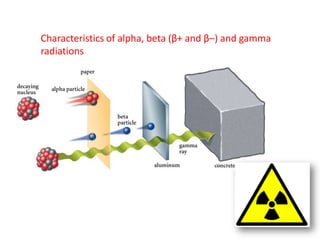
There are three types of radiation that can be emitted from a nucleus of an
unstable atom.

Alpha (α)and beta (β) are particles of matter
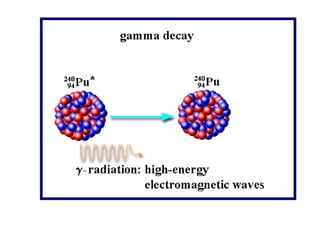
Gamma (γ) rays are photon of electromagnetic radiation, with a higher
frequency than an x-ray.
Characteristics of alpha, beta (β+ and β–) and gamma
 radiations


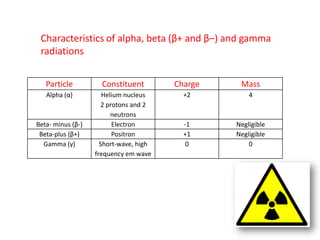
   Particle          Constituent        Charge    Mass
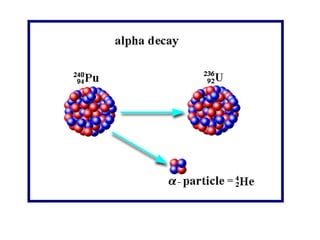
   Alpha (α)          Helium nucleus      +2         4
                      2 protons and 2
                         neutrons
Beta- minus (β-)          Electron        -1     Negligible
 Beta-plus (β+)           Positron        +1     Negligible
  Gamma (γ)          Short-wave, high      0         0
                   frequency em wave
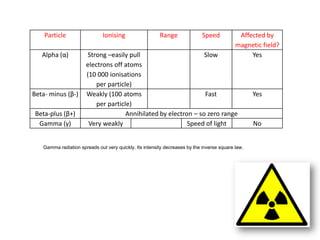
Particle                  Ionising                  Range               Speed           Affected by
                                                                                           magnetic field?
   Alpha (α)          Strong –easily pull                        Slow                           Yes
                      electrons off atoms
                      (10 000 ionisations
                          per particle)
Beta- minus (β-)      Weakly (100 atoms                          Fast                             Yes
                          per particle)
 Beta-plus (β+)                      Annihilated by electron – so zero range
  Gamma (γ)            Very weakly                         Speed of light                         No


   Gamma radiation spreads out very quickly. Its intensity decreases by the inverse square law.
Characteristics of alpha, beta (β+ and β–) and gamma
radiations
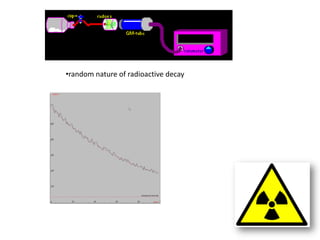
•random nature of radioactive decay
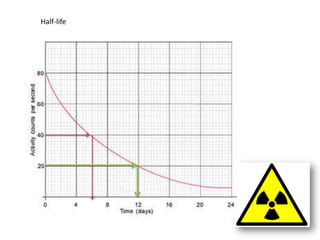
• The half-life of a radioactive isotope is defined as the
time it takes for the number of nuclei of the isotope in a
sample to halve or the time it takes for the count rate
from a sample containing the isotope to fall to half its
initial level.
Half-life
Resources
Specific texts
Jean Pope Medical Physics: Imaging (Heineman Advanced Science )
Roger Muncaster Medical Physics (A-Level Physics) Cheltenham: Stanley Thornes
(Publishers) Ltd
Martin Hollins (1990) Medical Physics (University of Btah Macmillan Science 16-19
Project) Basingstoke: Macmillan
John Ball and Adrian Moore (1997 3rd edn) Essential Physics for Radiographers
Oxford: Blackwell

General Physics books
Keith Johnson, Simmone Hewett, Sue Holt, John Miller (2000) Advanced Physics for
You Cheltenham: Nelson Thornes.
Ch 27 on Radioactivity
Ken Dobson, David Grace and David Lovett (2002 2nd edn) Physics (Collins
Advanced Science)
Ch 19 Medical Physics
Claire Thomas and Julie Wakeling (ed.) AS-Level Physics The Revision Guide (CGP)

20 1 radioactivity

  • 1.
    Radioactivity Medical Physics Unit 20 strand 1 (part)
  • 2.
    To achieve apass grade the To achieve a merit grade the evidence must show that the evidence must show that, in learner is able to: addition to the pass criteria, the learner is able to: P1 describe radioactivity, M1 explain the random including atomic structure nature of decay and how it relates to half-life
  • 3.
    What is radiation? Thenuclei of some atoms are unstable. In order to achieve stability they emit radiation. These materials are called radionuclides. They are radioactive. Radioactivity is a nuclear process – it is not a chemical process. It is not possible to control the rate of radioactive breakdown of a nuclei, it is a random process Radioactivity: industrial applications
  • 4.
  • 5.
    Atomic structure Atoms consist of a nucleus and electrons The nucleus is made up of protons and neutrons Blockbusters game
  • 7.
    Characteristics of alpha,beta (β+ and β–) and gamma radiations There are three types of radiation that can be emitted from a nucleus of an unstable atom. Alpha (α)and beta (β) are particles of matter Gamma (γ) rays are photon of electromagnetic radiation, with a higher frequency than an x-ray.
  • 8.
    Characteristics of alpha,beta (β+ and β–) and gamma radiations Particle Constituent Charge Mass Alpha (α) Helium nucleus +2 4 2 protons and 2 neutrons Beta- minus (β-) Electron -1 Negligible Beta-plus (β+) Positron +1 Negligible Gamma (γ) Short-wave, high 0 0 frequency em wave
  • 9.
    Particle Ionising Range Speed Affected by magnetic field? Alpha (α) Strong –easily pull Slow Yes electrons off atoms (10 000 ionisations per particle) Beta- minus (β-) Weakly (100 atoms Fast Yes per particle) Beta-plus (β+) Annihilated by electron – so zero range Gamma (γ) Very weakly Speed of light No Gamma radiation spreads out very quickly. Its intensity decreases by the inverse square law.
  • 10.
    Characteristics of alpha,beta (β+ and β–) and gamma radiations
  • 11.
    •random nature ofradioactive decay
  • 12.
    • The half-lifeof a radioactive isotope is defined as the time it takes for the number of nuclei of the isotope in a sample to halve or the time it takes for the count rate from a sample containing the isotope to fall to half its initial level.
  • 13.
  • 19.
    Resources Specific texts Jean PopeMedical Physics: Imaging (Heineman Advanced Science ) Roger Muncaster Medical Physics (A-Level Physics) Cheltenham: Stanley Thornes (Publishers) Ltd Martin Hollins (1990) Medical Physics (University of Btah Macmillan Science 16-19 Project) Basingstoke: Macmillan John Ball and Adrian Moore (1997 3rd edn) Essential Physics for Radiographers Oxford: Blackwell General Physics books Keith Johnson, Simmone Hewett, Sue Holt, John Miller (2000) Advanced Physics for You Cheltenham: Nelson Thornes. Ch 27 on Radioactivity Ken Dobson, David Grace and David Lovett (2002 2nd edn) Physics (Collins Advanced Science) Ch 19 Medical Physics Claire Thomas and Julie Wakeling (ed.) AS-Level Physics The Revision Guide (CGP)