Trait Theories
Personality Theories
Prepared By
Manu Melwin Joy
Assistant Professor
Ilahia School of Management Studies
Kerala, India.
Phone – 9744551114
Mail – manu_melwinjoy@yahoo.com
Kindly restrict the use of slides for personal purpose.
Please seek permission to reproduce the same in public forms and presentations.
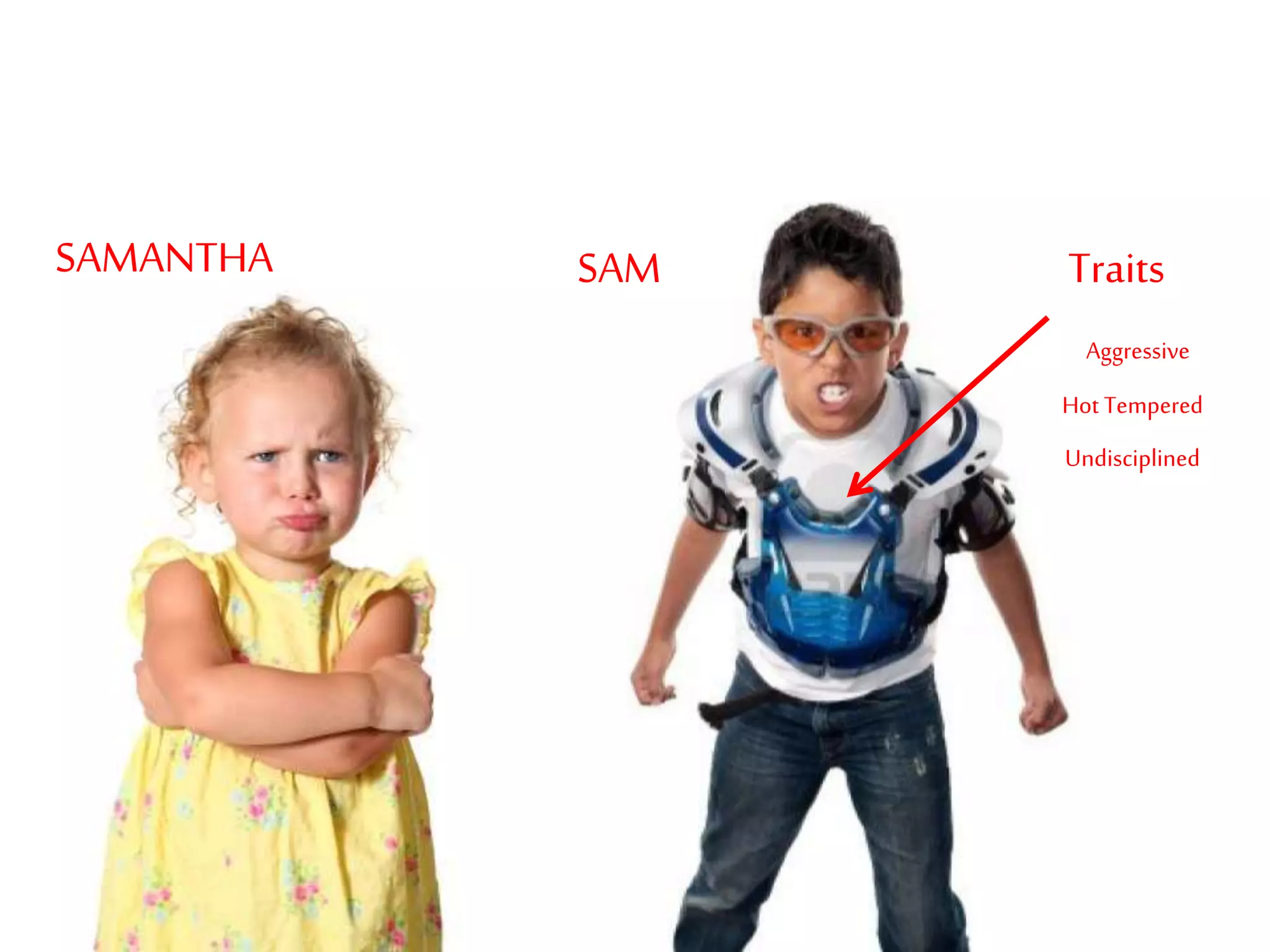
On the play ground, 6 year oldSam pushes little
Samanthaoff her tricycle and rides awayon it.
Why?
SAMSAMANTHA Traits
Aggressive
Hot Tempered
Undisciplined
personality traits are "enduring patterns of perceiving, relating
to, and thinking about the environment and oneself that are
exhibited in a wide range of social and personal contexts."
A trait is what wecall a characteristic way in which an individual
perceives,feels, believes, or acts.
Theorists generally assume
1. Traits are relatively stable over time,
2. Traits differ among individuals
3. Traits are also bipolar and
4. Traits influence behavior.
Threetrait theory
In 1936, psychologist Gordon Allport found that one English-
language dictionary alone contained more than 4,000 words
describing different personality traits. He categorized these
traits into three levels.
Threetrait theory
1. Cardinal Traits: Traits that dominate an individual’s whole life, often to the point
that the person becomes known specifically for these traits. Freudian,
Machiavellian, narcissism, Don Juan, Christ-like, etc.
2. Central Traits: These are the general characteristics that form the basic
foundations of personality. Terms such as intelligent, honest, shy and anxious
are considered central traits.
3. Secondary Traits: These are the traits that are sometimes related to attitudes or
preferences and often appear only in certain situations or under specific
circumstances. Some examples would be getting anxious when speaking to a
group or impatient while waiting in line.
16 personality factor theory
Trait theorist Raymond Cattell reduced the number of main
personality traits from All port’s initial list of over 4,000 down to 16
by means of a statistical technique called factor analysis.
16 personality factor theory
1. emotional, easily upset vs. calm, stable
2. Intelligent vs. unintelligent
3. suspicious vs. trusting
4. reserved, unfriendly vs. outgoing, friendly
5. assertive, dominant vs. not assertive, humble
6. sober, serious vs. happy-go-lucky
7. conscientious vs. expedient
8. shy, timid vs. venturesome
9. tender-minded vs. tough-minded
10.practical vs. imaginative
11.shrewd vs. forthright
12.self-assured, placid vs. apprehensive
13.conservative vs. experimenting
14.group oriented vs. self-sufficient
15.undisciplined vs. self-disciplined
16.Relaxed vs. tense, driven
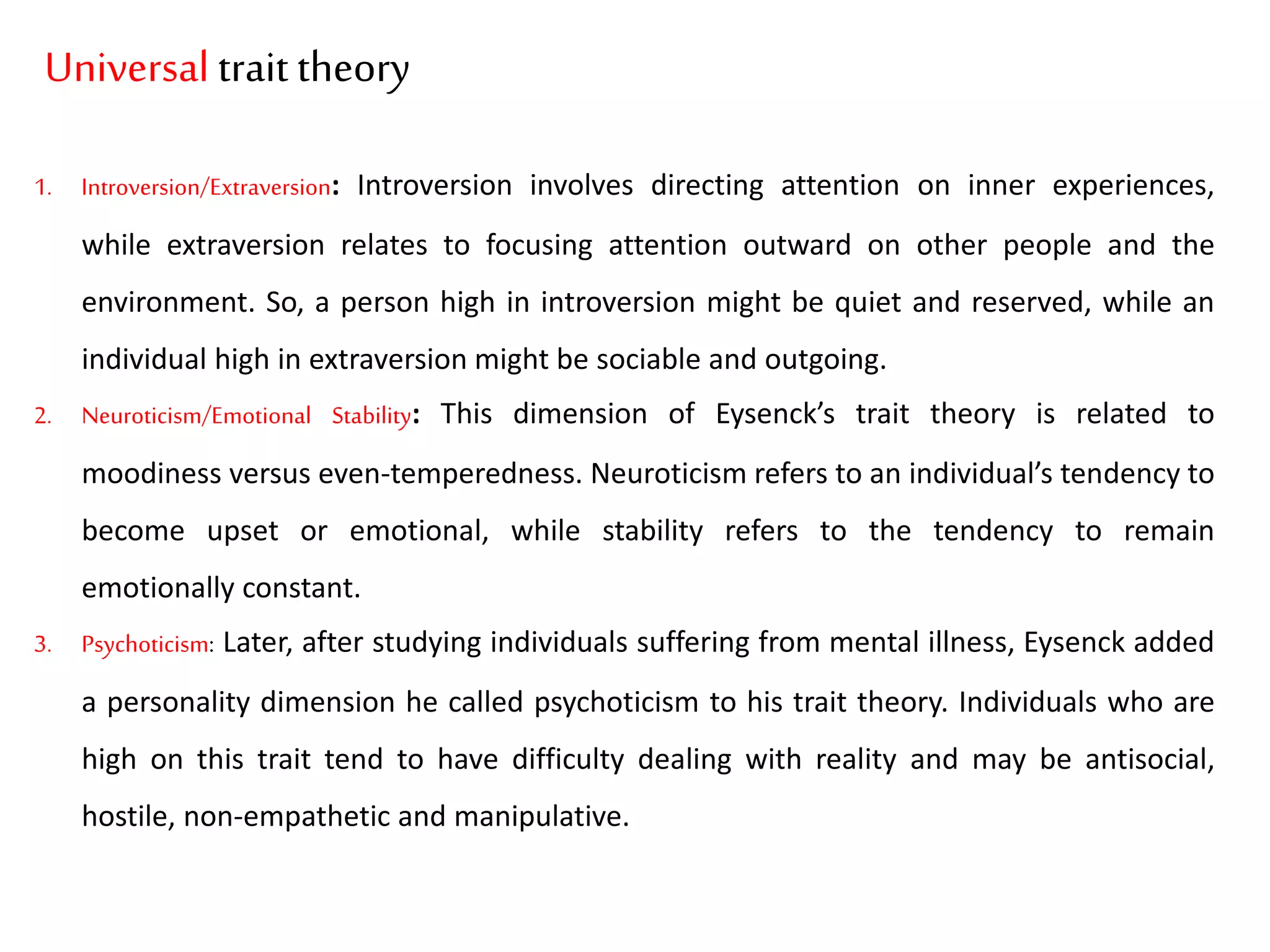
Universal trait theory
British psychologist Hans Eysenck developed a model of
personality based upon just three universal traits were sufficient
to describe human personality. Differences between Cattell
and Eysenck emerged due to preferences for different forms of
factor analysis, with Cattell using oblique, Eysenck orthogonal
rotation to analyze the factors that emerged when personality
questionnaires were subjected to statistical analysis.
1. Introversion/Extraversion: Introversion involves directing attention on inner experiences,
while extraversion relates to focusing attention outward on other people and the
environment. So, a person high in introversion might be quiet and reserved, while an
individual high in extraversion might be sociable and outgoing.
2. Neuroticism/Emotional Stability: This dimension of Eysenck’s trait theory is related to
moodiness versus even-temperedness. Neuroticism refers to an individual’s tendency to
become upset or emotional, while stability refers to the tendency to remain
emotionally constant.
3. Psychoticism: Later, after studying individuals suffering from mental illness, Eysenck added
a personality dimension he called psychoticism to his trait theory. Individuals who are
high on this trait tend to have difficulty dealing with reality and may be antisocial,
hostile, non-empathetic and manipulative.
Universal trait theory
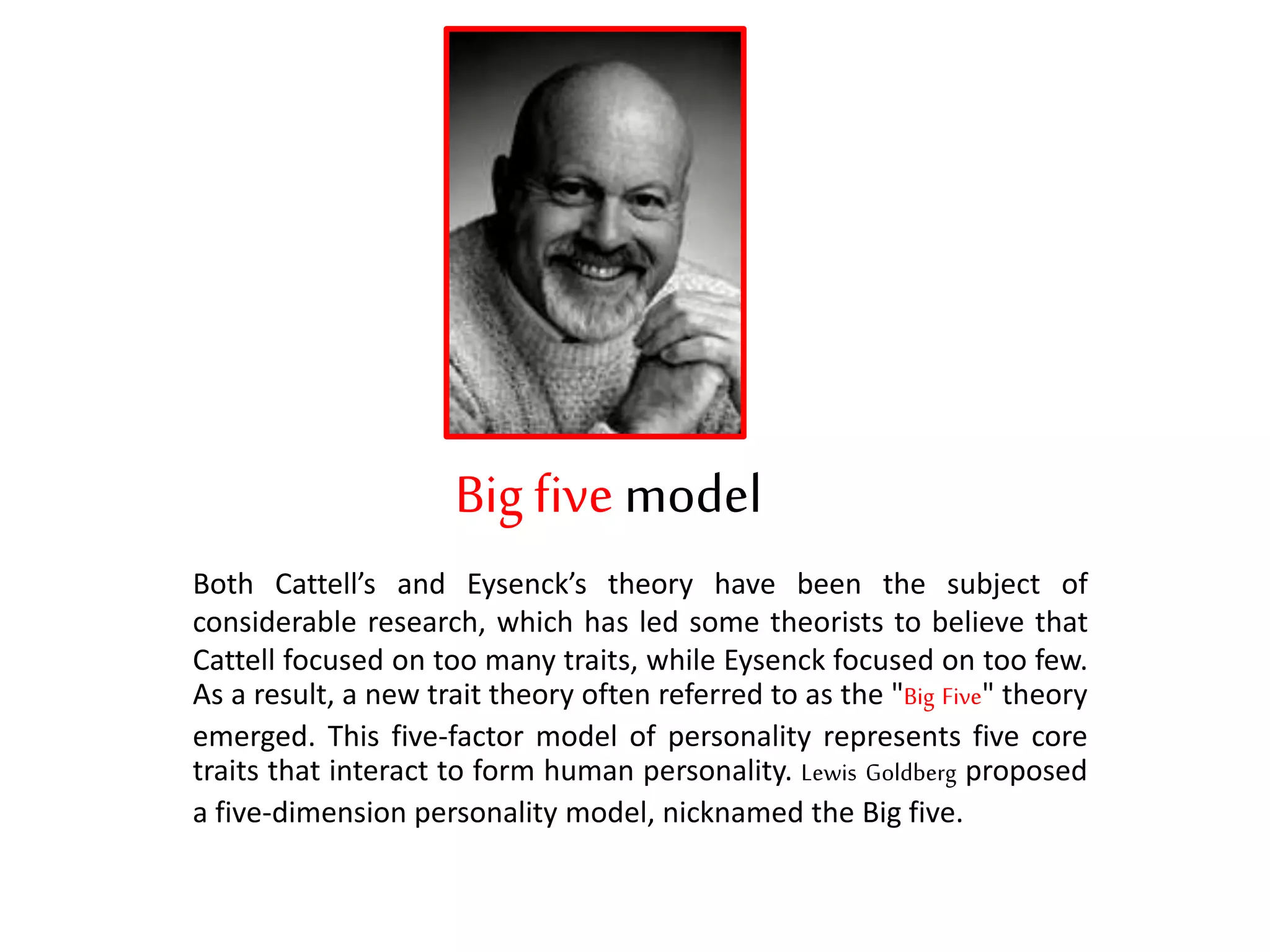
Big five model
Both Cattell’s and Eysenck’s theory have been the subject of
considerable research, which has led some theorists to believe that
Cattell focused on too many traits, while Eysenck focused on too few.
As a result, a new trait theory often referred to as the "Big Five" theory
emerged. This five-factor model of personality represents five core
traits that interact to form human personality. Lewis Goldberg proposed
a five-dimension personality model, nicknamed the Big five.
Big five model
1. Openness to Experience: the tendency to be imaginative, independent, and interested in
variety vs. practical, conforming, and interested in routine.
2. Conscientiousness: the tendency to be organized, careful, and disciplined vs.
disorganized, careless, and impulsive.
3. Extraversion: the tendency to be sociable, fun-loving, and affectionate vs. retiring,
somber, and reserved.
4. Agreeableness: the tendency to be soft-hearted, trusting, and helpful vs. ruthless,
suspicious, and uncooperative.
5. Neuroticism: the tendency to be calm, secure, and self-satisfied vs. anxious, insecure,
and self-pitying.
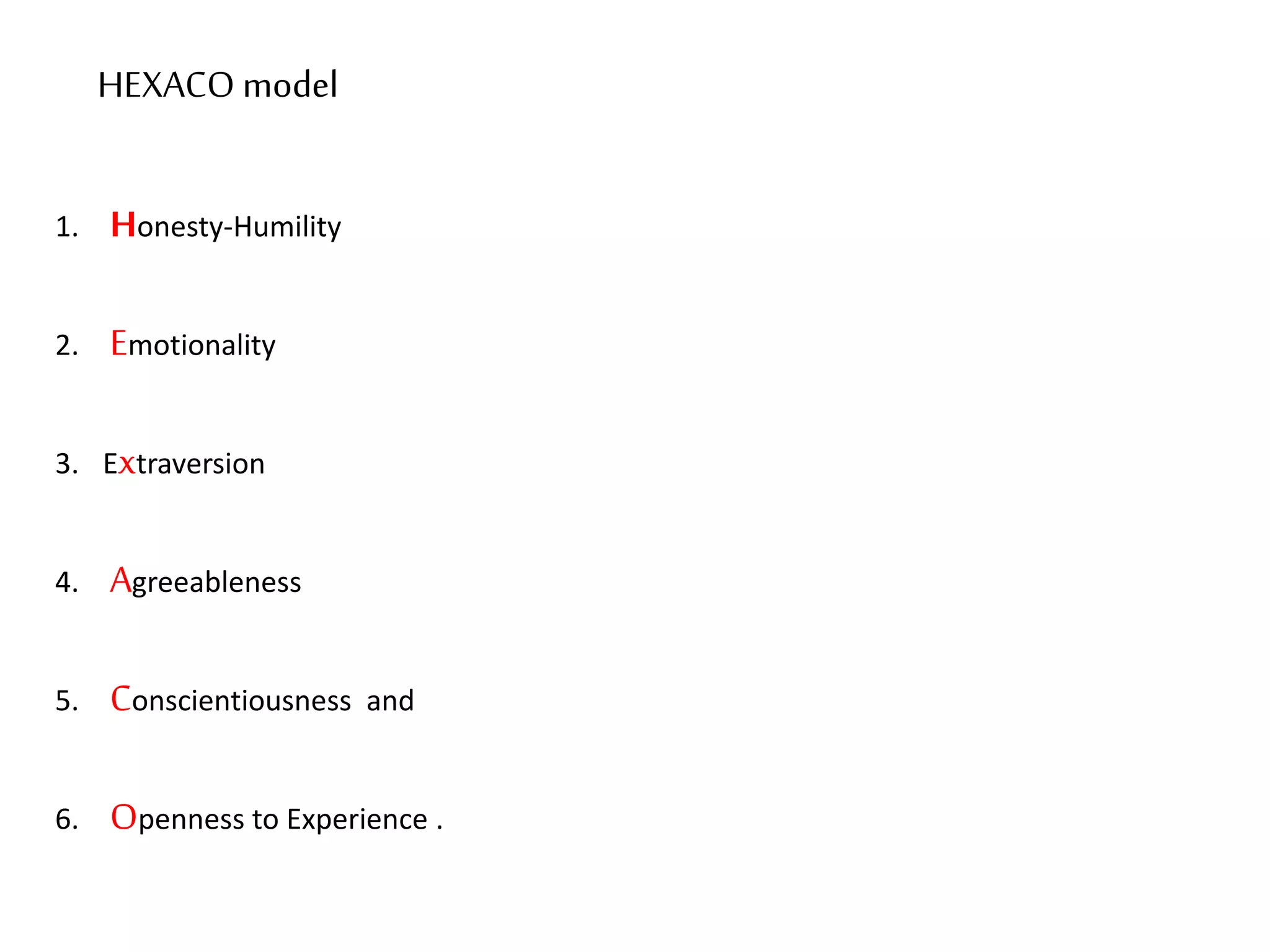
HEXACO model
Michael Ashton and Kibeom Lee , in 2008, proposed a six dimensional
HEXACO model of personality structure. Ashton and Lee especially
emphasize the Honesty-Humility (H) factor as differentiating the
HEXACO model from other personality frameworks. Specifically, the H
factor is described as sincere, honest, faithful/loyal,
modest/unassuming, fair-minded, VERSUS sly, deceitful, greedy,
pretentious, hypocritical, boastful and pompous. The H factor has
been linked to criminal, materialistic, power-seeking and unethical
tendencies.
HEXACO model
1. Honesty-Humility
2. Emotionality
3. Extraversion
4. Agreeableness
5. Conscientiousness and
6. Openness to Experience .
Criticisms of trait theories
1. being purely descriptive and offering little explanation of the underlying
causes of personality
2. Lead some people to accept oversimplified classifications
3. Underestimate the effect of specific situations on people's behavior.
4. Poor predictors of behavior.
Other TA topics available on slideshare
1. Strokes - http://www.slideshare.net/manumjoy/strokes-24081607.
2. Games People Play - http://www.slideshare.net/manumjoy/psychological-
games-people-play.
3. Structural Analysis - http://www.slideshare.net/manumjoy/the-ego-state-model.
4. What is TA? - http://www.slideshare.net/manumjoy/what-ta-is
5. Cycles of Development - http://www.slideshare.net/manumjoy/cycles-of-
developement-pamela-levin-transactional-analysis.
6. Stages of Cure - http://www.slideshare.net/manumjoy/stages-of-cure.
7. Transactions - http://www.slideshare.net/manumjoy/transactions-33677298.
8. Time Structuring - http://www.slideshare.net/manumjoy/time-structuring.
9. Life Position - http://www.slideshare.net/manumjoy/life-position.
10. Autonomy - http://www.slideshare.net/manumjoy/autonomy-33690557.
11. Structural Pathology - http://www.slideshare.net/manumjoy/structural-pathology.
12. Game Analysis - http://www.slideshare.net/manumjoy/game-analysis-33725636.
13. Integrated Adult - http://www.slideshare.net/manumjoy/integrated-adult.
14. Stroke Economy - http://www.slideshare.net/manumjoy/stroke-economy-
33826702.

Trait theories personality theories

  • 1.
  • 2.
    Prepared By Manu MelwinJoy Assistant Professor Ilahia School of Management Studies Kerala, India. Phone – 9744551114 Mail – manu_melwinjoy@yahoo.com Kindly restrict the use of slides for personal purpose. Please seek permission to reproduce the same in public forms and presentations.
  • 3.
    On the playground, 6 year oldSam pushes little Samanthaoff her tricycle and rides awayon it. Why?
  • 4.
  • 5.
    personality traits are"enduring patterns of perceiving, relating to, and thinking about the environment and oneself that are exhibited in a wide range of social and personal contexts." A trait is what wecall a characteristic way in which an individual perceives,feels, believes, or acts.
  • 6.
    Theorists generally assume 1.Traits are relatively stable over time, 2. Traits differ among individuals 3. Traits are also bipolar and 4. Traits influence behavior.
  • 7.
    Threetrait theory In 1936,psychologist Gordon Allport found that one English- language dictionary alone contained more than 4,000 words describing different personality traits. He categorized these traits into three levels.
  • 8.
    Threetrait theory 1. CardinalTraits: Traits that dominate an individual’s whole life, often to the point that the person becomes known specifically for these traits. Freudian, Machiavellian, narcissism, Don Juan, Christ-like, etc. 2. Central Traits: These are the general characteristics that form the basic foundations of personality. Terms such as intelligent, honest, shy and anxious are considered central traits. 3. Secondary Traits: These are the traits that are sometimes related to attitudes or preferences and often appear only in certain situations or under specific circumstances. Some examples would be getting anxious when speaking to a group or impatient while waiting in line.
  • 9.
    16 personality factortheory Trait theorist Raymond Cattell reduced the number of main personality traits from All port’s initial list of over 4,000 down to 16 by means of a statistical technique called factor analysis.
  • 10.
    16 personality factortheory 1. emotional, easily upset vs. calm, stable 2. Intelligent vs. unintelligent 3. suspicious vs. trusting 4. reserved, unfriendly vs. outgoing, friendly 5. assertive, dominant vs. not assertive, humble 6. sober, serious vs. happy-go-lucky 7. conscientious vs. expedient 8. shy, timid vs. venturesome 9. tender-minded vs. tough-minded 10.practical vs. imaginative 11.shrewd vs. forthright 12.self-assured, placid vs. apprehensive 13.conservative vs. experimenting 14.group oriented vs. self-sufficient 15.undisciplined vs. self-disciplined 16.Relaxed vs. tense, driven
  • 11.
    Universal trait theory Britishpsychologist Hans Eysenck developed a model of personality based upon just three universal traits were sufficient to describe human personality. Differences between Cattell and Eysenck emerged due to preferences for different forms of factor analysis, with Cattell using oblique, Eysenck orthogonal rotation to analyze the factors that emerged when personality questionnaires were subjected to statistical analysis.
  • 12.
    1. Introversion/Extraversion: Introversioninvolves directing attention on inner experiences, while extraversion relates to focusing attention outward on other people and the environment. So, a person high in introversion might be quiet and reserved, while an individual high in extraversion might be sociable and outgoing. 2. Neuroticism/Emotional Stability: This dimension of Eysenck’s trait theory is related to moodiness versus even-temperedness. Neuroticism refers to an individual’s tendency to become upset or emotional, while stability refers to the tendency to remain emotionally constant. 3. Psychoticism: Later, after studying individuals suffering from mental illness, Eysenck added a personality dimension he called psychoticism to his trait theory. Individuals who are high on this trait tend to have difficulty dealing with reality and may be antisocial, hostile, non-empathetic and manipulative. Universal trait theory
  • 13.
    Big five model BothCattell’s and Eysenck’s theory have been the subject of considerable research, which has led some theorists to believe that Cattell focused on too many traits, while Eysenck focused on too few. As a result, a new trait theory often referred to as the "Big Five" theory emerged. This five-factor model of personality represents five core traits that interact to form human personality. Lewis Goldberg proposed a five-dimension personality model, nicknamed the Big five.
  • 14.
    Big five model 1.Openness to Experience: the tendency to be imaginative, independent, and interested in variety vs. practical, conforming, and interested in routine. 2. Conscientiousness: the tendency to be organized, careful, and disciplined vs. disorganized, careless, and impulsive. 3. Extraversion: the tendency to be sociable, fun-loving, and affectionate vs. retiring, somber, and reserved. 4. Agreeableness: the tendency to be soft-hearted, trusting, and helpful vs. ruthless, suspicious, and uncooperative. 5. Neuroticism: the tendency to be calm, secure, and self-satisfied vs. anxious, insecure, and self-pitying.
  • 15.
    HEXACO model Michael Ashtonand Kibeom Lee , in 2008, proposed a six dimensional HEXACO model of personality structure. Ashton and Lee especially emphasize the Honesty-Humility (H) factor as differentiating the HEXACO model from other personality frameworks. Specifically, the H factor is described as sincere, honest, faithful/loyal, modest/unassuming, fair-minded, VERSUS sly, deceitful, greedy, pretentious, hypocritical, boastful and pompous. The H factor has been linked to criminal, materialistic, power-seeking and unethical tendencies.
  • 16.
    HEXACO model 1. Honesty-Humility 2.Emotionality 3. Extraversion 4. Agreeableness 5. Conscientiousness and 6. Openness to Experience .
  • 17.
    Criticisms of traittheories 1. being purely descriptive and offering little explanation of the underlying causes of personality 2. Lead some people to accept oversimplified classifications 3. Underestimate the effect of specific situations on people's behavior. 4. Poor predictors of behavior.
  • 19.
    Other TA topicsavailable on slideshare 1. Strokes - http://www.slideshare.net/manumjoy/strokes-24081607. 2. Games People Play - http://www.slideshare.net/manumjoy/psychological- games-people-play. 3. Structural Analysis - http://www.slideshare.net/manumjoy/the-ego-state-model. 4. What is TA? - http://www.slideshare.net/manumjoy/what-ta-is 5. Cycles of Development - http://www.slideshare.net/manumjoy/cycles-of- developement-pamela-levin-transactional-analysis. 6. Stages of Cure - http://www.slideshare.net/manumjoy/stages-of-cure. 7. Transactions - http://www.slideshare.net/manumjoy/transactions-33677298. 8. Time Structuring - http://www.slideshare.net/manumjoy/time-structuring. 9. Life Position - http://www.slideshare.net/manumjoy/life-position. 10. Autonomy - http://www.slideshare.net/manumjoy/autonomy-33690557. 11. Structural Pathology - http://www.slideshare.net/manumjoy/structural-pathology. 12. Game Analysis - http://www.slideshare.net/manumjoy/game-analysis-33725636. 13. Integrated Adult - http://www.slideshare.net/manumjoy/integrated-adult. 14. Stroke Economy - http://www.slideshare.net/manumjoy/stroke-economy- 33826702.