Concepts
 The word personality comes from the Latin root
persona, meaning "mask." According to this root,
personality is the impression we make on others; the
mask we present to the world.
 Personality is defined as "a unique set of traits and
characteristics, relatively stable over time.“ The
definition further suggests that personality does not
change from day to day. Over the short-term, our
personalities are relatively set or stable. However,
definition does not suggest that personality is
somehow rigid, unchangeable, and cast in concrete.
Definition recognizes that, over a longer term,
personality may change.
Definitions
 J.B. Watson (1930) : “ Personality is the sum of
activities that can be discovered by actual
observations over a long enough period of time to
give reliable information.”
 M. Prince (1929): Personality is the sum total of all
biological innate dispositions, impulses,
tendencies, appetites, and instincts of the
individual and the dispositions and tendencies
acquired by experience.”
 After analyzing 49 definitions by eminent
persons, Allport (1948) defined “Personality is the
dynamic organization within the individual of
those psychophysical systems that determine his
unique adjustment to his environment.”
Characteristics
 Personality is an internal process that guides behaviour.
 Gordon Allport (1961) makes the point that personality is
psychophysical, which means both physical and
psychological.
 Biological and genetic phenomena do have an impact on
personality.
 Child (1968) makes the point that personality is stable – or
at least relatively stable.
 Child (1968) includes consistency (within an individual)
and difference (between individuals) in his definition,
 Allport (1961) refers to characteristic patterns of behavior
within an individual.
Nature of Personality
 It is relatively stable but dynamic in nature.
 Helps in adjusting the individual with the
environment
 It is consistent.
 It is unique
Determinants of Personality
 Clssification of determinants of personality
 Personal factors such as physique, sex, nervous system
 Environmental factors such as home and family, school,
society etc.
Another classification
1. Biological factors
2. Psychological
3. Social and cultural
Biological determinants
 Hereditary influences
 Nervous system
 Body chemistry
Psychological determinants
 Intelligence and mental functioning
 Level of aspiration and achievement motivation
 Will power
Social and cultural determinants
 Home and family
 Parents
 Parental attitude
 School environment
 Cultural environments
Theories of Personality
 Type Theory
 Jung theory, Eysenck theory
 Trait Theory
 Allport theory, Cattell 16 PF theory
 Type cum Trait approach
 Big Five Theory
Jung Theory
 Extraversion - *Extraversion* is the tendency to
look to the outside world, especially people, for
one's pleasures. Extraverts are usually outgoing
and they enjoy social activities, but they are
uncomfortable when they are alone.
 Introversion - *Introversion* refers to a tendency
to prefer the world inside oneself. The more
obvious aspects of introversion are shyness, a
distaste for social functions, and a love of privacy.
Trait theory
 Allport Theory
 Cattell 16 PF theory
Allport theory
 He identified 17953 terms to define personality.
 After careful analysis he found 4541 term to define an
individual
Allport Trait theory
 Personality: A Psychological Interpretation (1937)
 Allport defined Trait as “ a generalized and
focalized neuropsychsic system with the capacity
to render many stimuli functionally equivalent,
and to initiate and guide consistent forms of
adoptive and expressive behavior (Allport, 1937).
Classification of traits (Allport)
 Cardinal traits : the traits ruling the personality of the
individual e.g sense of humour
 Central traits : easily detected traits that all people
have a certain number. E.g. shyness, timidity, honesty
 Secondary traits : Less important, style of walking, etc
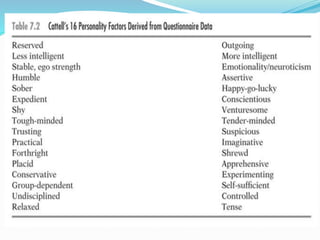
Cattell 16 PF
 171 basic traits
 Common traits it is found widely distributed in
general population . E.g Honesty, cooperation
 Unique traits : these traits are possessed by particular
persons e.g emotional stability
 Surface Traits : easily recognized e.g Curisioty,
 Source traits : it determines the behavior
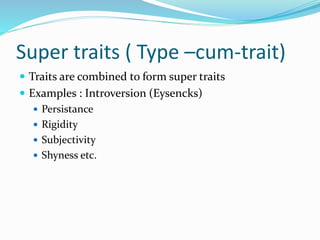
Super traits ( Type –cum-trait)
 Traits are combined to form super traits
 Examples : Introversion (Eysencks)
 Persistance
 Rigidity
 Subjectivity
 Shyness etc.
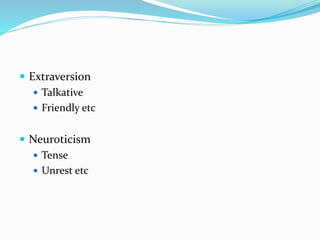
 Extraversion
 Talkative
 Friendly etc
 Neuroticism
 Tense
 Unrest etc
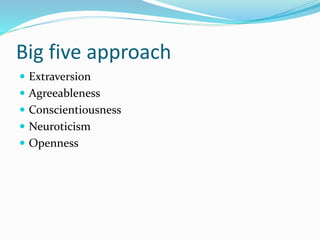
Big five approach
 Extraversion
 Agreeableness
 Conscientiousness
 Neuroticism
 Openness

Personality

  • 2.
    Concepts  The wordpersonality comes from the Latin root persona, meaning "mask." According to this root, personality is the impression we make on others; the mask we present to the world.  Personality is defined as "a unique set of traits and characteristics, relatively stable over time.“ The definition further suggests that personality does not change from day to day. Over the short-term, our personalities are relatively set or stable. However, definition does not suggest that personality is somehow rigid, unchangeable, and cast in concrete. Definition recognizes that, over a longer term, personality may change.
  • 3.
    Definitions  J.B. Watson(1930) : “ Personality is the sum of activities that can be discovered by actual observations over a long enough period of time to give reliable information.”  M. Prince (1929): Personality is the sum total of all biological innate dispositions, impulses, tendencies, appetites, and instincts of the individual and the dispositions and tendencies acquired by experience.”
  • 4.
     After analyzing49 definitions by eminent persons, Allport (1948) defined “Personality is the dynamic organization within the individual of those psychophysical systems that determine his unique adjustment to his environment.”
  • 5.
    Characteristics  Personality isan internal process that guides behaviour.  Gordon Allport (1961) makes the point that personality is psychophysical, which means both physical and psychological.  Biological and genetic phenomena do have an impact on personality.  Child (1968) makes the point that personality is stable – or at least relatively stable.  Child (1968) includes consistency (within an individual) and difference (between individuals) in his definition,  Allport (1961) refers to characteristic patterns of behavior within an individual.
  • 6.
    Nature of Personality It is relatively stable but dynamic in nature.  Helps in adjusting the individual with the environment  It is consistent.  It is unique
  • 7.
    Determinants of Personality Clssification of determinants of personality  Personal factors such as physique, sex, nervous system  Environmental factors such as home and family, school, society etc. Another classification 1. Biological factors 2. Psychological 3. Social and cultural
  • 8.
    Biological determinants  Hereditaryinfluences  Nervous system  Body chemistry
  • 9.
    Psychological determinants  Intelligenceand mental functioning  Level of aspiration and achievement motivation  Will power
  • 10.
    Social and culturaldeterminants  Home and family  Parents  Parental attitude  School environment  Cultural environments
  • 11.
    Theories of Personality Type Theory  Jung theory, Eysenck theory  Trait Theory  Allport theory, Cattell 16 PF theory  Type cum Trait approach  Big Five Theory
  • 12.
    Jung Theory  Extraversion- *Extraversion* is the tendency to look to the outside world, especially people, for one's pleasures. Extraverts are usually outgoing and they enjoy social activities, but they are uncomfortable when they are alone.  Introversion - *Introversion* refers to a tendency to prefer the world inside oneself. The more obvious aspects of introversion are shyness, a distaste for social functions, and a love of privacy.
  • 13.
    Trait theory  AllportTheory  Cattell 16 PF theory
  • 14.
    Allport theory  Heidentified 17953 terms to define personality.  After careful analysis he found 4541 term to define an individual
  • 15.
    Allport Trait theory Personality: A Psychological Interpretation (1937)  Allport defined Trait as “ a generalized and focalized neuropsychsic system with the capacity to render many stimuli functionally equivalent, and to initiate and guide consistent forms of adoptive and expressive behavior (Allport, 1937).
  • 16.
    Classification of traits(Allport)  Cardinal traits : the traits ruling the personality of the individual e.g sense of humour  Central traits : easily detected traits that all people have a certain number. E.g. shyness, timidity, honesty  Secondary traits : Less important, style of walking, etc
  • 17.
    Cattell 16 PF 171 basic traits  Common traits it is found widely distributed in general population . E.g Honesty, cooperation  Unique traits : these traits are possessed by particular persons e.g emotional stability  Surface Traits : easily recognized e.g Curisioty,  Source traits : it determines the behavior
  • 19.
    Super traits (Type –cum-trait)  Traits are combined to form super traits  Examples : Introversion (Eysencks)  Persistance  Rigidity  Subjectivity  Shyness etc.
  • 20.
     Extraversion  Talkative Friendly etc  Neuroticism  Tense  Unrest etc
  • 21.
    Big five approach Extraversion  Agreeableness  Conscientiousness  Neuroticism  Openness