
Personality Assessment
S.Lakshmanan,
Psychologist, and
Ex. Project Officer, NYK,
Puducherry.
PERSONALITY ASSESSMENT
Personality Assessment is a proficiency in professional
psychology that involves the administration, scoring,
and interpretation of empirically supported measures of
personality traits and styles in order to:
 Refine clinical diagnoses;
 Structure and inform psychological interventions; and
 Increase the accuracy of behavioral prediction in a
variety of contexts and settings (e.g., clinical, forensic,
organizational, educational).
USES OF PERSONALITY ASSESSMENT
 Personality tests are techniques designed to measure
one’s personality. They are used to diagnose
psychological problems as well as to screen candidates
for college and employment.
 There are two types of personality tests: self-report
inventories and projective tests. The MMPI is one of the
most common self-report inventories. It asks a series of
true/false questions that are designed to provide a clinical
profile of an individual.
 Projective tests use ambiguous images or other
ambiguous stimuli to assess an individual’s unconscious
fears, desires, and challenges. The Rorschach Inkblot
Test, the TAT, the RISB, and the C-TCB are all forms of
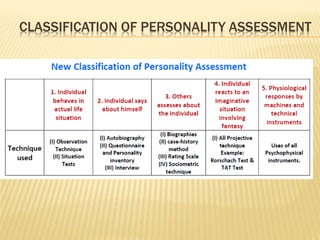
CLASSIFICATION OF PERSONALITY ASSESSMENT
Behavioral Assessments
BEHAVIORAL ASSESSMENTS
Behavioral
assessments
• Behaviorists do not want to “look into the mind” of an individual
• They assume that personality is merely habitually learned
responses to stimuli in the environment
• Preferred method for a behaviourist is to watch that behaviour unfold
in the real world.
OBSERVATION TECHNIQUE
LIMITATIONS OF OBSERVATION TECHNIQUE
Limitations
of
Naturalistic
Observation
1. Observers are often at the mercy of unpredictable events over
which they have little or no control.
2. There are problems of observer bias and expectations influencing
those
aspects and events that are attended to and remembered.
3. The generalisation of observation based on a few people and
situations, is questionable in regard to reliability and validity.
4. Observers may unwittingly interfere with the actual events they
wish to observe or record (Kazdin, 1982).
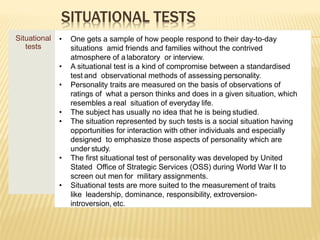
SITUATIONAL TESTS
Situational
tests
• One gets a sample of how people respond to their day-to-day
situations amid friends and families without the contrived
atmosphere of a laboratory or interview.
• A situational test is a kind of compromise between a standardised
test and observational methods of assessing personality.
• Personality traits are measured on the basis of observations of
ratings of what a person thinks and does in a given situation, which
resembles a real situation of everyday life.
• The subject has usually no idea that he is being studied.
• The situation represented by such tests is a social situation having
opportunities for interaction with other individuals and especially
designed to emphasize those aspects of personality which are
under study.
• The first situational test of personality was developed by United
Stated Office of Strategic Services (OSS) during World War II to
screen out men for military assignments.
• Situational tests are more suited to the measurement of traits
like leadership, dominance, responsibility, extroversion-
introversion, etc.
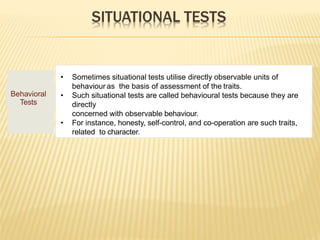
SITUATIONAL TESTS
Behavioral
Tests
• Sometimes situational tests utilise directly observable units of
behaviour as the basis of assessment of the traits.
• Such situational tests are called behavioural tests because they are
directly
concerned with observable behaviour.
• For instance, honesty, self-control, and co-operation are such traits,
related to character.
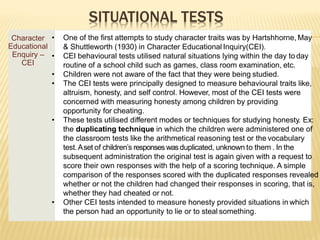
SITUATIONAL TESTS
Character
Educational
Enquiry –
CEI
• One of the first attempts to study character traits was by Hartshhorne, May
& Shuttleworth (1930) in Character Educational Inquiry(CEI).
• CEI behavioural tests utilised natural situations lying within the day to day
routine of a school child such as games, class room examination, etc.
• Children were not aware of the fact that they were being studied.
• The CEI tests were principally designed to measure behavioural traits like,
altruism, honesty, and self control. However, most of the CEI tests were
concerned with measuring honesty among children by providing
opportunity for cheating.
• These tests utilised different modes or techniques for studying honesty. Ex:
the duplicating technique in which the children were administered one of
the classroom tests like the arithmetical reasoning test or the vocabulary
test.Aset of children’s responses was duplicated, unknown to them . In the
subsequent administration the original test is again given with a request to
score their own responses with the help of a scoring technique. A simple
comparison of the responses scored with the duplicated responses revealed
whether or not the children had changed their responses in scoring, that is,
whether they had cheated or not.
• Other CEI tests intended to measure honesty provided situations in which
the person had an opportunity to lie or to steal something.
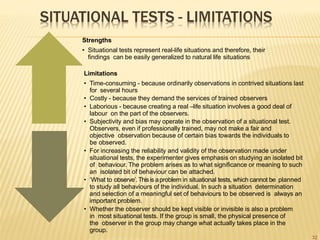
SITUATIONAL TESTS - LIMITATIONS
Strengths
• Situational tests represent real-life situations and therefore, their
findings can be easily generalized to natural life situations
Limitations
• Time-consuming - because ordinarily observations in contrived situations last
for several hours
• Costly - because they demand the services of trained observers
• Laborious - because creating a real –life situation involves a good deal of
labour on the part of the observers.
• Subjectivity and bias may operate in the observation of a situational test.
Observers, even if professionally trained, may not make a fair and
objective observation because of certain bias towards the individuals to
be observed.
• For increasing the reliability and validity of the observation made under
situational tests, the experimenter gives emphasis on studying an isolated bit
of behaviour. The problem arises as to what significance or meaning to such
an isolated bit of behaviour can be attached.
• ‘What to observe’.Thisis aproblem in situational tests, which cannot be planned
to study all behaviours of the individual. In such a situation determination
and selection of a meaningful set of behaviours to be observed is always an
important problem.
• Whether the observer should be kept visible or invisible is also a problem
in most situational tests. If the group is small, the physical presence of
the observer in the group may change what actually takes place in the
group.
32
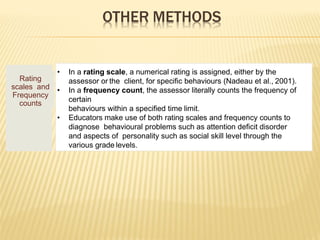
OTHER METHODS
Rating
scales and
Frequency
counts
• In a rating scale, a numerical rating is assigned, either by the
assessor or the client, for specific behaviours (Nadeau et al., 2001).
• In a frequency count, the assessor literally counts the frequency of
certain
behaviours within a specified time limit.
• Educators make use of both rating scales and frequency counts to
diagnose behavioural problems such as attention deficit disorder
and aspects of personality such as social skill level through the
various grade levels.
Self-Report Personality Tests/
Inventory
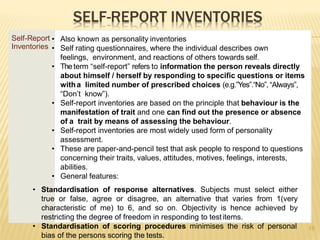
SELF-REPORT INVENTORIES
15
Self-Report
Inventories
• Also known as personality inventories
• Self rating questionnaires, where the individual describes own
feelings, environment, and reactions of others towards self.
• Theterm “self-report” refers to information the person reveals directly
about himself / herself by responding to specific questions or items
witha limited number of prescribed choices (e.g.”Yes”.“No”, “Always”,
“Don’t know”).
• Self-report inventories are based on the principle that behaviour is the
manifestation of trait and one can find out the presence or absence
of a trait by means of assessing the behaviour.
• Self-report inventories are most widely used form of personality
assessment.
• These are paper-and-pencil test that ask people to respond to questions
concerning their traits, values, attitudes, motives, feelings, interests,
abilities.
• General features:
• Standardisation of response alternatives. Subjects must select either
true or false, agree or disagree, an alternative that varies from 1(very
characteristic of me) to 6, and so on. Objectivity is hence achieved by
restricting the degree of freedom in responding to testitems.
• Standardisation of scoring procedures minimises the risk of personal
bias of the persons scoring the tests.
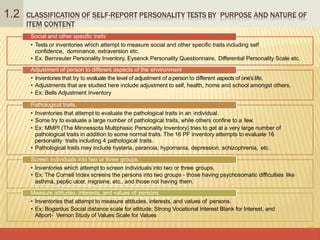
CLASSIFICATION OF SELF-REPORT PERSONALITY TESTS BY PURPOSE AND NATURE OF
ITEM CONTENT
16
1.2
Social and other specific traits
• Tests or inventories which attempt to measure social and other specific traits including self
confidence, dominance, extraversion etc.
• Ex: Bernreuter Personality Inventory, Eysenck Personality Questionnaire, Differential Personality Scale etc.
Adjustment of person to different aspects of the environment
• Inventories that try to evaluate the level of adjustment of a person to different aspects of one’s life.
• Adjustments that are studied here include adjustment to self, health, home and school amongst others.
• Ex: Bells Adjustment Inventory
Pathological traits.
• Inventories that attempt to evaluate the pathological traits in an individual.
• Some try to evaluate a large number of pathological traits, while others confine to a few.
• Ex: MMPI (The Minnessota Multiphasic Personality Inventory) tries to get at a very large number of
pathological traits in addition to some normal traits. The 16 PF inventory attempts to evaluate 16
personality traits including 4 pathological traits.
• Pathological traits may include hysteria, paranoia, hypomania, depression, schizophrenia, etc.
Screen individuals into two or three groups.
• Inventories which attempt to screen individuals into two or three groups.
• Ex: The Cornell Index screens the persons into two groups - those having psychosomatic difficulties like
asthma, peptic ulcer, migraine, etc., and those not having them.
Measure attitudes, interests, and values of persons.
• Inventories that attempt to measure attitudes, interests, and values of persons.
• Ex: Bogardus Social distance scale for attitude; Strong Vocational Interest Blank for Interest, and
Allport- Vernon Study of Values Scale for Values
1.3SINGLE-TRAIT TESTS
17
Single-
Trait tests
• Developed and used by researchers to measure specific
aspects of personality.
• They examine whether people who score at the upper and lower end
on the trait measure perform differently on the behavioural measure
or on the self- report measure.
• In other words any person participating in the study may receive a
high score (or may receive amedium or low score), but every person’s
score is equally meaningful asarepresentation of thatperson’s personality.
• Some single-dimension tests also provide separate measures of two
or three traits.
• Examples include:
a. the Locus of Control Scale (Rotter, 1966),
b. the Sensation Seeking Scale (Zuckerman, 1978),
c. the Self Monitoring Scale (Snyder, 1974).
• The scores obtained from these tests are assumed to reflect relatively
stable individual differences along specific trait dimensions.
1.4MULTIDIMENSIONAL TESTS
18
Multi-
dimensional
tests
• Many self-report inventories measure several personality
dimensions simultaneously
• These multi-dimensional tests have the advantage of providing a
more comprehensive overview of the person being assessed
and are used extensively in clinical, counseling, and personnel
settings.
• Ex: the Sixteen Personality Factor Questionnaire (16-PF) is a 187-
item test which measures 16 source traits of the normal personality
identified by Raymond Cattell (1965).
• Scores derived from each of the source trait measures (e.g.,
submissive- dominant, trusting-suspicious) are plotted on a graph to
provide a personality profile.
• This profile may be used by psychologist for counselling and to
make important employment and promotion decisions about
people.
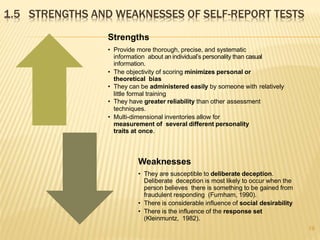
1.5 STRENGTHS AND WEAKNESSES OF SELF-REPORT TESTS
19
Strengths
• Provide more thorough, precise, and systematic
information about an individual’s personality than casual
information.
• The objectivity of scoring minimizes personal or
theoretical bias
• They can be administered easily by someone with relatively
little formal training
• They have greater reliability than other assessment
techniques.
• Multi-dimensional inventories allow for
measurement of several different personality
traits at once.
Weaknesses
• They are susceptible to deliberate deception.
Deliberate deception is most likely to occur when the
person believes there is something to be gained from
fraudulent responding (Furnham, 1990).
• There is considerable influence of social desirability
• There is the influence of the response set
(Kleinmuntz, 1982).
Important Personality Inventories
2.1 GALTON AND WOODWORTH
Galton’s
Personality
Questionnaire
• The first attempt to measure personality through a questionnaire was
made by Galton in 1880.
• He developed a questionnaire for studying mental imagery, that is inner
world of perception and feeling.
Woodworth
Personal
Data Sheet
• The first systematic effort to develop a personality inventory was
made by Woodworth in 1918.
• This inventory was known as Woodworth Personal Data Sheet and
consists of
116 questions, all relating to neurotic tendencies.
• The purpose was to screen out emotionally unfit men before they
were sent overseas during the World War I.
2.2 THE SIXTEEN PERSONALITY FACTOR QUESTIONNAIRE (16PF)
16PF • Using a statistical technique, called factor analysis that looks for
groupings and commonalities in numerical data, Cattell discovered
16 source traits
• Cattell (1995) devised a personality inventory based on these 16
source traits
• These 16 source traits are seen as trait dimensions or continuums, in
which there are two opposite traits at each end with many possible
degrees of the traits possible along the dimension.
• Ex: someone scoring near the reserved end of the reserved outgoing
dimension would be more introverted than someone scoring in the
middle or at the opposite end.
• He later determined there might be another seven source traits to
make a total of 23 (Cattell & Kline, 1977)
NEO – PI
NEO-PI • Stands for NeuroticismExtraversion Openness Personality Inventory
• This inventory is based on the five- factor model of personality
traits developed by Costa & McCrae.
MYERS BRIGGS TYPE INDICATOR – MBTI
(1/2)
MBTI
• This inventory is based on the ideas of Carl Jung and looks at four
personality dimensions, as detailed in following page.
• These four dimensions can differ for each individual, resulting in 16(4
x 4) possible personality types: ISTJ (Introverted, Sensing, Thinking,
Judgmental). ISTP (Introversion, Sensing, Thinking and Perceiving).
ISFP (Introversion, Sensing, Feeling and Perceiving). ISFJ (
Introversion, Sensing, Feeling and Judgmental) and so on.
• MBTI is often used to assess personality to help people know the
kinds of careers for which they may best be suited.
© M SAhluwalia Psychology Super Notes Psychology Learners
2.4 MYERS BRIGGS TYPE INDICATOR – MBTI (2/2)
© M SAhluwalia Psychology Super Notes Psychology Learners
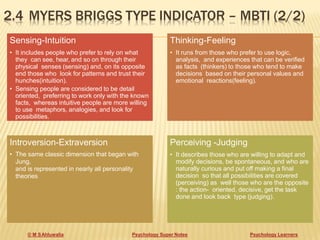
Sensing-Intuition
• It includes people who prefer to rely on what
they can see, hear, and so on through their
physical senses (sensing) and, on its opposite
end those who look for patterns and trust their
hunches(intuition).
• Sensing people are considered to be detail
oriented, preferring to work only with the known
facts, whereas intuitive people are more willing
to use metaphors, analogies, and look for
possibilities.
Thinking-Feeling
• It runs from those who prefer to use logic,
analysis, and experiences that can be verified
as facts (thinkers) to those who tend to make
decisions based on their personal values and
emotional reactions(feeling).
Introversion-Extraversion
• The same classic dimension that began with
Jung,
and is represented in nearly all personality
theories
Perceiving -Judging
• It describes those who are willing to adapt and
modify decisions, be spontaneous, and who are
naturally curious and put off making a final
decision so that all possibilities are covered
(perceiving) as well those who are the opposite
: the action- oriented, decisive, get the task
done and look back type (judging).
2.5 MINNESOTA MULTIPHASIC PERSONALITY INVENTORY – MMPI
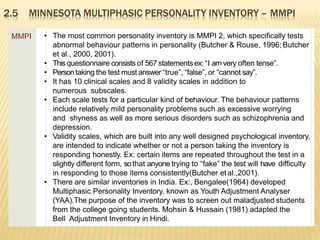
MMPI • The most common personality inventory is MMPI 2, which specifically tests
abnormal behaviour patterns in personality (Butcher & Rouse, 1996; Butcher
et al., 2000, 2001).
• This questionnaire consists of 567 statementsex: “I am very often tense”.
• Persontaking the test must answer “true”, “false”, or “cannot say”.
• It has 10 clinical scales and 8 validity scales in addition to
numerous subscales.
• Each scale tests for a particular kind of behaviour. The behaviour patterns
include relatively mild personality problems such as excessive worrying
and shyness as well as more serious disorders such as schizophrenia and
depression.
• Validity scales, which are built into any well designed psychological inventory,
are intended to indicate whether or not a person taking the inventory is
responding honestly. Ex: certain items are repeated throughout the test in a
slightly different form, sothat anyone trying to “fake” the test will have difficulty
in responding to those items consistently(Butcher etal.,2001).
• There are similar inventories in India. Ex:, Bengalee(1964) developed
Multiphasic Personality Inventory, known as Youth Adjustment Analyser
(YAA).The purpose of the inventory was to screen out maladjusted students
from the college going students. Mohsin & Hussain (1981) adapted the
Bell Adjustment Inventory in Hindi.
Projective Techniques
3.1 PROJECTIVE TECHNIQUES
Projective
T
echniques
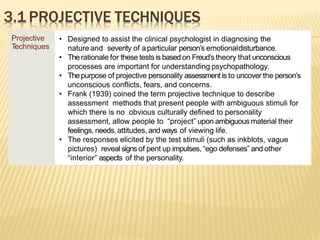
• Designed to assist the clinical psychologist in diagnosing the
natureand severity of aparticular person’s emotionaldisturbance.
• Therationale for these tests is based on Freud’s theory that unconscious
processes are important for understanding psychopathology.
• Thepurpose of projective personality assessment is to uncover the person’s
unconscious conflicts, fears, and concerns.
• Frank (1939) coined the term projective technique to describe
assessment methods that present people with ambiguous stimuli for
which there is no obvious culturally defined to personality
assessment, allow people to “project” upon ambiguous material their
feelings, needs, attitudes, and ways of viewing life.
• The responses elicited by the test stimuli (such as inkblots, vague
pictures) reveal signs of pent up impulses, “ego defenses” and other
“interior” aspects of the personality.
PROJECTIVE TECHNIQUES – FEATURES
Features of
Projective
T
echniques
• Some common features of Projective techniques are:
• They use ambiguous or unstructured test stimuli.
• The test taker is never told the purpose of the test or how
responseswill
be scored or interpreted.
• Instructions emphasize that there is no correct or incorrect
answers and that the test taker is free to respond in any
manner she sees fit.
• Scoring and interpretation rely heavily on subjective clinical
judgments.
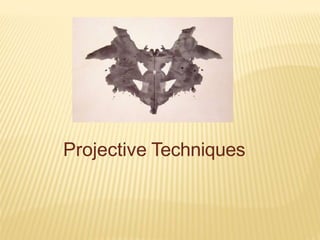
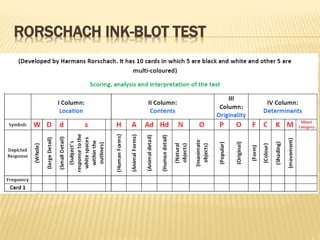
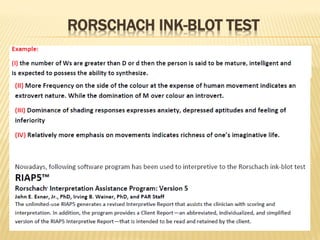
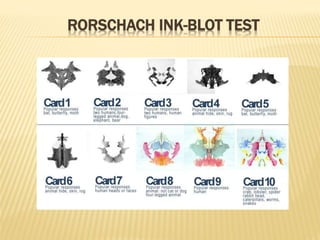
RORSCHACH INK-BLOT TEST
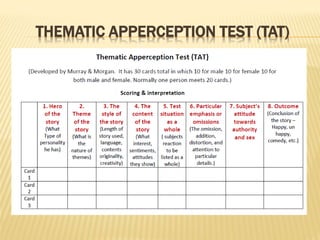
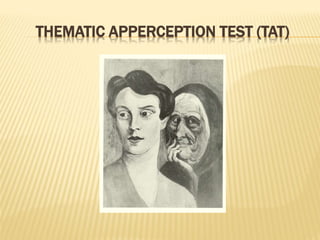
THEMATIC APPERCEPTION TEST (TAT)
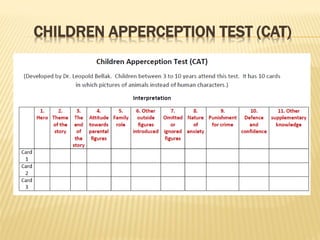
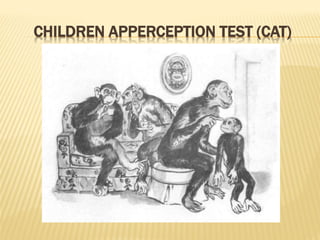
CHILDREN APPERCEPTION TEST (CAT)
124. Personality Assessment

124. Personality Assessment

  • 1.
  • 2.
    PERSONALITY ASSESSMENT Personality Assessmentis a proficiency in professional psychology that involves the administration, scoring, and interpretation of empirically supported measures of personality traits and styles in order to:  Refine clinical diagnoses;  Structure and inform psychological interventions; and  Increase the accuracy of behavioral prediction in a variety of contexts and settings (e.g., clinical, forensic, organizational, educational).
  • 3.
    USES OF PERSONALITYASSESSMENT  Personality tests are techniques designed to measure one’s personality. They are used to diagnose psychological problems as well as to screen candidates for college and employment.  There are two types of personality tests: self-report inventories and projective tests. The MMPI is one of the most common self-report inventories. It asks a series of true/false questions that are designed to provide a clinical profile of an individual.  Projective tests use ambiguous images or other ambiguous stimuli to assess an individual’s unconscious fears, desires, and challenges. The Rorschach Inkblot Test, the TAT, the RISB, and the C-TCB are all forms of
  • 4.
  • 5.
  • 6.
    BEHAVIORAL ASSESSMENTS Behavioral assessments • Behavioristsdo not want to “look into the mind” of an individual • They assume that personality is merely habitually learned responses to stimuli in the environment • Preferred method for a behaviourist is to watch that behaviour unfold in the real world.
  • 7.
  • 8.
    LIMITATIONS OF OBSERVATIONTECHNIQUE Limitations of Naturalistic Observation 1. Observers are often at the mercy of unpredictable events over which they have little or no control. 2. There are problems of observer bias and expectations influencing those aspects and events that are attended to and remembered. 3. The generalisation of observation based on a few people and situations, is questionable in regard to reliability and validity. 4. Observers may unwittingly interfere with the actual events they wish to observe or record (Kazdin, 1982).
  • 9.
    SITUATIONAL TESTS Situational tests • Onegets a sample of how people respond to their day-to-day situations amid friends and families without the contrived atmosphere of a laboratory or interview. • A situational test is a kind of compromise between a standardised test and observational methods of assessing personality. • Personality traits are measured on the basis of observations of ratings of what a person thinks and does in a given situation, which resembles a real situation of everyday life. • The subject has usually no idea that he is being studied. • The situation represented by such tests is a social situation having opportunities for interaction with other individuals and especially designed to emphasize those aspects of personality which are under study. • The first situational test of personality was developed by United Stated Office of Strategic Services (OSS) during World War II to screen out men for military assignments. • Situational tests are more suited to the measurement of traits like leadership, dominance, responsibility, extroversion- introversion, etc.
  • 10.
    SITUATIONAL TESTS Behavioral Tests • Sometimessituational tests utilise directly observable units of behaviour as the basis of assessment of the traits. • Such situational tests are called behavioural tests because they are directly concerned with observable behaviour. • For instance, honesty, self-control, and co-operation are such traits, related to character.
  • 11.
    SITUATIONAL TESTS Character Educational Enquiry – CEI •One of the first attempts to study character traits was by Hartshhorne, May & Shuttleworth (1930) in Character Educational Inquiry(CEI). • CEI behavioural tests utilised natural situations lying within the day to day routine of a school child such as games, class room examination, etc. • Children were not aware of the fact that they were being studied. • The CEI tests were principally designed to measure behavioural traits like, altruism, honesty, and self control. However, most of the CEI tests were concerned with measuring honesty among children by providing opportunity for cheating. • These tests utilised different modes or techniques for studying honesty. Ex: the duplicating technique in which the children were administered one of the classroom tests like the arithmetical reasoning test or the vocabulary test.Aset of children’s responses was duplicated, unknown to them . In the subsequent administration the original test is again given with a request to score their own responses with the help of a scoring technique. A simple comparison of the responses scored with the duplicated responses revealed whether or not the children had changed their responses in scoring, that is, whether they had cheated or not. • Other CEI tests intended to measure honesty provided situations in which the person had an opportunity to lie or to steal something.
  • 12.
    SITUATIONAL TESTS -LIMITATIONS Strengths • Situational tests represent real-life situations and therefore, their findings can be easily generalized to natural life situations Limitations • Time-consuming - because ordinarily observations in contrived situations last for several hours • Costly - because they demand the services of trained observers • Laborious - because creating a real –life situation involves a good deal of labour on the part of the observers. • Subjectivity and bias may operate in the observation of a situational test. Observers, even if professionally trained, may not make a fair and objective observation because of certain bias towards the individuals to be observed. • For increasing the reliability and validity of the observation made under situational tests, the experimenter gives emphasis on studying an isolated bit of behaviour. The problem arises as to what significance or meaning to such an isolated bit of behaviour can be attached. • ‘What to observe’.Thisis aproblem in situational tests, which cannot be planned to study all behaviours of the individual. In such a situation determination and selection of a meaningful set of behaviours to be observed is always an important problem. • Whether the observer should be kept visible or invisible is also a problem in most situational tests. If the group is small, the physical presence of the observer in the group may change what actually takes place in the group. 32
  • 13.
    OTHER METHODS Rating scales and Frequency counts •In a rating scale, a numerical rating is assigned, either by the assessor or the client, for specific behaviours (Nadeau et al., 2001). • In a frequency count, the assessor literally counts the frequency of certain behaviours within a specified time limit. • Educators make use of both rating scales and frequency counts to diagnose behavioural problems such as attention deficit disorder and aspects of personality such as social skill level through the various grade levels.
  • 14.
  • 15.
    SELF-REPORT INVENTORIES 15 Self-Report Inventories • Alsoknown as personality inventories • Self rating questionnaires, where the individual describes own feelings, environment, and reactions of others towards self. • Theterm “self-report” refers to information the person reveals directly about himself / herself by responding to specific questions or items witha limited number of prescribed choices (e.g.”Yes”.“No”, “Always”, “Don’t know”). • Self-report inventories are based on the principle that behaviour is the manifestation of trait and one can find out the presence or absence of a trait by means of assessing the behaviour. • Self-report inventories are most widely used form of personality assessment. • These are paper-and-pencil test that ask people to respond to questions concerning their traits, values, attitudes, motives, feelings, interests, abilities. • General features: • Standardisation of response alternatives. Subjects must select either true or false, agree or disagree, an alternative that varies from 1(very characteristic of me) to 6, and so on. Objectivity is hence achieved by restricting the degree of freedom in responding to testitems. • Standardisation of scoring procedures minimises the risk of personal bias of the persons scoring the tests.
  • 16.
    CLASSIFICATION OF SELF-REPORTPERSONALITY TESTS BY PURPOSE AND NATURE OF ITEM CONTENT 16 1.2 Social and other specific traits • Tests or inventories which attempt to measure social and other specific traits including self confidence, dominance, extraversion etc. • Ex: Bernreuter Personality Inventory, Eysenck Personality Questionnaire, Differential Personality Scale etc. Adjustment of person to different aspects of the environment • Inventories that try to evaluate the level of adjustment of a person to different aspects of one’s life. • Adjustments that are studied here include adjustment to self, health, home and school amongst others. • Ex: Bells Adjustment Inventory Pathological traits. • Inventories that attempt to evaluate the pathological traits in an individual. • Some try to evaluate a large number of pathological traits, while others confine to a few. • Ex: MMPI (The Minnessota Multiphasic Personality Inventory) tries to get at a very large number of pathological traits in addition to some normal traits. The 16 PF inventory attempts to evaluate 16 personality traits including 4 pathological traits. • Pathological traits may include hysteria, paranoia, hypomania, depression, schizophrenia, etc. Screen individuals into two or three groups. • Inventories which attempt to screen individuals into two or three groups. • Ex: The Cornell Index screens the persons into two groups - those having psychosomatic difficulties like asthma, peptic ulcer, migraine, etc., and those not having them. Measure attitudes, interests, and values of persons. • Inventories that attempt to measure attitudes, interests, and values of persons. • Ex: Bogardus Social distance scale for attitude; Strong Vocational Interest Blank for Interest, and Allport- Vernon Study of Values Scale for Values
  • 17.
    1.3SINGLE-TRAIT TESTS 17 Single- Trait tests •Developed and used by researchers to measure specific aspects of personality. • They examine whether people who score at the upper and lower end on the trait measure perform differently on the behavioural measure or on the self- report measure. • In other words any person participating in the study may receive a high score (or may receive amedium or low score), but every person’s score is equally meaningful asarepresentation of thatperson’s personality. • Some single-dimension tests also provide separate measures of two or three traits. • Examples include: a. the Locus of Control Scale (Rotter, 1966), b. the Sensation Seeking Scale (Zuckerman, 1978), c. the Self Monitoring Scale (Snyder, 1974). • The scores obtained from these tests are assumed to reflect relatively stable individual differences along specific trait dimensions.
  • 18.
    1.4MULTIDIMENSIONAL TESTS 18 Multi- dimensional tests • Manyself-report inventories measure several personality dimensions simultaneously • These multi-dimensional tests have the advantage of providing a more comprehensive overview of the person being assessed and are used extensively in clinical, counseling, and personnel settings. • Ex: the Sixteen Personality Factor Questionnaire (16-PF) is a 187- item test which measures 16 source traits of the normal personality identified by Raymond Cattell (1965). • Scores derived from each of the source trait measures (e.g., submissive- dominant, trusting-suspicious) are plotted on a graph to provide a personality profile. • This profile may be used by psychologist for counselling and to make important employment and promotion decisions about people.
  • 19.
    1.5 STRENGTHS ANDWEAKNESSES OF SELF-REPORT TESTS 19 Strengths • Provide more thorough, precise, and systematic information about an individual’s personality than casual information. • The objectivity of scoring minimizes personal or theoretical bias • They can be administered easily by someone with relatively little formal training • They have greater reliability than other assessment techniques. • Multi-dimensional inventories allow for measurement of several different personality traits at once. Weaknesses • They are susceptible to deliberate deception. Deliberate deception is most likely to occur when the person believes there is something to be gained from fraudulent responding (Furnham, 1990). • There is considerable influence of social desirability • There is the influence of the response set (Kleinmuntz, 1982).
  • 20.
  • 21.
    2.1 GALTON ANDWOODWORTH Galton’s Personality Questionnaire • The first attempt to measure personality through a questionnaire was made by Galton in 1880. • He developed a questionnaire for studying mental imagery, that is inner world of perception and feeling. Woodworth Personal Data Sheet • The first systematic effort to develop a personality inventory was made by Woodworth in 1918. • This inventory was known as Woodworth Personal Data Sheet and consists of 116 questions, all relating to neurotic tendencies. • The purpose was to screen out emotionally unfit men before they were sent overseas during the World War I.
  • 22.
    2.2 THE SIXTEENPERSONALITY FACTOR QUESTIONNAIRE (16PF) 16PF • Using a statistical technique, called factor analysis that looks for groupings and commonalities in numerical data, Cattell discovered 16 source traits • Cattell (1995) devised a personality inventory based on these 16 source traits • These 16 source traits are seen as trait dimensions or continuums, in which there are two opposite traits at each end with many possible degrees of the traits possible along the dimension. • Ex: someone scoring near the reserved end of the reserved outgoing dimension would be more introverted than someone scoring in the middle or at the opposite end. • He later determined there might be another seven source traits to make a total of 23 (Cattell & Kline, 1977)
  • 23.
    NEO – PI NEO-PI• Stands for NeuroticismExtraversion Openness Personality Inventory • This inventory is based on the five- factor model of personality traits developed by Costa & McCrae.
  • 24.
    MYERS BRIGGS TYPEINDICATOR – MBTI (1/2) MBTI • This inventory is based on the ideas of Carl Jung and looks at four personality dimensions, as detailed in following page. • These four dimensions can differ for each individual, resulting in 16(4 x 4) possible personality types: ISTJ (Introverted, Sensing, Thinking, Judgmental). ISTP (Introversion, Sensing, Thinking and Perceiving). ISFP (Introversion, Sensing, Feeling and Perceiving). ISFJ ( Introversion, Sensing, Feeling and Judgmental) and so on. • MBTI is often used to assess personality to help people know the kinds of careers for which they may best be suited. © M SAhluwalia Psychology Super Notes Psychology Learners
  • 25.
    2.4 MYERS BRIGGSTYPE INDICATOR – MBTI (2/2) © M SAhluwalia Psychology Super Notes Psychology Learners Sensing-Intuition • It includes people who prefer to rely on what they can see, hear, and so on through their physical senses (sensing) and, on its opposite end those who look for patterns and trust their hunches(intuition). • Sensing people are considered to be detail oriented, preferring to work only with the known facts, whereas intuitive people are more willing to use metaphors, analogies, and look for possibilities. Thinking-Feeling • It runs from those who prefer to use logic, analysis, and experiences that can be verified as facts (thinkers) to those who tend to make decisions based on their personal values and emotional reactions(feeling). Introversion-Extraversion • The same classic dimension that began with Jung, and is represented in nearly all personality theories Perceiving -Judging • It describes those who are willing to adapt and modify decisions, be spontaneous, and who are naturally curious and put off making a final decision so that all possibilities are covered (perceiving) as well those who are the opposite : the action- oriented, decisive, get the task done and look back type (judging).
  • 26.
    2.5 MINNESOTA MULTIPHASICPERSONALITY INVENTORY – MMPI MMPI • The most common personality inventory is MMPI 2, which specifically tests abnormal behaviour patterns in personality (Butcher & Rouse, 1996; Butcher et al., 2000, 2001). • This questionnaire consists of 567 statementsex: “I am very often tense”. • Persontaking the test must answer “true”, “false”, or “cannot say”. • It has 10 clinical scales and 8 validity scales in addition to numerous subscales. • Each scale tests for a particular kind of behaviour. The behaviour patterns include relatively mild personality problems such as excessive worrying and shyness as well as more serious disorders such as schizophrenia and depression. • Validity scales, which are built into any well designed psychological inventory, are intended to indicate whether or not a person taking the inventory is responding honestly. Ex: certain items are repeated throughout the test in a slightly different form, sothat anyone trying to “fake” the test will have difficulty in responding to those items consistently(Butcher etal.,2001). • There are similar inventories in India. Ex:, Bengalee(1964) developed Multiphasic Personality Inventory, known as Youth Adjustment Analyser (YAA).The purpose of the inventory was to screen out maladjusted students from the college going students. Mohsin & Hussain (1981) adapted the Bell Adjustment Inventory in Hindi.
  • 27.
  • 28.
    3.1 PROJECTIVE TECHNIQUES Projective T echniques •Designed to assist the clinical psychologist in diagnosing the natureand severity of aparticular person’s emotionaldisturbance. • Therationale for these tests is based on Freud’s theory that unconscious processes are important for understanding psychopathology. • Thepurpose of projective personality assessment is to uncover the person’s unconscious conflicts, fears, and concerns. • Frank (1939) coined the term projective technique to describe assessment methods that present people with ambiguous stimuli for which there is no obvious culturally defined to personality assessment, allow people to “project” upon ambiguous material their feelings, needs, attitudes, and ways of viewing life. • The responses elicited by the test stimuli (such as inkblots, vague pictures) reveal signs of pent up impulses, “ego defenses” and other “interior” aspects of the personality.
  • 29.
    PROJECTIVE TECHNIQUES –FEATURES Features of Projective T echniques • Some common features of Projective techniques are: • They use ambiguous or unstructured test stimuli. • The test taker is never told the purpose of the test or how responseswill be scored or interpreted. • Instructions emphasize that there is no correct or incorrect answers and that the test taker is free to respond in any manner she sees fit. • Scoring and interpretation rely heavily on subjective clinical judgments.
  • 30.
  • 31.
  • 32.
  • 33.
  • 34.
  • 35.
  • 36.