Rorschach
inkblot
test
 Is a psychological test in which subjects
perception of inkblot are rescored and then
analyzed using psychological interpretation,
complex scientifically derived algorithms, or
both.
 Some psychologist use these test to examine a
person personality characteristics and
emotional functioning.
 It has been employ to detect an underlying
thought disorder especially in the case where
patients are reluctant to describe their thinking
processes openly.
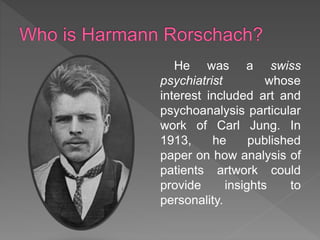
He was a swiss
psychiatrist whose
interest included art and
psychoanalysis particular
work of Carl Jung. In
1913, he published
paper on how analysis of
patients artwork could
provide insights to
personality.
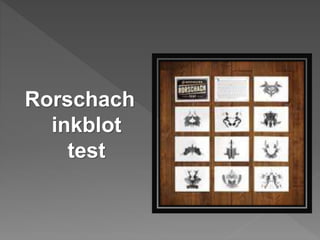
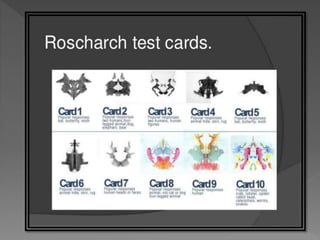
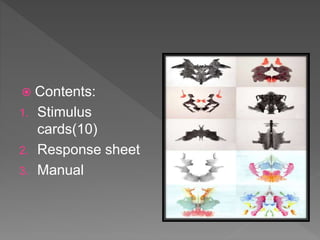
 Roschach consist of ten (10) Bilaterally
Symmetrical (mirrored image) inkblot printed
in separete cards.
 Five (5) achromatic inkblot or without colorblack
and white.
 Two (2) inkblot are black, red, and white.
 The reaming three inkblot are multicolored.
 Contents:
1. Stimulus
cards(10)
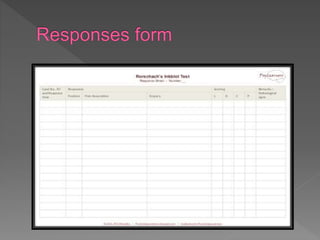
2. Response sheet
3. Manual
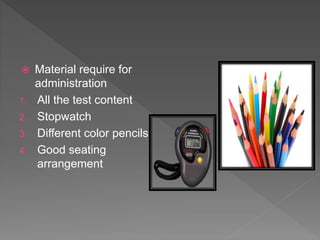
 Material require for
administration
1. All the test content
2. Stopwatch
3. Different color pencils
4. Good seating
arrangement
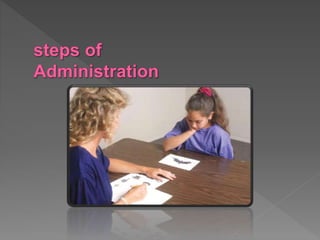
1) Introducing the subject to the
technique
2) Giving the test instruction
3) The response phase
4) The inquiry phase
› Site side by side
› Cards should not be made visible before
› Appropriate order with card I on top
› Hand the person the first card and asking
 “What might be this?”
 How many things I should find?
 Can I turn it?
› “It is up to you.”
 Should I just use my imagination?
› “Just tell me what you see there”.
 Examiner should use good common sense
and answered in a non direct way.
 The client should hold the card.
 Responses or Free Association Phase
› Test taker is instructed to tell what is on each of
the cards
› “What might this be?”
 Inquiry Phase
› Examiner attempts to determine what feature of
the inkblot played a role in formulate the test
taker's percept (perception of an image).
 Verbatim, no probing, silence by examiner is
the rule
 I don’t se anything there
› Take your time, we’re in no hurry (everyone can find
something)
› If you take time and look some more, I think you’ll
find something else too.
 Response time to be noted
 Total time to be noted
 Conducted after all responses are given to all 10
cards
 Gain information needed to score accurately
 Nondirective questions
 Complete location sheet
 Not used to generate new information
› “OK., we’ve done them all. Now we are going to going
back through them. It won’t take long I want to help me
see what you saw. I m going to read what you said, and
them I want you to show me where in the blot you saw it
and what is there that makes it look like that, so I can see
it too. I’d like to see it just like you did, so help me now. Do
you understand.”
 Focus on gaining information and ask question on:
› Location (where is it)
› Deteminants ( what makes it look like that?)
› Content ( what is it?)
 Example
 Responses:
It is a pretty flower
Inquiry :
E: (repeats responses)
S: yes that the stem & here are the patals
E: U mentioned that it is pretty
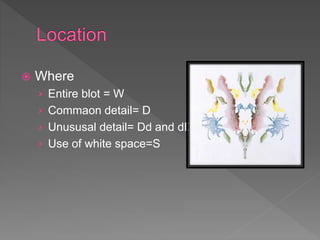
 Where
› Entire blot = W
› Commaon detail= D
› Unususal detail= Dd and dD
› Use of white space=S
 Why
 F= formshape
 C=color
 FC= shape and color
 CF= color and shape
 M= human movement
 FM= animal movement
 Fc= texture response
 Fk= shading response
 Fm= object movement
 Human= H
 Animal= A
 Human Aantomy= At
 Animal Anatomy= Aat
 Object= Obj
 Blood= blood
 Fire= fire
 Plant= plant
 Clouds= clouds
 Geographical= Geo
 Human like (ghost, cartoon)= (H)
 Animal like (dragon, cartoon)= (A)
 Human part= Hd
 Animal parts= Ad
 food= Fd
 Sex= sex
 Abstract= Abs
 Force= m
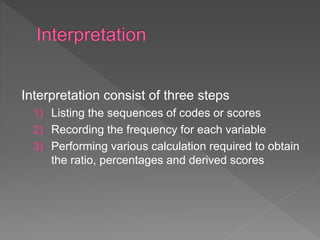
Interpretation consist of three steps
1) Listing the sequences of codes or scores
2) Recording the frequency for each variable
3) Performing various calculation required to obtain
the ratio, percentages and derived scores
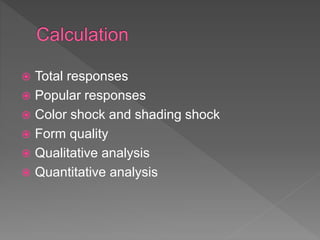
 Total responses
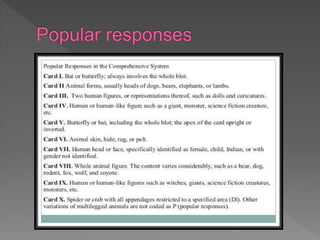
 Popular responses
 Color shock and shading shock
 Form quality
 Qualitative analysis
 Quantitative analysis

Inkblot test (rorschach inkblot)

  • 2.
  • 3.
     Is apsychological test in which subjects perception of inkblot are rescored and then analyzed using psychological interpretation, complex scientifically derived algorithms, or both.  Some psychologist use these test to examine a person personality characteristics and emotional functioning.  It has been employ to detect an underlying thought disorder especially in the case where patients are reluctant to describe their thinking processes openly.
  • 4.
    He was aswiss psychiatrist whose interest included art and psychoanalysis particular work of Carl Jung. In 1913, he published paper on how analysis of patients artwork could provide insights to personality.
  • 6.
     Roschach consistof ten (10) Bilaterally Symmetrical (mirrored image) inkblot printed in separete cards.  Five (5) achromatic inkblot or without colorblack and white.  Two (2) inkblot are black, red, and white.  The reaming three inkblot are multicolored.
  • 7.
  • 8.
     Material requirefor administration 1. All the test content 2. Stopwatch 3. Different color pencils 4. Good seating arrangement
  • 10.
    1) Introducing thesubject to the technique 2) Giving the test instruction 3) The response phase 4) The inquiry phase
  • 11.
    › Site sideby side › Cards should not be made visible before › Appropriate order with card I on top › Hand the person the first card and asking  “What might be this?”
  • 12.
     How manythings I should find?  Can I turn it? › “It is up to you.”  Should I just use my imagination? › “Just tell me what you see there”.  Examiner should use good common sense and answered in a non direct way.  The client should hold the card.
  • 13.
     Responses orFree Association Phase › Test taker is instructed to tell what is on each of the cards › “What might this be?”  Inquiry Phase › Examiner attempts to determine what feature of the inkblot played a role in formulate the test taker's percept (perception of an image).
  • 14.
     Verbatim, noprobing, silence by examiner is the rule  I don’t se anything there › Take your time, we’re in no hurry (everyone can find something) › If you take time and look some more, I think you’ll find something else too.  Response time to be noted  Total time to be noted
  • 15.
     Conducted afterall responses are given to all 10 cards  Gain information needed to score accurately  Nondirective questions  Complete location sheet  Not used to generate new information › “OK., we’ve done them all. Now we are going to going back through them. It won’t take long I want to help me see what you saw. I m going to read what you said, and them I want you to show me where in the blot you saw it and what is there that makes it look like that, so I can see it too. I’d like to see it just like you did, so help me now. Do you understand.”
  • 16.
     Focus ongaining information and ask question on: › Location (where is it) › Deteminants ( what makes it look like that?) › Content ( what is it?)  Example  Responses: It is a pretty flower Inquiry : E: (repeats responses) S: yes that the stem & here are the patals E: U mentioned that it is pretty
  • 18.
     Where › Entireblot = W › Commaon detail= D › Unususal detail= Dd and dD › Use of white space=S
  • 19.
     Why  F=formshape  C=color  FC= shape and color  CF= color and shape  M= human movement  FM= animal movement  Fc= texture response  Fk= shading response  Fm= object movement
  • 20.
     Human= H Animal= A  Human Aantomy= At  Animal Anatomy= Aat  Object= Obj  Blood= blood  Fire= fire  Plant= plant  Clouds= clouds  Geographical= Geo  Human like (ghost, cartoon)= (H)  Animal like (dragon, cartoon)= (A)  Human part= Hd  Animal parts= Ad  food= Fd  Sex= sex  Abstract= Abs  Force= m
  • 24.
    Interpretation consist ofthree steps 1) Listing the sequences of codes or scores 2) Recording the frequency for each variable 3) Performing various calculation required to obtain the ratio, percentages and derived scores
  • 26.
     Total responses Popular responses  Color shock and shading shock  Form quality  Qualitative analysis  Quantitative analysis