Chapter 7
Understanding Self and
Others
Making deals is something
human do all the time
Specific Cognitive Abilities
needed to make deals & to avoid being cheated
Lida Cosmides & John Tobby (1992)
 Recognize many different people
 Remember one’s past interaction with people
 Communicate one’s belief and desires to others
 Understand the beliefs and desires to others
 Represent the cost and benefit of items service
that being exchanged
Social Cognition
 Thinking about one’s own thoughts, feelings,
motives, and behaviors, and those of other
people
 Thinking about the self, other people, and
social relationships
I. The
Development of
Self
A. The Development of a
Concept of Self
Some core concepts in the study
of self
Self –
Concept
• A person’s awareness (& potentially definition)
of one’s self, including physical and
psychological characteristics and skills.
• Involves knowledge of the self, as reflected in
toddlers, by visual-recognition.
Self – Esteem • The evaluative component of the self.
• The judgements people make of their general
worth as a person and the feelings associated
with their judgement.
5 Area of Self-Esteem
 Scholastic competence
 Social competence
 Behavioral conduct
 Athletic competence
 Physical appearance
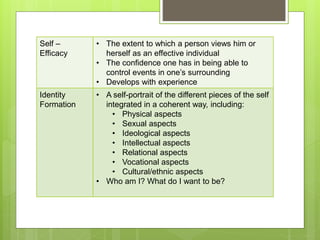
Self –
Efficacy
• The extent to which a person views him or
herself as an effective individual
• The confidence one has in being able to
control events in one’s surrounding
• Develops with experience
Identity
Formation
• A self-portrait of the different pieces of the self
integrated in a coherent way, including:
• Physical aspects
• Sexual aspects
• Ideological aspects
• Intellectual aspects
• Relational aspects
• Vocational aspects
• Cultural/ethnic aspects
• Who am I? What do I want to be?
Early signs of self-
Awareness
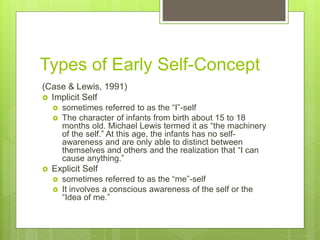
Types of Early Self-Concept
(Case & Lewis, 1991)
 Implicit Self
 sometimes referred to as the “I”-self
 The character of infants from birth about 15 to 18
months old. Michael Lewis termed it as “the machinery
of the self.” At this age, the infants has no self-
awareness and are only able to distinct between
themselves and others and the realization that “I can
cause anything.”
 Explicit Self
 sometimes referred to as the “me”-self
 It involves a conscious awareness of the self or the
“Idea of me.”
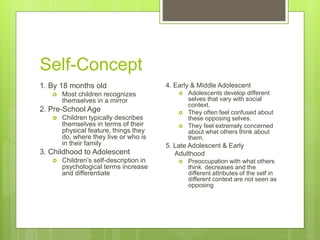
Self-Concept
1. By 18 months old
 Most children recognizes
themselves in a mirror
2. Pre-School Age
 Children typically describes
themselves in terms of their
physical feature, things they
do, where they live or who is
in their family
3. Childhood to Adolescent
 Children’s self-description in
psychological terms increase
and differentiate
4. Early & Middle Adolescent
 Adolescents develop different
selves that vary with social
context.
 They often feel confused about
these opposing selves.
 They feel extremely concerned
about what others think about
them.
5. Late Adolescent & Early
Adulthood
 Preoccupation with what others
think decreases and the
different attributes of the self in
different context are not seen as
opposing
B. The Development of Self-
Esteem
the judgement people make of their general self-worth
and the feelings associated with those judgements
Self-esteem can be viewed as a
product of 2 internal
assessments:
 The discrepancy between the perceived self
and the ideal self
 Support from social others
Self-Esteem & Self-Worth
 Pre-School Children
Children distinguish two
categories of self-esteem:
 Their physical & cognitive
competence and their
general competence
 By the 3rd/4th Grade
Children differentiate among
five categories of self-worth/
self-esteem
They become more realistic
with their own competence
 Adolescence
 At the beginning of
adolescence, children’s
self-esteem typically
declines some often
associated with the
transition to high-school.
Self-esteem then
increased again in most
adolescents. Many
adolescences, experience
temporary period, of
discomfort that are soon
overcome.
C. The Development of Self-
Efficacy
People’s belief about their capabilities to produce
designated levels of performance that exercise influence over
events that affect their lives.” (Bandura, 1994, p.71)
It is the confidence one has in being able to control
events in one’s surroundings.
It is a person’s perception of his or her ability to reach a
specific goal.
 Begins early, infants learn that they can exert
some control over their environment
 3-4 months learns that their actions has
consequences
The Optimistic Child
 Positive sense of self efficacy is facilitated by a generally
optimistic (and often unrealistic) opinion of their own abilities.
 Believes that they know more than they actually do and can
do more than they actually can provides them with positive
perceptions of their own skills.
 Can make relatively accurate predictions of how other
children are likely to perform but gets overly optimistic in
predicting their own future which is due to wishful thinking
(concept originally introduced by Piaget)
 Overestimates their abilities which enhances their self-
efficacy and gives them confidence to attempt new things
 Produces more positive outcomes than realistic children
The Possible Pitfalls of
Overestimating One’s Abilities
 Embarrassment that comes from publicly
displaying the skills that you do not have
 Can cause injury especially boys who
overestimates their physical abilities.
Childhood by its very nature
involves reaching beyond
one’s current abilities.
D. Building an Identity
 Self – complicated concept with many
different components that develops more in
infancy and childhood.
 Identity – is a self-portrait od the different
pieces of self in a coherent and integrated
mode. It is one of the main psychological
challenges in adolescence.
On Adolescent Identity
Erik Erikson and the adolescent
crisis
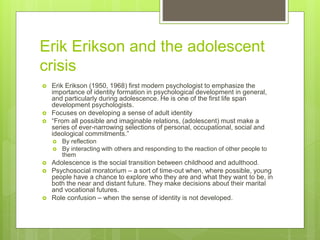
 Erik Erikson (1950, 1968) first modern psychologist to emphasize the
importance of identity formation in psychological development in general,
and particularly during adolescence. He is one of the first life span
development psychologists.
 Focuses on developing a sense of adult identity
 “From all possible and imaginable relations, (adolescent) must make a
series of ever-narrowing selections of personal, occupational, social and
ideological commitments.”
 By reflection
 By interacting with others and responding to the reaction of other people to
them
 Adolescence is the social transition between childhood and adulthood.
 Psychosocial moratorium – a sort of time-out when, where possible, young
people have a chance to explore who they are and what they want to be, in
both the near and distant future. They make decisions about their marital
and vocational futures.
 Role confusion – when the sense of identity is not developed.
Marcia’s identity status approach
 James Marcia (1980, 1994) extended Erikson’s ideas and
develop the identity status approach, which pays
special attention to occupational and ideological aspect of
identity.
 Two dimensions of identity:
 Crisis( or exploration)
 Is the adolescent facing an identity crisis?
 Is the person actively involved personal search among different
identity alternatives?
 Has the person resolved his or her crisis?
 Commitment
 Has the person already made a commitment to a particular
identity?
 Is he or she showing a personal investment in that identity.
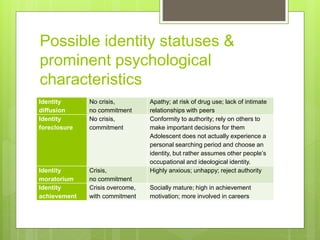
Possible identity statuses &
prominent psychological
characteristics
Identity
diffusion
No crisis,
no commitment
Apathy; at risk of drug use; lack of intimate
relationships with peers
Identity
foreclosure
No crisis,
commitment
Conformity to authority; rely on others to
make important decisions for them
Adolescent does not actually experience a
personal searching period and choose an
identity, but rather assumes other people’s
occupational and ideological identity.
Identity
moratorium
Crisis,
no commitment
Highly anxious; unhappy; reject authority
Identity
achievement
Crisis overcome,
with commitment
Socially mature; high in achievement
motivation; more involved in careers
 People in the diffusion and moratorium
statuses tend to make a commitment, and
move into identity achievement status. Many
adolescent in the foreclosure status, who
experience no crisis, tend to remain in this
state into young adulthood
Factors influencing identity
formation
David Shaffer (2009)
 Level of cognitive development
 Relationship with parents
 Education
 Cultural-historical references
The Development of Ethnic
Identity
Aspects of Ethnic Identity
(Martha Benal & colleagues, 1993)
 Ethnic self-identification – children identify themselves
as a member of their ethnic group.
 Ethnic constancy – children realize that importance
aspects of their ethnic group are constant over time and
situations and that they will always be a member of ethnic
group.
 Ethnic-role behavior – children engage in behaviors or
take on roles that characterize their ethnic group.
 Ethnic knowledge – children became aware that their
ethnic group has certain features, such as customs, types
of food, language, that distinguish it from other groups.
 Ethnic feelings and preferences – children have
positive feelings about and preferences for characteristics
of their ethnic group
 Developing a strong sense of identity show
healthy psychological development for most
adolescents.
 Bicultural identity – the ability of people to
integrate their ethnic identity with that of the
majority culture in which they are living.
II. Children’s
Theory of Mind
Understanding Others
 Public self – the me that other people see
 Private self – the I that represents
 Theory of mind –a person’s concept of mental
activity; used to refer to how children
conceptualize mental activity and how they
attribute intention to and predict the behavior of
others.
 Belief-desire reasoning – the process whereby we
explain and predict what people do based on what
we understand their desires and beliefs to be.
A. Basic Social-Cognitive Skills
Underlying Theory of Mind
Elementary social-cognitive
abilities:
 self-awareness – an ability to differentiate oneself
from other people
 seeing oneself and other individuals as
intentional agents - individuals who cause things
to happen and whose behavior is designed to
achieve some goal.
 Perspective taking – the ability to take point of
view of others
 Egocentrism – preschoolers’ tendency to assume that
other people see and understand the world as they do.
Share attention (or joint attention)
 Is where two people both attending to the same thing or
even and sharing that experience.
 Is more than a two-way ( or dyadic) relationship, but
involves at least a two people and a third object (which
can be another person) meaning a three-way or triadic.
 Not something babies come into the world knowing
how to do although they do seemed biased toward
social stimuli from birth.
 By 2 or 3 months (or earlier) they can recognize self-
produced, biological motion and soon turn to look into
the same direction of another person.
B. The Development of Mind
Reading
Mind Reading
 one central skill that is also requires other
than shared attention. It is putting yourself in
another person’s shoes (or mankind), and
trying to figure out what he or she is thinking.
False-Beliefs Tasks
 are the gold standard of mind-reading tasks,
and it is not until about 4 years of age when
children typically solve them.
 A type of task, used in theory-of-the-mind
studies, in which the child must infer that
another person holds a belief that is false
Solving False-beliefs Tasks
1. Beginning around 9 months of age, infants:
 Will gaze in the direction that adults are looking or pointing
 Engage in repetitive interaction with an adult and an object
 Imitate an adult’s actions
 Point or hold up objects to another person
2. These abilities increase over the second year of life
3. Most 3-year-old children cannot solve the false-belief
tasks; however, they have some understanding that other
people have desires and knowledge different from their
own.
4. Most 4-year-old children can pass false-belief tasks. They
are capable of mind reading (that is adopting others’
perspective and realizing that other people’s feelings,
thoughts, beliefs, and knowledge can be different from
their own)
 Despite the impressive evidence that most 3 year
old children can’t solve false-belief tasks, they
seem to have some understanding that other
people have desires and knowledge different their
own.
 There is some evidence that 2.5 and 3 year old
children can pass standard false-belief tasks, but
only when implicit (unconscious and not
verbalize) as opposed to explicit (available to
conscious awareness and verbalizable) measures
are considered.
Influences on Children’s
Performance on False-belief
Tasks
Factors:
 Attachment
 Parenting styles
 Parent-child communication
 Language skills
 Maternal warmth
 The extent to which mothers use mental state talk
 Executive function
 the basic cognitive abilities involved in planning,
executing, and inhibiting actions
 Children need basic-level information-processing
abilities to regulate their own behavior if they pass the
task.
 3- and 4- year old children’s performance on false-
belief tasks is related to family size and structure
 Specifically having older but not younger sibling is
associated with better theory of mind.
 Sibling always compete with one another with the older
having the advantage, younger children are motivated to
develop their latent talents
 The advanced forms of mind reading are typically
absent or significantly delayed in one particular class of
developmental disability, autism.
Autism
 A developmental disorder characterized by severe social and
communication disabilities.
 Nearly 30 genes associated with autism but no single gene or set
of genes cause autism. One hypothesis is that the genes that are
normally active by neuronal activity after birth malfunction,
resulting in errors in synaptogenesis or other aspects of neural
functioning.
 A part of the brain, the superior temporal sulcus (which is involved in
dynamic processing of emotion), function abnormally in adults and
children with autism when processing social stimuli
 Mind-blindness – or inability to read minds is claimed by Simon
Baron-Cohen (1995, 2005) as the primary deficit of children with
autism
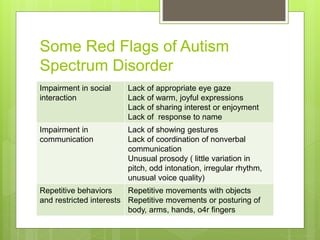
Some Red Flags of Autism
Spectrum Disorder
Impairment in social
interaction
Lack of appropriate eye gaze
Lack of warm, joyful expressions
Lack of sharing interest or enjoyment
Lack of response to name
Impairment in
communication
Lack of showing gestures
Lack of coordination of nonverbal
communication
Unusual prosody ( little variation in
pitch, odd intonation, irregular rhythm,
unusual voice quality)
Repetitive behaviors
and restricted interests
Repetitive movements with objects
Repetitive movements or posturing of
body, arms, hands, o4r fingers
C. Extending Theory of the
Mind
Children’s belief in Fantasy
Children extend their theory-of-
mind abilities to help explain
some natural phenomena not
commonly associated to with
social patterns
 Animism - Preschool tend to treat inanimate
objects as if they were alive
 Promiscuous teleology
 children’s tendency to reason about events and
objects in terms of purpose.
 Deborah Kelemen (2004) use this term to refer
it to such thinking
 Teleology – the tendency to reason about
events in terms of purpose
III. The
Development of
Social Learning
Social Learning
 Human’s ability to learn from one another that
that permitted our ancestors to attain the
ecological domain to essentially be the master
of all they surveyed.
 The acquisition of social information and
behavior in which one individual comes to
behave similarly to others (Boesch & Tomas,
1998)
A. Types of Social Learning
 Mimicry - the duplication of a behavior without any understanding of the
global of that behavior.
 Emulation - one individual observes another interacting with an object to
achieve a specific goal. The first individual then interacts with the object
attempting to attain the same end but does not duplicate the same
behavior as the model to achieve the goal.
 Imitative learning - reproduction of observed behaviour before to achieve
a specific goal. This requires an understanding of the goal that the model
had in mind, as well as the reproduction of important components out the
observed behavior.
 Teaching (Instructed learning) - actor A modifies his or her behavior only
in the presence of another, actor B, without attaining any immediate
benefits. As a result of encouraging or discourage B's behavior, B
acquires a new skill. To be done effecticely, teachingrequires both the
instructor and studenttake the perspective of the other.
Mirror neurons
 A neuron, found in both monkeys and
humans, that fires both when an individual
observes the same action performed by
another.
B. What kind of Social Learning
Do Children Engage in and
How Does it Develop?
 All culture have religion and a belief in some supernatural being
or power might a believe in supernatural agents be a by Product
of our Developing Symbolic System.
 Deborah Kelemen(2004)-states that as we have just seen, young
children believe that things occurs for a reason ,and they endow
fantasy creature with opinion desires and knowledge.
 Paul Bloom(2004)-argued that children’s distinction between
Social and Nonsocial phenomenon seen early in Infancy ,sets
the stage for humans natural distinction between body and soul.
 Rene-Descartes-the 18th century French Philosopher-status that
distinction referring to nonhuman animals as beast-machine, or
Automata without minds of souls.

Chapter 7 - Understanding the Self and Others

  • 1.
  • 2.
    Making deals issomething human do all the time
  • 3.
    Specific Cognitive Abilities neededto make deals & to avoid being cheated Lida Cosmides & John Tobby (1992)  Recognize many different people  Remember one’s past interaction with people  Communicate one’s belief and desires to others  Understand the beliefs and desires to others  Represent the cost and benefit of items service that being exchanged
  • 4.
    Social Cognition  Thinkingabout one’s own thoughts, feelings, motives, and behaviors, and those of other people  Thinking about the self, other people, and social relationships
  • 5.
  • 6.
    A. The Developmentof a Concept of Self
  • 7.
    Some core conceptsin the study of self Self – Concept • A person’s awareness (& potentially definition) of one’s self, including physical and psychological characteristics and skills. • Involves knowledge of the self, as reflected in toddlers, by visual-recognition. Self – Esteem • The evaluative component of the self. • The judgements people make of their general worth as a person and the feelings associated with their judgement.
  • 8.
    5 Area ofSelf-Esteem  Scholastic competence  Social competence  Behavioral conduct  Athletic competence  Physical appearance
  • 9.
    Self – Efficacy • Theextent to which a person views him or herself as an effective individual • The confidence one has in being able to control events in one’s surrounding • Develops with experience Identity Formation • A self-portrait of the different pieces of the self integrated in a coherent way, including: • Physical aspects • Sexual aspects • Ideological aspects • Intellectual aspects • Relational aspects • Vocational aspects • Cultural/ethnic aspects • Who am I? What do I want to be?
  • 10.
    Early signs ofself- Awareness
  • 11.
    Types of EarlySelf-Concept (Case & Lewis, 1991)  Implicit Self  sometimes referred to as the “I”-self  The character of infants from birth about 15 to 18 months old. Michael Lewis termed it as “the machinery of the self.” At this age, the infants has no self- awareness and are only able to distinct between themselves and others and the realization that “I can cause anything.”  Explicit Self  sometimes referred to as the “me”-self  It involves a conscious awareness of the self or the “Idea of me.”
  • 12.
    Self-Concept 1. By 18months old  Most children recognizes themselves in a mirror 2. Pre-School Age  Children typically describes themselves in terms of their physical feature, things they do, where they live or who is in their family 3. Childhood to Adolescent  Children’s self-description in psychological terms increase and differentiate 4. Early & Middle Adolescent  Adolescents develop different selves that vary with social context.  They often feel confused about these opposing selves.  They feel extremely concerned about what others think about them. 5. Late Adolescent & Early Adulthood  Preoccupation with what others think decreases and the different attributes of the self in different context are not seen as opposing
  • 13.
    B. The Developmentof Self- Esteem the judgement people make of their general self-worth and the feelings associated with those judgements
  • 14.
    Self-esteem can beviewed as a product of 2 internal assessments:  The discrepancy between the perceived self and the ideal self  Support from social others
  • 15.
    Self-Esteem & Self-Worth Pre-School Children Children distinguish two categories of self-esteem:  Their physical & cognitive competence and their general competence  By the 3rd/4th Grade Children differentiate among five categories of self-worth/ self-esteem They become more realistic with their own competence  Adolescence  At the beginning of adolescence, children’s self-esteem typically declines some often associated with the transition to high-school. Self-esteem then increased again in most adolescents. Many adolescences, experience temporary period, of discomfort that are soon overcome.
  • 16.
    C. The Developmentof Self- Efficacy People’s belief about their capabilities to produce designated levels of performance that exercise influence over events that affect their lives.” (Bandura, 1994, p.71) It is the confidence one has in being able to control events in one’s surroundings. It is a person’s perception of his or her ability to reach a specific goal.
  • 17.
     Begins early,infants learn that they can exert some control over their environment  3-4 months learns that their actions has consequences
  • 18.
    The Optimistic Child Positive sense of self efficacy is facilitated by a generally optimistic (and often unrealistic) opinion of their own abilities.  Believes that they know more than they actually do and can do more than they actually can provides them with positive perceptions of their own skills.  Can make relatively accurate predictions of how other children are likely to perform but gets overly optimistic in predicting their own future which is due to wishful thinking (concept originally introduced by Piaget)  Overestimates their abilities which enhances their self- efficacy and gives them confidence to attempt new things  Produces more positive outcomes than realistic children
  • 19.
    The Possible Pitfallsof Overestimating One’s Abilities  Embarrassment that comes from publicly displaying the skills that you do not have  Can cause injury especially boys who overestimates their physical abilities.
  • 20.
    Childhood by itsvery nature involves reaching beyond one’s current abilities.
  • 21.
  • 22.
     Self –complicated concept with many different components that develops more in infancy and childhood.  Identity – is a self-portrait od the different pieces of self in a coherent and integrated mode. It is one of the main psychological challenges in adolescence.
  • 23.
  • 24.
    Erik Erikson andthe adolescent crisis  Erik Erikson (1950, 1968) first modern psychologist to emphasize the importance of identity formation in psychological development in general, and particularly during adolescence. He is one of the first life span development psychologists.  Focuses on developing a sense of adult identity  “From all possible and imaginable relations, (adolescent) must make a series of ever-narrowing selections of personal, occupational, social and ideological commitments.”  By reflection  By interacting with others and responding to the reaction of other people to them  Adolescence is the social transition between childhood and adulthood.  Psychosocial moratorium – a sort of time-out when, where possible, young people have a chance to explore who they are and what they want to be, in both the near and distant future. They make decisions about their marital and vocational futures.  Role confusion – when the sense of identity is not developed.
  • 26.
    Marcia’s identity statusapproach  James Marcia (1980, 1994) extended Erikson’s ideas and develop the identity status approach, which pays special attention to occupational and ideological aspect of identity.  Two dimensions of identity:  Crisis( or exploration)  Is the adolescent facing an identity crisis?  Is the person actively involved personal search among different identity alternatives?  Has the person resolved his or her crisis?  Commitment  Has the person already made a commitment to a particular identity?  Is he or she showing a personal investment in that identity.
  • 27.
    Possible identity statuses& prominent psychological characteristics Identity diffusion No crisis, no commitment Apathy; at risk of drug use; lack of intimate relationships with peers Identity foreclosure No crisis, commitment Conformity to authority; rely on others to make important decisions for them Adolescent does not actually experience a personal searching period and choose an identity, but rather assumes other people’s occupational and ideological identity. Identity moratorium Crisis, no commitment Highly anxious; unhappy; reject authority Identity achievement Crisis overcome, with commitment Socially mature; high in achievement motivation; more involved in careers
  • 28.
     People inthe diffusion and moratorium statuses tend to make a commitment, and move into identity achievement status. Many adolescent in the foreclosure status, who experience no crisis, tend to remain in this state into young adulthood
  • 29.
    Factors influencing identity formation DavidShaffer (2009)  Level of cognitive development  Relationship with parents  Education  Cultural-historical references
  • 30.
    The Development ofEthnic Identity
  • 31.
    Aspects of EthnicIdentity (Martha Benal & colleagues, 1993)  Ethnic self-identification – children identify themselves as a member of their ethnic group.  Ethnic constancy – children realize that importance aspects of their ethnic group are constant over time and situations and that they will always be a member of ethnic group.  Ethnic-role behavior – children engage in behaviors or take on roles that characterize their ethnic group.  Ethnic knowledge – children became aware that their ethnic group has certain features, such as customs, types of food, language, that distinguish it from other groups.  Ethnic feelings and preferences – children have positive feelings about and preferences for characteristics of their ethnic group
  • 32.
     Developing astrong sense of identity show healthy psychological development for most adolescents.  Bicultural identity – the ability of people to integrate their ethnic identity with that of the majority culture in which they are living.
  • 33.
    II. Children’s Theory ofMind Understanding Others
  • 34.
     Public self– the me that other people see  Private self – the I that represents  Theory of mind –a person’s concept of mental activity; used to refer to how children conceptualize mental activity and how they attribute intention to and predict the behavior of others.  Belief-desire reasoning – the process whereby we explain and predict what people do based on what we understand their desires and beliefs to be.
  • 35.
    A. Basic Social-CognitiveSkills Underlying Theory of Mind
  • 36.
    Elementary social-cognitive abilities:  self-awareness– an ability to differentiate oneself from other people  seeing oneself and other individuals as intentional agents - individuals who cause things to happen and whose behavior is designed to achieve some goal.  Perspective taking – the ability to take point of view of others  Egocentrism – preschoolers’ tendency to assume that other people see and understand the world as they do.
  • 37.
    Share attention (orjoint attention)  Is where two people both attending to the same thing or even and sharing that experience.  Is more than a two-way ( or dyadic) relationship, but involves at least a two people and a third object (which can be another person) meaning a three-way or triadic.  Not something babies come into the world knowing how to do although they do seemed biased toward social stimuli from birth.  By 2 or 3 months (or earlier) they can recognize self- produced, biological motion and soon turn to look into the same direction of another person.
  • 38.
    B. The Developmentof Mind Reading
  • 39.
    Mind Reading  onecentral skill that is also requires other than shared attention. It is putting yourself in another person’s shoes (or mankind), and trying to figure out what he or she is thinking.
  • 40.
    False-Beliefs Tasks  arethe gold standard of mind-reading tasks, and it is not until about 4 years of age when children typically solve them.  A type of task, used in theory-of-the-mind studies, in which the child must infer that another person holds a belief that is false
  • 41.
  • 42.
    1. Beginning around9 months of age, infants:  Will gaze in the direction that adults are looking or pointing  Engage in repetitive interaction with an adult and an object  Imitate an adult’s actions  Point or hold up objects to another person 2. These abilities increase over the second year of life 3. Most 3-year-old children cannot solve the false-belief tasks; however, they have some understanding that other people have desires and knowledge different from their own. 4. Most 4-year-old children can pass false-belief tasks. They are capable of mind reading (that is adopting others’ perspective and realizing that other people’s feelings, thoughts, beliefs, and knowledge can be different from their own)
  • 43.
     Despite theimpressive evidence that most 3 year old children can’t solve false-belief tasks, they seem to have some understanding that other people have desires and knowledge different their own.  There is some evidence that 2.5 and 3 year old children can pass standard false-belief tasks, but only when implicit (unconscious and not verbalize) as opposed to explicit (available to conscious awareness and verbalizable) measures are considered.
  • 44.
  • 45.
    Factors:  Attachment  Parentingstyles  Parent-child communication  Language skills  Maternal warmth  The extent to which mothers use mental state talk  Executive function  the basic cognitive abilities involved in planning, executing, and inhibiting actions
  • 46.
     Children needbasic-level information-processing abilities to regulate their own behavior if they pass the task.  3- and 4- year old children’s performance on false- belief tasks is related to family size and structure  Specifically having older but not younger sibling is associated with better theory of mind.  Sibling always compete with one another with the older having the advantage, younger children are motivated to develop their latent talents  The advanced forms of mind reading are typically absent or significantly delayed in one particular class of developmental disability, autism.
  • 47.
    Autism  A developmentaldisorder characterized by severe social and communication disabilities.  Nearly 30 genes associated with autism but no single gene or set of genes cause autism. One hypothesis is that the genes that are normally active by neuronal activity after birth malfunction, resulting in errors in synaptogenesis or other aspects of neural functioning.  A part of the brain, the superior temporal sulcus (which is involved in dynamic processing of emotion), function abnormally in adults and children with autism when processing social stimuli  Mind-blindness – or inability to read minds is claimed by Simon Baron-Cohen (1995, 2005) as the primary deficit of children with autism
  • 48.
    Some Red Flagsof Autism Spectrum Disorder Impairment in social interaction Lack of appropriate eye gaze Lack of warm, joyful expressions Lack of sharing interest or enjoyment Lack of response to name Impairment in communication Lack of showing gestures Lack of coordination of nonverbal communication Unusual prosody ( little variation in pitch, odd intonation, irregular rhythm, unusual voice quality) Repetitive behaviors and restricted interests Repetitive movements with objects Repetitive movements or posturing of body, arms, hands, o4r fingers
  • 49.
    C. Extending Theoryof the Mind Children’s belief in Fantasy
  • 50.
    Children extend theirtheory-of- mind abilities to help explain some natural phenomena not commonly associated to with social patterns
  • 51.
     Animism -Preschool tend to treat inanimate objects as if they were alive  Promiscuous teleology  children’s tendency to reason about events and objects in terms of purpose.  Deborah Kelemen (2004) use this term to refer it to such thinking  Teleology – the tendency to reason about events in terms of purpose
  • 52.
  • 53.
    Social Learning  Human’sability to learn from one another that that permitted our ancestors to attain the ecological domain to essentially be the master of all they surveyed.  The acquisition of social information and behavior in which one individual comes to behave similarly to others (Boesch & Tomas, 1998)
  • 54.
    A. Types ofSocial Learning
  • 55.
     Mimicry -the duplication of a behavior without any understanding of the global of that behavior.  Emulation - one individual observes another interacting with an object to achieve a specific goal. The first individual then interacts with the object attempting to attain the same end but does not duplicate the same behavior as the model to achieve the goal.  Imitative learning - reproduction of observed behaviour before to achieve a specific goal. This requires an understanding of the goal that the model had in mind, as well as the reproduction of important components out the observed behavior.  Teaching (Instructed learning) - actor A modifies his or her behavior only in the presence of another, actor B, without attaining any immediate benefits. As a result of encouraging or discourage B's behavior, B acquires a new skill. To be done effecticely, teachingrequires both the instructor and studenttake the perspective of the other.
  • 56.
    Mirror neurons  Aneuron, found in both monkeys and humans, that fires both when an individual observes the same action performed by another.
  • 57.
    B. What kindof Social Learning Do Children Engage in and How Does it Develop?
  • 58.
     All culturehave religion and a belief in some supernatural being or power might a believe in supernatural agents be a by Product of our Developing Symbolic System.  Deborah Kelemen(2004)-states that as we have just seen, young children believe that things occurs for a reason ,and they endow fantasy creature with opinion desires and knowledge.  Paul Bloom(2004)-argued that children’s distinction between Social and Nonsocial phenomenon seen early in Infancy ,sets the stage for humans natural distinction between body and soul.  Rene-Descartes-the 18th century French Philosopher-status that distinction referring to nonhuman animals as beast-machine, or Automata without minds of souls.

Editor's Notes