MS-I (ZOOLOGY)
OBJECTIVES
OF THIS PRESENTATION
 What is RT-PCR?
 How does it works?
 What does it tell us?
 Applications
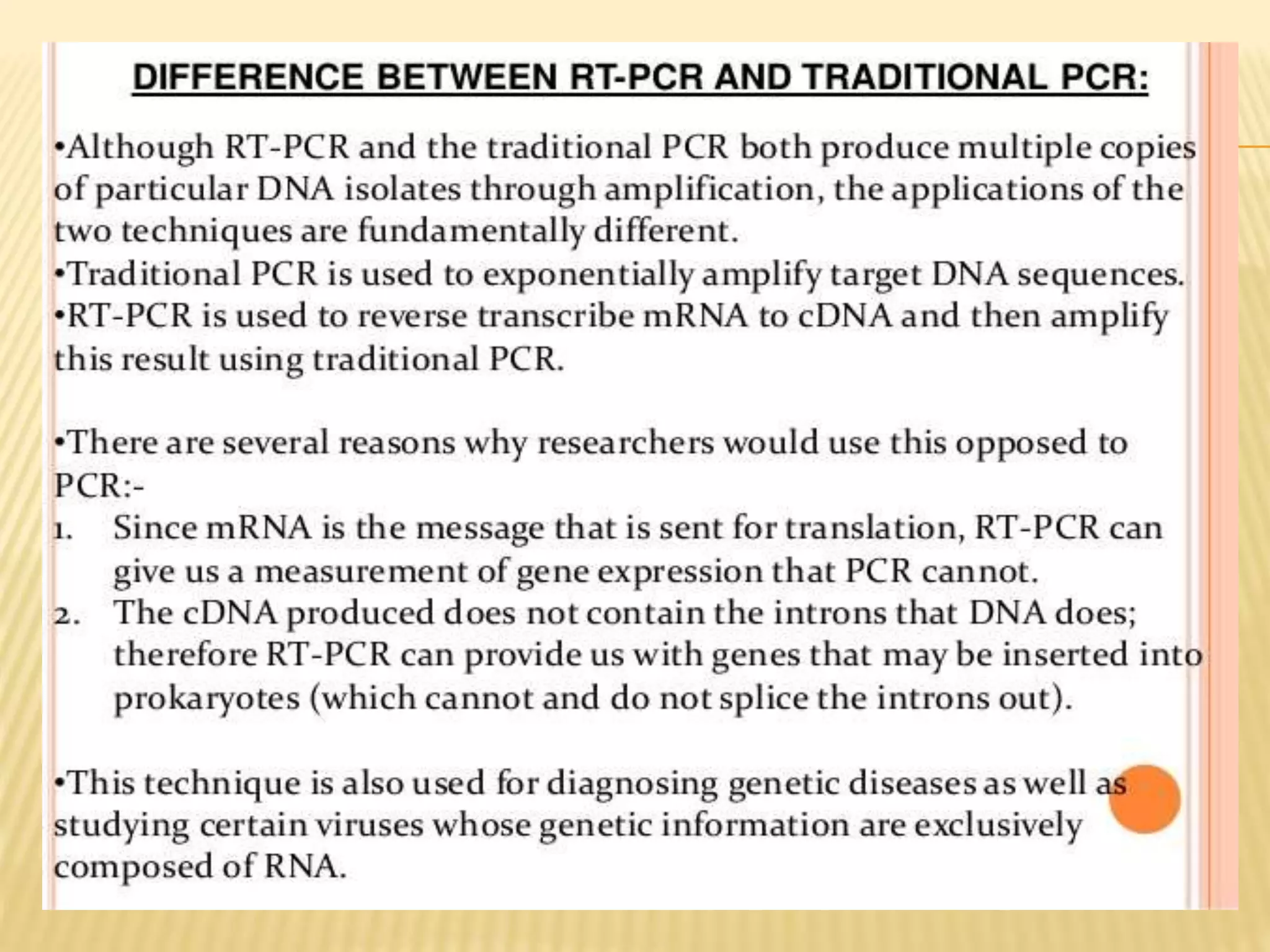
 Difference between RT-PCR and
Conventional PCR
 What work is done through RT-PCR?
INTRODUCTION
 RT-PCR stands for Reverse Transcription-Polymerase
Chain Reaction. It is a technique used in genetic studies
that allows the detection and quantification of mRNA.
 Sensitive method that shows whether or not a specific gene
is being expressed in a given sample.
 RT-PCR is often confused with (qPCR) by students and
scientists alike. However, they are separate and distinct
techniques.
 RT-PCR is used to qualitatively detect gene expression
through creation of complementary DNA (cDNA) transcripts
from RNA, qPCR is used to quantitatively measure the
amplification of DNA using fluorescent probes.
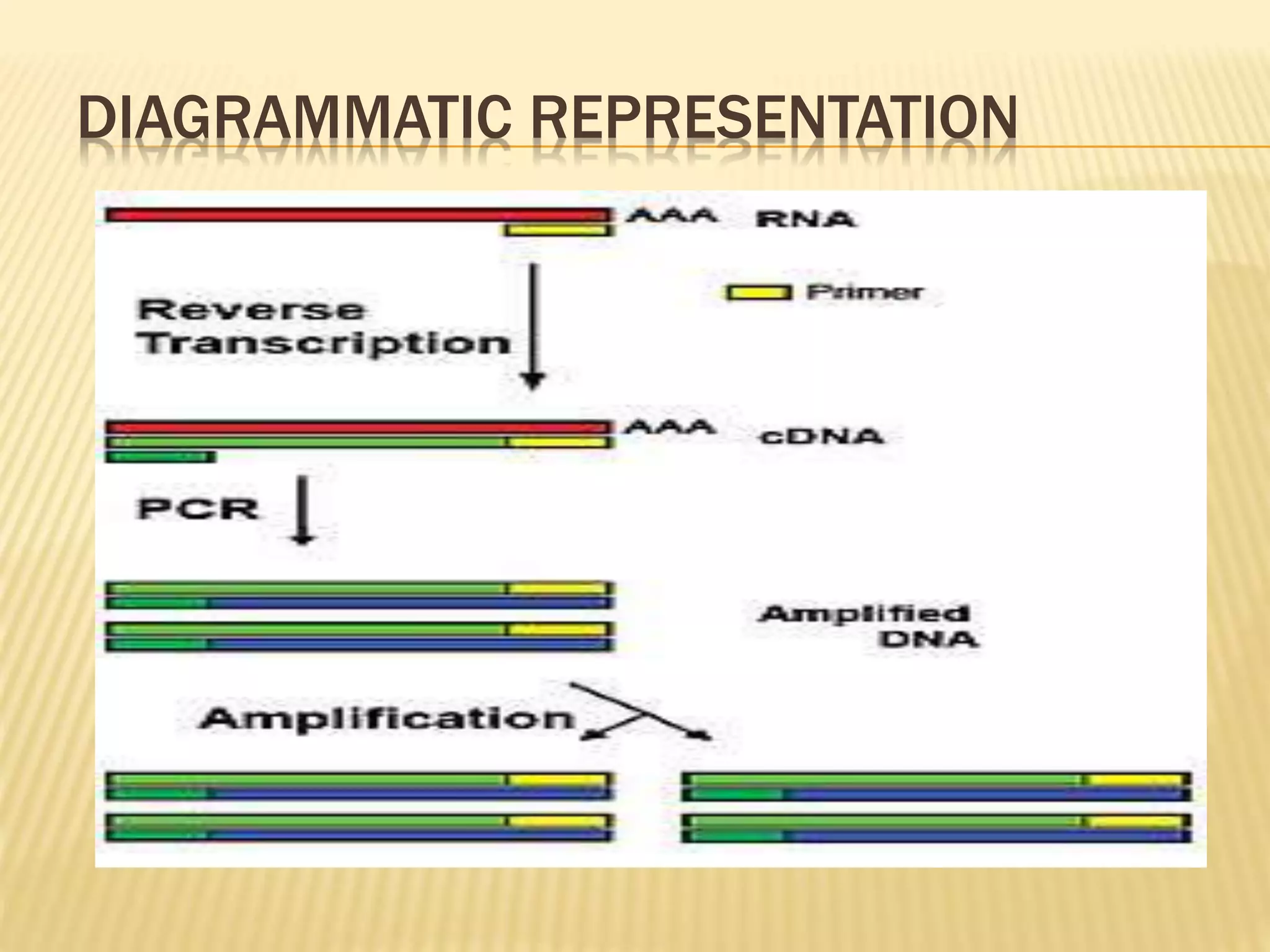
DIAGRAMMATIC REPRESENTATION
HISTORY
 Reverse transcriptase discovery in 1977 led
to the development of RT-PCR
 since it displaced the Northern blot method
PRINCIPLE
 In RT-PCR, the RNA template is first converted into
a complementary DNA (cDNA) using a reverse
transcriptase. The cDNA is then used as a template for
exponential amplification using PCR.
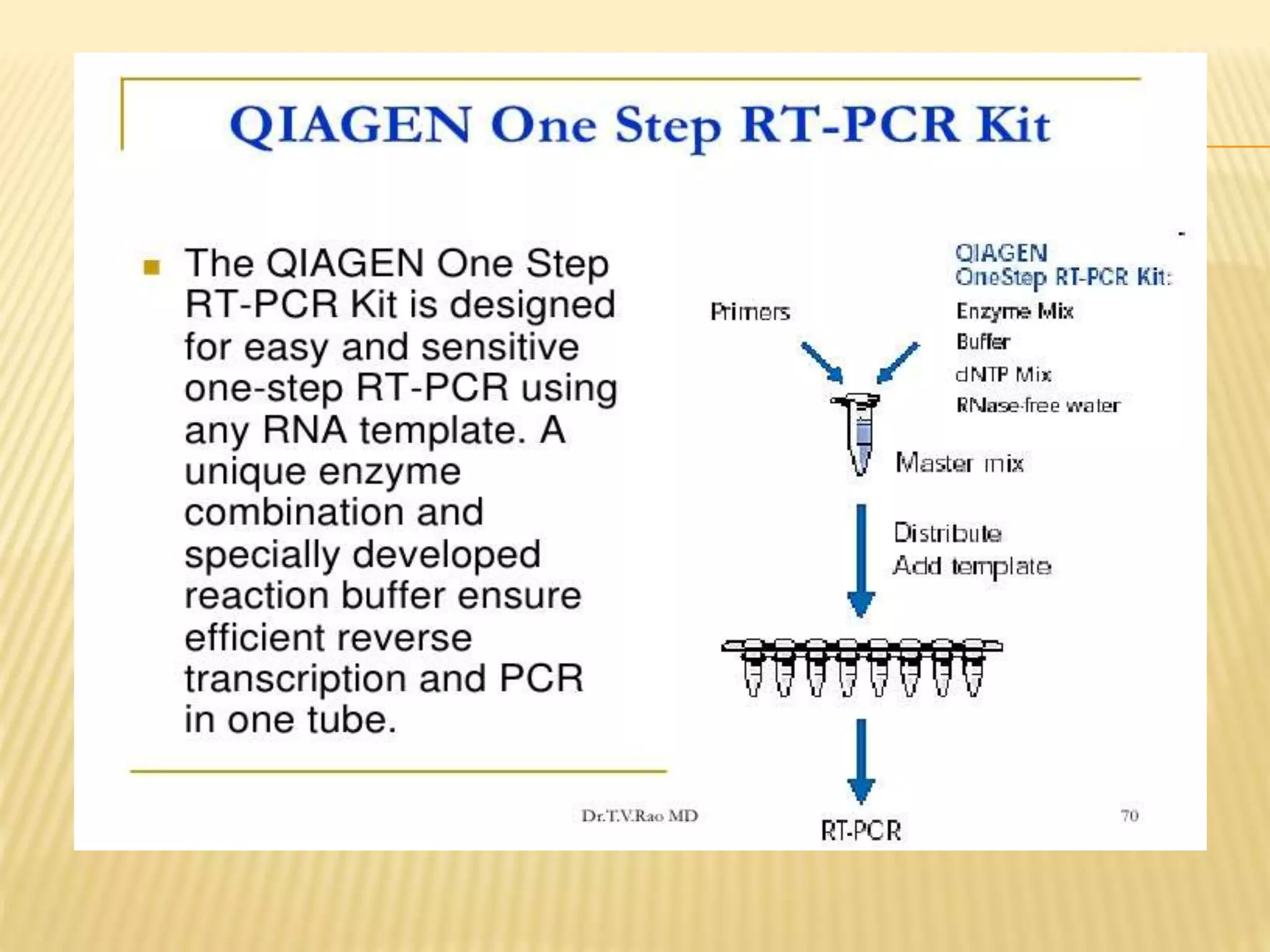
 In the one-step approach, the entire reaction occurs in a
single tube.
 In two-step reaction the reverse transcriptase reaction and
PCR amplification be performed in separate tubes.
One-step RT-PCR vs. two-step RT-PCR
PROTOCOL
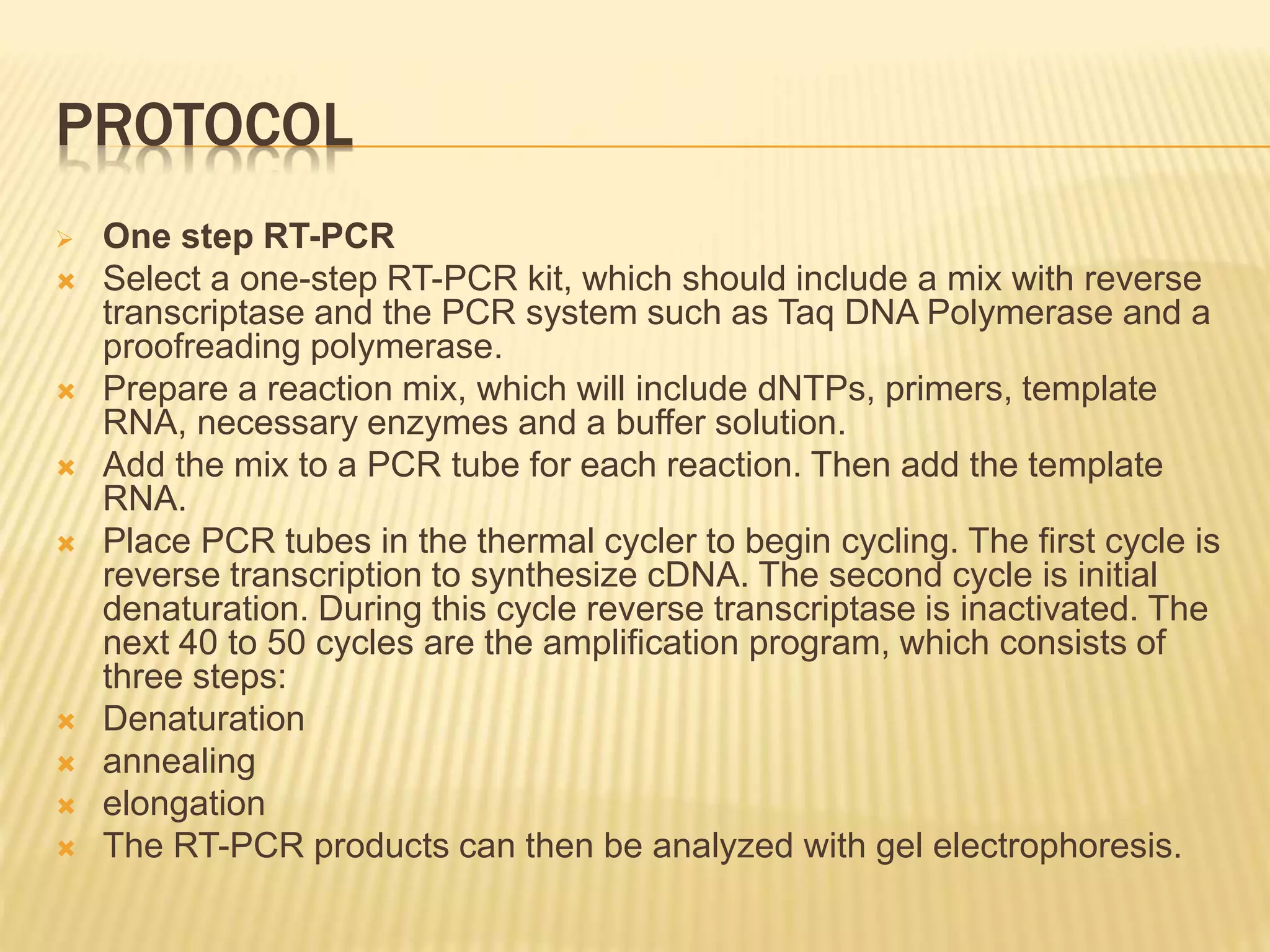
 One step RT-PCR
 Select a one-step RT-PCR kit, which should include a mix with reverse
transcriptase and the PCR system such as Taq DNA Polymerase and a
proofreading polymerase.
 Prepare a reaction mix, which will include dNTPs, primers, template
RNA, necessary enzymes and a buffer solution.
 Add the mix to a PCR tube for each reaction. Then add the template
RNA.
 Place PCR tubes in the thermal cycler to begin cycling. The first cycle is
reverse transcription to synthesize cDNA. The second cycle is initial
denaturation. During this cycle reverse transcriptase is inactivated. The
next 40 to 50 cycles are the amplification program, which consists of
three steps:
 Denaturation
 annealing
 elongation
 The RT-PCR products can then be analyzed with gel electrophoresis.
PROTOCOL
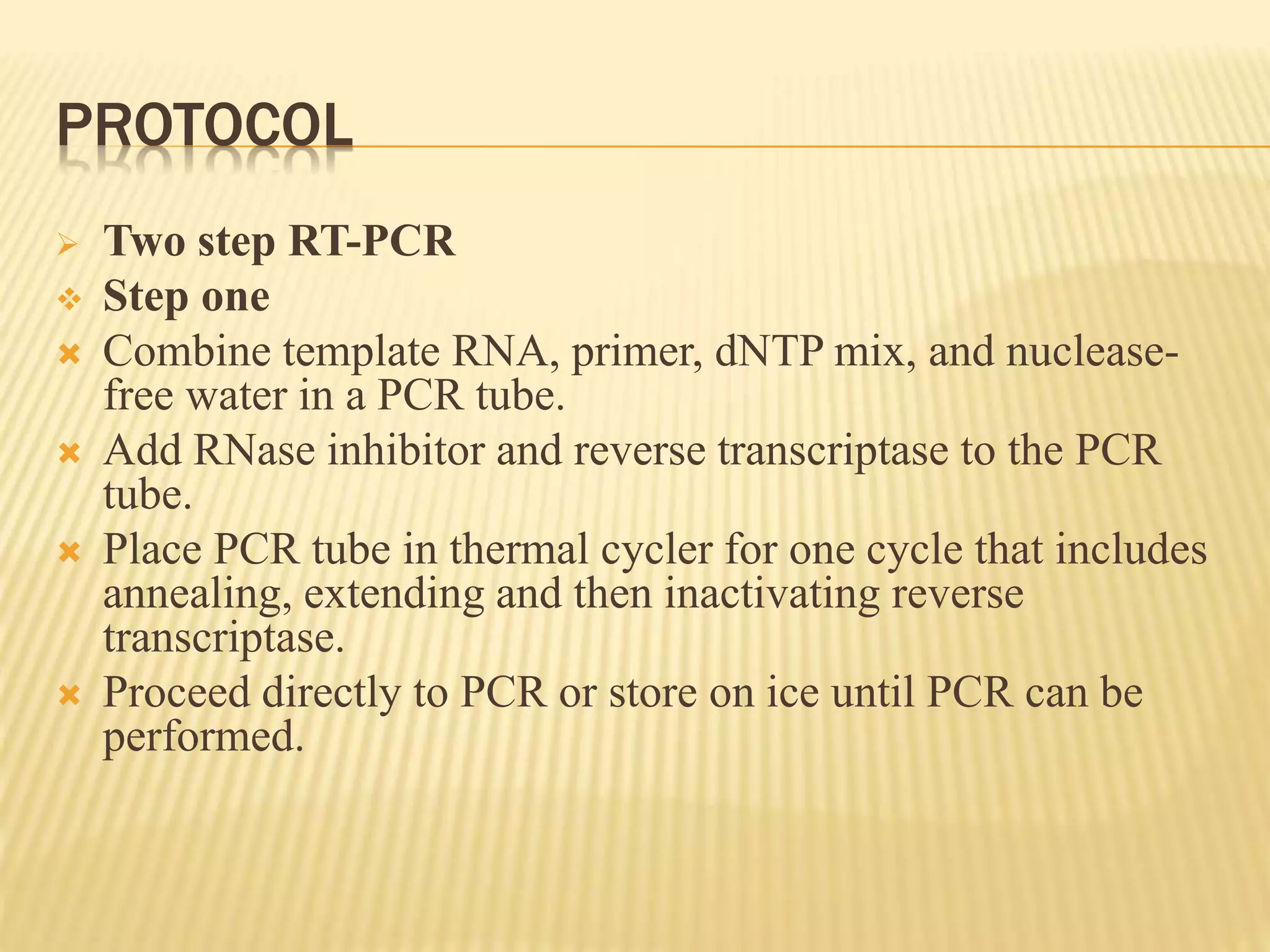
 Two step RT-PCR
 Step one
 Combine template RNA, primer, dNTP mix, and nuclease-
free water in a PCR tube.
 Add RNase inhibitor and reverse transcriptase to the PCR
tube.
 Place PCR tube in thermal cycler for one cycle that includes
annealing, extending and then inactivating reverse
transcriptase.
 Proceed directly to PCR or store on ice until PCR can be
performed.
 Step two
 Add a master mix (containing buffer, dNTP mix, MgCl2, Taq
polymerase and nuclease-free water) to each PCR tube.
 Add appropriate primer.
 Place PCR tubes in thermal cycler for 30 cycles of the
amplification program, which includes three steps:
 denaturation
 annealing
 elongation
 The RT-PCR products can then be analyzed with gel
electrophores contamination due to more frequent sample
handling
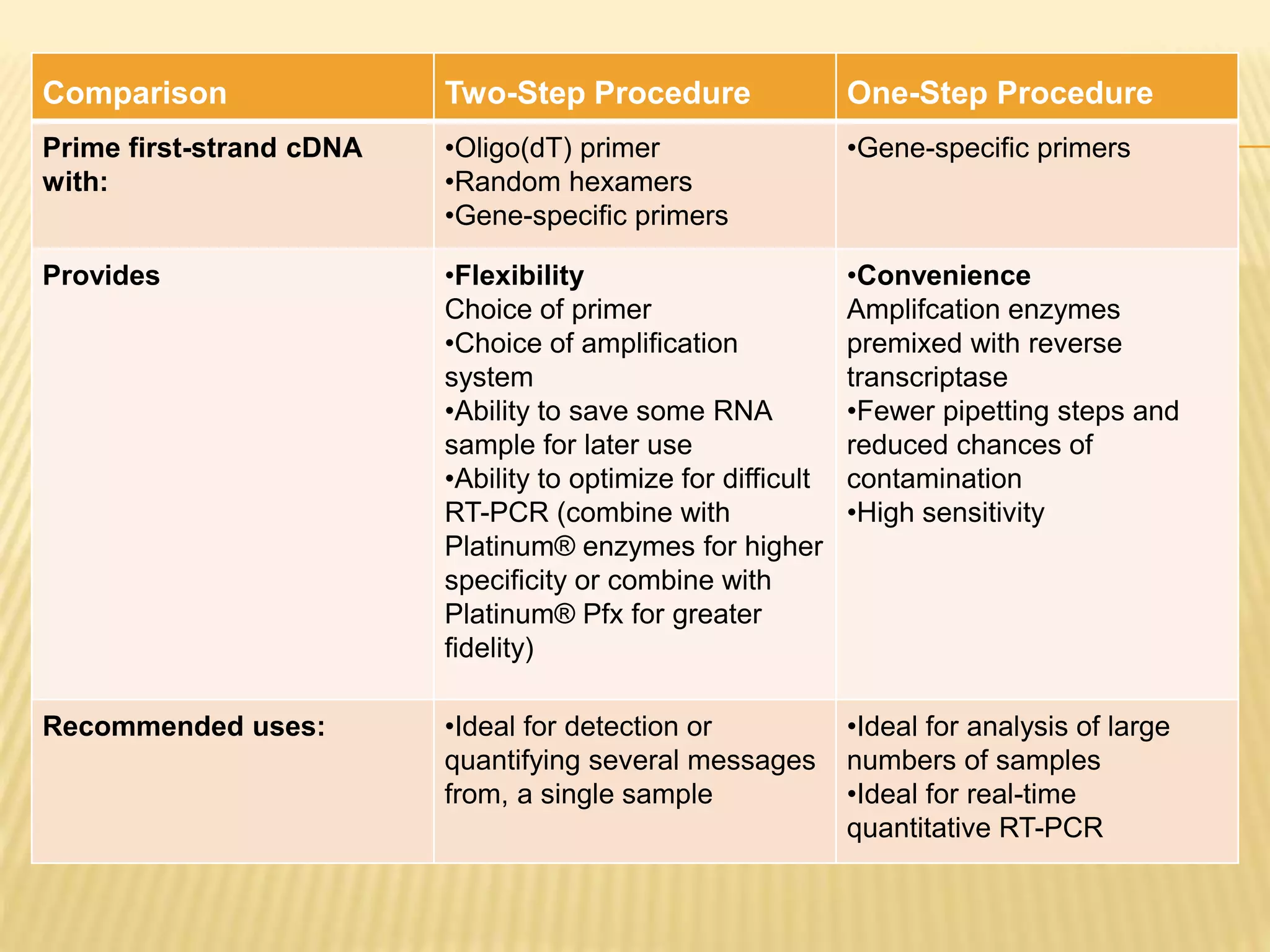
Comparison Two-Step Procedure One-Step Procedure
Prime first-strand cDNA
with:
•Oligo(dT) primer
•Random hexamers
•Gene-specific primers
Provides •Flexibility
Choice of primer
•Choice of amplification
system
•Ability to save some RNA
sample for later use
•Ability to optimize for difficult
RT-PCR (combine with
Platinum® enzymes for higher
specificity or combine with
Platinum® Pfx for greater
fidelity)
•Convenience
Amplifcation enzymes
premixed with reverse
transcriptase
•Fewer pipetting steps and
reduced chances of
contamination
•High sensitivity
Recommended uses: •Ideal for detection or
quantifying several messages
from, a single sample
•Ideal for analysis of large
numbers of samples
•Ideal for real-time
quantitative RT-PCR
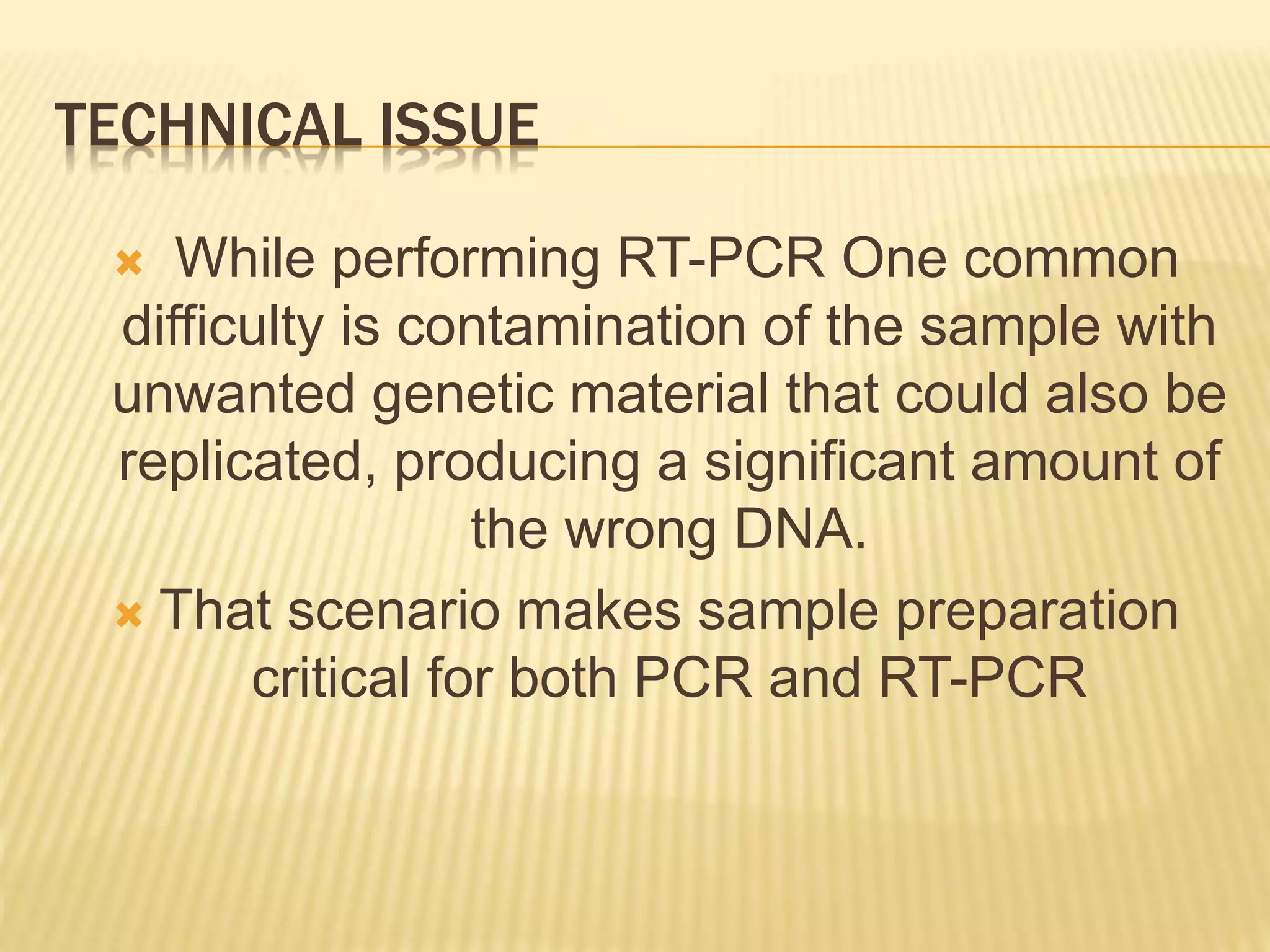
TECHNICAL ISSUE
 While performing RT-PCR One common
difficulty is contamination of the sample with
unwanted genetic material that could also be
replicated, producing a significant amount of
the wrong DNA.
 That scenario makes sample preparation
critical for both PCR and RT-PCR
Solution
 So manufacturers have developed several products and kits to
keep this step unsullied.
 Ambion, Amersham Pharmacia Biotech, Applied Biosystems,
BIO 101, CLONTECH, Roche Molecular Biochemicals, and
Sigma-Aldrich, among others, also produce kits for
simplifying extraction and cleanup of DNA and RNA prior to
PCR.
 Offer particular help to researchers who may have limited
experience in isolating nucleic acids
LITERATURE WORK
 Use of Propidium Monoazide in Reverse Transcriptase PCR To Distinguish
between Infectious and Noninfectious Enteric Viruses in Water Samples
(Appl. Environ. Microbiol. July 2010 vol. 76 no. 13 4318-4326)
 Molecular staging of prostate cancer with the use of an enhanced reverse
transcriptase-PCR assay
( Urology Volume 43, Issue 6, June 1994, Pages 765–775)
 CCHF virus variants in Pakistan and Afghanistan: Emerging diversity
and epidemiology
(Journal of Clinical Virology Volume 67, June 2015, Pages 25–30)
 Rapid detection and typing of dengue viruses from clinical samples by using
reverse transcriptase-polymerase chain reaction.
(J. Clin. Microbiol. March 1992vol. 30 no. 3 545-551)
RT PCR

RT PCR

  • 1.
  • 2.
    OBJECTIVES OF THIS PRESENTATION What is RT-PCR?  How does it works?  What does it tell us?  Applications  Difference between RT-PCR and Conventional PCR  What work is done through RT-PCR?
  • 3.
    INTRODUCTION  RT-PCR standsfor Reverse Transcription-Polymerase Chain Reaction. It is a technique used in genetic studies that allows the detection and quantification of mRNA.  Sensitive method that shows whether or not a specific gene is being expressed in a given sample.  RT-PCR is often confused with (qPCR) by students and scientists alike. However, they are separate and distinct techniques.  RT-PCR is used to qualitatively detect gene expression through creation of complementary DNA (cDNA) transcripts from RNA, qPCR is used to quantitatively measure the amplification of DNA using fluorescent probes.
  • 4.
  • 5.
    HISTORY  Reverse transcriptasediscovery in 1977 led to the development of RT-PCR  since it displaced the Northern blot method
  • 6.
    PRINCIPLE  In RT-PCR,the RNA template is first converted into a complementary DNA (cDNA) using a reverse transcriptase. The cDNA is then used as a template for exponential amplification using PCR.  In the one-step approach, the entire reaction occurs in a single tube.  In two-step reaction the reverse transcriptase reaction and PCR amplification be performed in separate tubes. One-step RT-PCR vs. two-step RT-PCR
  • 8.
    PROTOCOL  One stepRT-PCR  Select a one-step RT-PCR kit, which should include a mix with reverse transcriptase and the PCR system such as Taq DNA Polymerase and a proofreading polymerase.  Prepare a reaction mix, which will include dNTPs, primers, template RNA, necessary enzymes and a buffer solution.  Add the mix to a PCR tube for each reaction. Then add the template RNA.  Place PCR tubes in the thermal cycler to begin cycling. The first cycle is reverse transcription to synthesize cDNA. The second cycle is initial denaturation. During this cycle reverse transcriptase is inactivated. The next 40 to 50 cycles are the amplification program, which consists of three steps:  Denaturation  annealing  elongation  The RT-PCR products can then be analyzed with gel electrophoresis.
  • 11.
    PROTOCOL  Two stepRT-PCR  Step one  Combine template RNA, primer, dNTP mix, and nuclease- free water in a PCR tube.  Add RNase inhibitor and reverse transcriptase to the PCR tube.  Place PCR tube in thermal cycler for one cycle that includes annealing, extending and then inactivating reverse transcriptase.  Proceed directly to PCR or store on ice until PCR can be performed.
  • 12.
     Step two Add a master mix (containing buffer, dNTP mix, MgCl2, Taq polymerase and nuclease-free water) to each PCR tube.  Add appropriate primer.  Place PCR tubes in thermal cycler for 30 cycles of the amplification program, which includes three steps:  denaturation  annealing  elongation  The RT-PCR products can then be analyzed with gel electrophores contamination due to more frequent sample handling
  • 13.
    Comparison Two-Step ProcedureOne-Step Procedure Prime first-strand cDNA with: •Oligo(dT) primer •Random hexamers •Gene-specific primers •Gene-specific primers Provides •Flexibility Choice of primer •Choice of amplification system •Ability to save some RNA sample for later use •Ability to optimize for difficult RT-PCR (combine with Platinum® enzymes for higher specificity or combine with Platinum® Pfx for greater fidelity) •Convenience Amplifcation enzymes premixed with reverse transcriptase •Fewer pipetting steps and reduced chances of contamination •High sensitivity Recommended uses: •Ideal for detection or quantifying several messages from, a single sample •Ideal for analysis of large numbers of samples •Ideal for real-time quantitative RT-PCR
  • 16.
    TECHNICAL ISSUE  Whileperforming RT-PCR One common difficulty is contamination of the sample with unwanted genetic material that could also be replicated, producing a significant amount of the wrong DNA.  That scenario makes sample preparation critical for both PCR and RT-PCR
  • 17.
    Solution  So manufacturershave developed several products and kits to keep this step unsullied.  Ambion, Amersham Pharmacia Biotech, Applied Biosystems, BIO 101, CLONTECH, Roche Molecular Biochemicals, and Sigma-Aldrich, among others, also produce kits for simplifying extraction and cleanup of DNA and RNA prior to PCR.  Offer particular help to researchers who may have limited experience in isolating nucleic acids
  • 21.
    LITERATURE WORK  Useof Propidium Monoazide in Reverse Transcriptase PCR To Distinguish between Infectious and Noninfectious Enteric Viruses in Water Samples (Appl. Environ. Microbiol. July 2010 vol. 76 no. 13 4318-4326)  Molecular staging of prostate cancer with the use of an enhanced reverse transcriptase-PCR assay ( Urology Volume 43, Issue 6, June 1994, Pages 765–775)  CCHF virus variants in Pakistan and Afghanistan: Emerging diversity and epidemiology (Journal of Clinical Virology Volume 67, June 2015, Pages 25–30)  Rapid detection and typing of dengue viruses from clinical samples by using reverse transcriptase-polymerase chain reaction. (J. Clin. Microbiol. March 1992vol. 30 no. 3 545-551)