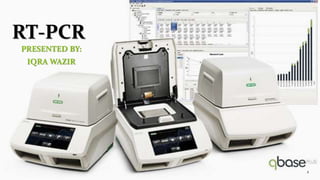
RT-PCR
PRESENTED BY:
IQRA WAZIR
2
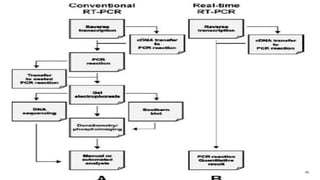
Conventional and qRT-PCR
PCR vs RT-PCR
Types of RT-PCR & Primer Designs
Protocol & Application of RT-PCR
3
Conventional Reverse Transcription-PCR
(RT-PCR)
Variant of polymerase chain reaction (PCR)
Commonly used in molecular biology to detect RNA expression
RT-PCR is often confused with real-time polymerase chain reaction
(qPCR)
However, they are separate and distinct techniques.
RT-PCR is used to qualitatively detect gene expression through
creation of complementary DNA (cDNA) transcripts from RNA.
4
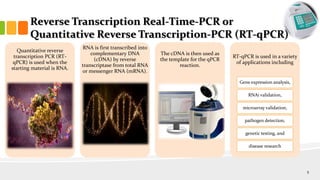
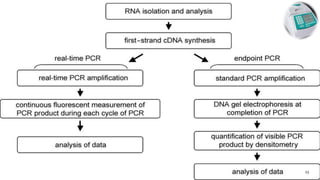
Reverse Transcription Real-Time-PCR or
Quantitative Reverse Transcription-PCR (RT-qPCR)
Quantitative reverse
transcription PCR (RT-
qPCR) is used when the
starting material is RNA.
RNA is first transcribed into
complementary DNA
(cDNA) by reverse
transcriptase from total RNA
or messenger RNA (mRNA).
The cDNA is then used as
the template for the qPCR
reaction.
RT-qPCR is used in a variety
of applications including
Gene expression analysis,
RNAi validation,
microarray validation,
pathogen detection,
genetic testing, and
disease research
5
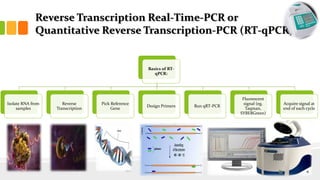
Reverse Transcription Real-Time-PCR or
Quantitative Reverse Transcription-PCR (RT-qPCR)
Basics of RT-
qPCR:
Isolate RNA from
samples
Reverse
Transcription
Pick Reference
Gene
Design Primers Run qRT-PCR
Fluorescent
signal (eg.
Taqman,
SYBERGreen)
Acquire signal at
end of each cycle
6
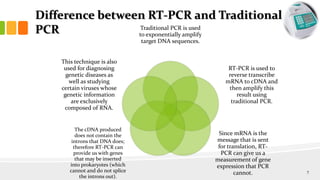
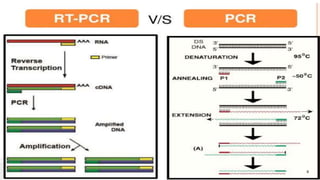
Difference between RT-PCR and Traditional
PCR Traditional PCR is used
to exponentially amplify
target DNA sequences.
RT-PCR is used to
reverse transcribe
mRNA to cDNA and
then amplify this
result using
traditional PCR.
Since mRNA is the
message that is sent
for translation, RT-
PCR can give us a
measurement of gene
expression that PCR
cannot.
The cDNA produced
does not contain the
introns that DNA does;
therefore RT-PCR can
provide us with genes
that may be inserted
into prokaryotes (which
cannot and do not splice
the introns out).
This technique is also
used for diagnosing
genetic diseases as
well as studying
certain viruses whose
genetic information
are exclusively
composed of RNA.
7
8
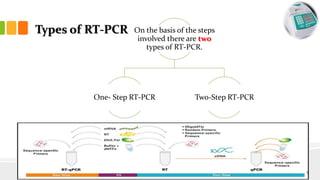
Types of RT-PCR On the basis of the steps
involved there are two
types of RT-PCR.
One- Step RT-PCR Two-Step RT-PCR
9
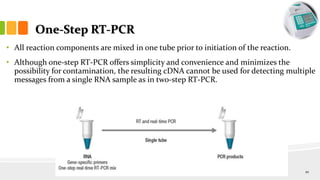
One-Step RT-PCR
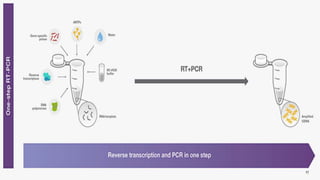
• All reaction components are mixed in one tube prior to initiation of the reaction.
• Although one-step RT-PCR offers simplicity and convenience and minimizes the
possibility for contamination, the resulting cDNA cannot be used for detecting multiple
messages from a single RNA sample as in two-step RT-PCR.
10
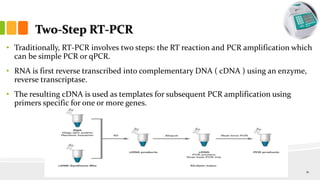
Two-Step RT-PCR
• Traditionally, RT-PCR involves two steps: the RT reaction and PCR amplification which
can be simple PCR or qPCR.
• RNA is first reverse transcribed into complementary DNA ( cDNA ) using an enzyme,
reverse transcriptase.
• The resulting cDNA is used as templates for subsequent PCR amplification using
primers specific for one or more genes.
11
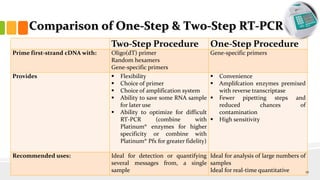
Comparison of One-Step & Two-Step RT-PCR
Two-Step Procedure One-Step Procedure
Prime first-strand cDNA with: Oligo(dT) primer
Random hexamers
Gene-specific primers
Provides  Flexibility
 Choice of primer
 Choice of amplification system
 Ability to save some RNA sample
for later use
 Ability to optimize for difficult
RT-PCR (combine with
Platinum® enzymes for higher
specificity or combine with
Platinum® Pfx for greater fidelity)
 Convenience
 Amplifcation enzymes premixed
with reverse transcriptase
 Fewer pipetting steps and
reduced chances of
contamination
 High sensitivity
Recommended uses: Ideal for detection or quantifying
several messages from, a single
sample
Ideal for analysis of large numbers of
samples
Ideal for real-time quantitative 12
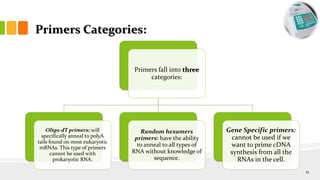
Primers Categories:
Primers fall into three
categories:
Oligo-dT primers: will
specifically anneal to polyA
tails found on most eukaryotic
mRNAs. This type of primers
cannot be used with
prokaryotic RNA.
Random hexamers
primers: have the ability
to anneal to all types of
RNA without knowledge of
sequence.
Gene Specific primers:
cannot be used if we
want to prime cDNA
synthesis from all the
RNAs in the cell.
13
Protocol
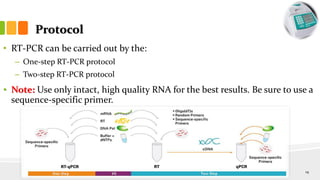
• RT-PCR can be carried out by the:
– One-step RT-PCR protocol
– Two-step RT-PCR protocol
• Note: Use only intact, high quality RNA for the best results. Be sure to use a
sequence-specific primer.
14
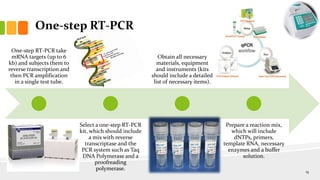
One-step RT-PCR
One-step RT-PCR take
mRNA targets (up to 6
kb) and subjects them to
reverse transcription and
then PCR amplification
in a single test tube.
Select a one-step RT-PCR
kit, which should include
a mix with reverse
transcriptase and the
PCR system such as Taq
DNA Polymerase and a
proofreading
polymerase.
Obtain all necessary
materials, equipment
and instruments (kits
should include a detailed
list of necessary items).
Prepare a reaction mix,
which will include
dNTPs, primers,
template RNA, necessary
enzymes and a buffer
solution.
15
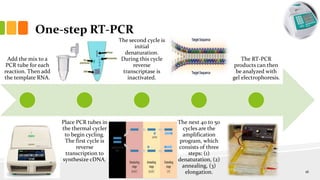
One-step RT-PCR
Add the mix to a
PCR tube for each
reaction. Then add
the template RNA.
Place PCR tubes in
the thermal cycler
to begin cycling.
The first cycle is
reverse
transcription to
synthesize cDNA.
The second cycle is
initial
denaturation.
During this cycle
reverse
transcriptase is
inactivated.
The next 40 to 50
cycles are the
amplification
program, which
consists of three
steps: (1)
denaturation, (2)
annealing, (3)
elongation.
The RT-PCR
products can then
be analyzed with
gel electrophoresis.
16
17
Two-Step RT-PCR
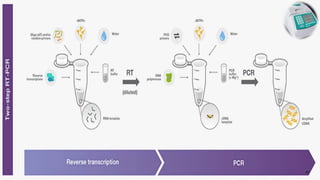
Two-step RT-PCR, as the name implies, occurs in two steps.
First the reverse transcription and then the PCR.
This method is more sensitive than the one-step method.
Kits are also useful for two-step RT-PCR.
Use only intact, high quality RNA for the best results.
The primer for two-step does not have to be sequence specific.
18
Two-Step RT-PCR
Step one
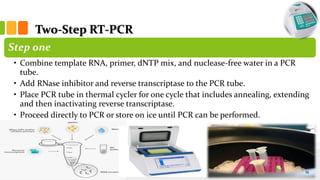
• Combine template RNA, primer, dNTP mix, and nuclease-free water in a PCR
tube.
• Add RNase inhibitor and reverse transcriptase to the PCR tube.
• Place PCR tube in thermal cycler for one cycle that includes annealing, extending
and then inactivating reverse transcriptase.
• Proceed directly to PCR or store on ice until PCR can be performed.
19
Two-Step RT-PCR
Step two
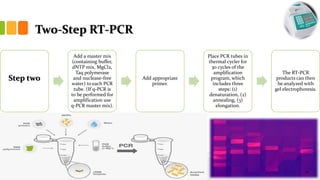
Add a master mix
(containing buffer,
dNTP mix, MgCl2,
Taq polymerase
and nuclease-free
water) to each PCR
tube. (If q-PCR is
to be performed for
amplification use
q-PCR master mix).
Add appropriate
primer.
Place PCR tubes in
thermal cycler for
30 cycles of the
amplification
program, which
includes three
steps: (1)
denaturation, (2)
annealing, (3)
elongation.
The RT-PCR
products can then
be analyzed with
gel electrophoresis.
20
21
22
23
Crucial Aspect & Controls of RT-PCR
experiment
• DNA contamination must be avoided
• To avoid DNA contamination, two approaches can be used:
1. Treat the sample with DNase (A deoxyribonuclease is any enzyme that
catalyzes the hydrolytic cleavage of phosphodiester linkages in the DNA
backbone, thus degrading DNA).
2. Use in the reaction a negative control which does not contain reverse
transcriptase enzyme (-RT).
• If the DNA is effectively eliminated from the starting material (RNA sample):
1. Amplification using “-RT” cDNA template should show no product
2. “+RT” cDNA template should result in a product. 24
Applications of RT-PCR
Research methods
• For example, Lin et al. used qRT-PCR to measure expression of Gal genes
in yeast cells.
Genetic Disease Diagnosis
• RT-PCR can be used to diagnose genetic disease such as Lesch–Nyhan
syndrome (juvenile gout, is a rare inherited disorder caused by a
deficiency of the enzyme hypoxanthine-guanine
phosphoribosyltransferase (HGPRT), produced by mutations in the
HPRT gene located on the X chromosome).
• Also can be used as a test for bird flu- H7N9. 25
Applications of RT-PCR
• Gene Insertion
• RT-PCR can also be very useful in the insertion of eukaryotic genes into
prokaryotes.
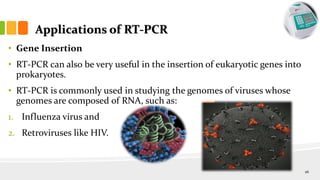
• RT-PCR is commonly used in studying the genomes of viruses whose
genomes are composed of RNA, such as:
1. Influenza virus and
2. Retroviruses like HIV.
26
Applications of RT-PCR
Cancer Detection
• Scientists are working on ways to use RT-PCR in cancer detection to help
improve prognosis, and monitor response to therapy
RNA extracts
• RT-PCR is used to test RNA extracts from different tissues also for the
presence of a particular transcript in order to determine the expression
pattern of a gene.
27
Applications of RT-PCR
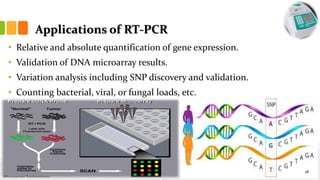
• Relative and absolute quantification of gene expression.
• Validation of DNA microarray results.
• Variation analysis including SNP discovery and validation.
• Counting bacterial, viral, or fungal loads, etc.
28
YOU CAN ASK QUESTIONS!
29
30

Rt pcr (Reverse transcription PCR)

  • 2.
  • 3.
    Conventional and qRT-PCR PCRvs RT-PCR Types of RT-PCR & Primer Designs Protocol & Application of RT-PCR 3
  • 4.
    Conventional Reverse Transcription-PCR (RT-PCR) Variantof polymerase chain reaction (PCR) Commonly used in molecular biology to detect RNA expression RT-PCR is often confused with real-time polymerase chain reaction (qPCR) However, they are separate and distinct techniques. RT-PCR is used to qualitatively detect gene expression through creation of complementary DNA (cDNA) transcripts from RNA. 4
  • 5.
    Reverse Transcription Real-Time-PCRor Quantitative Reverse Transcription-PCR (RT-qPCR) Quantitative reverse transcription PCR (RT- qPCR) is used when the starting material is RNA. RNA is first transcribed into complementary DNA (cDNA) by reverse transcriptase from total RNA or messenger RNA (mRNA). The cDNA is then used as the template for the qPCR reaction. RT-qPCR is used in a variety of applications including Gene expression analysis, RNAi validation, microarray validation, pathogen detection, genetic testing, and disease research 5
  • 6.
    Reverse Transcription Real-Time-PCRor Quantitative Reverse Transcription-PCR (RT-qPCR) Basics of RT- qPCR: Isolate RNA from samples Reverse Transcription Pick Reference Gene Design Primers Run qRT-PCR Fluorescent signal (eg. Taqman, SYBERGreen) Acquire signal at end of each cycle 6
  • 7.
    Difference between RT-PCRand Traditional PCR Traditional PCR is used to exponentially amplify target DNA sequences. RT-PCR is used to reverse transcribe mRNA to cDNA and then amplify this result using traditional PCR. Since mRNA is the message that is sent for translation, RT- PCR can give us a measurement of gene expression that PCR cannot. The cDNA produced does not contain the introns that DNA does; therefore RT-PCR can provide us with genes that may be inserted into prokaryotes (which cannot and do not splice the introns out). This technique is also used for diagnosing genetic diseases as well as studying certain viruses whose genetic information are exclusively composed of RNA. 7
  • 8.
  • 9.
    Types of RT-PCROn the basis of the steps involved there are two types of RT-PCR. One- Step RT-PCR Two-Step RT-PCR 9
  • 10.
    One-Step RT-PCR • Allreaction components are mixed in one tube prior to initiation of the reaction. • Although one-step RT-PCR offers simplicity and convenience and minimizes the possibility for contamination, the resulting cDNA cannot be used for detecting multiple messages from a single RNA sample as in two-step RT-PCR. 10
  • 11.
    Two-Step RT-PCR • Traditionally,RT-PCR involves two steps: the RT reaction and PCR amplification which can be simple PCR or qPCR. • RNA is first reverse transcribed into complementary DNA ( cDNA ) using an enzyme, reverse transcriptase. • The resulting cDNA is used as templates for subsequent PCR amplification using primers specific for one or more genes. 11
  • 12.
    Comparison of One-Step& Two-Step RT-PCR Two-Step Procedure One-Step Procedure Prime first-strand cDNA with: Oligo(dT) primer Random hexamers Gene-specific primers Gene-specific primers Provides  Flexibility  Choice of primer  Choice of amplification system  Ability to save some RNA sample for later use  Ability to optimize for difficult RT-PCR (combine with Platinum® enzymes for higher specificity or combine with Platinum® Pfx for greater fidelity)  Convenience  Amplifcation enzymes premixed with reverse transcriptase  Fewer pipetting steps and reduced chances of contamination  High sensitivity Recommended uses: Ideal for detection or quantifying several messages from, a single sample Ideal for analysis of large numbers of samples Ideal for real-time quantitative 12
  • 13.
    Primers Categories: Primers fallinto three categories: Oligo-dT primers: will specifically anneal to polyA tails found on most eukaryotic mRNAs. This type of primers cannot be used with prokaryotic RNA. Random hexamers primers: have the ability to anneal to all types of RNA without knowledge of sequence. Gene Specific primers: cannot be used if we want to prime cDNA synthesis from all the RNAs in the cell. 13
  • 14.
    Protocol • RT-PCR canbe carried out by the: – One-step RT-PCR protocol – Two-step RT-PCR protocol • Note: Use only intact, high quality RNA for the best results. Be sure to use a sequence-specific primer. 14
  • 15.
    One-step RT-PCR One-step RT-PCRtake mRNA targets (up to 6 kb) and subjects them to reverse transcription and then PCR amplification in a single test tube. Select a one-step RT-PCR kit, which should include a mix with reverse transcriptase and the PCR system such as Taq DNA Polymerase and a proofreading polymerase. Obtain all necessary materials, equipment and instruments (kits should include a detailed list of necessary items). Prepare a reaction mix, which will include dNTPs, primers, template RNA, necessary enzymes and a buffer solution. 15
  • 16.
    One-step RT-PCR Add themix to a PCR tube for each reaction. Then add the template RNA. Place PCR tubes in the thermal cycler to begin cycling. The first cycle is reverse transcription to synthesize cDNA. The second cycle is initial denaturation. During this cycle reverse transcriptase is inactivated. The next 40 to 50 cycles are the amplification program, which consists of three steps: (1) denaturation, (2) annealing, (3) elongation. The RT-PCR products can then be analyzed with gel electrophoresis. 16
  • 17.
  • 18.
    Two-Step RT-PCR Two-step RT-PCR,as the name implies, occurs in two steps. First the reverse transcription and then the PCR. This method is more sensitive than the one-step method. Kits are also useful for two-step RT-PCR. Use only intact, high quality RNA for the best results. The primer for two-step does not have to be sequence specific. 18
  • 19.
    Two-Step RT-PCR Step one •Combine template RNA, primer, dNTP mix, and nuclease-free water in a PCR tube. • Add RNase inhibitor and reverse transcriptase to the PCR tube. • Place PCR tube in thermal cycler for one cycle that includes annealing, extending and then inactivating reverse transcriptase. • Proceed directly to PCR or store on ice until PCR can be performed. 19
  • 20.
    Two-Step RT-PCR Step two Adda master mix (containing buffer, dNTP mix, MgCl2, Taq polymerase and nuclease-free water) to each PCR tube. (If q-PCR is to be performed for amplification use q-PCR master mix). Add appropriate primer. Place PCR tubes in thermal cycler for 30 cycles of the amplification program, which includes three steps: (1) denaturation, (2) annealing, (3) elongation. The RT-PCR products can then be analyzed with gel electrophoresis. 20
  • 21.
  • 22.
  • 23.
  • 24.
    Crucial Aspect &Controls of RT-PCR experiment • DNA contamination must be avoided • To avoid DNA contamination, two approaches can be used: 1. Treat the sample with DNase (A deoxyribonuclease is any enzyme that catalyzes the hydrolytic cleavage of phosphodiester linkages in the DNA backbone, thus degrading DNA). 2. Use in the reaction a negative control which does not contain reverse transcriptase enzyme (-RT). • If the DNA is effectively eliminated from the starting material (RNA sample): 1. Amplification using “-RT” cDNA template should show no product 2. “+RT” cDNA template should result in a product. 24
  • 25.
    Applications of RT-PCR Researchmethods • For example, Lin et al. used qRT-PCR to measure expression of Gal genes in yeast cells. Genetic Disease Diagnosis • RT-PCR can be used to diagnose genetic disease such as Lesch–Nyhan syndrome (juvenile gout, is a rare inherited disorder caused by a deficiency of the enzyme hypoxanthine-guanine phosphoribosyltransferase (HGPRT), produced by mutations in the HPRT gene located on the X chromosome). • Also can be used as a test for bird flu- H7N9. 25
  • 26.
    Applications of RT-PCR •Gene Insertion • RT-PCR can also be very useful in the insertion of eukaryotic genes into prokaryotes. • RT-PCR is commonly used in studying the genomes of viruses whose genomes are composed of RNA, such as: 1. Influenza virus and 2. Retroviruses like HIV. 26
  • 27.
    Applications of RT-PCR CancerDetection • Scientists are working on ways to use RT-PCR in cancer detection to help improve prognosis, and monitor response to therapy RNA extracts • RT-PCR is used to test RNA extracts from different tissues also for the presence of a particular transcript in order to determine the expression pattern of a gene. 27
  • 28.
    Applications of RT-PCR •Relative and absolute quantification of gene expression. • Validation of DNA microarray results. • Variation analysis including SNP discovery and validation. • Counting bacterial, viral, or fungal loads, etc. 28
  • 29.
    YOU CAN ASKQUESTIONS! 29
  • 30.