Molecular Motor-ATP SYNTHASE
By-Lovnish Thakur
ASU2014010100099
3rd SEM, Integrated Biotech
Introduction
All living organisms, from bacteria, fungi, spinach and
worms to crocodiles and humans, use ATP for energy
conversion. Originally, the energy comes from the sun.
Plants capture it during photosynthesis and convert it to
chemical energy as ATP. Using this energy, plants
produce carbohydrates, fats and proteins which are
eaten by animals and human beings. In metabolism,
the food is broken down and the energy released is
used to make ATP. Energy is interconverted between
various forms. ATP is an energy currency.
ATP
• ATP is the most commonly used "energy
currency" of cells from most organisms. It is
formed from adenosine diphosphate (ADP) and
inorganic phosphate (Pi), and needs energy.
• The overall reaction sequence is: ADP + Pi → ATP,
where ADP and Pi are joined together by ATP
synthase
• ATP synthase utilizes the energy stored in this
electrochemical gradient to drive nucleotide
synthesis.
ATP Synthase
ATP synthase—also called FoF1 ATPase is the
universal protein that terminates oxidative
phosphorylation by synthesizing ATP from ADP
and phosphate.
ATP Synthase is one of the most important
enzymes found in the mitochondria of cells
www.slideshare.net
Structure
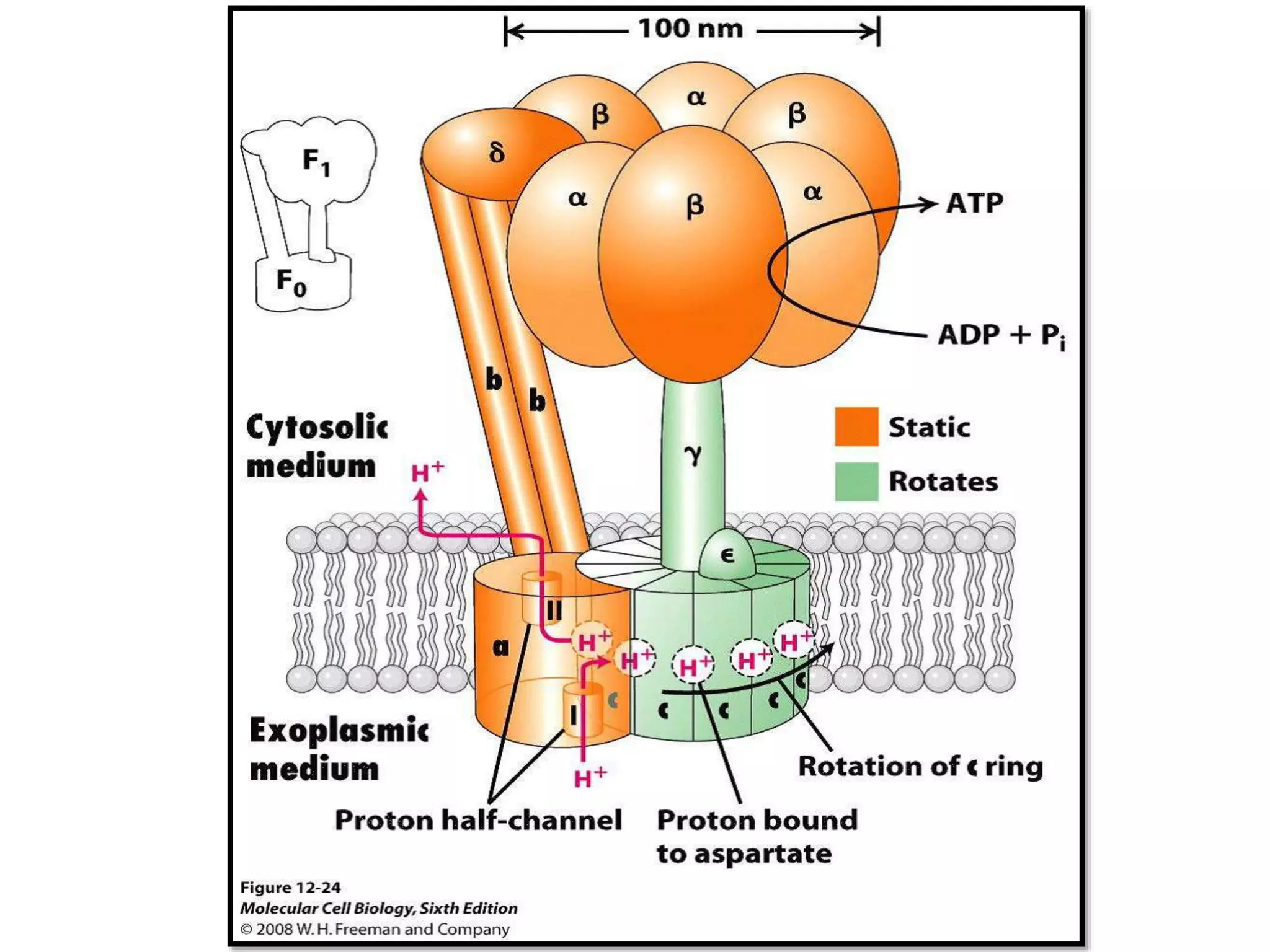
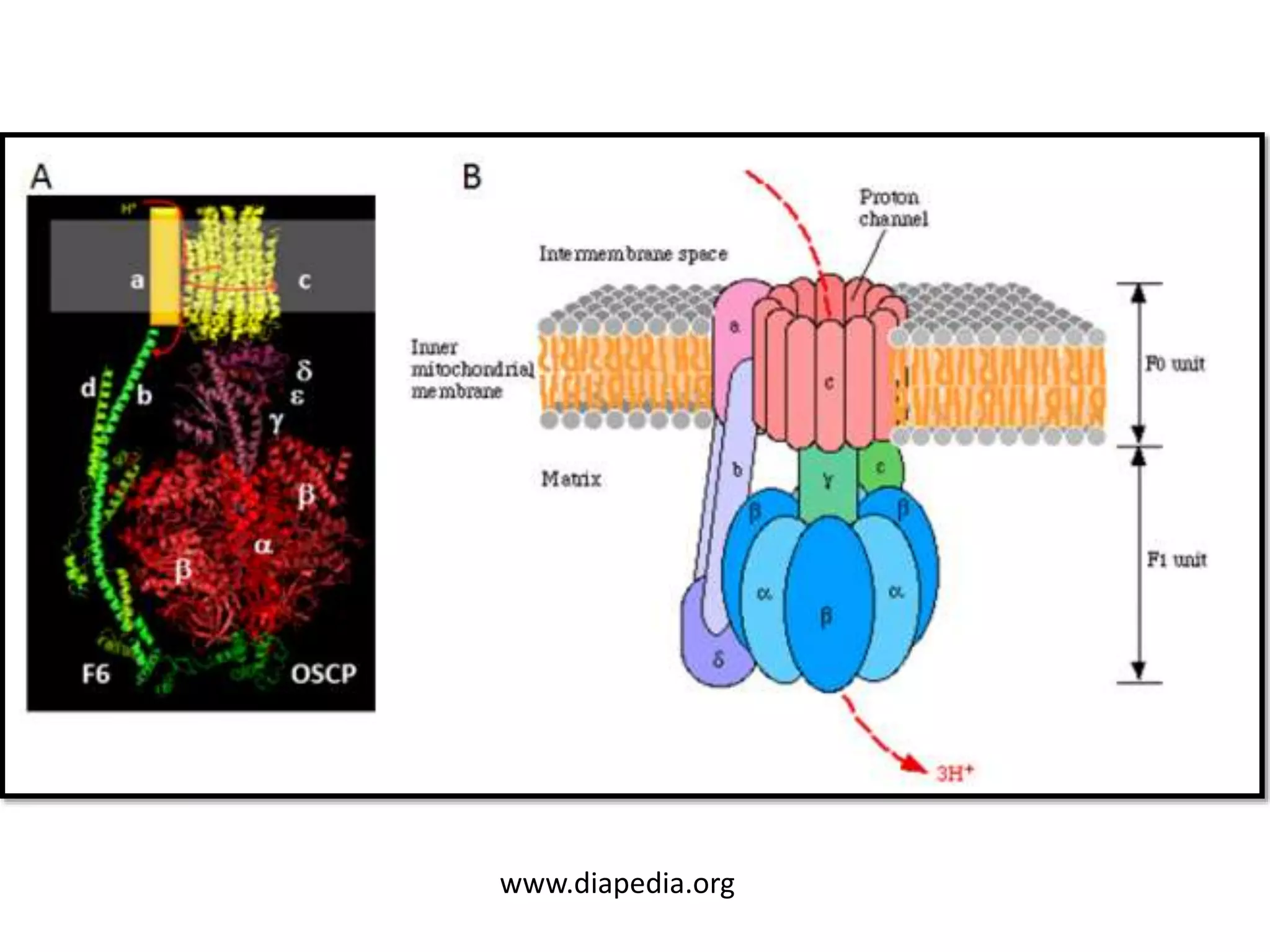
• ATP synthase is composed of at least 8 subunit
types, whose stochiometry is denoted with
subscripts: (a3, b3, g, d, e, a6, b2, c12), which
combine into two distinct regions.
• The F1 portion is soluble and consists of a
hexamer, a3b3. This hexamer is arranged in an
annulus about a central shaft consisting of the
coiled-coil g subunit.
• The Fo portion consists of three transmembrane
subunits: a6, b2 and c12.
Working
ATP synthesis does not require the input of
energy, but the release of the newly
synthesized ATP does require energy.
The movement of protons through the F0
channel causes the γ subunit to rotate which
drives a conformational change in the
structure of the β-subunit resulting in the
binding of substrates (ADP and Pi) and the
release of the product ATP.
www.diapedia.org
Reference
• www.denstoredanske.dk/Natur_og.../ATPsynt
ase
• thegrantlab.org/resources/handout_motors_
CSUSM_11.pdf
• https://www.rpi.edu/dept/bcbp/molbiochem/
MBWeb/mb1/.../f1fo.htm
THANK YOU

Atp synthase

  • 1.
    Molecular Motor-ATP SYNTHASE By-LovnishThakur ASU2014010100099 3rd SEM, Integrated Biotech
  • 2.
    Introduction All living organisms,from bacteria, fungi, spinach and worms to crocodiles and humans, use ATP for energy conversion. Originally, the energy comes from the sun. Plants capture it during photosynthesis and convert it to chemical energy as ATP. Using this energy, plants produce carbohydrates, fats and proteins which are eaten by animals and human beings. In metabolism, the food is broken down and the energy released is used to make ATP. Energy is interconverted between various forms. ATP is an energy currency.
  • 3.
    ATP • ATP isthe most commonly used "energy currency" of cells from most organisms. It is formed from adenosine diphosphate (ADP) and inorganic phosphate (Pi), and needs energy. • The overall reaction sequence is: ADP + Pi → ATP, where ADP and Pi are joined together by ATP synthase • ATP synthase utilizes the energy stored in this electrochemical gradient to drive nucleotide synthesis.
  • 4.
    ATP Synthase ATP synthase—alsocalled FoF1 ATPase is the universal protein that terminates oxidative phosphorylation by synthesizing ATP from ADP and phosphate. ATP Synthase is one of the most important enzymes found in the mitochondria of cells
  • 5.
  • 6.
    Structure • ATP synthaseis composed of at least 8 subunit types, whose stochiometry is denoted with subscripts: (a3, b3, g, d, e, a6, b2, c12), which combine into two distinct regions. • The F1 portion is soluble and consists of a hexamer, a3b3. This hexamer is arranged in an annulus about a central shaft consisting of the coiled-coil g subunit. • The Fo portion consists of three transmembrane subunits: a6, b2 and c12.
  • 8.
    Working ATP synthesis doesnot require the input of energy, but the release of the newly synthesized ATP does require energy. The movement of protons through the F0 channel causes the γ subunit to rotate which drives a conformational change in the structure of the β-subunit resulting in the binding of substrates (ADP and Pi) and the release of the product ATP.
  • 9.
  • 10.
  • 11.