Vitamins as coenzymes, different
forms and deficiency disorders
By –Lovnish Thakur
ASU2014010100099
BSBT-513(METABOLISM& METABOLOMICS)
Vitamins
• Vitamins are organic compounds which are
needed in small quantities to sustain life.
• Get from food, because the human body
either does not produce enough of them, or
none at all
Vitamin role & deficiency disorders
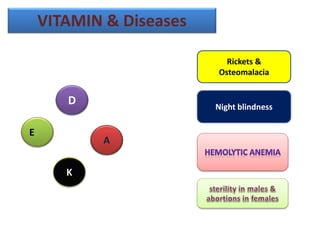
A
K
D
E
VITAMIN & Diseases
Night blindness
Rickets &
Osteomalacia
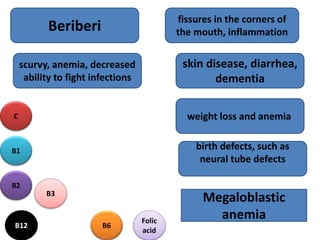
B1
B6
C
B3
B2
Folic
acid
B12
skin disease, diarrhea,
dementia
Megaloblastic
anemia
weight loss and anemia
fissures in the corners of
the mouth, inflammation
scurvy, anemia, decreased
ability to fight infections
Beriberi
birth defects, such as
neural tube defects
VITAMIN AS A CO-ENZYME
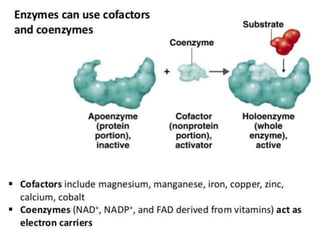
Coenzymes
• small organic non-protein molecules
Loosely attached to apoenzymes, seperated easily by dialysis
they are often called co-substrate or secondary substrate
Reaction involving:
 oxidoreduction,
 group. transfer,
 Isomerization and
 covalent bond formation
Why vitamin act as a coenzyme
• group transfer agents
• carrying electrons
• chemical groups such as acyl groups, methyl
groups, etc., depending on the coenzyme
Examples
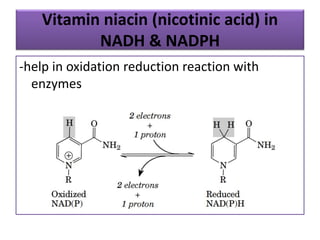
Vitamin niacin (nicotinic acid) in
NADH & NADPH
-help in oxidation reduction reaction with
enzymes
BIOTIN
• Biotin is a prosthetic coenzyme that catalyzes
carboxyl-group transfer
• ATP-dependent carboxylation reactions
Vitamin E (α-tocopherol)
• Vitamin E is an important lipid-soluble
antioxidant that helps protect
polyunsaturated fatty acids in membrane
phospholipids from oxidative damage
• Vitamin E probably picks up electrons from
lipid free radical species.
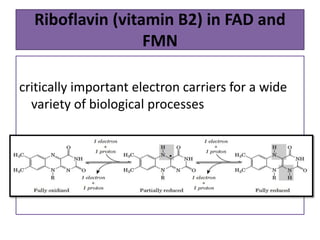
Riboflavin (vitamin B2) in FAD and
FMN
critically important electron carriers for a wide
variety of biological processes
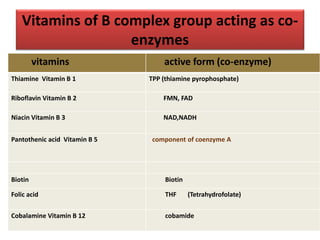
Vitamins of B complex group acting as co-
enzymes
vitamins active form (co-enzyme)
Thiamine Vitamin B 1 TPP (thiamine pyrophosphate)
Riboflavin Vitamin B 2 FMN, FAD
Niacin Vitamin B 3 NAD,NADH
Pantothenic acid Vitamin B 5 component of coenzyme A
Biotin Biotin
Folic acid THF (Tetrahydrofolate)
Cobalamine Vitamin B 12 cobamide
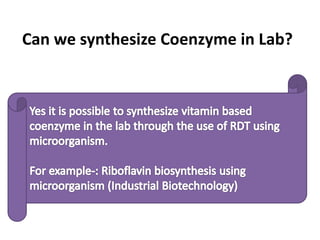
Can we synthesize Coenzyme in Lab?
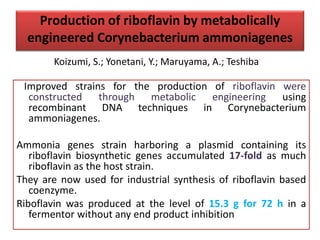
Production of riboflavin by metabolically
engineered Corynebacterium ammoniagenes
Improved strains for the production of riboflavin were
constructed through metabolic engineering using
recombinant DNA techniques in Corynebacterium
ammoniagenes.
Ammonia genes strain harboring a plasmid containing its
riboflavin biosynthetic genes accumulated 17-fold as much
riboflavin as the host strain.
They are now used for industrial synthesis of riboflavin based
coenzyme.
Riboflavin was produced at the level of 15.3 g for 72 h in a
fermentor without any end product inhibition
Koizumi, S.; Yonetani, Y.; Maruyama, A.; Teshiba
Reference
• Vitamins: What Vitamins Do I Need
(http://www.medicalnewstoday.com/articles/195878.php)
• Vitamins That Function As Coenzymes
(http://www.livestrong.com/article/291313-vitamins-that-function-as-
coenzymes/)
• https://www.rose-hulman.edu/~brandt/Chem330/Vitamin.pdf
• "Coenzymes and Vitamins
("http://www.uwyo.edu/molecbio/courses/molb3610/files/chapter%2
07%20coenzymes%20and%20vitamines.pdf)
• Regulation of riboflavin biosynthesis and transport genes in bacteria by
transcriptional and translational attenuation
(https://nar.oxfordjournals.org/content/30/14/3141.full)
• Production of riboflavin by metabolically engineered Corynebacterium
ammoniagenes
(Applied Microbiology & Biotechnology . Jun2000, Vol. 53 Issue 6)
YOU

Vitamins as coenzymes, different forms and deficiency disorders

  • 1.
    Vitamins as coenzymes,different forms and deficiency disorders By –Lovnish Thakur ASU2014010100099 BSBT-513(METABOLISM& METABOLOMICS)
  • 2.
    Vitamins • Vitamins areorganic compounds which are needed in small quantities to sustain life. • Get from food, because the human body either does not produce enough of them, or none at all
  • 3.
    Vitamin role &deficiency disorders
  • 4.
    A K D E VITAMIN & Diseases Nightblindness Rickets & Osteomalacia
  • 5.
    B1 B6 C B3 B2 Folic acid B12 skin disease, diarrhea, dementia Megaloblastic anemia weightloss and anemia fissures in the corners of the mouth, inflammation scurvy, anemia, decreased ability to fight infections Beriberi birth defects, such as neural tube defects
  • 6.
    VITAMIN AS ACO-ENZYME
  • 8.
    Coenzymes • small organicnon-protein molecules Loosely attached to apoenzymes, seperated easily by dialysis they are often called co-substrate or secondary substrate Reaction involving:  oxidoreduction,  group. transfer,  Isomerization and  covalent bond formation
  • 9.
    Why vitamin actas a coenzyme • group transfer agents • carrying electrons • chemical groups such as acyl groups, methyl groups, etc., depending on the coenzyme
  • 10.
  • 11.
    Vitamin niacin (nicotinicacid) in NADH & NADPH -help in oxidation reduction reaction with enzymes
  • 12.
    BIOTIN • Biotin isa prosthetic coenzyme that catalyzes carboxyl-group transfer • ATP-dependent carboxylation reactions
  • 13.
    Vitamin E (α-tocopherol) •Vitamin E is an important lipid-soluble antioxidant that helps protect polyunsaturated fatty acids in membrane phospholipids from oxidative damage • Vitamin E probably picks up electrons from lipid free radical species.
  • 14.
    Riboflavin (vitamin B2)in FAD and FMN critically important electron carriers for a wide variety of biological processes
  • 15.
    Vitamins of Bcomplex group acting as co- enzymes vitamins active form (co-enzyme) Thiamine Vitamin B 1 TPP (thiamine pyrophosphate) Riboflavin Vitamin B 2 FMN, FAD Niacin Vitamin B 3 NAD,NADH Pantothenic acid Vitamin B 5 component of coenzyme A Biotin Biotin Folic acid THF (Tetrahydrofolate) Cobalamine Vitamin B 12 cobamide
  • 16.
    Can we synthesizeCoenzyme in Lab?
  • 17.
    Production of riboflavinby metabolically engineered Corynebacterium ammoniagenes Improved strains for the production of riboflavin were constructed through metabolic engineering using recombinant DNA techniques in Corynebacterium ammoniagenes. Ammonia genes strain harboring a plasmid containing its riboflavin biosynthetic genes accumulated 17-fold as much riboflavin as the host strain. They are now used for industrial synthesis of riboflavin based coenzyme. Riboflavin was produced at the level of 15.3 g for 72 h in a fermentor without any end product inhibition Koizumi, S.; Yonetani, Y.; Maruyama, A.; Teshiba
  • 18.
    Reference • Vitamins: WhatVitamins Do I Need (http://www.medicalnewstoday.com/articles/195878.php) • Vitamins That Function As Coenzymes (http://www.livestrong.com/article/291313-vitamins-that-function-as- coenzymes/) • https://www.rose-hulman.edu/~brandt/Chem330/Vitamin.pdf • "Coenzymes and Vitamins ("http://www.uwyo.edu/molecbio/courses/molb3610/files/chapter%2 07%20coenzymes%20and%20vitamines.pdf) • Regulation of riboflavin biosynthesis and transport genes in bacteria by transcriptional and translational attenuation (https://nar.oxfordjournals.org/content/30/14/3141.full) • Production of riboflavin by metabolically engineered Corynebacterium ammoniagenes (Applied Microbiology & Biotechnology . Jun2000, Vol. 53 Issue 6)
  • 19.

Editor's Notes

  • #16 Nicotinamide adenine dinucleotide Nicotinamide adenine dinucleotide Flavin adenine dinucleotide Flavin mononucleotide