Local Field Potential Review
 What is LFP
 Origin of LFP
 Different Frequency Bands
 Paper Review-1
 Paper Review-2
 Paper Review-3
 Paper Review-4
1/31/2015 1Presented by: Md. Kafiul Islam
Local Field Potential
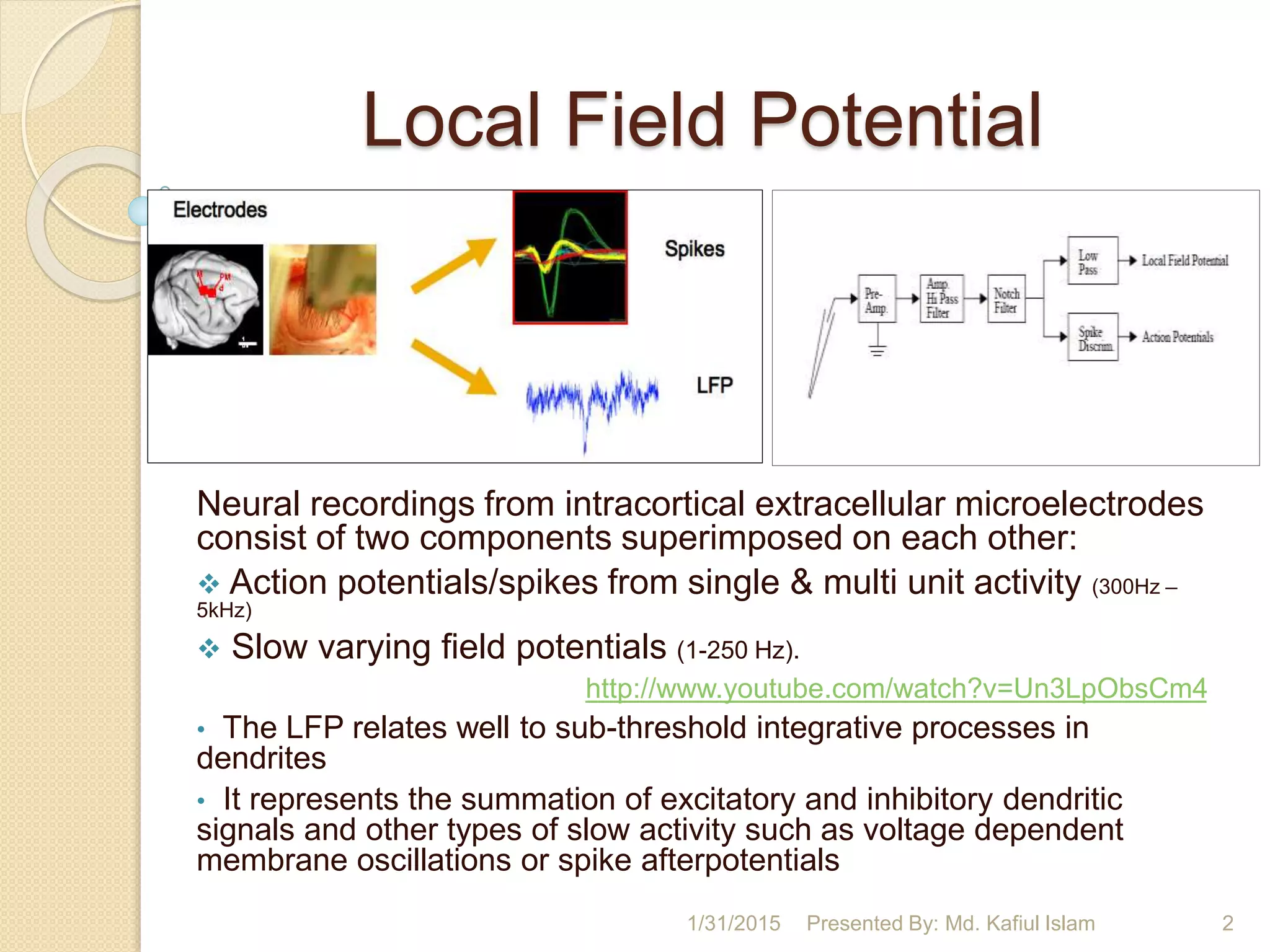
Neural recordings from intracortical extracellular microelectrodes
consist of two components superimposed on each other:
 Action potentials/spikes from single & multi unit activity (300Hz –
5kHz)
 Slow varying field potentials (1-250 Hz).
http://www.youtube.com/watch?v=Un3LpObsCm4
• The LFP relates well to sub-threshold integrative processes in
dendrites
• It represents the summation of excitatory and inhibitory dendritic
signals and other types of slow activity such as voltage dependent
membrane oscillations or spike afterpotentials
1/31/2015 2Presented By: Md. Kafiul Islam
Origin of LFP
 LFP mostly represents the inputs to a particular
brain region and local processing taking place
around the recording electrode, while the
spikes represent the outputs generated by the
region.
 Belitski et al. examined correlations between
the stimulus and spikes and LFP recorded on
the same electrode in the visual cortex of an
anesthetized macaque while presenting a color
movie [later slide].
 Nicolelis et al. reported correlations between
spikes and the 8-10 Hz LFP signal.1/31/2015 3Presented By: Md. Kafiul Islam
Different Frequency Bands
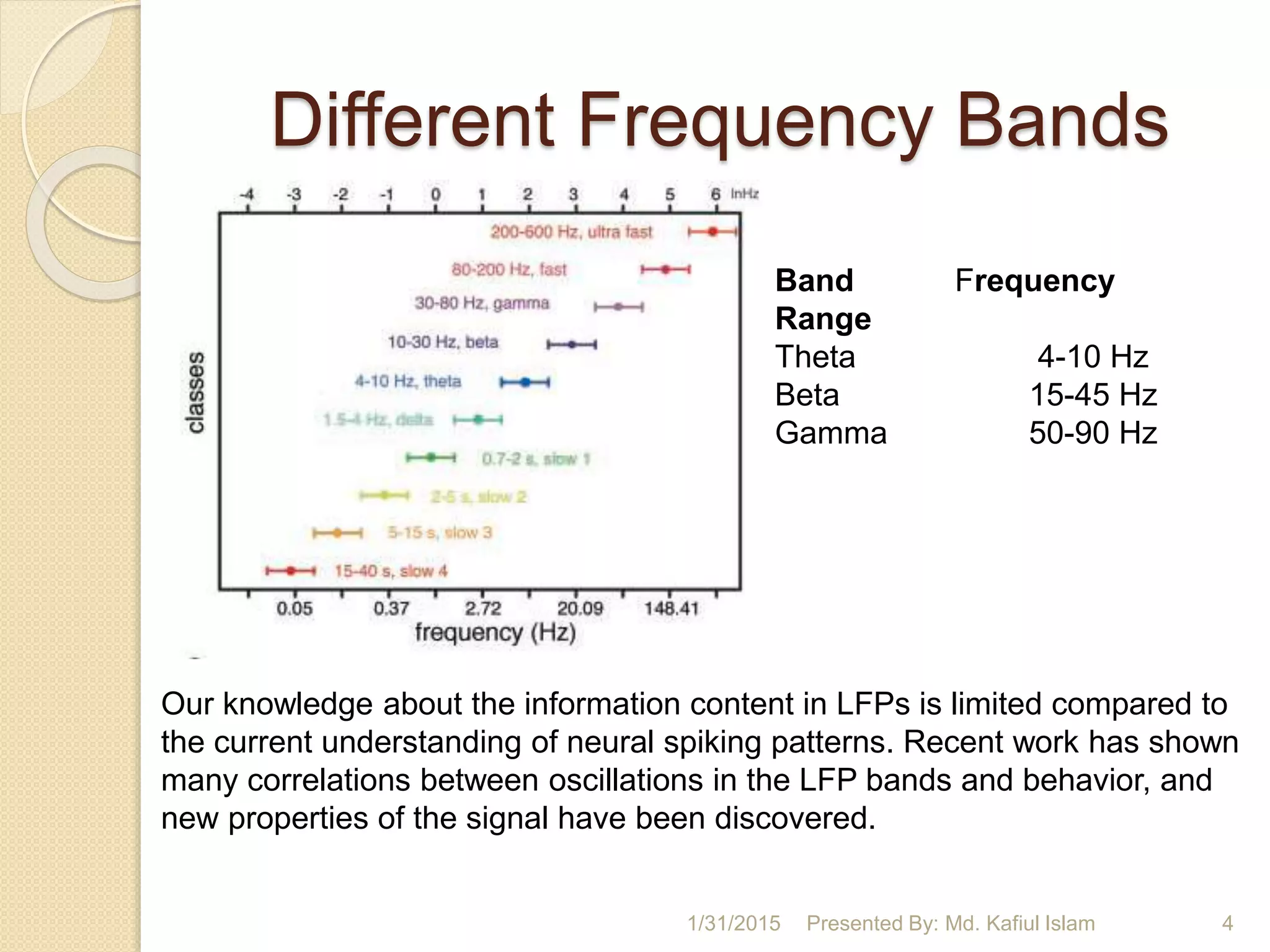
Band Frequency
Range
Theta 4-10 Hz
Beta 15-45 Hz
Gamma 50-90 Hz
1/31/2015 4Presented By: Md. Kafiul Islam
Our knowledge about the information content in LFPs is limited compared to
the current understanding of neural spiking patterns. Recent work has shown
many correlations between oscillations in the LFP bands and behavior, and
new properties of the signal have been discovered.
LFP and spike responses
during movie stimulation (Belitski
et al. 2008, JNS)
Observations:
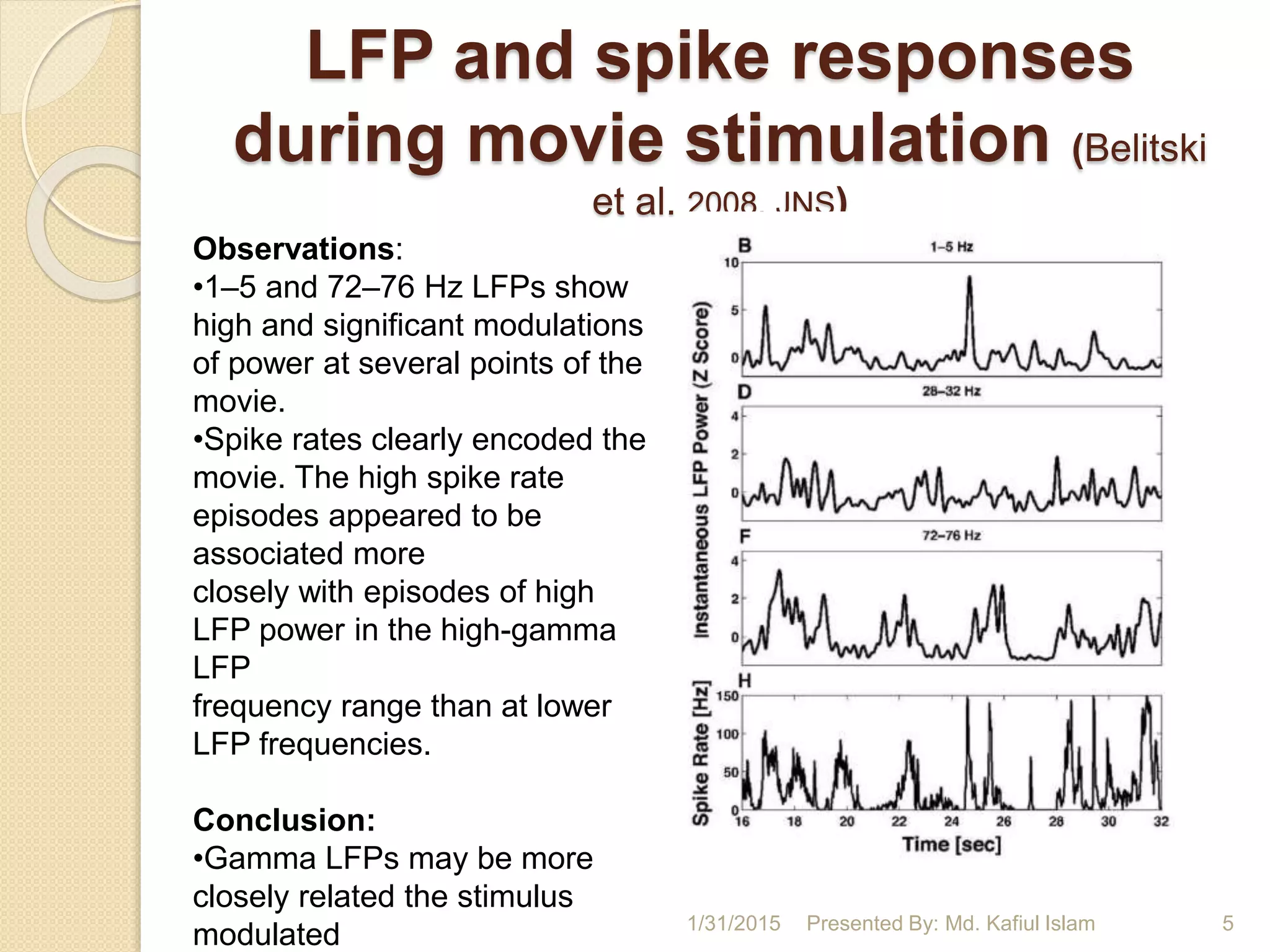
•1–5 and 72–76 Hz LFPs show
high and significant modulations
of power at several points of the
movie.
•Spike rates clearly encoded the
movie. The high spike rate
episodes appeared to be
associated more
closely with episodes of high
LFP power in the high-gamma
LFP
frequency range than at lower
LFP frequencies.
Conclusion:
•Gamma LFPs may be more
closely related the stimulus
modulated 1/31/2015 5Presented By: Md. Kafiul Islam
LFP and Spike responses
during movie stimulation (Belitski et
al.): Cont…
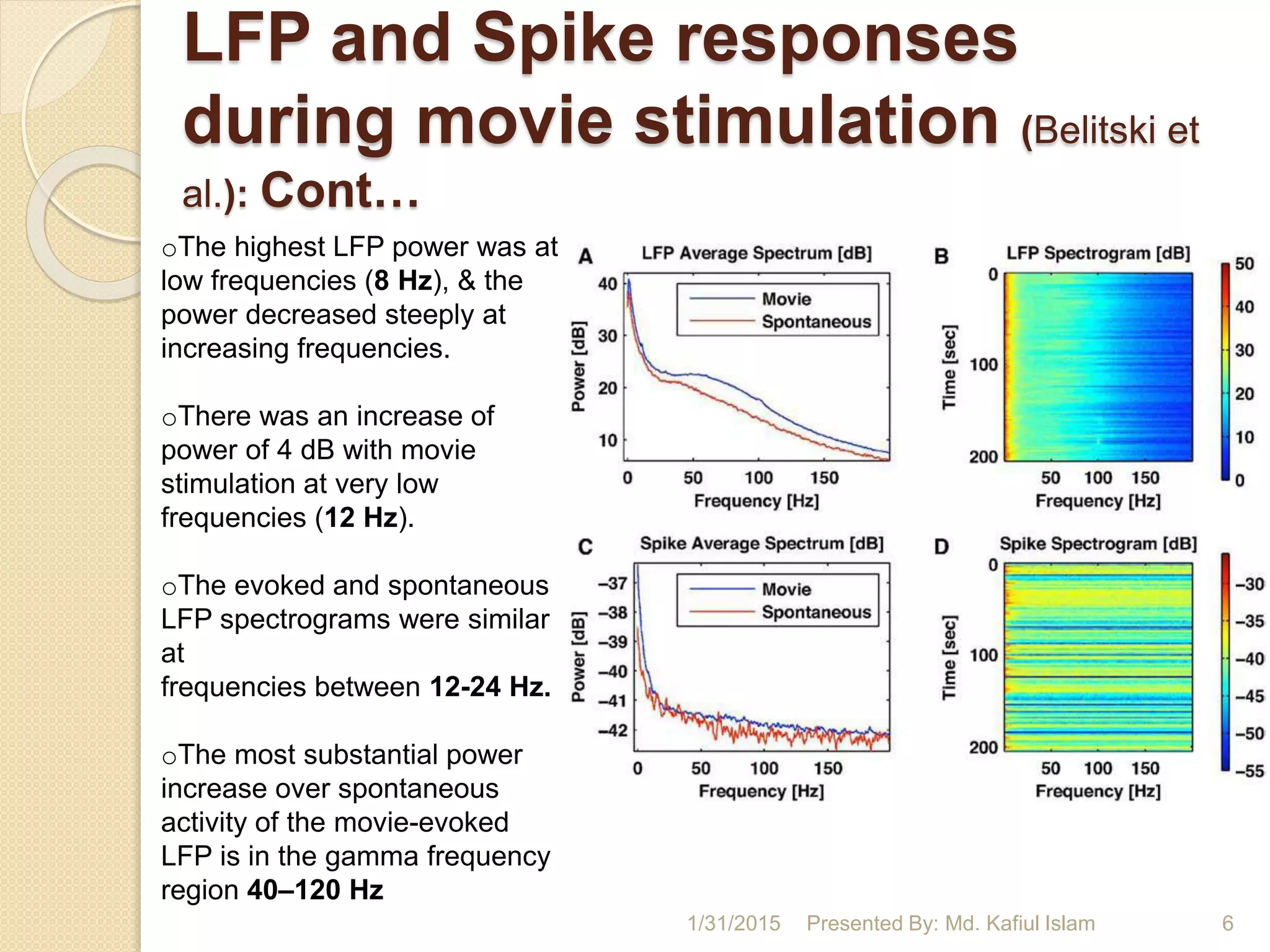
oThe highest LFP power was at
low frequencies (8 Hz), & the
power decreased steeply at
increasing frequencies.
oThere was an increase of
power of 4 dB with movie
stimulation at very low
frequencies (12 Hz).
oThe evoked and spontaneous
LFP spectrograms were similar
at
frequencies between 12-24 Hz.
oThe most substantial power
increase over spontaneous
activity of the movie-evoked
LFP is in the gamma frequency
region 40–120 Hz
1/31/2015 6Presented By: Md. Kafiul Islam
Some Findings:
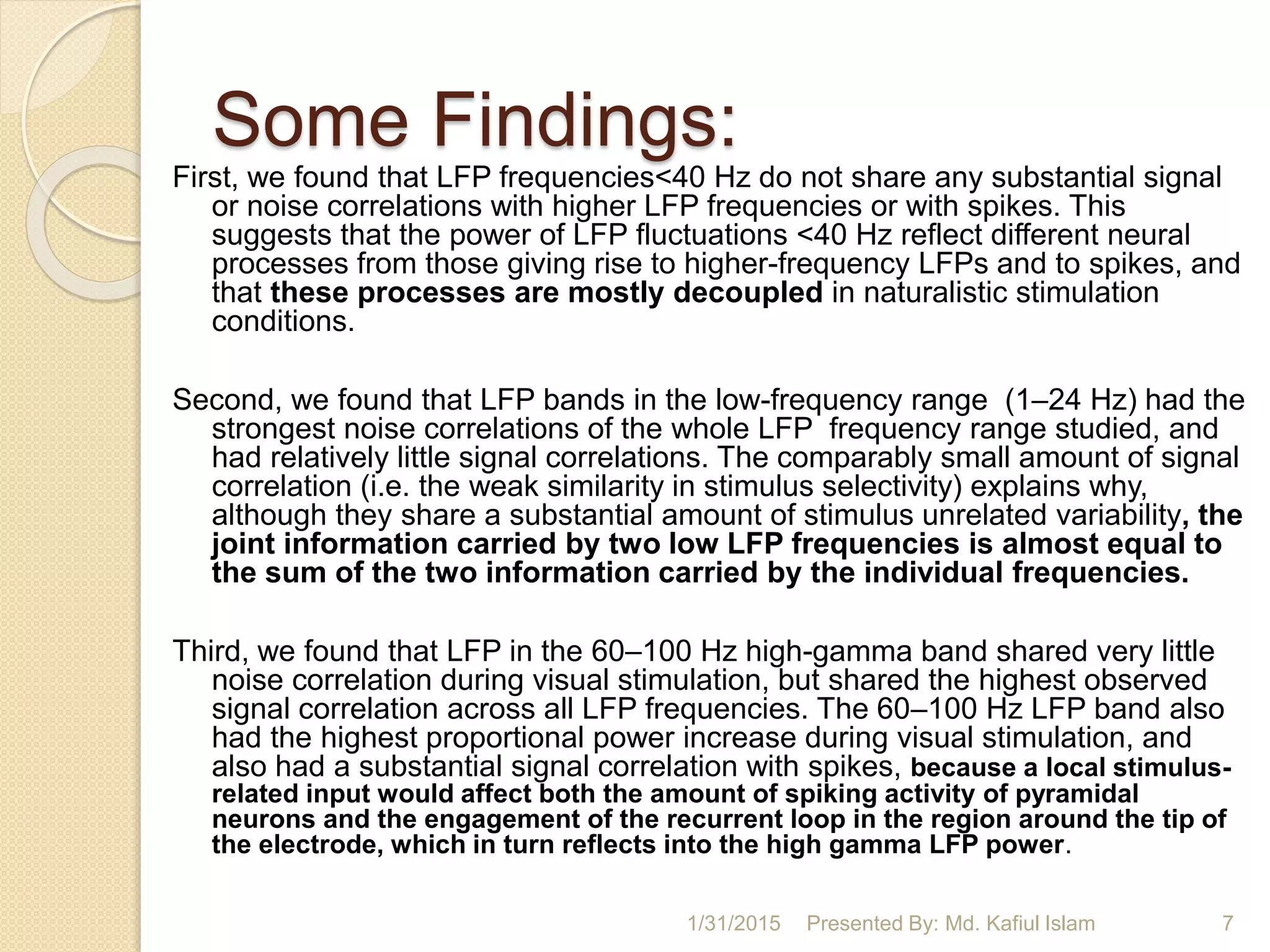
First, we found that LFP frequencies<40 Hz do not share any substantial signal
or noise correlations with higher LFP frequencies or with spikes. This
suggests that the power of LFP fluctuations <40 Hz reflect different neural
processes from those giving rise to higher-frequency LFPs and to spikes, and
that these processes are mostly decoupled in naturalistic stimulation
conditions.
Second, we found that LFP bands in the low-frequency range (1–24 Hz) had the
strongest noise correlations of the whole LFP frequency range studied, and
had relatively little signal correlations. The comparably small amount of signal
correlation (i.e. the weak similarity in stimulus selectivity) explains why,
although they share a substantial amount of stimulus unrelated variability, the
joint information carried by two low LFP frequencies is almost equal to
the sum of the two information carried by the individual frequencies.
Third, we found that LFP in the 60–100 Hz high-gamma band shared very little
noise correlation during visual stimulation, but shared the highest observed
signal correlation across all LFP frequencies. The 60–100 Hz LFP band also
had the highest proportional power increase during visual stimulation, and
also had a substantial signal correlation with spikes, because a local stimulus-
related input would affect both the amount of spiking activity of pyramidal
neurons and the engagement of the recurrent loop in the region around the tip of
the electrode, which in turn reflects into the high gamma LFP power.
1/31/2015 Presented By: Md. Kafiul Islam 7
Neuronal Shot Noise and
Brownian 1/f2 Behavior in the LFP
(Milstein et al. 2009)
1/31/2015 Presented By: Md. Kafiul Islam 8
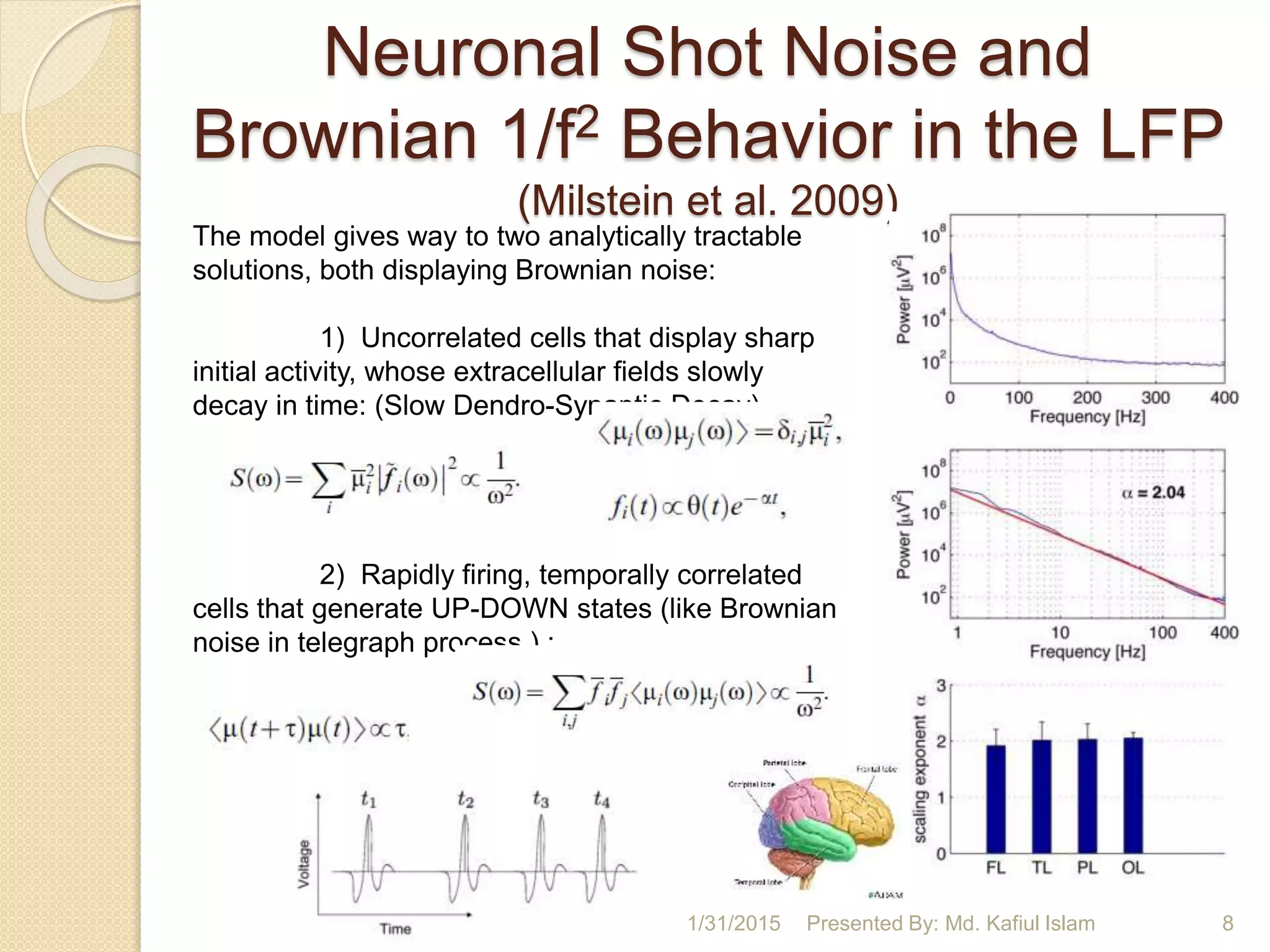
The model gives way to two analytically tractable
solutions, both displaying Brownian noise:
1) Uncorrelated cells that display sharp
initial activity, whose extracellular fields slowly
decay in time: (Slow Dendro-Synaptic Decay)
2) Rapidly firing, temporally correlated
cells that generate UP-DOWN states (like Brownian
noise in telegraph process ) :
LFP as an input to BMI (MS Thesis by
Gireeja, 2009, UCB)
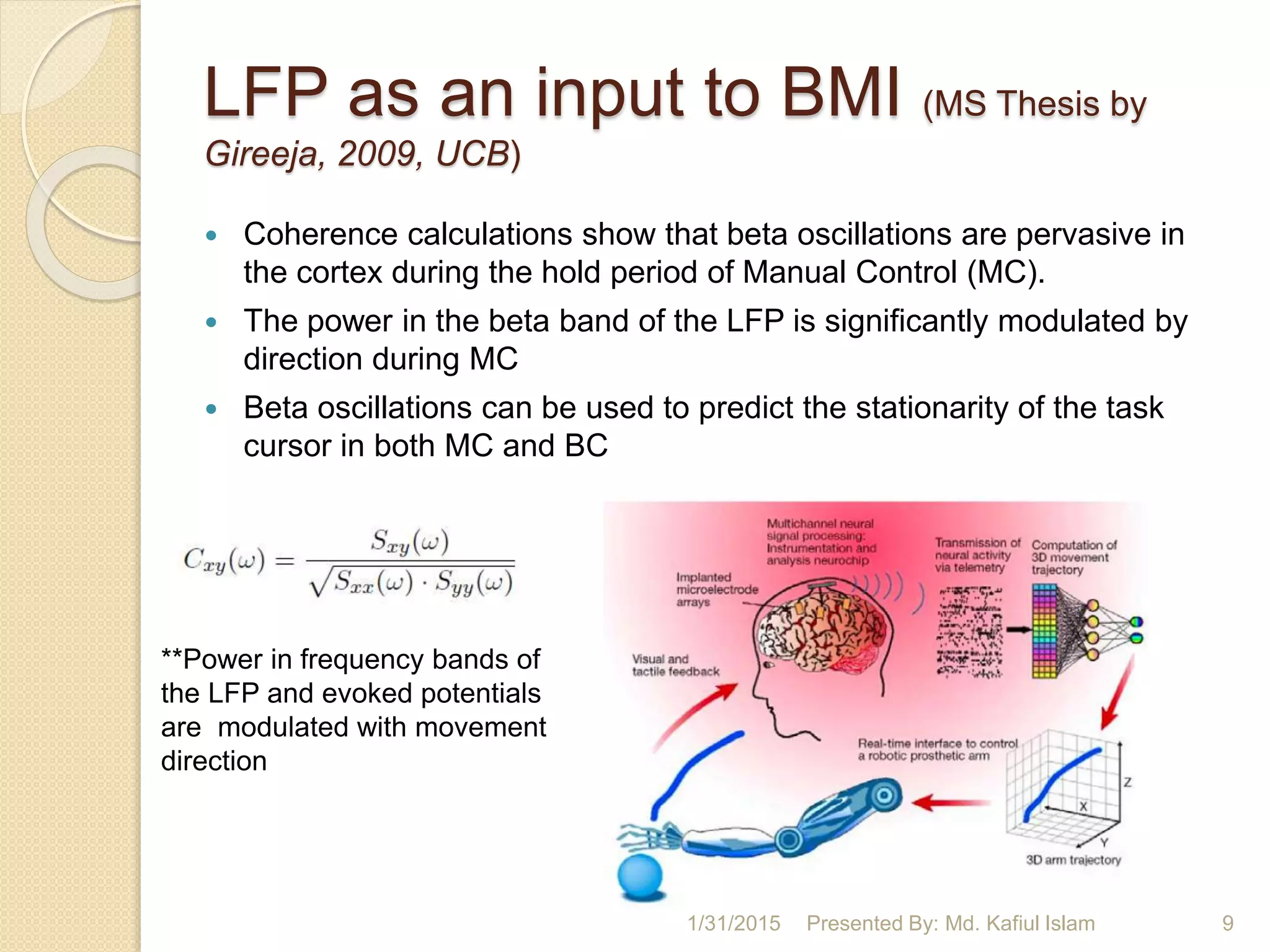
 Coherence calculations show that beta oscillations are pervasive in
the cortex during the hold period of Manual Control (MC).
 The power in the beta band of the LFP is significantly modulated by
direction during MC
 Beta oscillations can be used to predict the stationarity of the task
cursor in both MC and BC
1/31/2015 Presented By: Md. Kafiul Islam 9
**Power in frequency bands of
the LFP and evoked potentials
are modulated with movement
direction
LFP as an input to BMI:
Different Oscillations
Beta Oscillations:
We still lack a clear understanding of the functionality of beta oscillations. Results obtained
so far suggest that beta oscillations may serve as:
 idle oscillations, a default state that the cortex reverts to when no other important
events are happening
 a carrier wave for communication
 a timing signal for spike synchronization across brain regions
 a ‘planning’ oscillation
Gamma Oscillations:
 Gamma coherence relates to behavior and information transfer
 Spike-field coherence and oscillatory synchrony may sub serve neuronal communication
 Gamma band spike-field coherence in the visual cortex has been shown to increase with
attention to a stimulus
 The degree of gamma synchronization prior to and during a behavioral change was
correlated with response times to that change.
 Gamma frequency oscillations may also predict spike response latency.
1/31/2015 10Presented By: Md. Kafiul Islam
Neuronal Oscillations in Cortical
Networks (Science; Buzsáki, et al. 2004)
 Mammalian cortical neurons form behavior-
dependent oscillating networks of various sizes
covering freq from 0.05 Hz to 500 Hz.
 Recent findings indicate that network oscillations
bias input selection, temporally link neurons into
assemblies, and facilitate synaptic plasticity.
 Even single neurons are capable with complex
dynamics, including their intrinsic abilities to
resonate and oscillate at multiple frequencies,
which suggests that precise timing of their activity
within neuronal networks could represent
information.
1/31/2015 Presented By: Md. Kafiul Islam 11
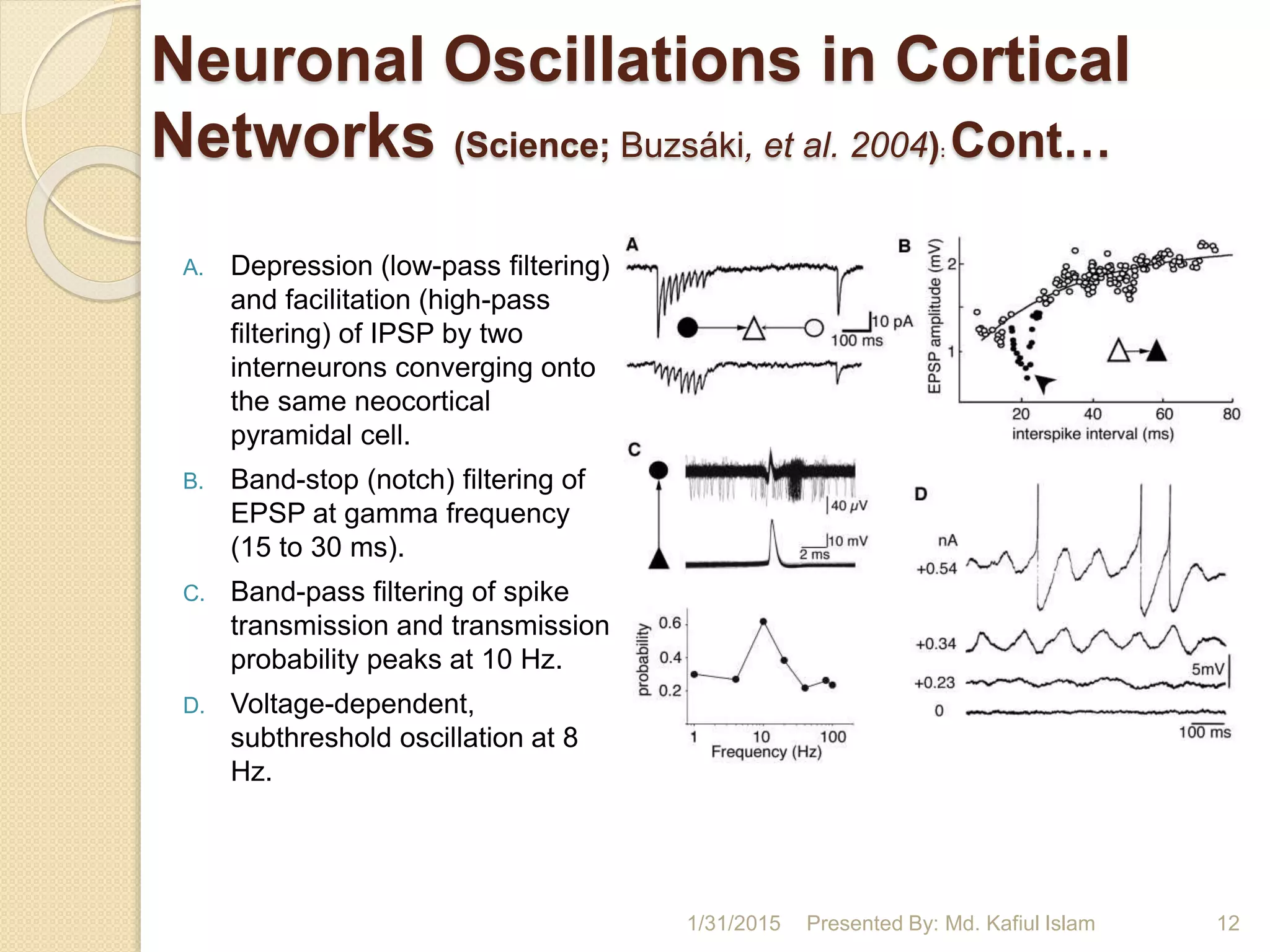
Neuronal Oscillations in Cortical
Networks (Science; Buzsáki, et al. 2004): Cont…
A. Depression (low-pass filtering)
and facilitation (high-pass
filtering) of IPSP by two
interneurons converging onto
the same neocortical
pyramidal cell.
B. Band-stop (notch) filtering of
EPSP at gamma frequency
(15 to 30 ms).
C. Band-pass filtering of spike
transmission and transmission
probability peaks at 10 Hz.
D. Voltage-dependent,
subthreshold oscillation at 8
Hz.
1/31/2015 Presented By: Md. Kafiul Islam 12

Local Field Potential (LFP): Literature Review

  • 1.
    Local Field PotentialReview  What is LFP  Origin of LFP  Different Frequency Bands  Paper Review-1  Paper Review-2  Paper Review-3  Paper Review-4 1/31/2015 1Presented by: Md. Kafiul Islam
  • 2.
    Local Field Potential Neuralrecordings from intracortical extracellular microelectrodes consist of two components superimposed on each other:  Action potentials/spikes from single & multi unit activity (300Hz – 5kHz)  Slow varying field potentials (1-250 Hz). http://www.youtube.com/watch?v=Un3LpObsCm4 • The LFP relates well to sub-threshold integrative processes in dendrites • It represents the summation of excitatory and inhibitory dendritic signals and other types of slow activity such as voltage dependent membrane oscillations or spike afterpotentials 1/31/2015 2Presented By: Md. Kafiul Islam
  • 3.
    Origin of LFP LFP mostly represents the inputs to a particular brain region and local processing taking place around the recording electrode, while the spikes represent the outputs generated by the region.  Belitski et al. examined correlations between the stimulus and spikes and LFP recorded on the same electrode in the visual cortex of an anesthetized macaque while presenting a color movie [later slide].  Nicolelis et al. reported correlations between spikes and the 8-10 Hz LFP signal.1/31/2015 3Presented By: Md. Kafiul Islam
  • 4.
    Different Frequency Bands BandFrequency Range Theta 4-10 Hz Beta 15-45 Hz Gamma 50-90 Hz 1/31/2015 4Presented By: Md. Kafiul Islam Our knowledge about the information content in LFPs is limited compared to the current understanding of neural spiking patterns. Recent work has shown many correlations between oscillations in the LFP bands and behavior, and new properties of the signal have been discovered.
  • 5.
    LFP and spikeresponses during movie stimulation (Belitski et al. 2008, JNS) Observations: •1–5 and 72–76 Hz LFPs show high and significant modulations of power at several points of the movie. •Spike rates clearly encoded the movie. The high spike rate episodes appeared to be associated more closely with episodes of high LFP power in the high-gamma LFP frequency range than at lower LFP frequencies. Conclusion: •Gamma LFPs may be more closely related the stimulus modulated 1/31/2015 5Presented By: Md. Kafiul Islam
  • 6.
    LFP and Spikeresponses during movie stimulation (Belitski et al.): Cont… oThe highest LFP power was at low frequencies (8 Hz), & the power decreased steeply at increasing frequencies. oThere was an increase of power of 4 dB with movie stimulation at very low frequencies (12 Hz). oThe evoked and spontaneous LFP spectrograms were similar at frequencies between 12-24 Hz. oThe most substantial power increase over spontaneous activity of the movie-evoked LFP is in the gamma frequency region 40–120 Hz 1/31/2015 6Presented By: Md. Kafiul Islam
  • 7.
    Some Findings: First, wefound that LFP frequencies<40 Hz do not share any substantial signal or noise correlations with higher LFP frequencies or with spikes. This suggests that the power of LFP fluctuations <40 Hz reflect different neural processes from those giving rise to higher-frequency LFPs and to spikes, and that these processes are mostly decoupled in naturalistic stimulation conditions. Second, we found that LFP bands in the low-frequency range (1–24 Hz) had the strongest noise correlations of the whole LFP frequency range studied, and had relatively little signal correlations. The comparably small amount of signal correlation (i.e. the weak similarity in stimulus selectivity) explains why, although they share a substantial amount of stimulus unrelated variability, the joint information carried by two low LFP frequencies is almost equal to the sum of the two information carried by the individual frequencies. Third, we found that LFP in the 60–100 Hz high-gamma band shared very little noise correlation during visual stimulation, but shared the highest observed signal correlation across all LFP frequencies. The 60–100 Hz LFP band also had the highest proportional power increase during visual stimulation, and also had a substantial signal correlation with spikes, because a local stimulus- related input would affect both the amount of spiking activity of pyramidal neurons and the engagement of the recurrent loop in the region around the tip of the electrode, which in turn reflects into the high gamma LFP power. 1/31/2015 Presented By: Md. Kafiul Islam 7
  • 8.
    Neuronal Shot Noiseand Brownian 1/f2 Behavior in the LFP (Milstein et al. 2009) 1/31/2015 Presented By: Md. Kafiul Islam 8 The model gives way to two analytically tractable solutions, both displaying Brownian noise: 1) Uncorrelated cells that display sharp initial activity, whose extracellular fields slowly decay in time: (Slow Dendro-Synaptic Decay) 2) Rapidly firing, temporally correlated cells that generate UP-DOWN states (like Brownian noise in telegraph process ) :
  • 9.
    LFP as aninput to BMI (MS Thesis by Gireeja, 2009, UCB)  Coherence calculations show that beta oscillations are pervasive in the cortex during the hold period of Manual Control (MC).  The power in the beta band of the LFP is significantly modulated by direction during MC  Beta oscillations can be used to predict the stationarity of the task cursor in both MC and BC 1/31/2015 Presented By: Md. Kafiul Islam 9 **Power in frequency bands of the LFP and evoked potentials are modulated with movement direction
  • 10.
    LFP as aninput to BMI: Different Oscillations Beta Oscillations: We still lack a clear understanding of the functionality of beta oscillations. Results obtained so far suggest that beta oscillations may serve as:  idle oscillations, a default state that the cortex reverts to when no other important events are happening  a carrier wave for communication  a timing signal for spike synchronization across brain regions  a ‘planning’ oscillation Gamma Oscillations:  Gamma coherence relates to behavior and information transfer  Spike-field coherence and oscillatory synchrony may sub serve neuronal communication  Gamma band spike-field coherence in the visual cortex has been shown to increase with attention to a stimulus  The degree of gamma synchronization prior to and during a behavioral change was correlated with response times to that change.  Gamma frequency oscillations may also predict spike response latency. 1/31/2015 10Presented By: Md. Kafiul Islam
  • 11.
    Neuronal Oscillations inCortical Networks (Science; Buzsáki, et al. 2004)  Mammalian cortical neurons form behavior- dependent oscillating networks of various sizes covering freq from 0.05 Hz to 500 Hz.  Recent findings indicate that network oscillations bias input selection, temporally link neurons into assemblies, and facilitate synaptic plasticity.  Even single neurons are capable with complex dynamics, including their intrinsic abilities to resonate and oscillate at multiple frequencies, which suggests that precise timing of their activity within neuronal networks could represent information. 1/31/2015 Presented By: Md. Kafiul Islam 11
  • 12.
    Neuronal Oscillations inCortical Networks (Science; Buzsáki, et al. 2004): Cont… A. Depression (low-pass filtering) and facilitation (high-pass filtering) of IPSP by two interneurons converging onto the same neocortical pyramidal cell. B. Band-stop (notch) filtering of EPSP at gamma frequency (15 to 30 ms). C. Band-pass filtering of spike transmission and transmission probability peaks at 10 Hz. D. Voltage-dependent, subthreshold oscillation at 8 Hz. 1/31/2015 Presented By: Md. Kafiul Islam 12

Editor's Notes

  • #6  Figure: Illustration of the time course of the band passed LFP and of spiking activity during movie presentation, observed on a single electrode (animal D04, electrode 7). B, The average over all trials of the time course of the instantaneous power of the 1–5 Hz LFP. The instantaneous power is normalized as a Z score (i.e., we subtracted the mean over the movie and divided by the SD over the movie of the instantaneous power). D, The average over all trials of the time course of the instantaneous power of the 28 –32 Hz LFP, with conventions as in B. F, The average over all trials of the time course of the instantaneous power of the 72–76 Hz LFP, with conventions as in B. H, Spike rate, averaged over all movie trials and computed in 4-ms-long sliding time bins, during the 16 s movie extract.
  • #7  Figure: Spectral properties of LFPs and spikes during movie stimulation and spontaneous activity. All data from this figure were taken from the example channel (electrode 7, animal D04). A, The blue line plots the trial-averaged LFP spectrum over the entire movie presentation. The red line plots the average LFP spectrum during spontaneous activity. B, Trial-averaged spectrogram of the LFP (units of decibels) along the movie presentation. C, The blue line plots the trial-averaged spike spectrum over the entire movie presentation. The red line plots the average spike spectrum during spontaneous activity. D, Trial-averaged spectrogram of the spiking activity as a function of time during movie presentation (units of decibels).
  • #9  Figure: Power law and scaling exponent in local field potentials recorded from the human cerebral cortex. Top: Exemplary power spectrum of local field potentials recorded from a micro-wire in the temporal lobe. Middle: The scaling exponent (here α = 2.04) was determined by a linear least-square fit of the log-log power spectrum. Bottom: Scaling exponents (mean+/- stand. dev.), averaged across micro-wires for different brain regions. FL: frontal lobe α = 1.9260.29; TL: temporal lobe α = 2.0260.33; PL: parietal lobe α = 2.0360.28; OL: occipital lobe α = 2.0560.10.
  • #13 Resonance and oscillation are affected by both synaptic and intrinsic mechanisms. (A) Depression (low-pass filtering) and facilitation (high-pass filtering) of inhibitory postsynaptic potentials by two interneurons (circles) converging onto the same neocortical pyramidal cell (triangle). (B) Band-stop (notch) filtering of excitatory postsynaptic potentials at gamma frequency (15 to 30 ms, arrowhead) between layer 5 pyramidal cells. (C) Band-pass filtering of spike transmission. (Top) Monosynaptic discharge of a CA1 interneuron by an intracellularly driven pyramidal cell. (Bottom) Spike transmission probability is frequency dependent and peaks at 10 Hz. (D) Voltage-dependent, subthreshold oscillation in layer 2 entorhinal cortical neuron at 8 Hz.