Design and Implementation of an EOG-based Mouse Cursor
Control for Application in Human-Computer Interaction
Authored by
Ahsan-ul Kabir, Faisal Bin Shahin, and Md. Kafiul Islam
Presented by
Md. Kafiul Islam, PhD, SMIEEE
Asst. Prof., Dept. of EEE, IUB
Dhaka, Bangladesh
kafiul_islam@iub.edu.bd
1
2020 4th International Conference on Data Processing and Robotics (ICDPR 2020)
Presentation Outline
 Introduction
Motivation and Objectives
 Electro-oculography (EOG) Basics
 Proposed System Design & Implementation
Hardware Implementation
Signal Analysis in MATLAB
 Performance Evaluation
 Conclusion & Future work
2
Motivation and Objectives
3
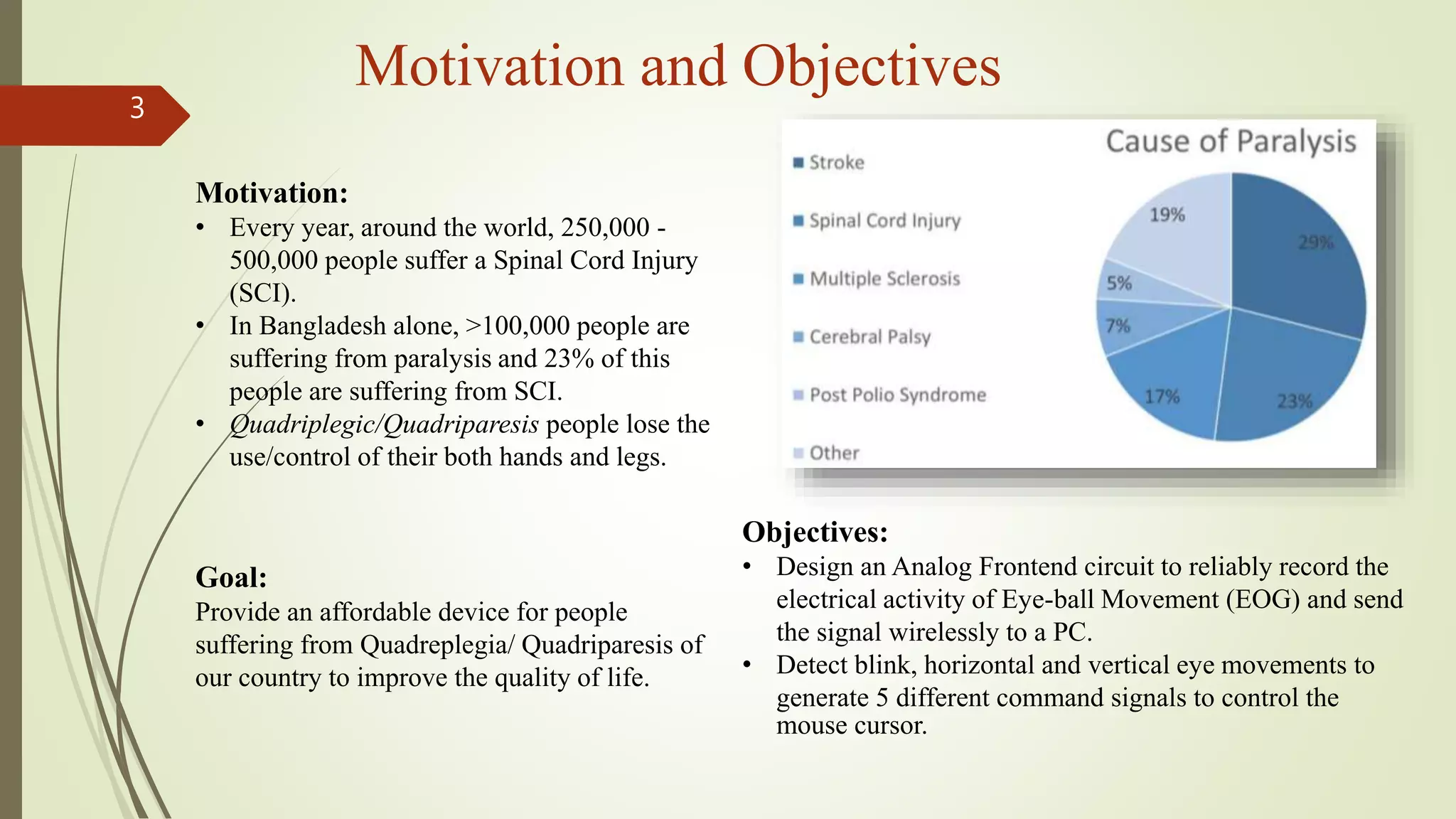
Motivation:
• Every year, around the world, 250,000 -
500,000 people suffer a Spinal Cord Injury
(SCI).
• In Bangladesh alone, >100,000 people are
suffering from paralysis and 23% of this
people are suffering from SCI.
• Quadriplegic/Quadriparesis people lose the
use/control of their both hands and legs.
Objectives:
• Design an Analog Frontend circuit to reliably record the
electrical activity of Eye-ball Movement (EOG) and send
the signal wirelessly to a PC.
• Detect blink, horizontal and vertical eye movements to
generate 5 different command signals to control the
mouse cursor.
Goal:
Provide an affordable device for people
suffering from Quadreplegia/ Quadriparesis of
our country to improve the quality of life.
Electro-Oculography (EOG)
4
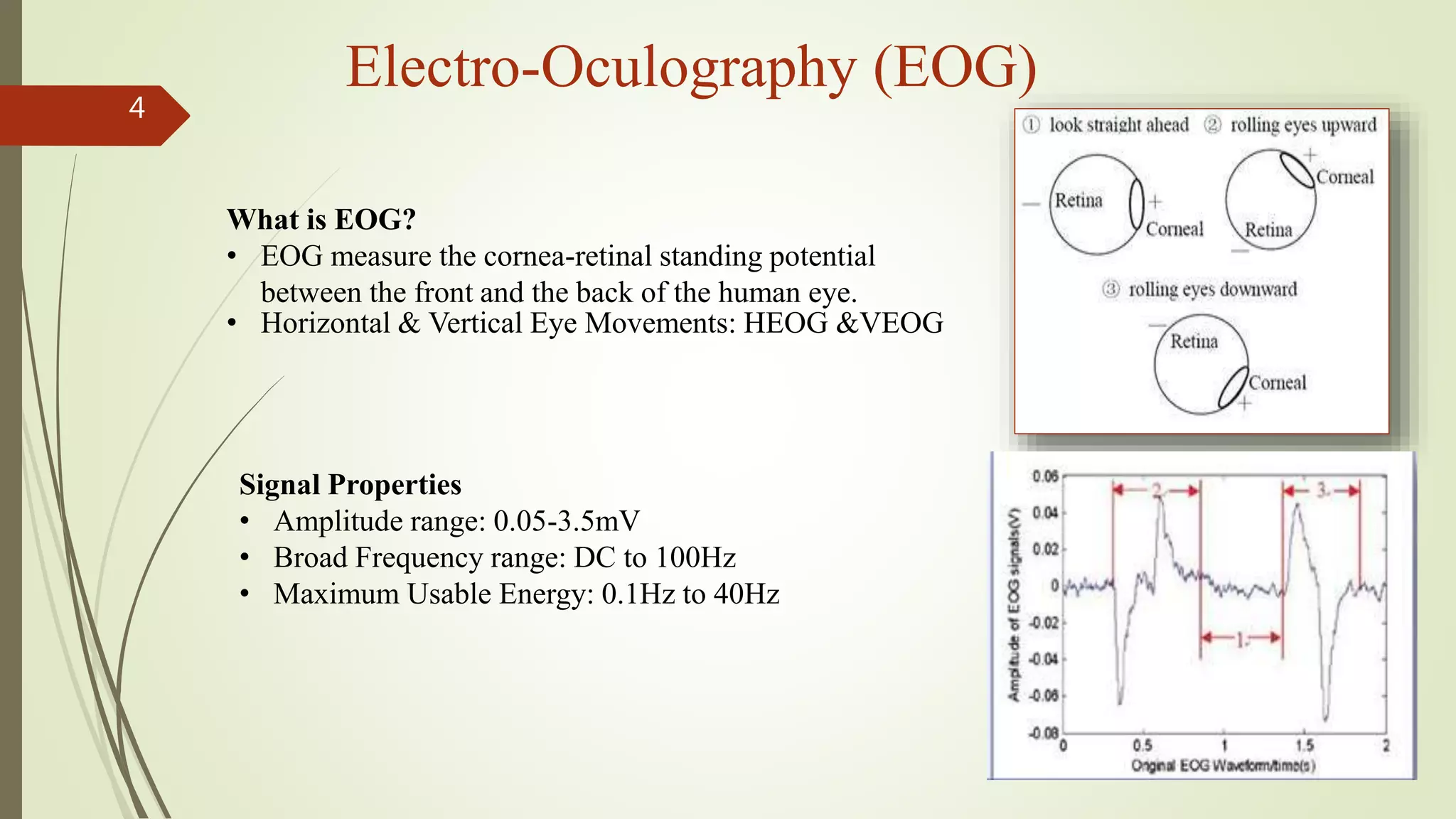
Signal Properties
• Amplitude range: 0.05-3.5mV
• Broad Frequency range: DC to 100Hz
• Maximum Usable Energy: 0.1Hz to 40Hz
What is EOG?
• EOG measure the cornea-retinal standing potential
between the front and the back of the human eye.
• Horizontal & Vertical Eye Movements: HEOG &VEOG
5
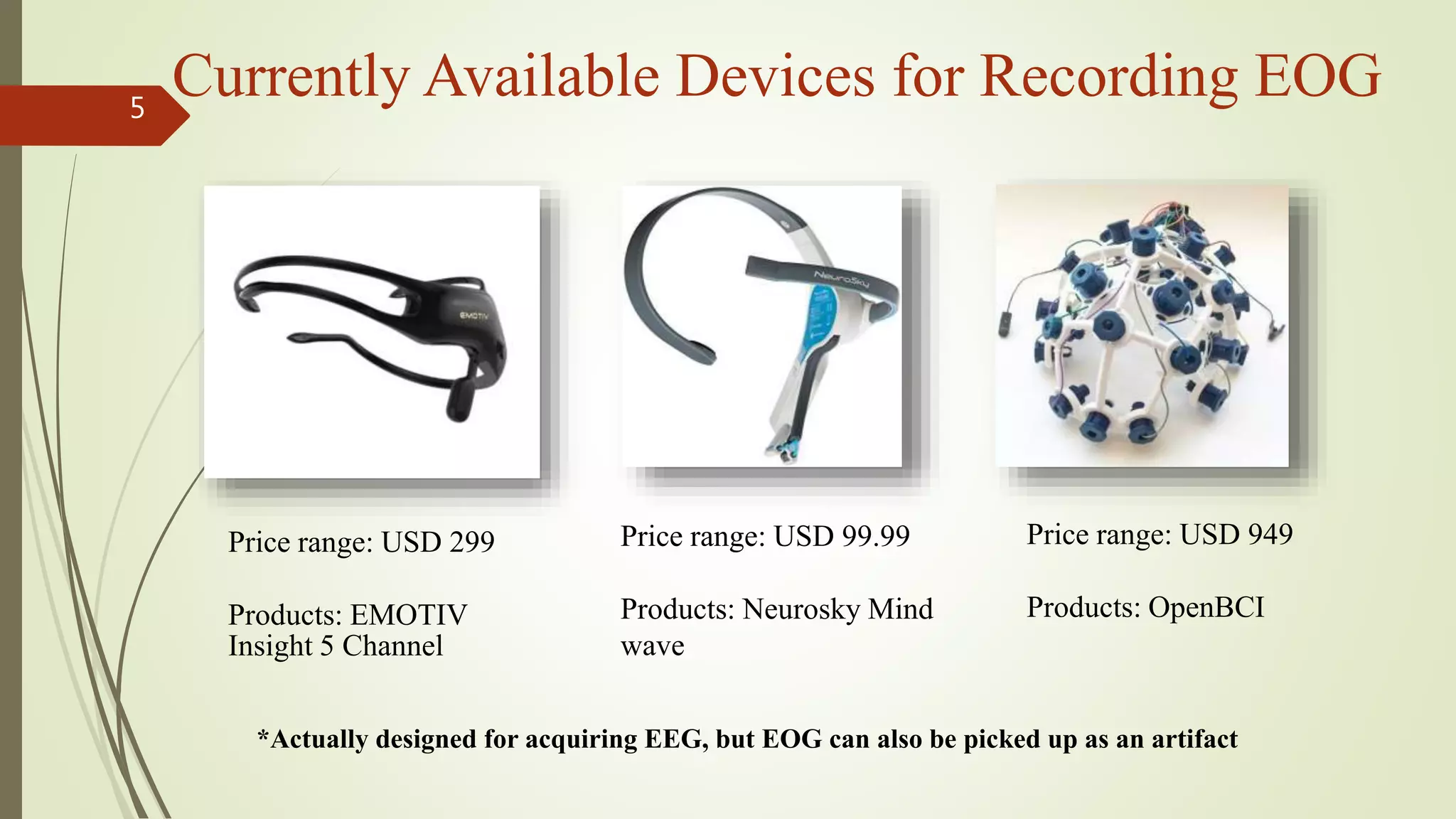
Currently Available Devices for Recording EOG
Price range: USD 299
Products: EMOTIV
Insight 5 Channel
Price range: USD 99.99
Products: Neurosky Mind
wave
Price range: USD 949
Products: OpenBCI
*Actually designed for acquiring EEG, but EOG can also be picked up as an artifact
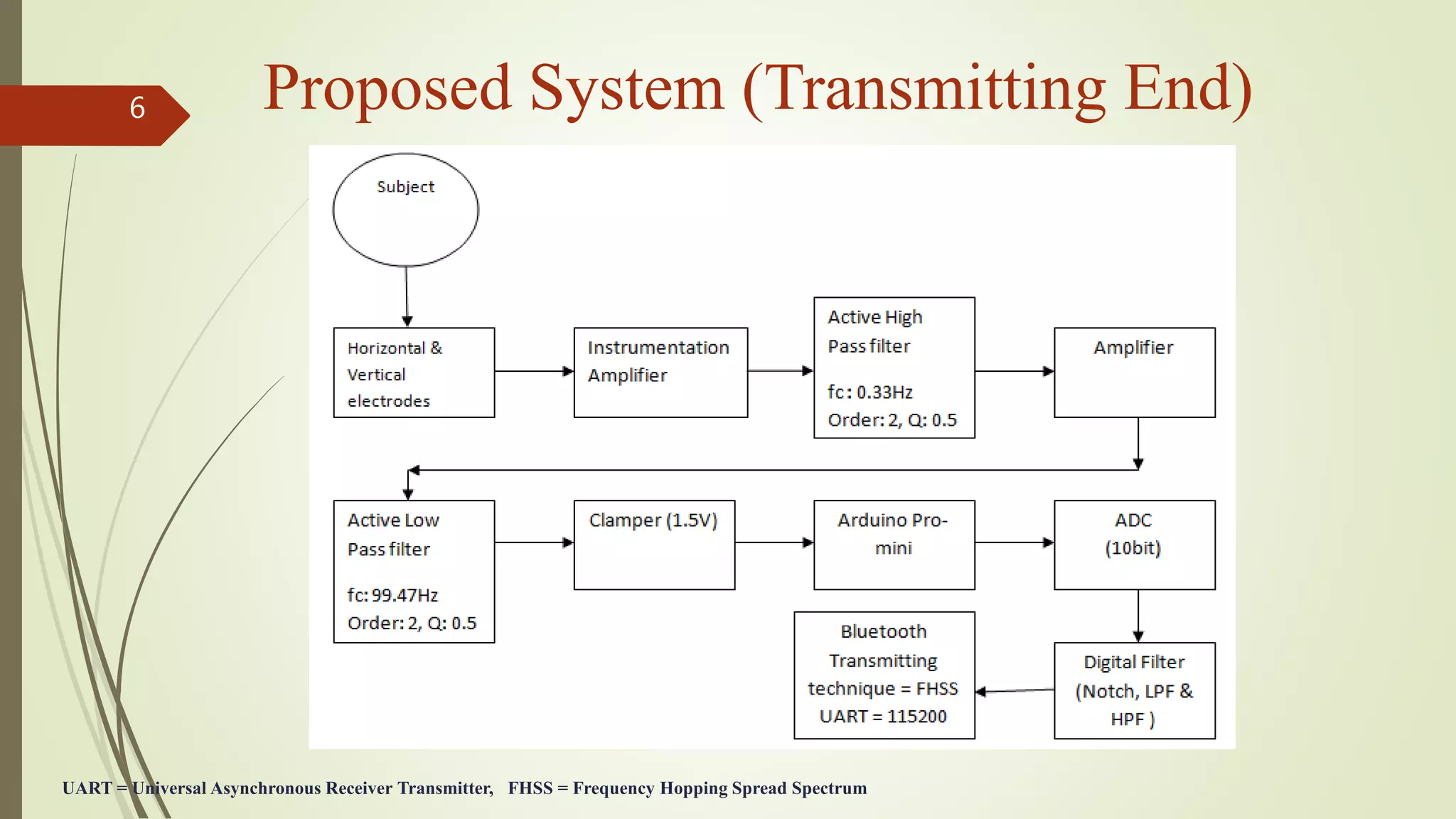
6 Proposed System (Transmitting End)
UART = Universal Asynchronous Receiver Transmitter, FHSS = Frequency Hopping Spread Spectrum
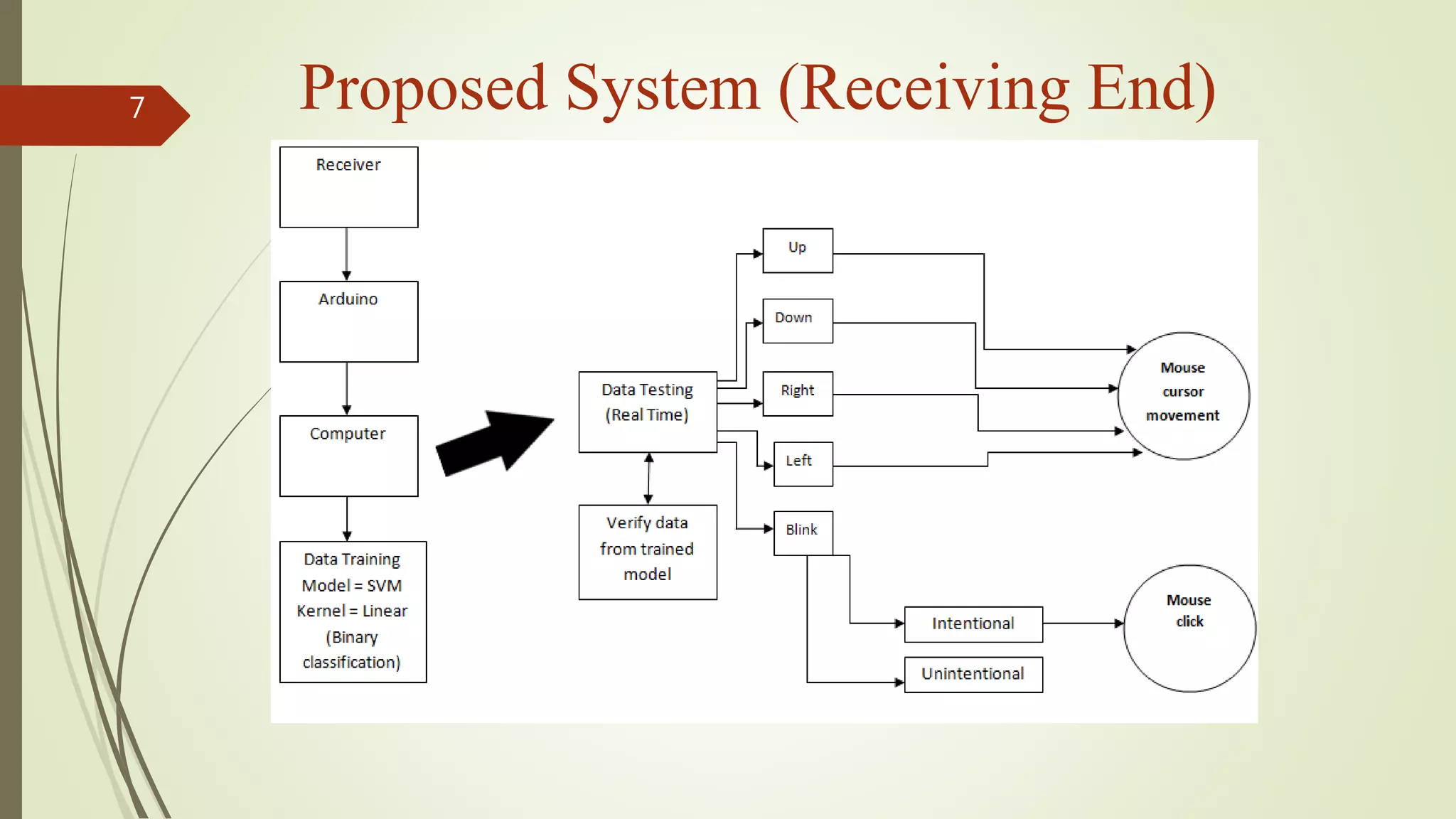
7 Proposed System (Receiving End)
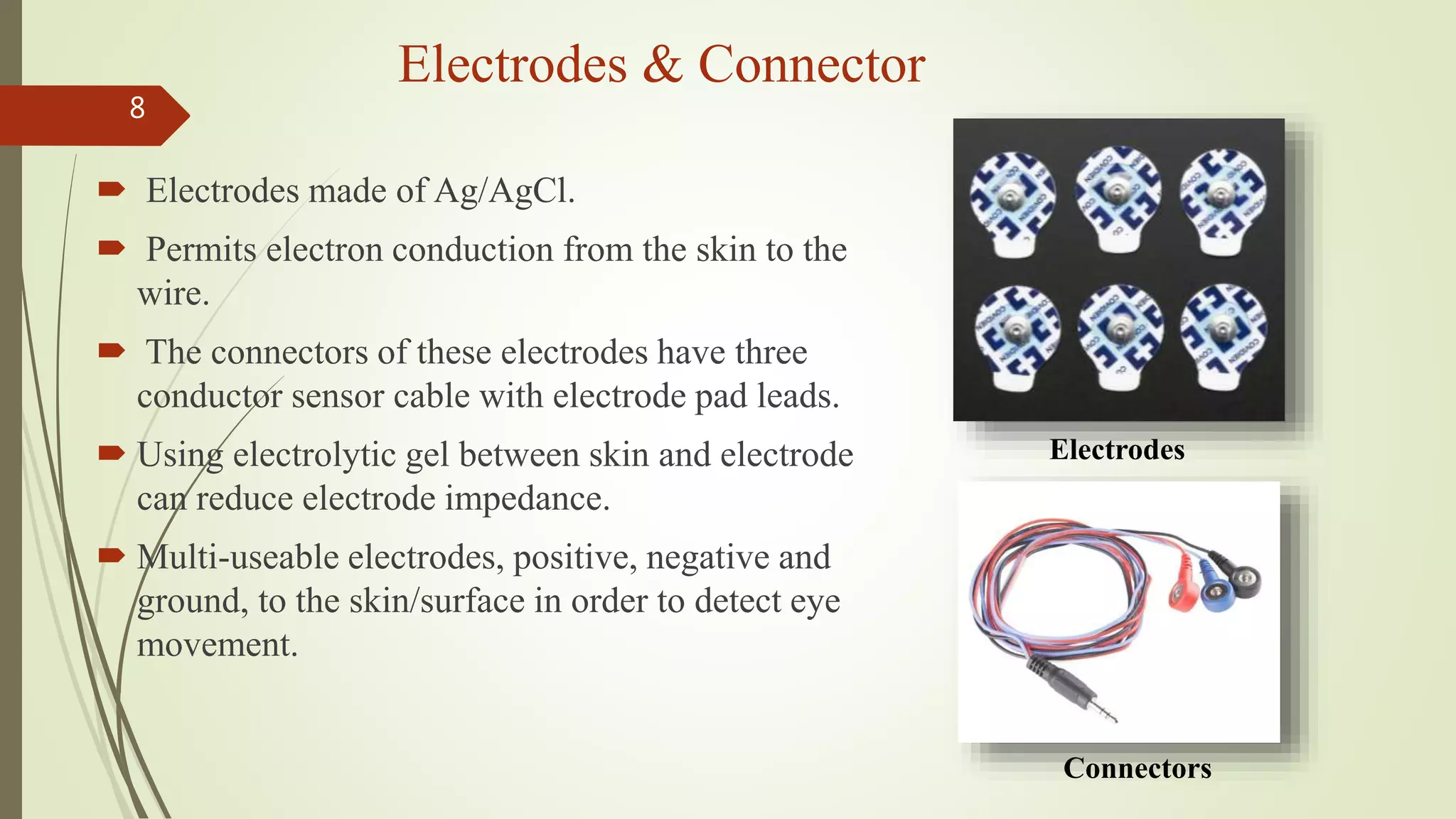
Electrodes & Connector
 Electrodes made of Ag/AgCl.
 Permits electron conduction from the skin to the
wire.
 The connectors of these electrodes have three
conductor sensor cable with electrode pad leads.
 Using electrolytic gel between skin and electrode
can reduce electrode impedance.
 Multi-useable electrodes, positive, negative and
ground, to the skin/surface in order to detect eye
movement.
8
Connectors
Electrodes
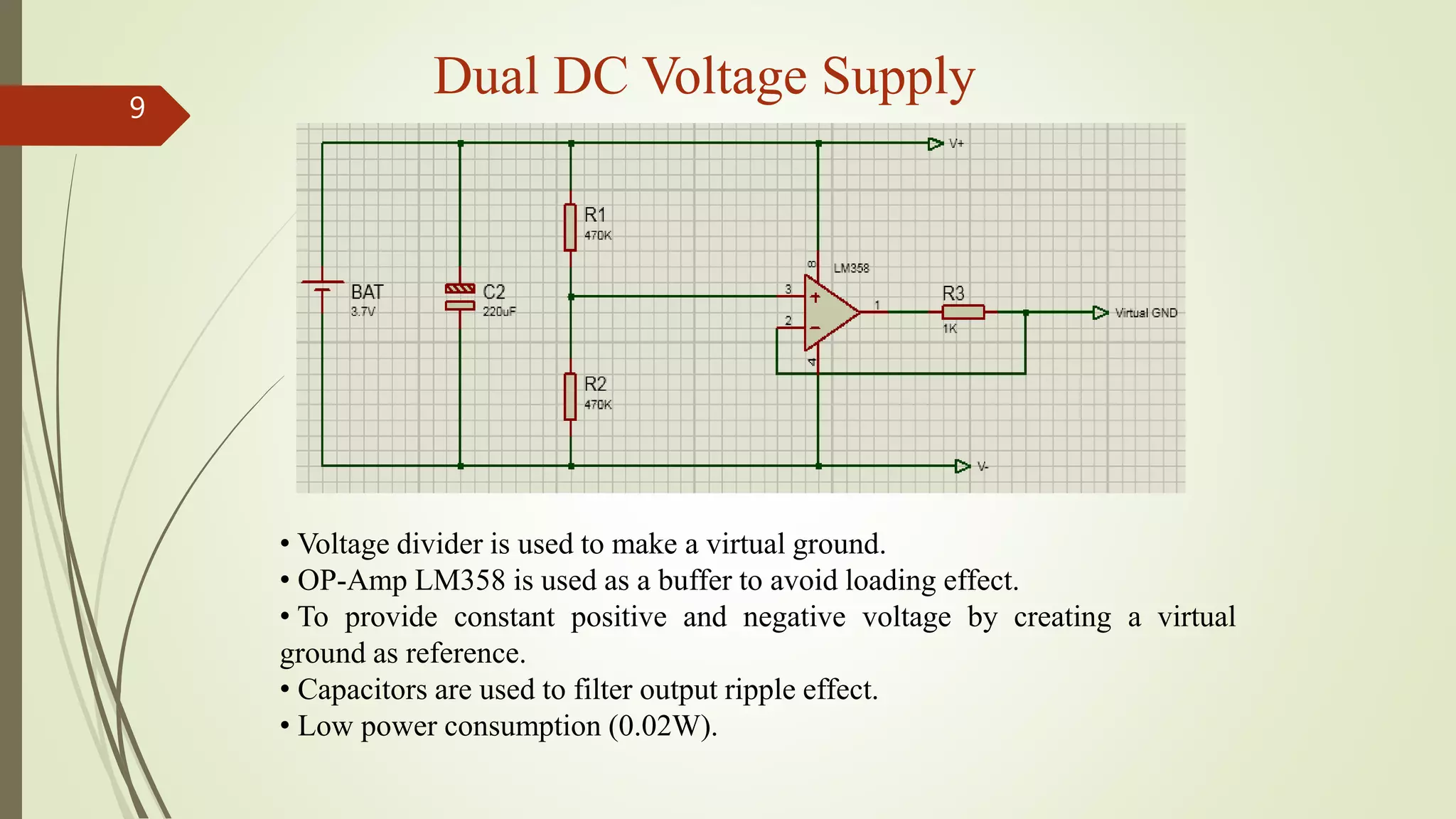
Dual DC Voltage Supply9
• Voltage divider is used to make a virtual ground.
• OP-Amp LM358 is used as a buffer to avoid loading effect.
• To provide constant positive and negative voltage by creating a virtual
ground as reference.
• Capacitors are used to filter output ripple effect.
• Low power consumption (0.02W).
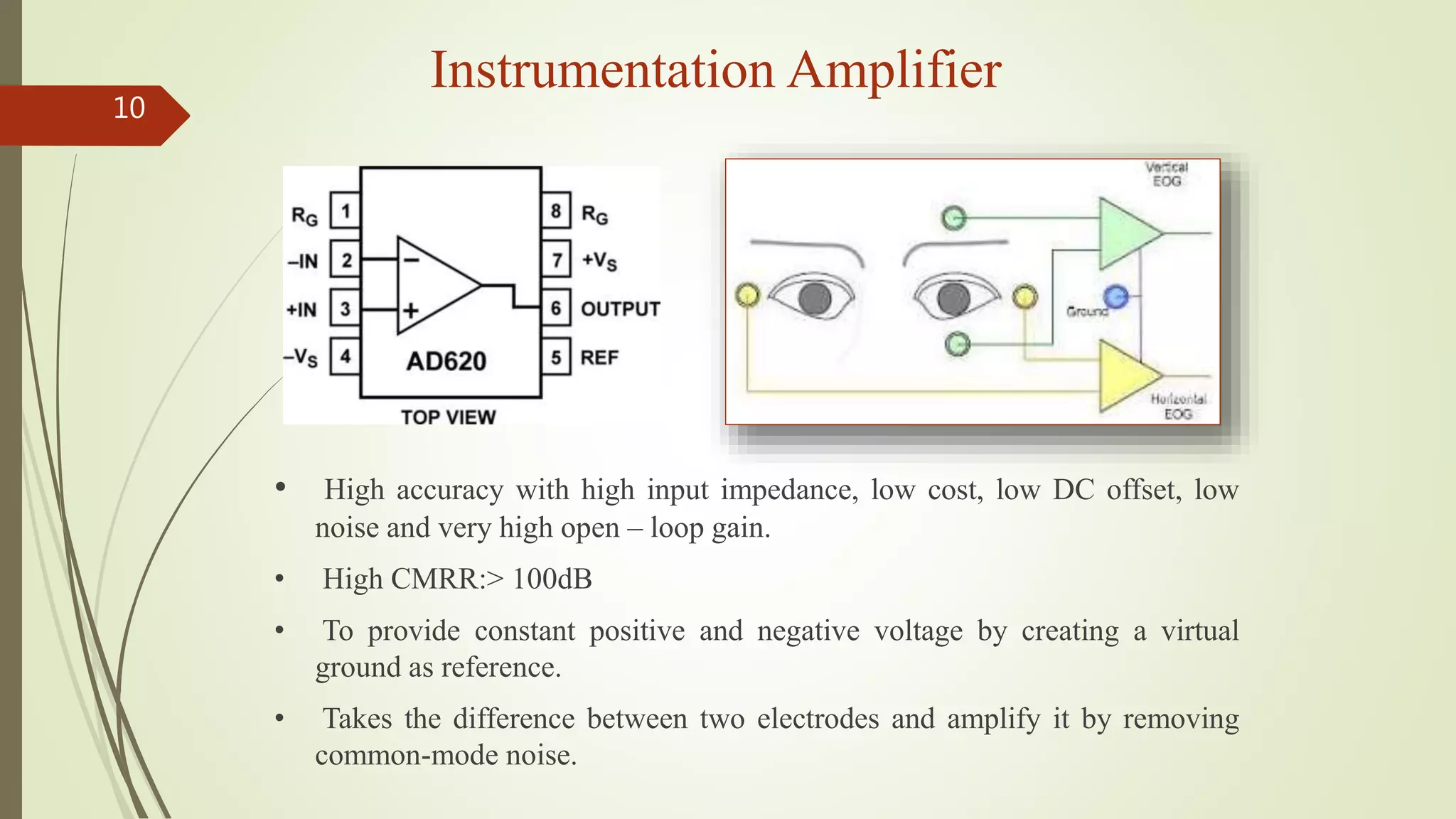
Instrumentation Amplifier
10
• High accuracy with high input impedance, low cost, low DC offset, low
noise and very high open – loop gain.
• High CMRR:> 100dB
• To provide constant positive and negative voltage by creating a virtual
ground as reference.
• Takes the difference between two electrodes and amplify it by removing
common-mode noise.
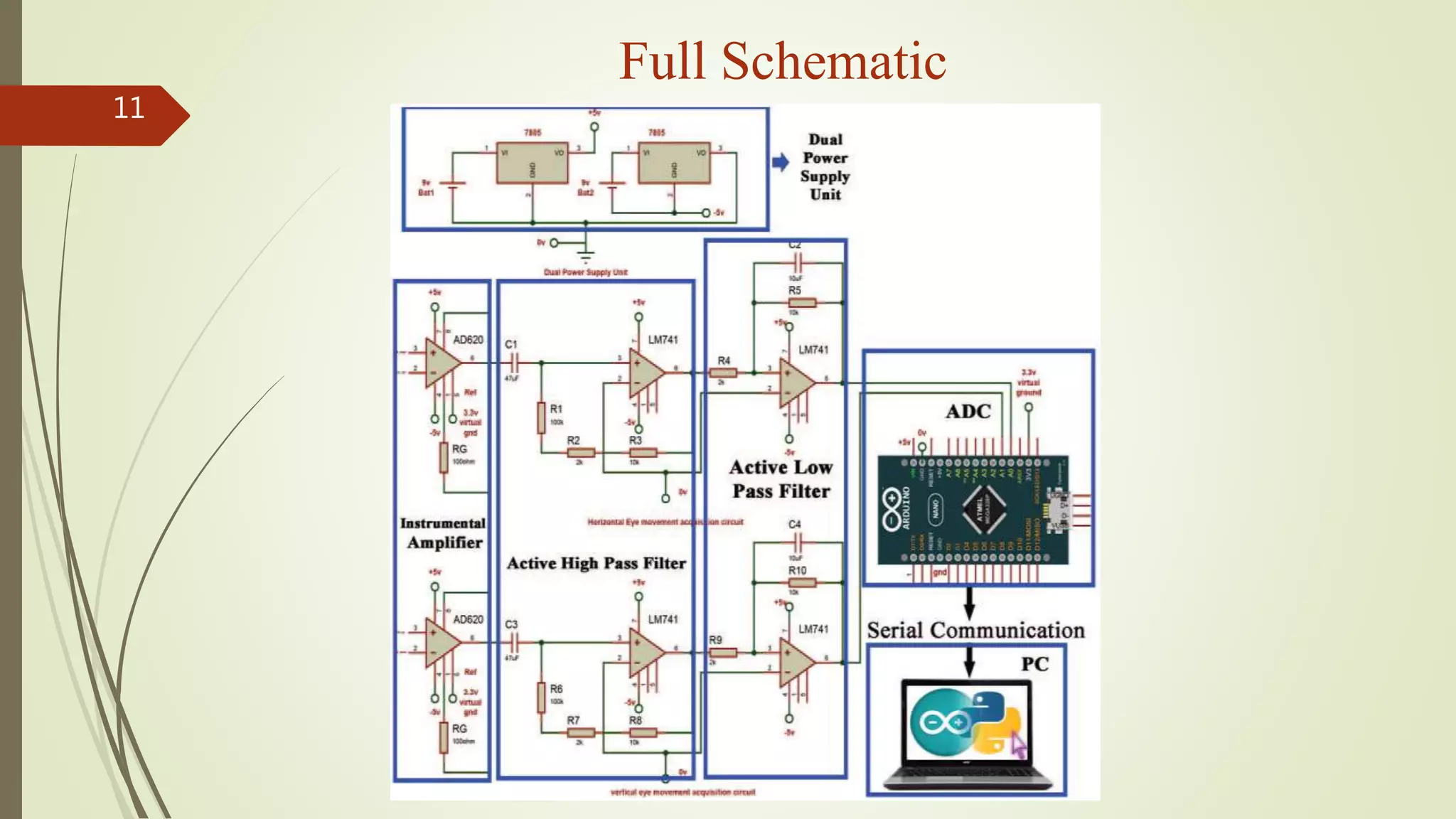
Full Schematic
11
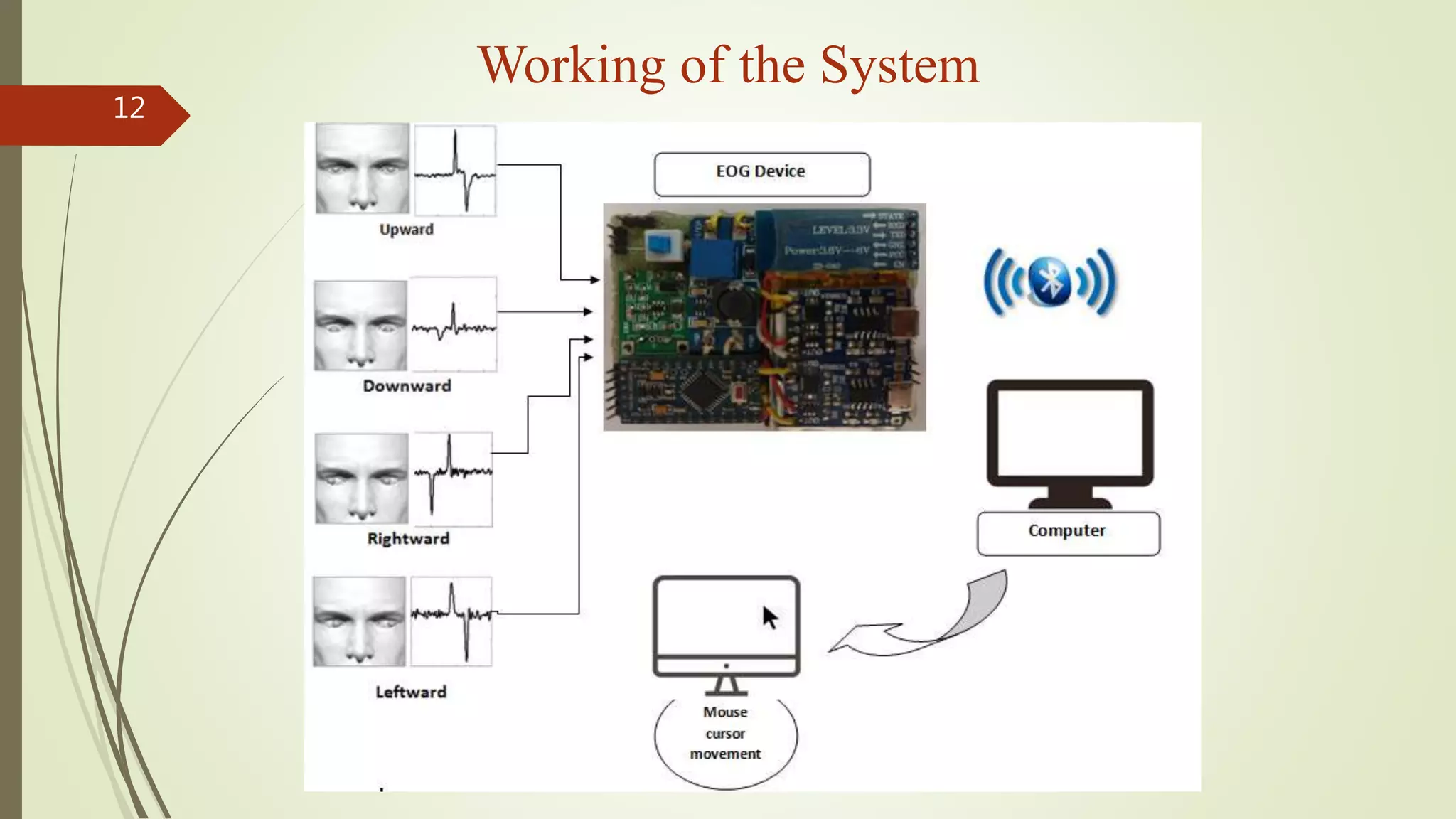
Working of the System
12
13
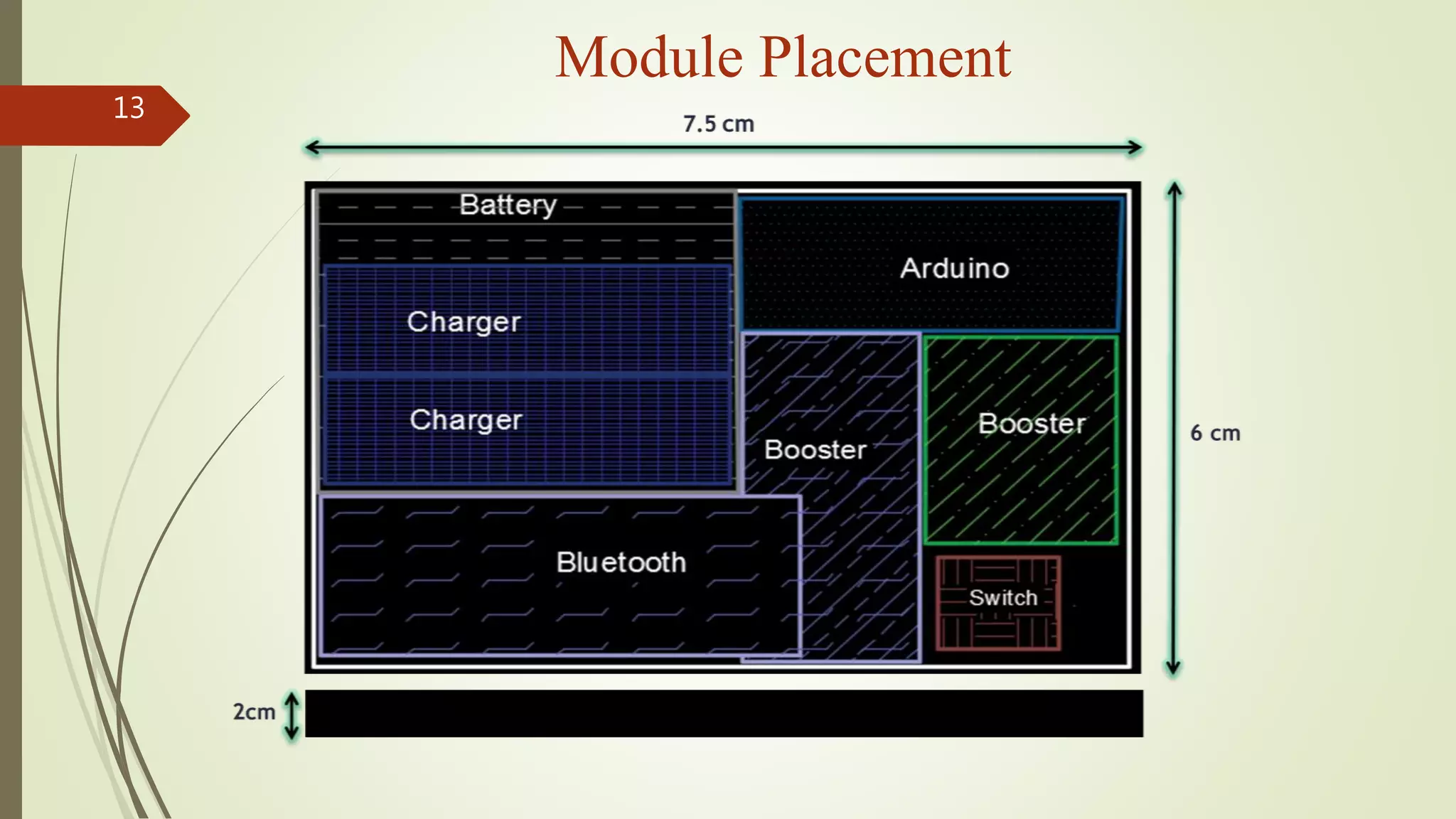
Module Placement
14
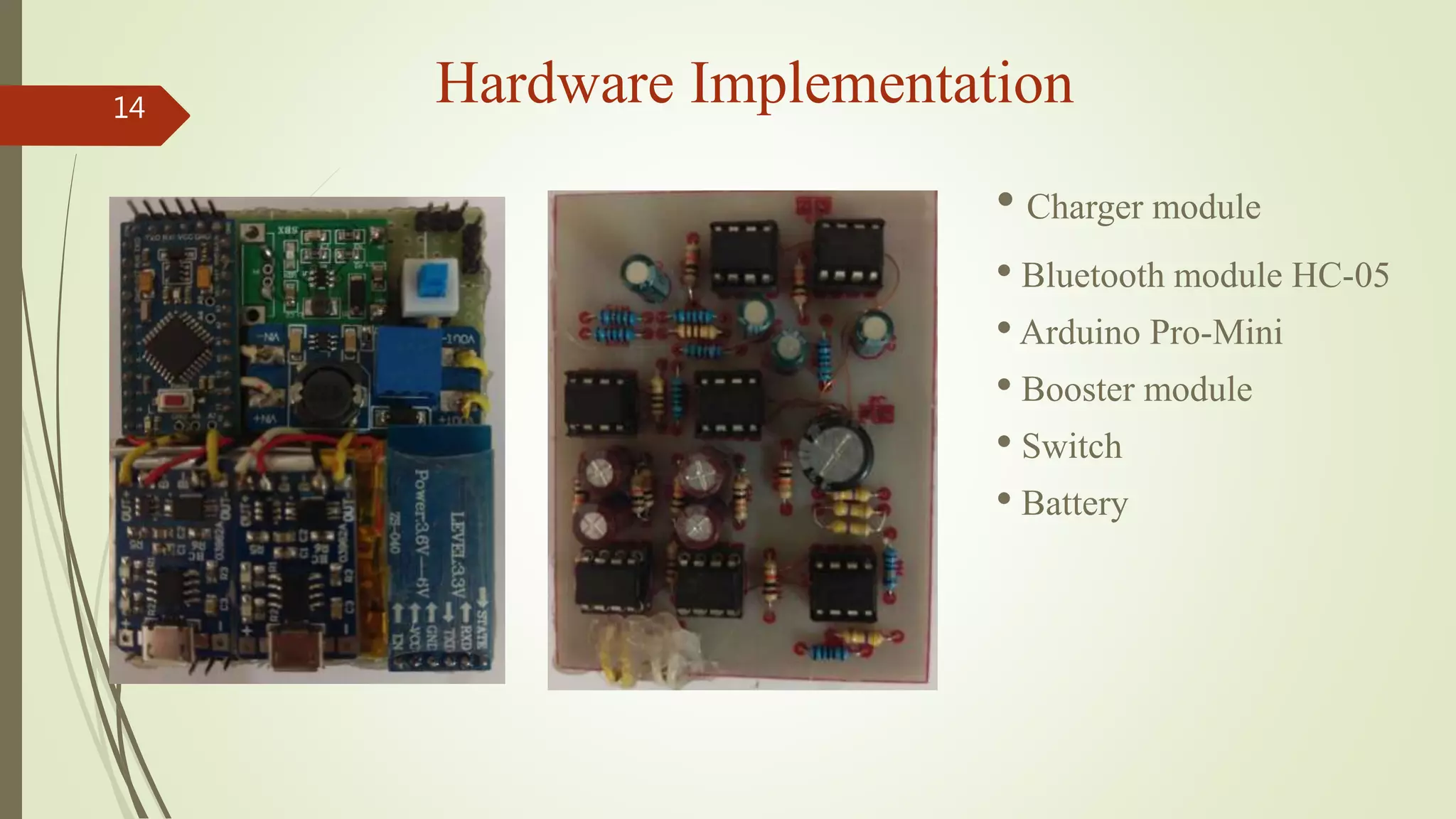
Hardware Implementation
• Charger module
• Bluetooth module HC-05
• Arduino Pro-Mini
• Booster module
• Switch
• Battery
15
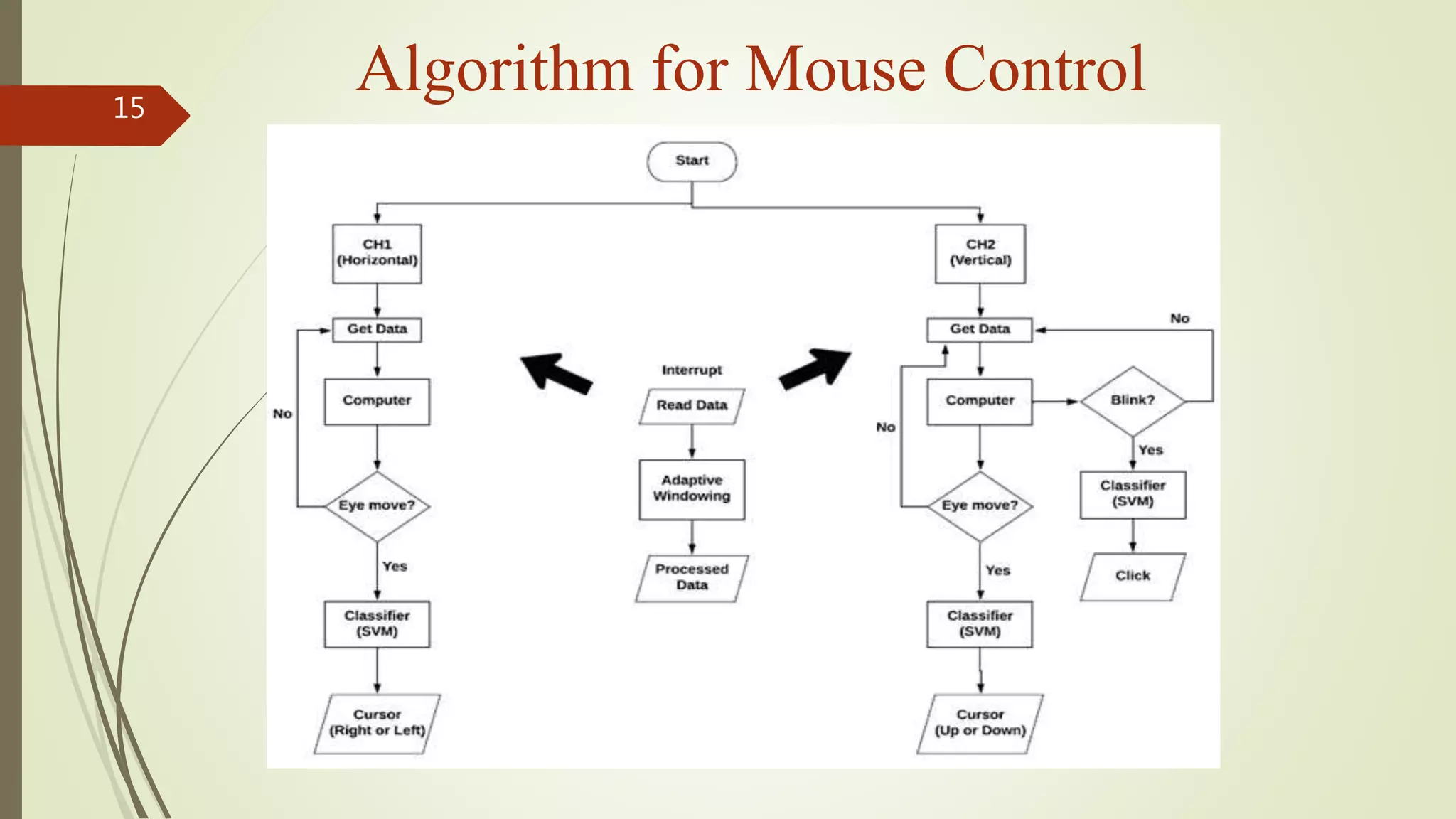
Algorithm for Mouse Control
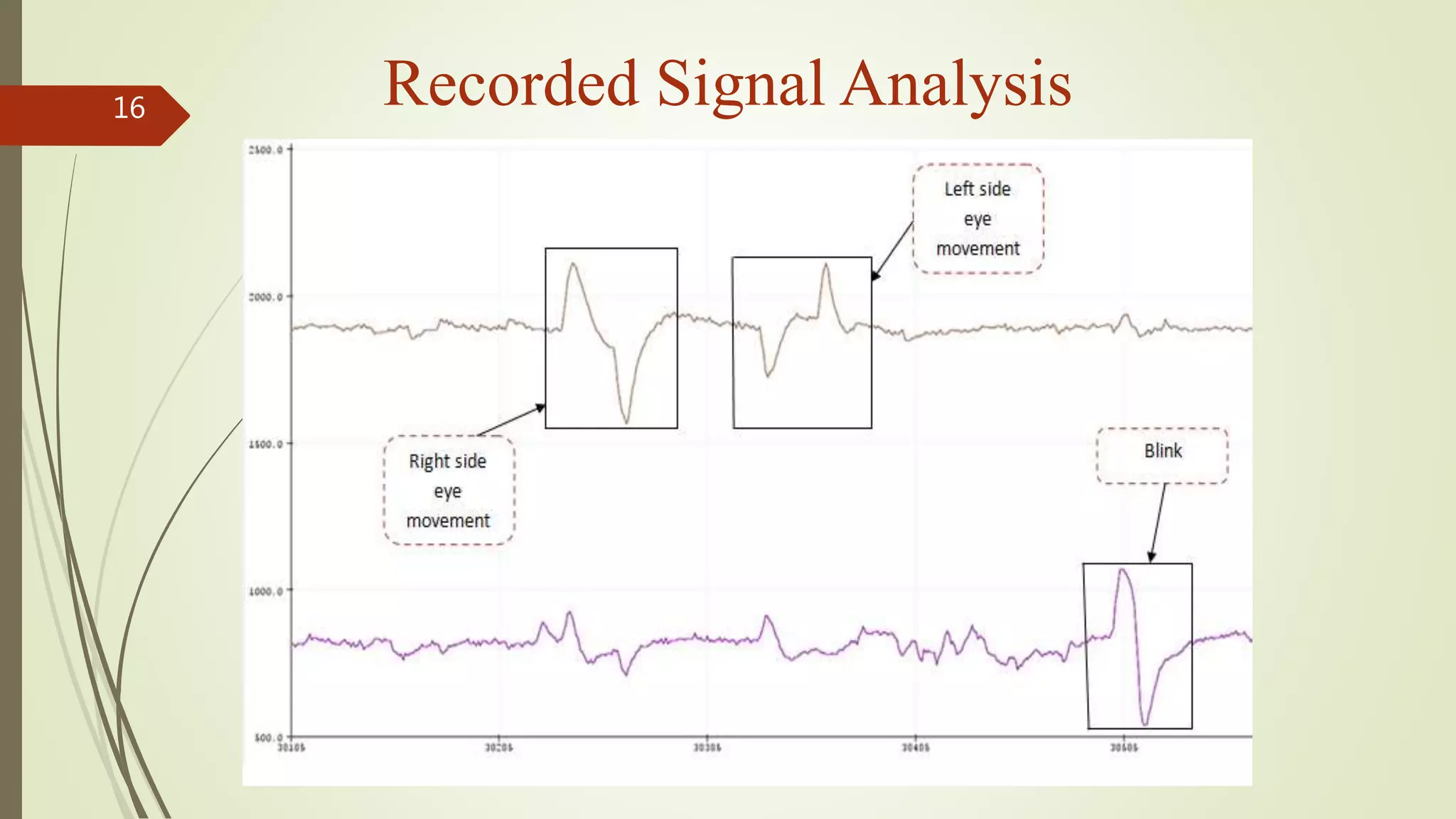
16 Recorded Signal Analysis
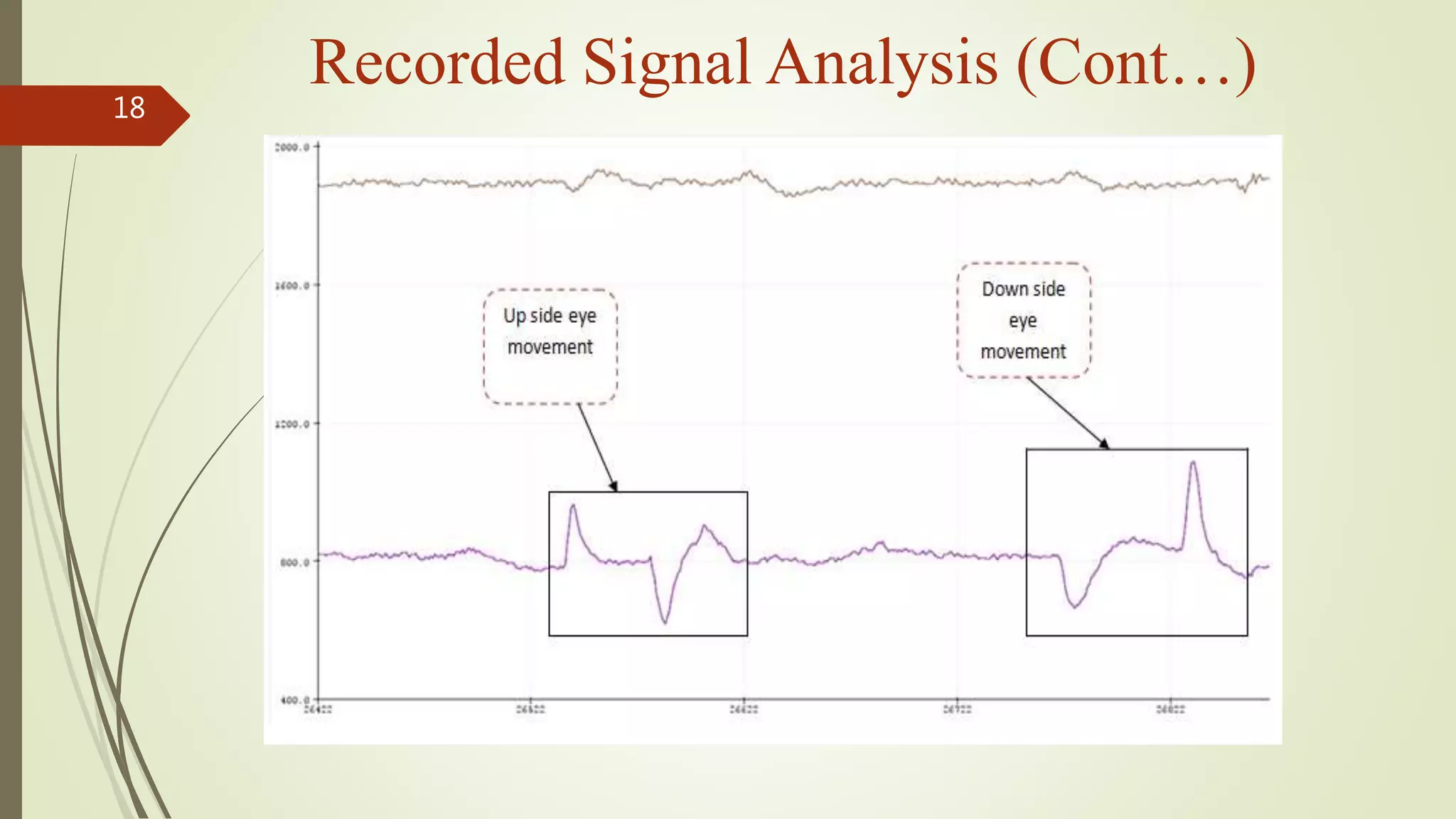
Recorded Signal Analysis (Cont…)
18
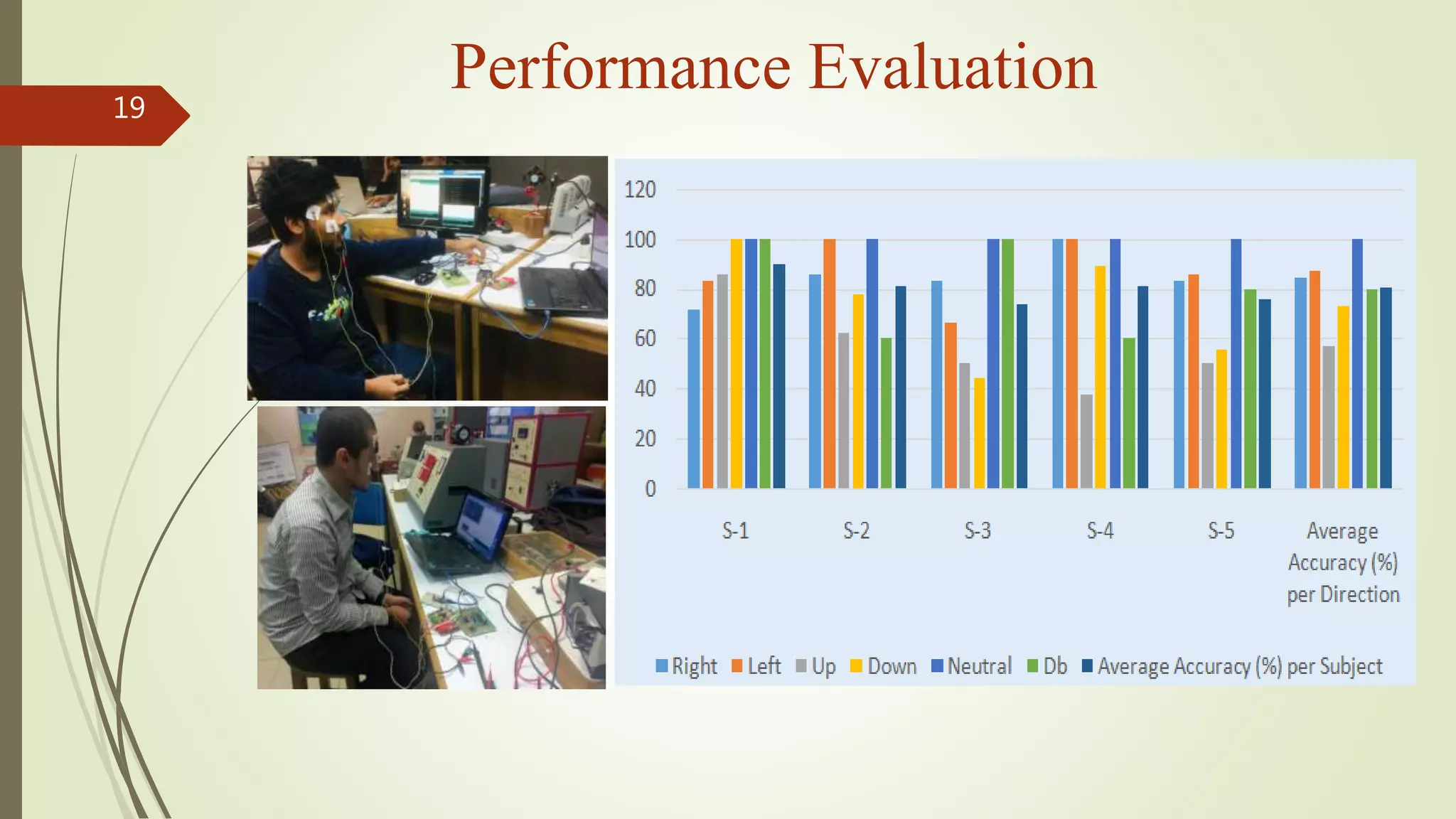
Performance Evaluation19
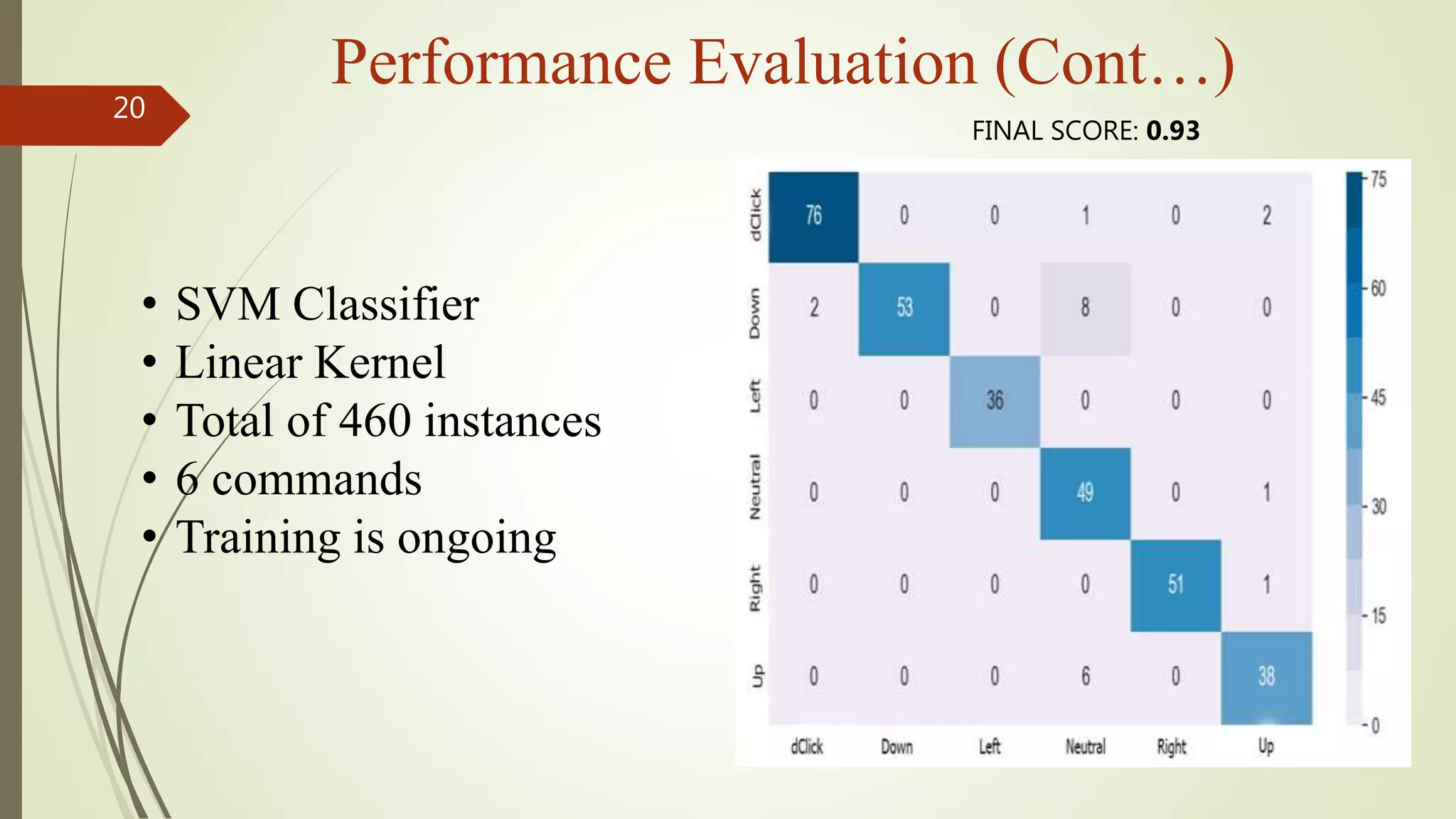
Performance Evaluation (Cont…)
20
• SVM Classifier
• Linear Kernel
• Total of 460 instances
• 6 commands
• Training is ongoing
FINAL SCORE: 0.93
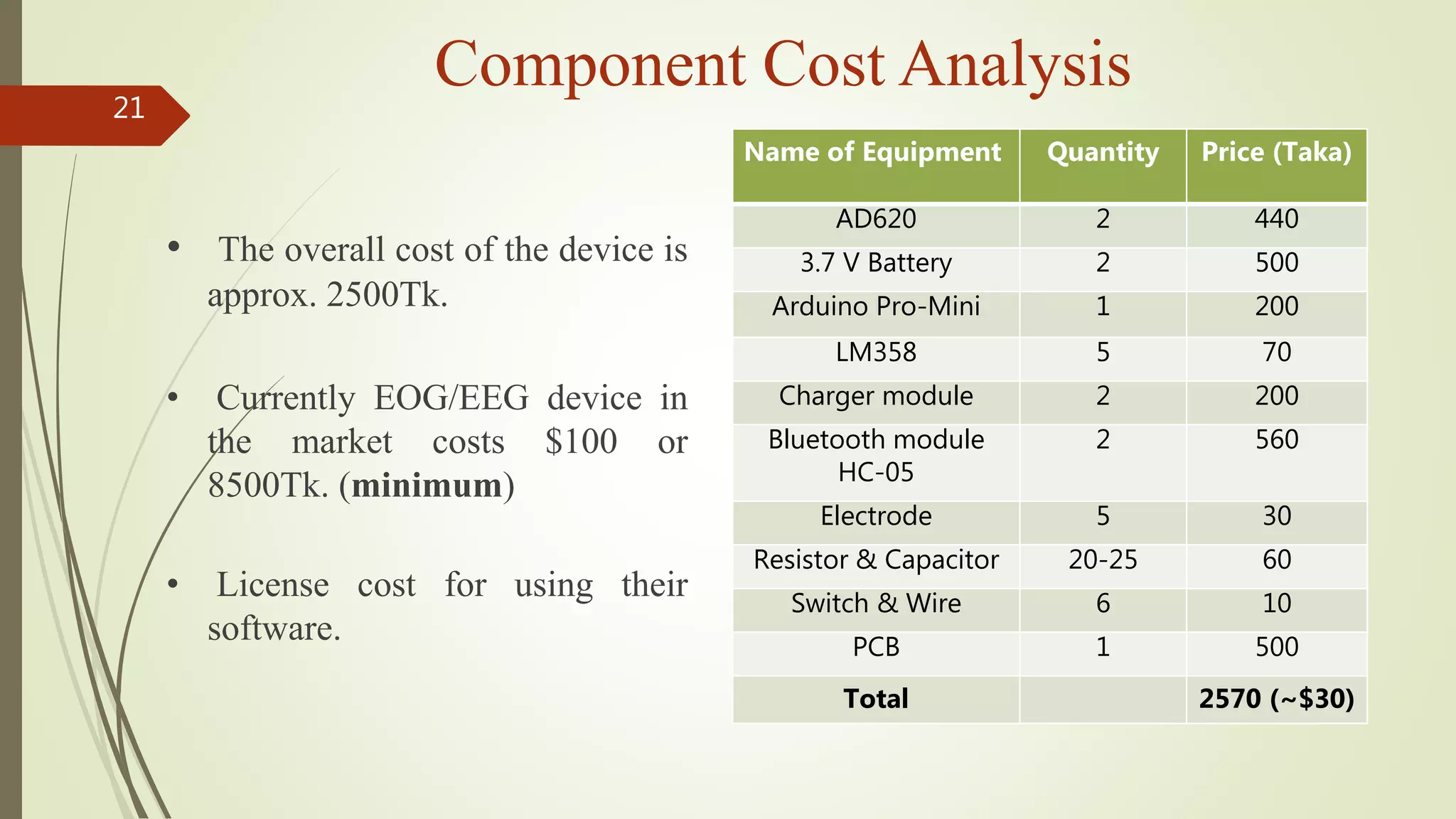
Component Cost Analysis21
Name of Equipment Quantity Price (Taka)
AD620 2 440
3.7 V Battery 2 500
Arduino Pro-Mini 1 200
LM358 5 70
Charger module 2 200
Bluetooth module
HC-05
2 560
Electrode 5 30
Resistor & Capacitor 20-25 60
Switch & Wire 6 10
PCB 1 500
Total 2570 (~$30)
• The overall cost of the device is
approx. 2500Tk.
• Currently EOG/EEG device in
the market costs $100 or
8500Tk. (minimum)
• License cost for using their
software.
Limitations22
• Able to classify between intentional and unintentional
blink up-to 50%
• No diagonal mouse cursor movement
• Slow cursor movement compare to traditional mouse.
• Not suitable for MAC user.
Other Potential Applications of the Developed Module
23
• Controlling devices or machines other than computer, e.g. electric
wheelchair, light/fan/AC ON-OFF, smartphone control.
• By tuning the overall gain of amplifiers and cut-off frequencies of
filters, same wireless module can be used to record other biomedical
signals such as EEG, ECG, EMG, etc.
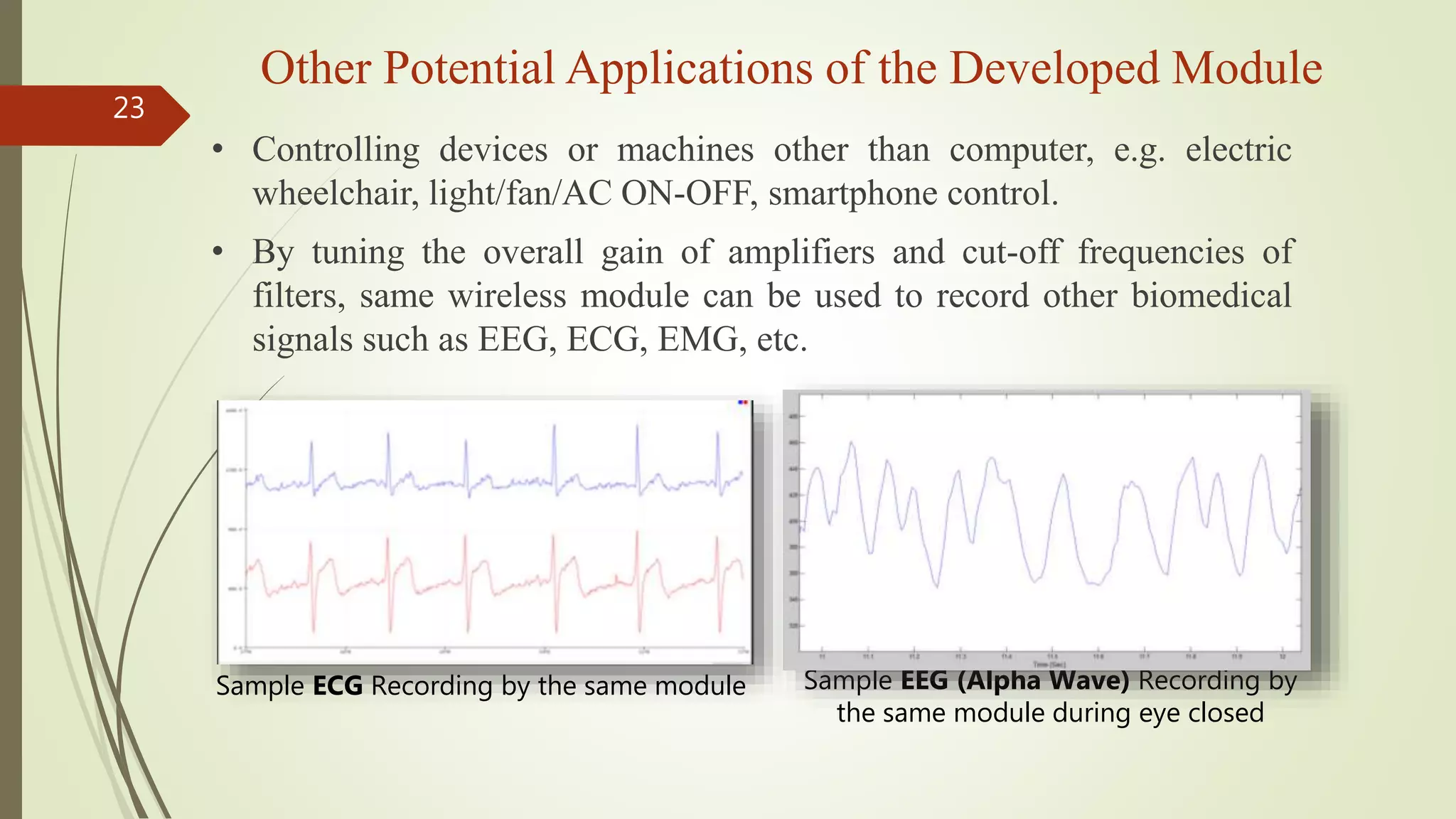
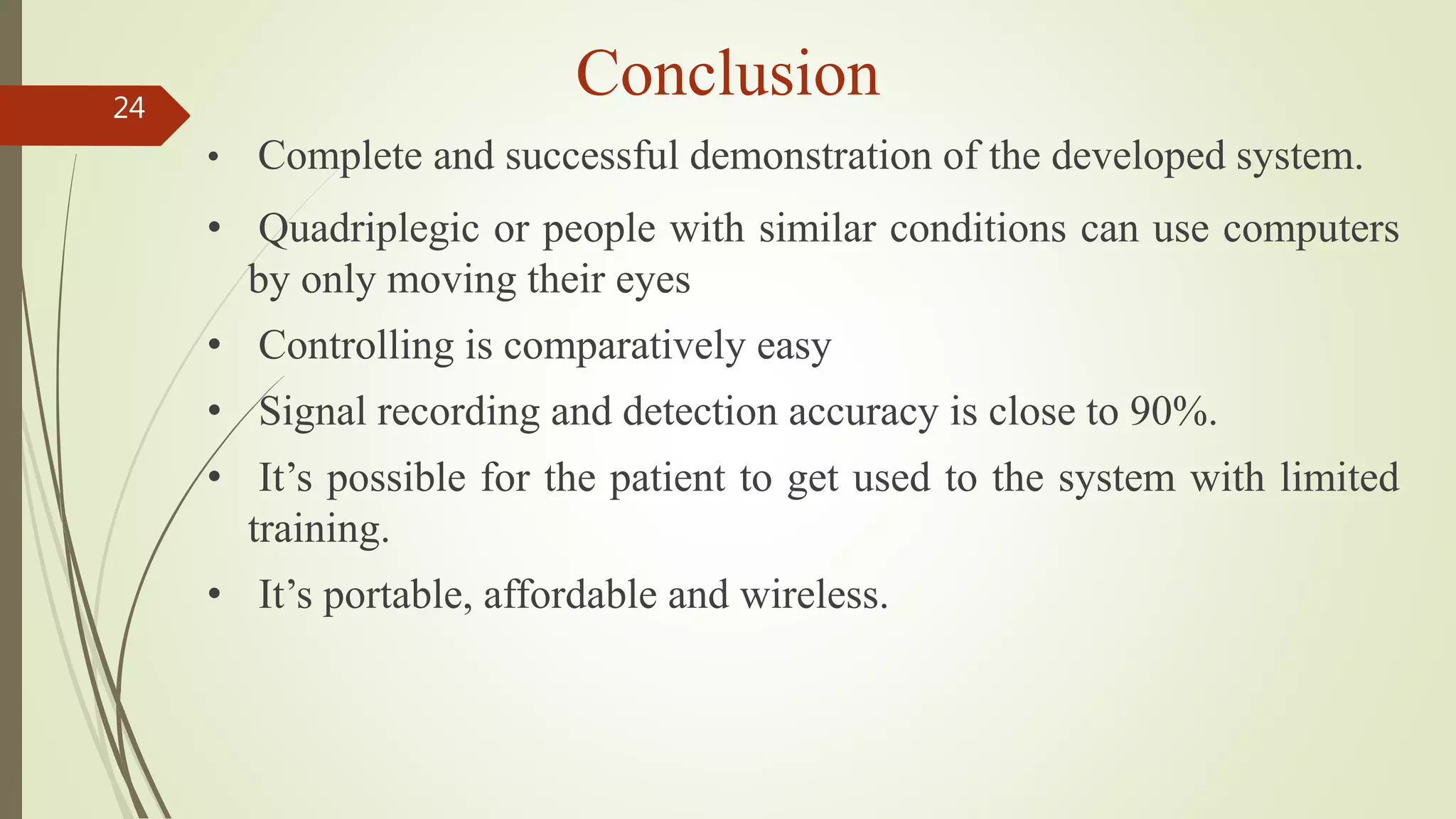
Sample ECG Recording by the same module Sample EEG (Alpha Wave) Recording by
the same module during eye closed
Conclusion24
• Complete and successful demonstration of the developed system.
• Quadriplegic or people with similar conditions can use computers
by only moving their eyes
• Controlling is comparatively easy
• Signal recording and detection accuracy is close to 90%.
• It’s possible for the patient to get used to the system with limited
training.
• It’s portable, affordable and wireless.
Future Works25
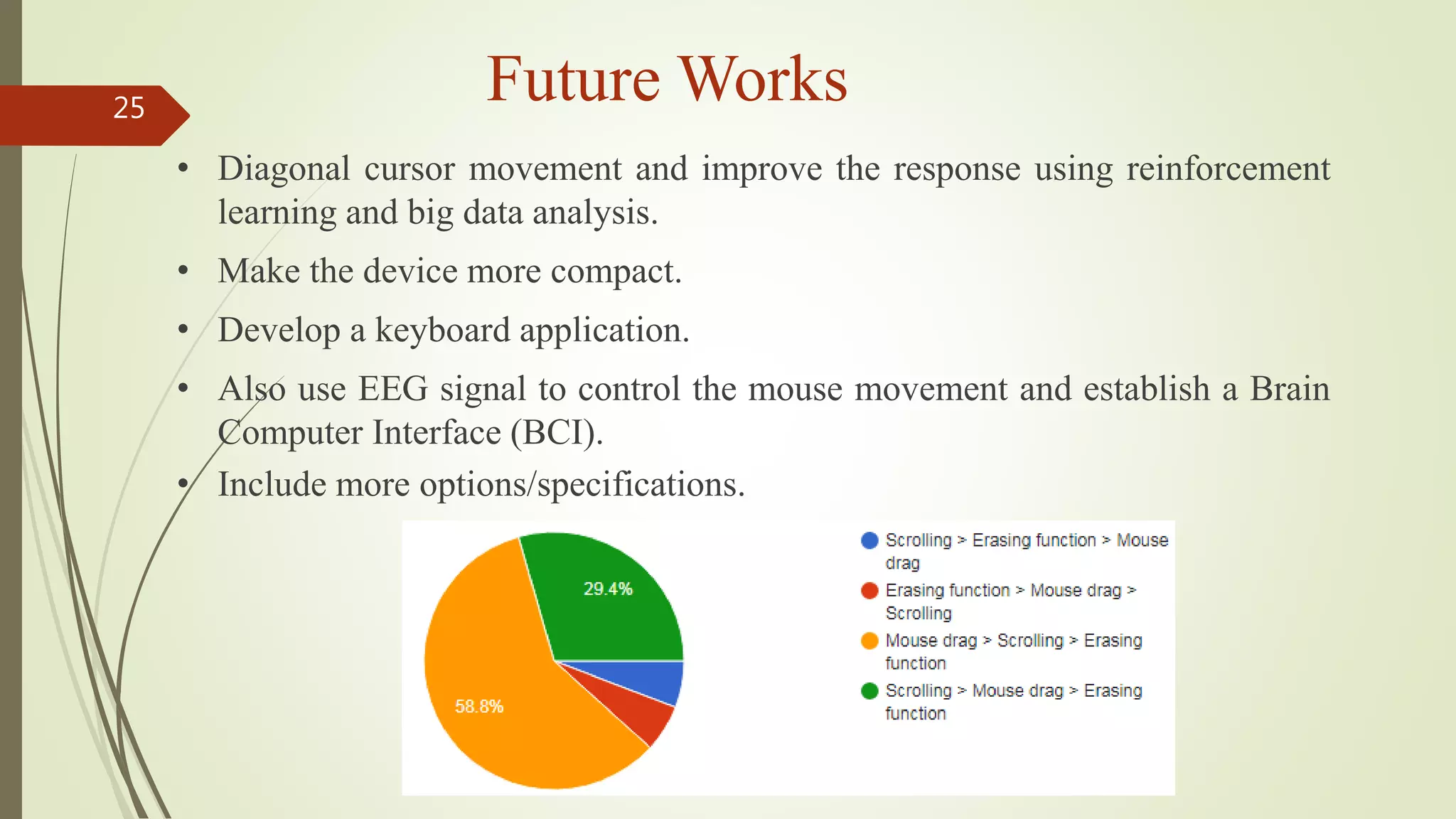
• Diagonal cursor movement and improve the response using reinforcement
learning and big data analysis.
• Make the device more compact.
• Develop a keyboard application.
• Also use EEG signal to control the mouse movement and establish a Brain
Computer Interface (BCI).
• Include more options/specifications.
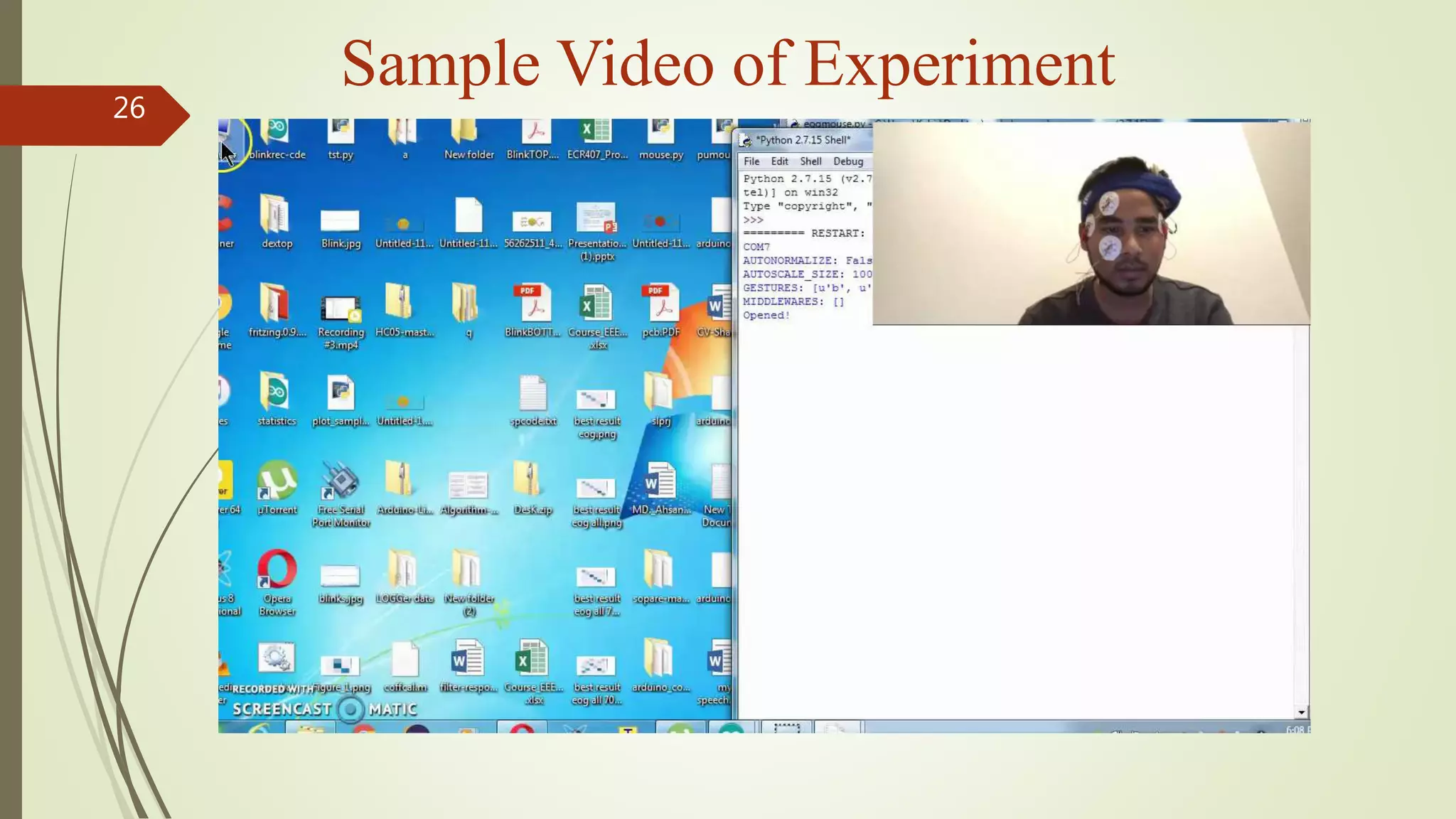
Sample Video of Experiment26
References
26
• https://www.healthline.com/health/quadriparesis#vs.-quadriplegia
• http://www.womentribe.com/health/7-most-common-causes-ofparalysis.html
•https://www.reallusion.com/iclone/help/3DXchange5/Pipeline/04_Modify_Page/Face_Setup_Sect
ion/Setting_Eye_Movement_Data.htm
• https://www.sparkfun.com/products/14758
• https://www.emotiv.com/product/emotiv-insight-5-channel-mobile-eeg/
• https://docs.openbci.com/Headware/03-Ultracortex-Mark-III-Nova
• http://www.robotpark.com/Muscle-Sensor-Surface-EMG-Electrodes-H124SG-Covidien-Pack-of-6
• http://sitiapple.blogspot.com/2013/03/electrooculograph-signal.html
• https://www.semanticscholar.org/paper/Wavelet-Frequency-Energy-Distribution-of-Potential-
Bukhari-Daud/8b10d0b9539d22ac8cafaf7a5fabbf51ae7817b6/figure/0
• https://www.seminarsonly.com/electronics/Electrooculography.php
Thank You!
27

ICDPR@SG 2020 PID_A304_presentation

  • 1.
    Design and Implementationof an EOG-based Mouse Cursor Control for Application in Human-Computer Interaction Authored by Ahsan-ul Kabir, Faisal Bin Shahin, and Md. Kafiul Islam Presented by Md. Kafiul Islam, PhD, SMIEEE Asst. Prof., Dept. of EEE, IUB Dhaka, Bangladesh kafiul_islam@iub.edu.bd 1 2020 4th International Conference on Data Processing and Robotics (ICDPR 2020)
  • 2.
    Presentation Outline  Introduction Motivationand Objectives  Electro-oculography (EOG) Basics  Proposed System Design & Implementation Hardware Implementation Signal Analysis in MATLAB  Performance Evaluation  Conclusion & Future work 2
  • 3.
    Motivation and Objectives 3 Motivation: •Every year, around the world, 250,000 - 500,000 people suffer a Spinal Cord Injury (SCI). • In Bangladesh alone, >100,000 people are suffering from paralysis and 23% of this people are suffering from SCI. • Quadriplegic/Quadriparesis people lose the use/control of their both hands and legs. Objectives: • Design an Analog Frontend circuit to reliably record the electrical activity of Eye-ball Movement (EOG) and send the signal wirelessly to a PC. • Detect blink, horizontal and vertical eye movements to generate 5 different command signals to control the mouse cursor. Goal: Provide an affordable device for people suffering from Quadreplegia/ Quadriparesis of our country to improve the quality of life.
  • 4.
    Electro-Oculography (EOG) 4 Signal Properties •Amplitude range: 0.05-3.5mV • Broad Frequency range: DC to 100Hz • Maximum Usable Energy: 0.1Hz to 40Hz What is EOG? • EOG measure the cornea-retinal standing potential between the front and the back of the human eye. • Horizontal & Vertical Eye Movements: HEOG &VEOG
  • 5.
    5 Currently Available Devicesfor Recording EOG Price range: USD 299 Products: EMOTIV Insight 5 Channel Price range: USD 99.99 Products: Neurosky Mind wave Price range: USD 949 Products: OpenBCI *Actually designed for acquiring EEG, but EOG can also be picked up as an artifact
  • 6.
    6 Proposed System(Transmitting End) UART = Universal Asynchronous Receiver Transmitter, FHSS = Frequency Hopping Spread Spectrum
  • 7.
    7 Proposed System(Receiving End)
  • 8.
    Electrodes & Connector Electrodes made of Ag/AgCl.  Permits electron conduction from the skin to the wire.  The connectors of these electrodes have three conductor sensor cable with electrode pad leads.  Using electrolytic gel between skin and electrode can reduce electrode impedance.  Multi-useable electrodes, positive, negative and ground, to the skin/surface in order to detect eye movement. 8 Connectors Electrodes
  • 9.
    Dual DC VoltageSupply9 • Voltage divider is used to make a virtual ground. • OP-Amp LM358 is used as a buffer to avoid loading effect. • To provide constant positive and negative voltage by creating a virtual ground as reference. • Capacitors are used to filter output ripple effect. • Low power consumption (0.02W).
  • 10.
    Instrumentation Amplifier 10 • Highaccuracy with high input impedance, low cost, low DC offset, low noise and very high open – loop gain. • High CMRR:> 100dB • To provide constant positive and negative voltage by creating a virtual ground as reference. • Takes the difference between two electrodes and amplify it by removing common-mode noise.
  • 11.
  • 12.
    Working of theSystem 12
  • 13.
  • 14.
    14 Hardware Implementation • Chargermodule • Bluetooth module HC-05 • Arduino Pro-Mini • Booster module • Switch • Battery
  • 15.
  • 16.
  • 17.
  • 18.
  • 19.
    Performance Evaluation (Cont…) 20 •SVM Classifier • Linear Kernel • Total of 460 instances • 6 commands • Training is ongoing FINAL SCORE: 0.93
  • 20.
    Component Cost Analysis21 Nameof Equipment Quantity Price (Taka) AD620 2 440 3.7 V Battery 2 500 Arduino Pro-Mini 1 200 LM358 5 70 Charger module 2 200 Bluetooth module HC-05 2 560 Electrode 5 30 Resistor & Capacitor 20-25 60 Switch & Wire 6 10 PCB 1 500 Total 2570 (~$30) • The overall cost of the device is approx. 2500Tk. • Currently EOG/EEG device in the market costs $100 or 8500Tk. (minimum) • License cost for using their software.
  • 21.
    Limitations22 • Able toclassify between intentional and unintentional blink up-to 50% • No diagonal mouse cursor movement • Slow cursor movement compare to traditional mouse. • Not suitable for MAC user.
  • 22.
    Other Potential Applicationsof the Developed Module 23 • Controlling devices or machines other than computer, e.g. electric wheelchair, light/fan/AC ON-OFF, smartphone control. • By tuning the overall gain of amplifiers and cut-off frequencies of filters, same wireless module can be used to record other biomedical signals such as EEG, ECG, EMG, etc. Sample ECG Recording by the same module Sample EEG (Alpha Wave) Recording by the same module during eye closed
  • 23.
    Conclusion24 • Complete andsuccessful demonstration of the developed system. • Quadriplegic or people with similar conditions can use computers by only moving their eyes • Controlling is comparatively easy • Signal recording and detection accuracy is close to 90%. • It’s possible for the patient to get used to the system with limited training. • It’s portable, affordable and wireless.
  • 24.
    Future Works25 • Diagonalcursor movement and improve the response using reinforcement learning and big data analysis. • Make the device more compact. • Develop a keyboard application. • Also use EEG signal to control the mouse movement and establish a Brain Computer Interface (BCI). • Include more options/specifications.
  • 25.
    Sample Video ofExperiment26
  • 26.
    References 26 • https://www.healthline.com/health/quadriparesis#vs.-quadriplegia • http://www.womentribe.com/health/7-most-common-causes-ofparalysis.html •https://www.reallusion.com/iclone/help/3DXchange5/Pipeline/04_Modify_Page/Face_Setup_Sect ion/Setting_Eye_Movement_Data.htm •https://www.sparkfun.com/products/14758 • https://www.emotiv.com/product/emotiv-insight-5-channel-mobile-eeg/ • https://docs.openbci.com/Headware/03-Ultracortex-Mark-III-Nova • http://www.robotpark.com/Muscle-Sensor-Surface-EMG-Electrodes-H124SG-Covidien-Pack-of-6 • http://sitiapple.blogspot.com/2013/03/electrooculograph-signal.html • https://www.semanticscholar.org/paper/Wavelet-Frequency-Energy-Distribution-of-Potential- Bukhari-Daud/8b10d0b9539d22ac8cafaf7a5fabbf51ae7817b6/figure/0 • https://www.seminarsonly.com/electronics/Electrooculography.php
  • 27.