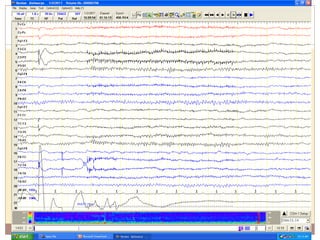
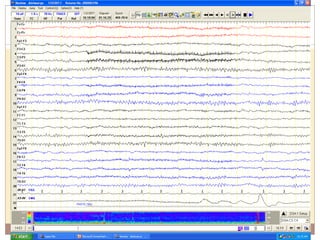
Normal EEG
 Dr. Sachin Adukia
 Dr. Gopal Krishna Dash
Contents
 Introduction
 Descriptors of EEG activity
 Normal EEG (Wakeful adult)
 Normal Sleep EEG
 Benign or normal EEG variants
 Activation procedures
Brief History
 Vladimirovich (1912)
 first animal EEG study (dog)
 Cybulski (1914)
 first EEG recordings of induced seizures
 Berger (1924)
 first human EEG recordings
 'invented' the term electroencephalogram (EEG)
 American EEG Society formed in 1947
 Aserinsky & Kleitman (1953)
 first EEG recordings of REM sleep
Introduction
 What
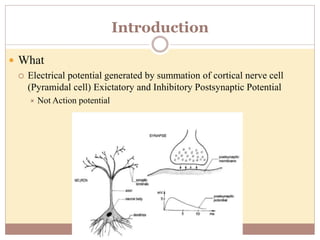
 Electrical potential generated by summation of cortical nerve cell
(Pyramidal cell) Exictatory and Inhibitory Postsynaptic Potential
 Not Action potential
 Generator
 Thalamic pacemaker cells in nucleus reticularis
 Thalamocortical neurons stimulated excitatory impulses to
cortex.
 Tracing
 EEG is difference in voltage between 2 recording electrodes
plotted over time
 EEG recording depends upon differential amplification:
 output - expressed as d/b 2 inputs in an electrode: called a channel.
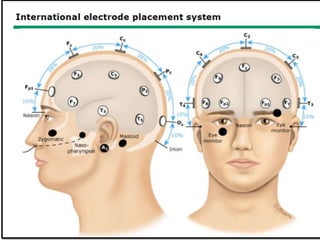
 Typically, 21 or more channels in a montage
 Common average reference
 Each electrode is compared to avg signal from all other electrodes
 Those susceptible to artifact (Fp1, Fp2, O1, O2) are excluded
 Bipolar montage
 each channel consists of comparison of 2 adjacent electrodes
 Transverse bipolar
 Electrode pairs are arranged in a L-R pattern, starting in the front
moving posteriorly
 AKA “coronal” montage
Basic descriptors
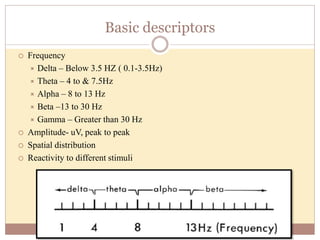
 Frequency
 Delta – Below 3.5 HZ ( 0.1-3.5Hz)
 Theta – 4 to & 7.5Hz
 Alpha – 8 to 13 Hz
 Beta –13 to 30 Hz
 Gamma – Greater than 30 Hz
 Amplitude- uV, peak to peak
 Spatial distribution
 Reactivity to different stimuli
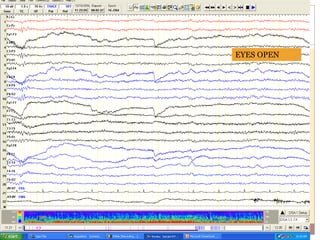
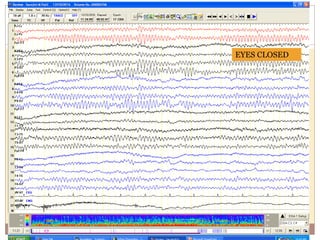
Alpha
 Origin: thalamus, cortex and corticothalamic reverberating circuits
 Frequency of 8-13Hz
 During wakefulness
 Over posterior regions of the head.
 Amplitude < 50µV.
 Best seen with eyes closed and physical and mental relaxation.
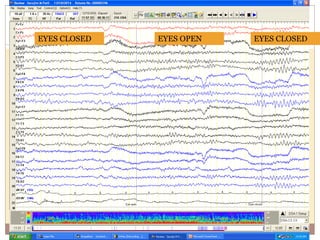
 Attenuated by: Visual or mental effort, eye opening, alerting stimuli.
 Amplitude higher on the right.
 Morphology : rounded or sinusoidal.
 Spatial distribution: Posterior : Occipital, Parietal, posterior temporal.
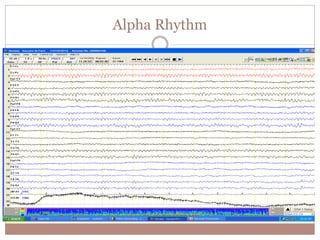
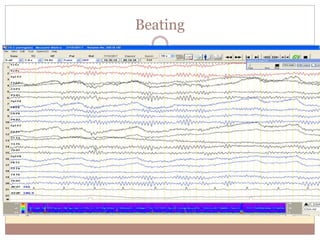
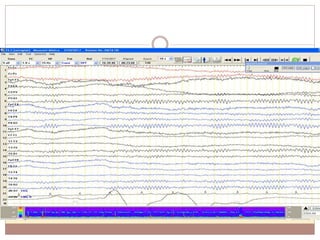
Alpha Rhythm
Beating
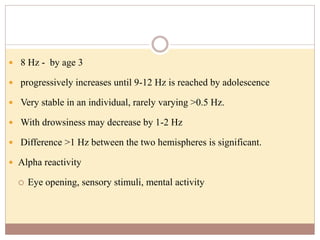
 8 Hz - by age 3
 progressively increases until 9-12 Hz is reached by adolescence
 Very stable in an individual, rarely varying >0.5 Hz.
 With drowsiness may decrease by 1-2 Hz
 Difference >1 Hz between the two hemispheres is significant.
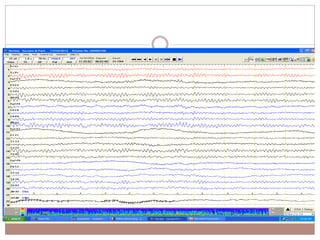
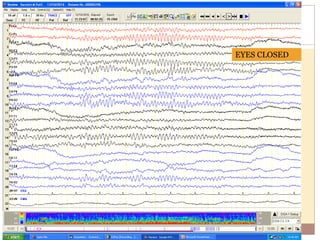
 Alpha reactivity
 Eye opening, sensory stimuli, mental activity
EYES CLOSED
EYES OPEN
EYES CLOSED
EYES CLOSEDEYES CLOSED EYES OPEN
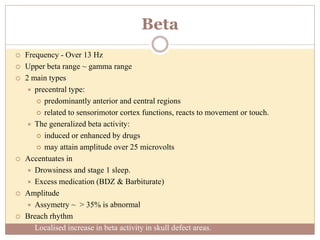
Beta
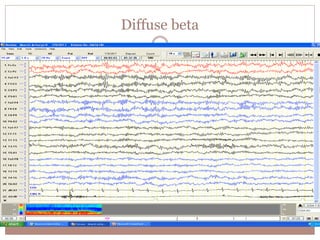
 Frequency - Over 13 Hz
 Upper beta range ~ gamma range
 2 main types
 precentral type:
 predominantly anterior and central regions
 related to sensorimotor cortex functions, reacts to movement or touch.
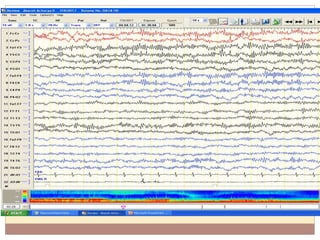
 The generalized beta activity:
 induced or enhanced by drugs
 may attain amplitude over 25 microvolts
 Accentuates in
 Drowsiness and stage 1 sleep.
 Excess medication (BDZ & Barbiturate)
 Amplitude
 Assymetry ~ > 35% is abnormal
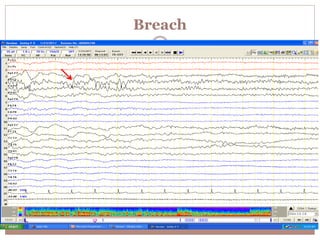
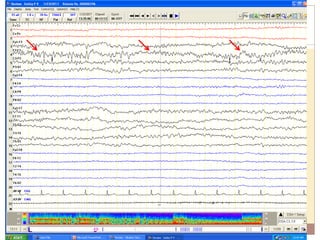
 Breach rhythm
 Localised increase in beta activity in skull defect areas.
Diffuse beta
Breach
Theta
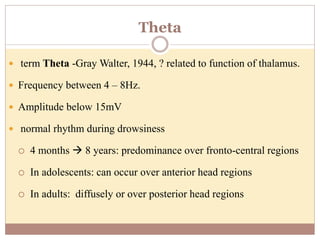
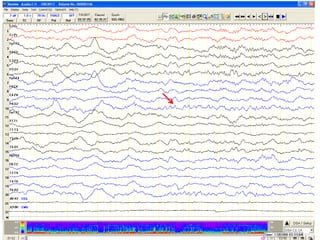
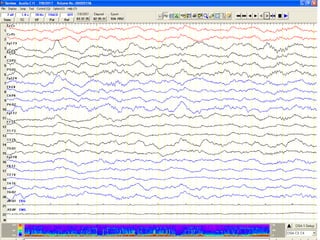
 term Theta -Gray Walter, 1944, ? related to function of thalamus.
 Frequency between 4 – 8Hz.
 Amplitude below 15mV
 normal rhythm during drowsiness
 4 months  8 years: predominance over fronto-central regions
 In adolescents: can occur over anterior head regions
 In adults: diffusely or over posterior head regions
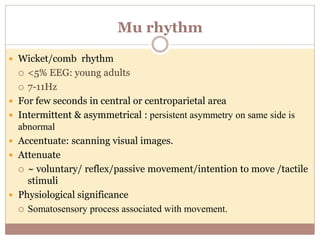
Mu rhythm
 Wicket/comb rhythm
 <5% EEG: young adults
 7-11Hz
 For few seconds in central or centroparietal area
 Intermittent & asymmetrical : persistent asymmetry on same side is
abnormal
 Accentuate: scanning visual images.
 Attenuate
 ~ voluntary/ reflex/passive movement/intention to move /tactile
stimuli
 Physiological significance
 Somatosensory process associated with movement.
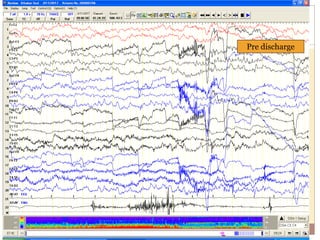
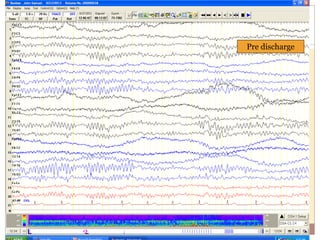
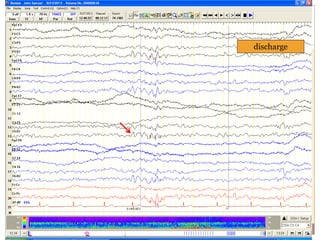
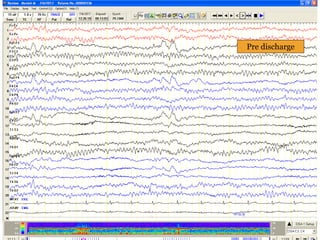
Pre discharge
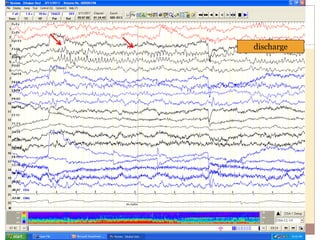
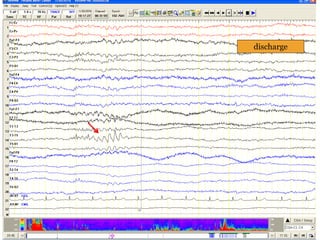
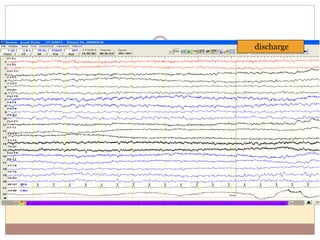
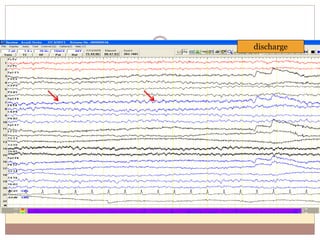
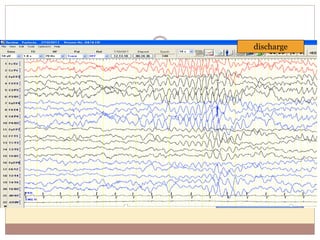
discharge
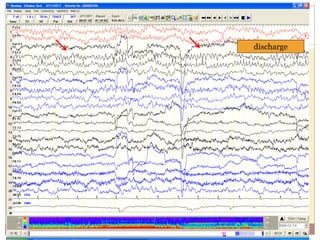
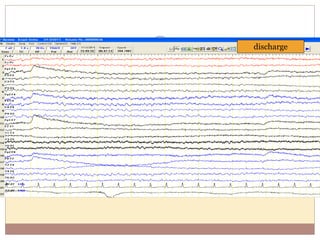
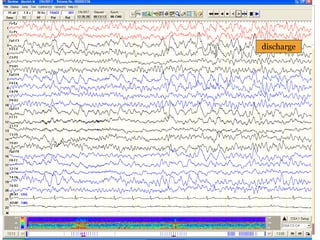
discharge
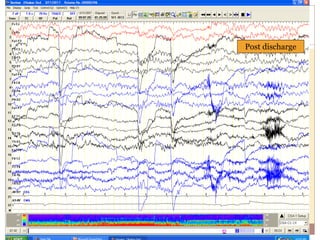
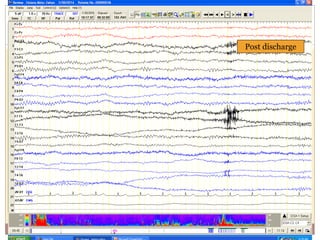
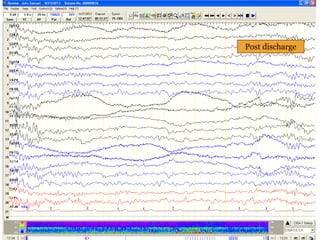
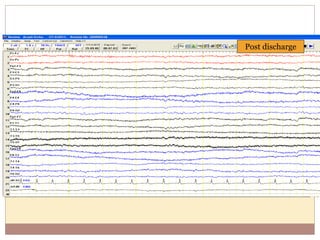
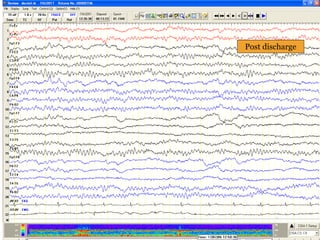
Post discharge
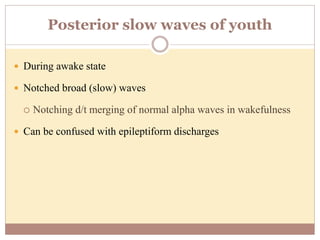
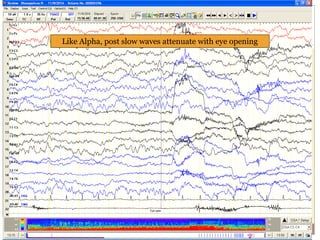
Posterior slow waves of youth
 During awake state
 Notched broad (slow) waves
 Notching d/t merging of normal alpha waves in wakefulness
 Can be confused with epileptiform discharges
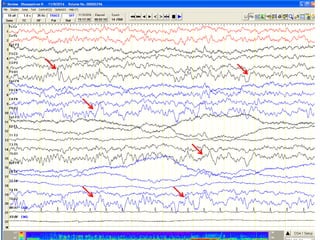
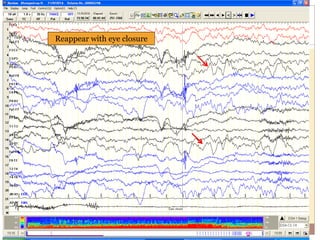
Like Alpha, post slow waves attenuate with eye opening
Reappear with eye closure
Normal sleep EEG (adults)
 Elements of normal sleep activity
 Slow waves
 Positive occipital sharp transients
 Vertex sharp transients
 Sleep spindles
 K complexes
 Sleep stages
 Drowsiness
 II Light sleep
 III Deep sleep
 IV Very deep sleep
 Sleep cycle
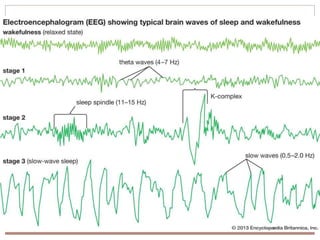
Stage 1
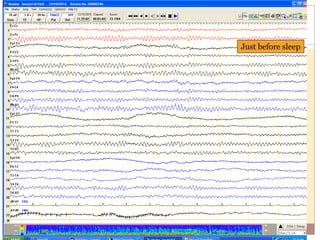
 In adults, most sensitive sign of drowsiness is the
disappearance of eye blinks and slow eye movements
 Slowing, dropout or attenuation of the background
 Occurrence of theta activity over posterior regions
Just before sleep
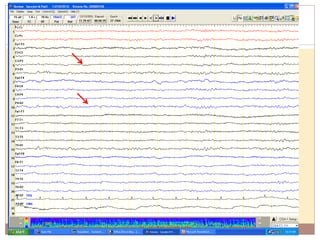
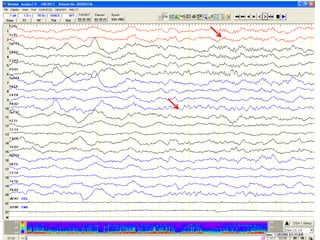
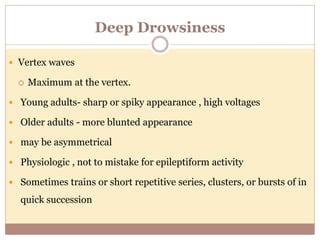
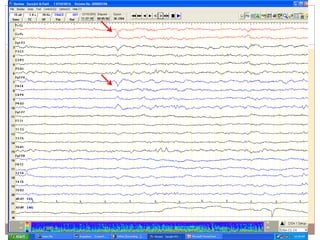
Deep Drowsiness
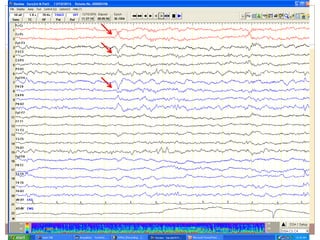
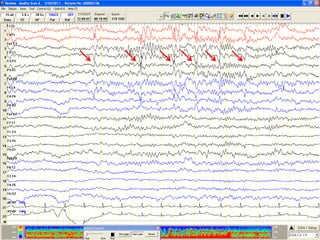
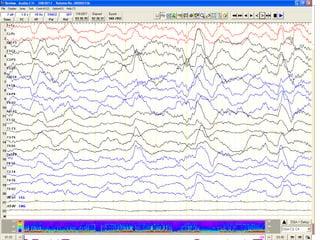
 Vertex waves
 Maximum at the vertex.
 Young adults- sharp or spiky appearance , high voltages
 Older adults - more blunted appearance
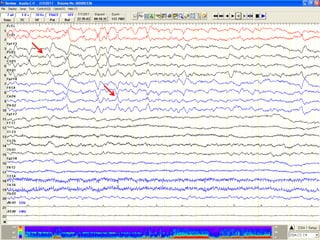
 may be asymmetrical
 Physiologic , not to mistake for epileptiform activity
 Sometimes trains or short repetitive series, clusters, or bursts of in
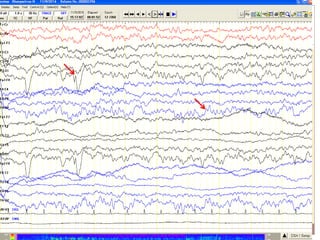
quick succession
Vertex waves may be asymmetrical
Stage 2
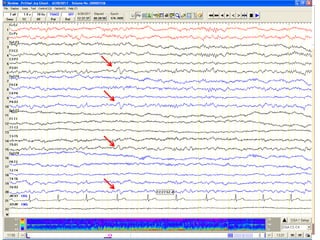
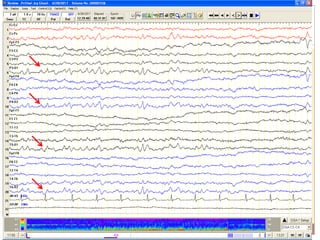
 Positive Occipital Sharp Transients of Sleep (POSTS)
 Sharp-contoured, monophasic, surface-positive transients
 single or in trains of 4-5 Hz over occipital regions
 Similar appearance to lambda waves of awake record
 Usually bilaterally synchronous, may be asymmetric
 Predominantly during drowsiness and light sleep
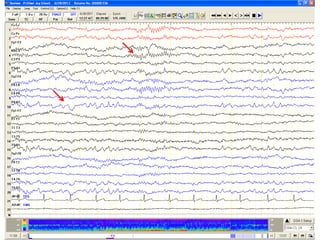
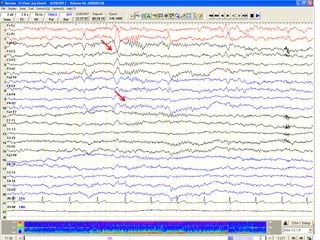
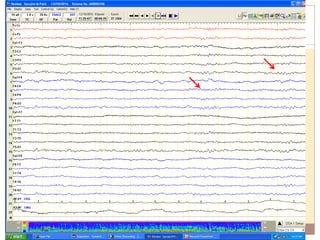
Sleep spindles
 frequency of 13-14 Hz
 symmetric and synchronous
 at intervals of 5-15 seconds
 Spindle trains ranging from 0.5-1.5 sec duration
 prolonged trains or continuous spindle ? Medication: BZP
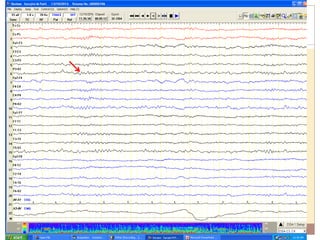
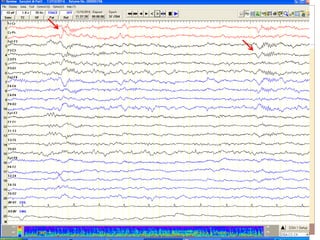
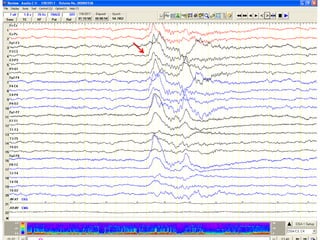
K- complex
 Broad diphasic or polyphasic waveform (>500 msec)
 Seen in Stage II, III, IV NREM sleep.
 Frontal and central region
 Initial sharp component f/b slow component.
 Sharp component is biphasic.
 Slow component represented by large waves followed by
superimposed spindles representing fast component.
 can occur in response to afferent stimulation and may be linked to
an arousal response
Stage 3
 Background activity shows delta frequency (0.7-3Hz).
 Rhythmic 5-9Hz low voltage activity.
 Sleep spindles- less prominent
 K complexes
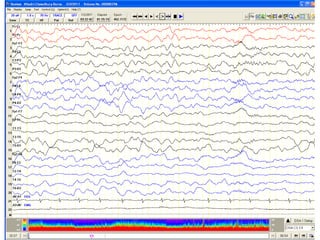
Stage 4
 rarely obtained in routine office EEG
 Prominent Delta activity.
 Sleep spindles and K complexes are rare
Sleep Cycle
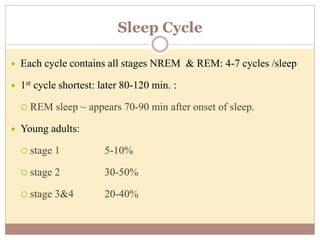
 Each cycle contains all stages NREM & REM: 4-7 cycles /sleep
 1st cycle shortest: later 80-120 min. :
 REM sleep ~ appears 70-90 min after onset of sleep.
 Young adults:
 stage 1 5-10%
 stage 2 30-50%
 stage 3&4 20-40%
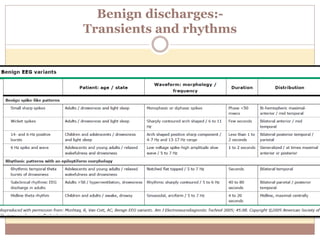
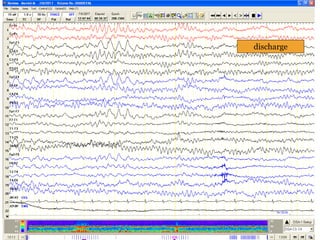
Benign discharges:-
Transients and rhythms
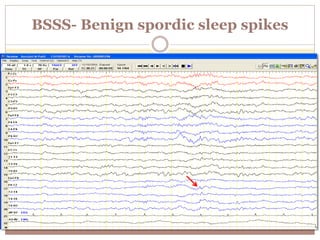
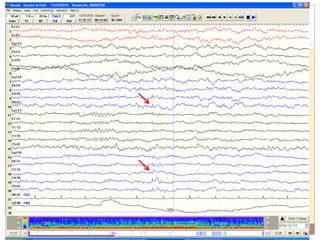
BSSS- Benign spordic sleep spikes
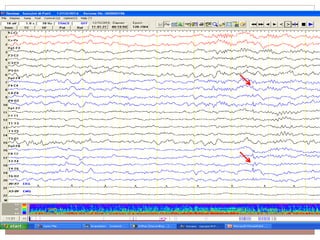
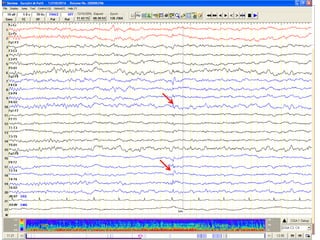
Wicket Spikes
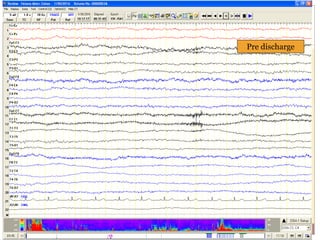
Pre discharge
discharge
Post discharge
14 and 6 spike waves
Pre discharge
discharge
Post discharge
RMTD-
Rhythmic mid-temporal theta discharges
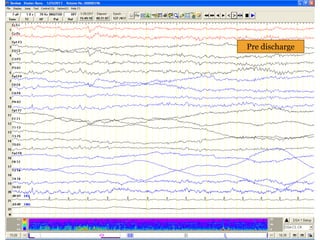
Pre discharge
discharge
Post discharge
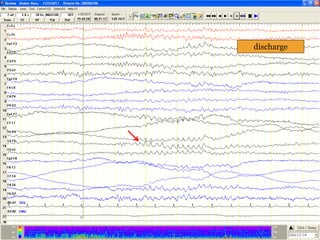
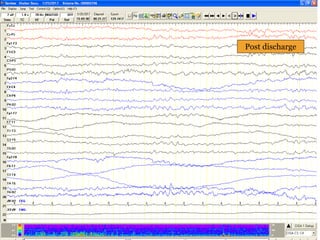
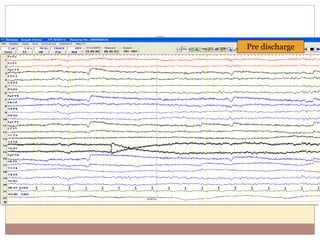
SREDA
Subclinical Rhythmic Electrographic Discharge Of Adults
Pre discharge
discharge
discharge
discharge
Post discharge
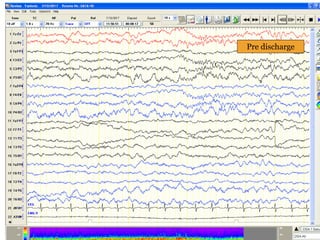
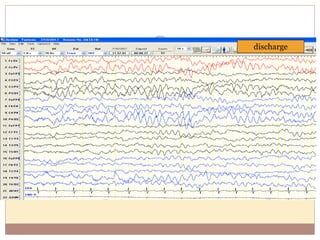
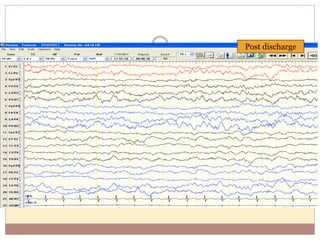
Hypersynchronous hypnogogia
Pre discharge
discharge
Post discharge
discharge
Hyperventilation
 Often produces little change in the EEG in adult
 If there is a change, usually consists of generalized slowing.
 either gradual or abrupt onset in theta or delta range
 may continue as series of rhythmic slow waves or consist of
repeated bursts of slow waves at irregular intervals
Pre discharge
discharge
Post discharge
discharge
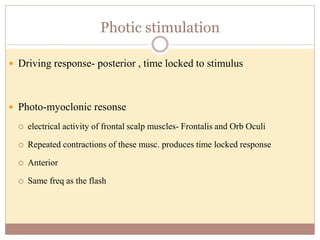
Photic stimulation
 Driving response- posterior , time locked to stimulus
 Photo-myoclonic resonse
 electrical activity of frontal scalp muscles- Frontalis and Orb Oculi
 Repeated contractions of these musc. produces time locked response
 Anterior
 Same freq as the flash
References
 Abou-Khalil B, Misulis KE. Atlas of EEG & seizure
semiology: Text with DVD. Butterworth-Heinemann;
2005 Oct 12.
 Laoprasert P. Atlas of pediatric EEG. McGraw Hill
Professional; 2010 Dec 31.
Thank You

normal eeg

  • 1.
    Normal EEG  Dr.Sachin Adukia  Dr. Gopal Krishna Dash
  • 2.
    Contents  Introduction  Descriptorsof EEG activity  Normal EEG (Wakeful adult)  Normal Sleep EEG  Benign or normal EEG variants  Activation procedures
  • 3.
    Brief History  Vladimirovich(1912)  first animal EEG study (dog)  Cybulski (1914)  first EEG recordings of induced seizures  Berger (1924)  first human EEG recordings  'invented' the term electroencephalogram (EEG)  American EEG Society formed in 1947  Aserinsky & Kleitman (1953)  first EEG recordings of REM sleep
  • 4.
    Introduction  What  Electricalpotential generated by summation of cortical nerve cell (Pyramidal cell) Exictatory and Inhibitory Postsynaptic Potential  Not Action potential
  • 5.
     Generator  Thalamicpacemaker cells in nucleus reticularis  Thalamocortical neurons stimulated excitatory impulses to cortex.  Tracing  EEG is difference in voltage between 2 recording electrodes plotted over time
  • 7.
     EEG recordingdepends upon differential amplification:  output - expressed as d/b 2 inputs in an electrode: called a channel.  Typically, 21 or more channels in a montage  Common average reference  Each electrode is compared to avg signal from all other electrodes  Those susceptible to artifact (Fp1, Fp2, O1, O2) are excluded  Bipolar montage  each channel consists of comparison of 2 adjacent electrodes  Transverse bipolar  Electrode pairs are arranged in a L-R pattern, starting in the front moving posteriorly  AKA “coronal” montage
  • 8.
    Basic descriptors  Frequency Delta – Below 3.5 HZ ( 0.1-3.5Hz)  Theta – 4 to & 7.5Hz  Alpha – 8 to 13 Hz  Beta –13 to 30 Hz  Gamma – Greater than 30 Hz  Amplitude- uV, peak to peak  Spatial distribution  Reactivity to different stimuli
  • 9.
    Alpha  Origin: thalamus,cortex and corticothalamic reverberating circuits  Frequency of 8-13Hz  During wakefulness  Over posterior regions of the head.  Amplitude < 50µV.  Best seen with eyes closed and physical and mental relaxation.  Attenuated by: Visual or mental effort, eye opening, alerting stimuli.  Amplitude higher on the right.  Morphology : rounded or sinusoidal.  Spatial distribution: Posterior : Occipital, Parietal, posterior temporal.
  • 10.
  • 12.
  • 14.
     8 Hz- by age 3  progressively increases until 9-12 Hz is reached by adolescence  Very stable in an individual, rarely varying >0.5 Hz.  With drowsiness may decrease by 1-2 Hz  Difference >1 Hz between the two hemispheres is significant.  Alpha reactivity  Eye opening, sensory stimuli, mental activity
  • 15.
  • 16.
  • 17.
  • 18.
  • 19.
    Beta  Frequency -Over 13 Hz  Upper beta range ~ gamma range  2 main types  precentral type:  predominantly anterior and central regions  related to sensorimotor cortex functions, reacts to movement or touch.  The generalized beta activity:  induced or enhanced by drugs  may attain amplitude over 25 microvolts  Accentuates in  Drowsiness and stage 1 sleep.  Excess medication (BDZ & Barbiturate)  Amplitude  Assymetry ~ > 35% is abnormal  Breach rhythm  Localised increase in beta activity in skull defect areas.
  • 20.
  • 22.
  • 24.
    Theta  term Theta-Gray Walter, 1944, ? related to function of thalamus.  Frequency between 4 – 8Hz.  Amplitude below 15mV  normal rhythm during drowsiness  4 months  8 years: predominance over fronto-central regions  In adolescents: can occur over anterior head regions  In adults: diffusely or over posterior head regions
  • 27.
    Mu rhythm  Wicket/combrhythm  <5% EEG: young adults  7-11Hz  For few seconds in central or centroparietal area  Intermittent & asymmetrical : persistent asymmetry on same side is abnormal  Accentuate: scanning visual images.  Attenuate  ~ voluntary/ reflex/passive movement/intention to move /tactile stimuli  Physiological significance  Somatosensory process associated with movement.
  • 28.
  • 29.
  • 30.
  • 31.
  • 32.
    Posterior slow wavesof youth  During awake state  Notched broad (slow) waves  Notching d/t merging of normal alpha waves in wakefulness  Can be confused with epileptiform discharges
  • 35.
    Like Alpha, postslow waves attenuate with eye opening
  • 36.
  • 37.
    Normal sleep EEG(adults)  Elements of normal sleep activity  Slow waves  Positive occipital sharp transients  Vertex sharp transients  Sleep spindles  K complexes  Sleep stages  Drowsiness  II Light sleep  III Deep sleep  IV Very deep sleep  Sleep cycle
  • 38.
    Stage 1  Inadults, most sensitive sign of drowsiness is the disappearance of eye blinks and slow eye movements  Slowing, dropout or attenuation of the background  Occurrence of theta activity over posterior regions
  • 39.
  • 42.
    Deep Drowsiness  Vertexwaves  Maximum at the vertex.  Young adults- sharp or spiky appearance , high voltages  Older adults - more blunted appearance  may be asymmetrical  Physiologic , not to mistake for epileptiform activity  Sometimes trains or short repetitive series, clusters, or bursts of in quick succession
  • 46.
    Vertex waves maybe asymmetrical
  • 48.
    Stage 2  PositiveOccipital Sharp Transients of Sleep (POSTS)  Sharp-contoured, monophasic, surface-positive transients  single or in trains of 4-5 Hz over occipital regions  Similar appearance to lambda waves of awake record  Usually bilaterally synchronous, may be asymmetric  Predominantly during drowsiness and light sleep
  • 53.
    Sleep spindles  frequencyof 13-14 Hz  symmetric and synchronous  at intervals of 5-15 seconds  Spindle trains ranging from 0.5-1.5 sec duration  prolonged trains or continuous spindle ? Medication: BZP
  • 57.
    K- complex  Broaddiphasic or polyphasic waveform (>500 msec)  Seen in Stage II, III, IV NREM sleep.  Frontal and central region  Initial sharp component f/b slow component.  Sharp component is biphasic.  Slow component represented by large waves followed by superimposed spindles representing fast component.  can occur in response to afferent stimulation and may be linked to an arousal response
  • 59.
    Stage 3  Backgroundactivity shows delta frequency (0.7-3Hz).  Rhythmic 5-9Hz low voltage activity.  Sleep spindles- less prominent  K complexes
  • 60.
    Stage 4  rarelyobtained in routine office EEG  Prominent Delta activity.  Sleep spindles and K complexes are rare
  • 64.
    Sleep Cycle  Eachcycle contains all stages NREM & REM: 4-7 cycles /sleep  1st cycle shortest: later 80-120 min. :  REM sleep ~ appears 70-90 min after onset of sleep.  Young adults:  stage 1 5-10%  stage 2 30-50%  stage 3&4 20-40%
  • 65.
  • 66.
  • 70.
  • 71.
  • 72.
  • 73.
  • 74.
    14 and 6spike waves
  • 75.
  • 76.
  • 77.
  • 78.
  • 79.
  • 80.
  • 81.
  • 82.
  • 83.
  • 84.
  • 85.
  • 86.
  • 87.
  • 88.
  • 89.
  • 90.
  • 91.
  • 92.
  • 93.
    Hyperventilation  Often produceslittle change in the EEG in adult  If there is a change, usually consists of generalized slowing.  either gradual or abrupt onset in theta or delta range  may continue as series of rhythmic slow waves or consist of repeated bursts of slow waves at irregular intervals
  • 94.
  • 95.
  • 96.
  • 97.
  • 98.
    Photic stimulation  Drivingresponse- posterior , time locked to stimulus  Photo-myoclonic resonse  electrical activity of frontal scalp muscles- Frontalis and Orb Oculi  Repeated contractions of these musc. produces time locked response  Anterior  Same freq as the flash
  • 104.
    References  Abou-Khalil B,Misulis KE. Atlas of EEG & seizure semiology: Text with DVD. Butterworth-Heinemann; 2005 Oct 12.  Laoprasert P. Atlas of pediatric EEG. McGraw Hill Professional; 2010 Dec 31.
  • 105.