
1
Supervised by: Dr. Md. Kafiul Islam,
Assistant Professor, EEE, IUB
OUTLINE
 Introduction
 Motivation
 Electrocardiogram (ECG)
 Support vector machine (SVM)
 How SVM works (Linear)
 How SVM works (non-linear)
 Artificial Neural Network (ANN)
 Materials
 Method
 Pre-processing
 Morphological features
 Result and discussion (SVM)
 Comparison with related work
 Result and discussion (ANN)
 Conclusion
 Limitation
 Future work
2
INTRODUCTION
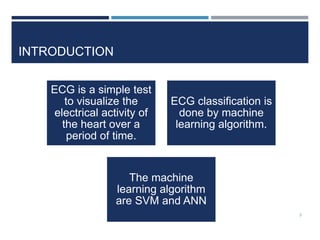
ECG is a simple test
to visualize the
electrical activity of
the heart over a
period of time.
ECG classification is
done by machine
learning algorithm.
The machine
learning algorithm
are SVM and ANN
3
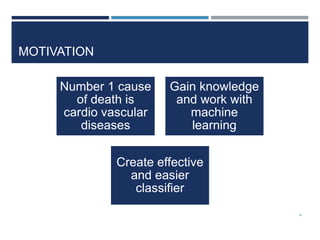
MOTIVATION
Number 1 cause
of death is
cardio vascular
diseases
Gain knowledge
and work with
machine
learning
Create effective
and easier
classifier
4
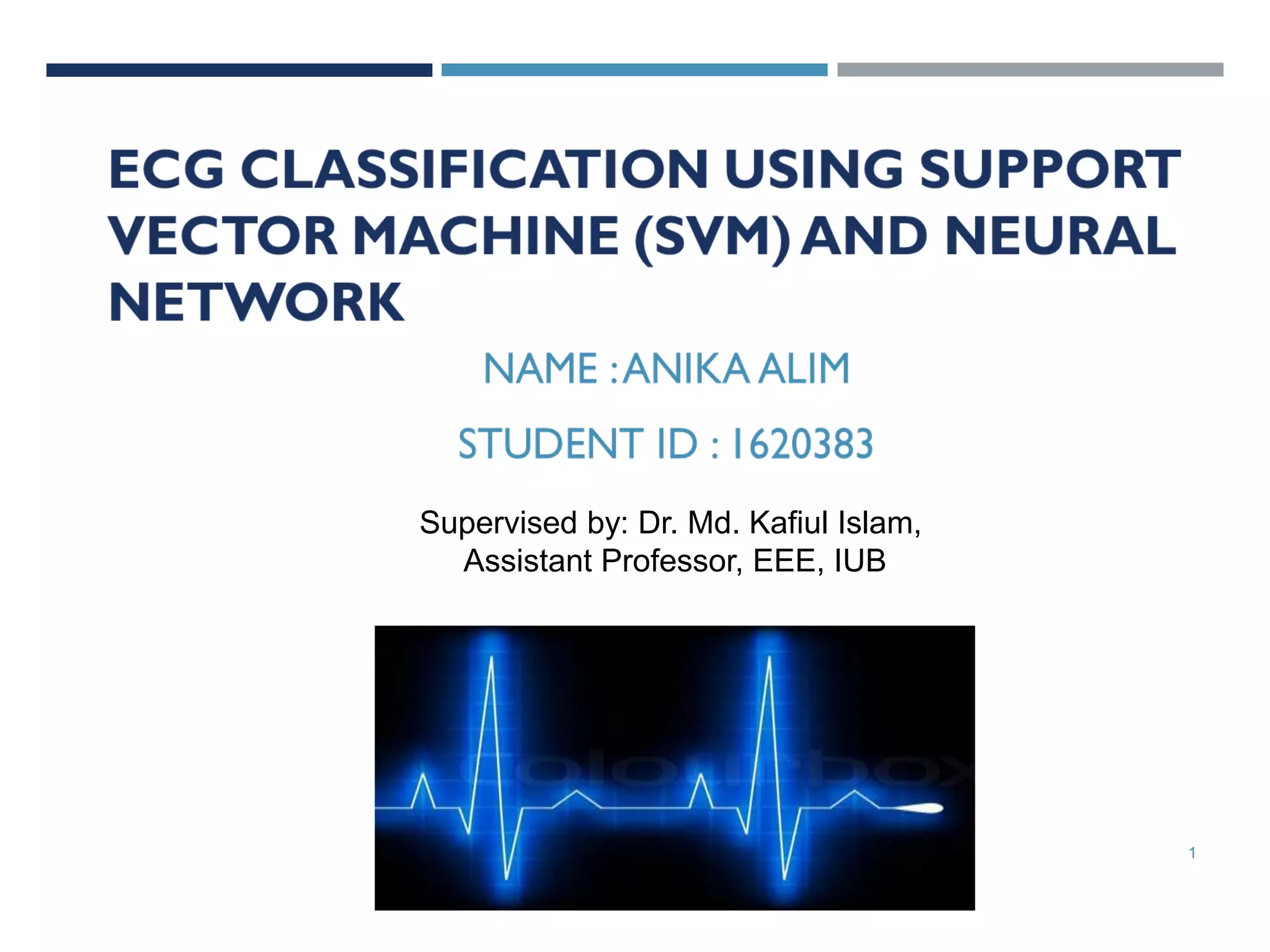
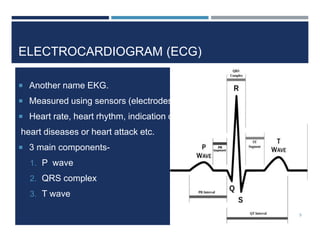
ELECTROCARDIOGRAM (ECG)
 Another name EKG.
 Measured using sensors (electrodes).
 Heart rate, heart rhythm, indication of
heart diseases or heart attack etc.
 3 main components-
1. P wave
2. QRS complex
3. T wave
5
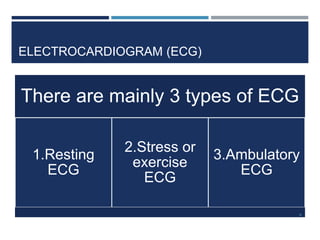
ELECTROCARDIOGRAM (ECG)
There are mainly 3 types of ECG
1.Resting
ECG
2.Stress or
exercise
ECG
3.Ambulatory
ECG
6
SUPPORT VECTOR MACHINE (SVM)
 Supervised machine learning algorithm.
 Commonly use in classification and regression analysis.
Other applications -
 Image classification,
 Text classification,
 Biological science etc.
7
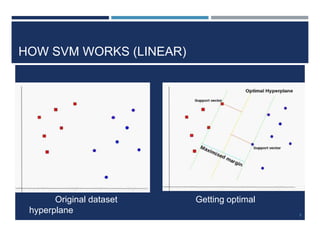
HOW SVM WORKS (LINEAR)
Original dataset Getting optimal
hyperplane 8
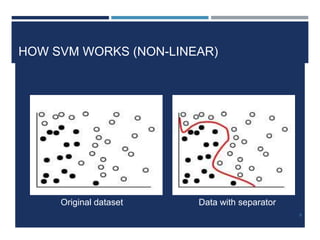
HOW SVM WORKS (NON-LINEAR)
Original dataset Data with separator
9
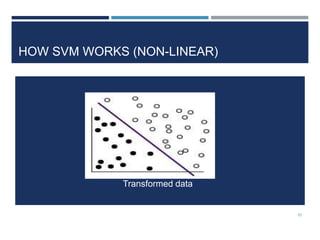
HOW SVM WORKS (NON-LINEAR)
Transformed data
10
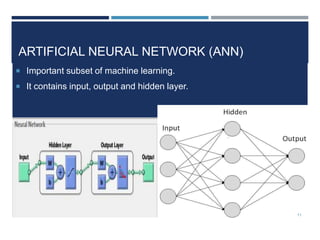
ARTIFICIAL NEURAL NETWORK (ANN)
 Important subset of machine learning.
 It contains input, output and hidden layer.
11
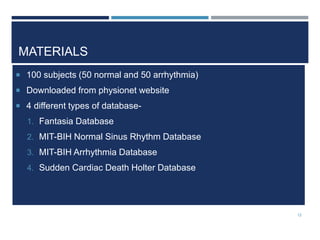
MATERIALS
 100 subjects (50 normal and 50 arrhythmia)
 Downloaded from physionet website
 4 different types of database-
1. Fantasia Database
2. MIT-BIH Normal Sinus Rhythm Database
3. MIT-BIH Arrhythmia Database
4. Sudden Cardiac Death Holter Database
12
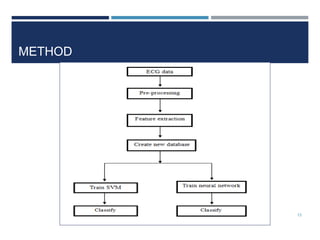
METHOD
13
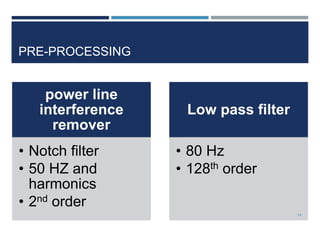
PRE-PROCESSING
power line
interference
remover
• Notch filter
• 50 HZ and
harmonics
• 2nd order
Low pass filter
• 80 Hz
• 128th order
14
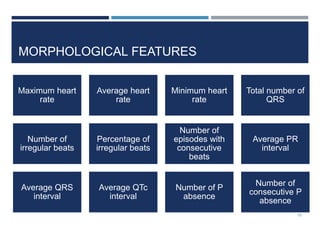
MORPHOLOGICAL FEATURES
Maximum heart
rate
Average heart
rate
Minimum heart
rate
Total number of
QRS
Number of
irregular beats
Percentage of
irregular beats
Number of
episodes with
consecutive
beats
Average PR
interval
Average QRS
interval
Average QTc
interval
Number of P
absence
Number of
consecutive P
absence
15
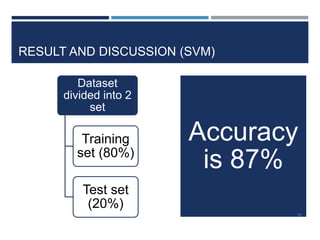
RESULT AND DISCUSSION (SVM)
Dataset
divided into 2
set
Training
set (80%)
Test set
(20%)
Accuracy
is 87%
16
COMPARISON WITH RELATED WORK
Related Project Database Method Accuracy
ECG feature extraction
and classification using
wavelet transform and
support vector machines
MIT-BIH
arrhythmia
2 different feature extraction
methods-The wavelet
transform and
autoregressive modeling
(AR)
99.68%
Domain adaptation
methods for ECG
classification
MIT-BIH
arrhythmia
(divided in 2 set)
Two kinds of features:
1) ECG morphology
features and 2) ECG
wavelet features with
QRS width.
97% and
91%
ECG beat classification
method for ECG printout
with Principle components
analysis and support
vector machines
MIT-BIH
arrhythmia
Discrete wavelet transform
(DWT) and principle
components analysis (PCA)
99.6367%
with LIBSVM
This project
Fantasia, MIT-
BIH normal
sinus rhythm,
MIT-BIH
Morphology Feature
extraction method (12
features) 87%
17
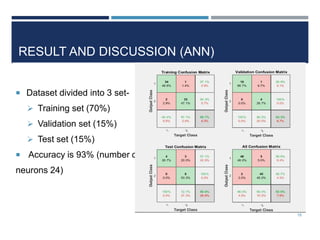
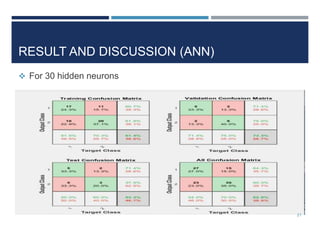
RESULT AND DISCUSSION (ANN)
 Dataset divided into 3 set-
 Training set (70%)
 Validation set (15%)
 Test set (15%)
 Accuracy is 93% (number of
neurons 24)
18
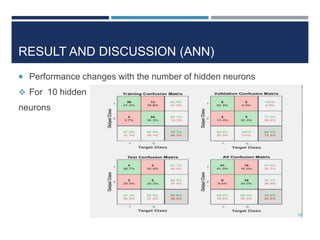
RESULT AND DISCUSSION (ANN)
 Performance changes with the number of hidden neurons
 For 10 hidden
neurons
19
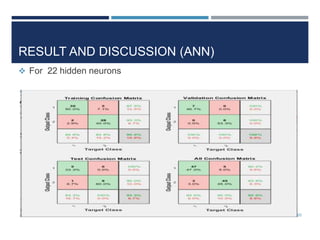
RESULT AND DISCUSSION (ANN)
 For 22 hidden neurons
20
RESULT AND DISCUSSION (ANN)
 For 30 hidden neurons
21
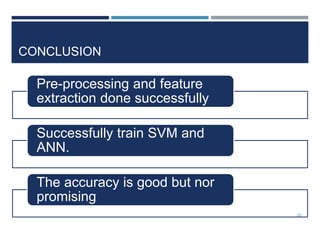
CONCLUSION
Pre-processing and feature
extraction done successfully
Successfully train SVM and
ANN.
The accuracy is good but nor
promising
22
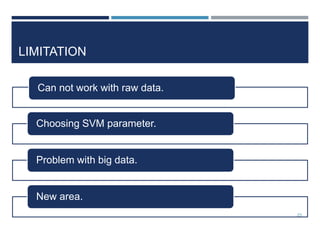
LIMITATION
Can not work with raw data.
Choosing SVM parameter.
Problem with big data.
New area.
23
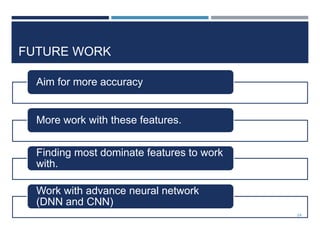
FUTURE WORK
Aim for more accuracy
More work with these features.
Finding most dominate features to work
with.
Work with advance neural network
(DNN and CNN)
24
Thank you
25

ECG Classification using SVM

  • 1.
    1 Supervised by: Dr.Md. Kafiul Islam, Assistant Professor, EEE, IUB
  • 2.
    OUTLINE  Introduction  Motivation Electrocardiogram (ECG)  Support vector machine (SVM)  How SVM works (Linear)  How SVM works (non-linear)  Artificial Neural Network (ANN)  Materials  Method  Pre-processing  Morphological features  Result and discussion (SVM)  Comparison with related work  Result and discussion (ANN)  Conclusion  Limitation  Future work 2
  • 3.
    INTRODUCTION ECG is asimple test to visualize the electrical activity of the heart over a period of time. ECG classification is done by machine learning algorithm. The machine learning algorithm are SVM and ANN 3
  • 4.
    MOTIVATION Number 1 cause ofdeath is cardio vascular diseases Gain knowledge and work with machine learning Create effective and easier classifier 4
  • 5.
    ELECTROCARDIOGRAM (ECG)  Anothername EKG.  Measured using sensors (electrodes).  Heart rate, heart rhythm, indication of heart diseases or heart attack etc.  3 main components- 1. P wave 2. QRS complex 3. T wave 5
  • 6.
    ELECTROCARDIOGRAM (ECG) There aremainly 3 types of ECG 1.Resting ECG 2.Stress or exercise ECG 3.Ambulatory ECG 6
  • 7.
    SUPPORT VECTOR MACHINE(SVM)  Supervised machine learning algorithm.  Commonly use in classification and regression analysis. Other applications -  Image classification,  Text classification,  Biological science etc. 7
  • 8.
    HOW SVM WORKS(LINEAR) Original dataset Getting optimal hyperplane 8
  • 9.
    HOW SVM WORKS(NON-LINEAR) Original dataset Data with separator 9
  • 10.
    HOW SVM WORKS(NON-LINEAR) Transformed data 10
  • 11.
    ARTIFICIAL NEURAL NETWORK(ANN)  Important subset of machine learning.  It contains input, output and hidden layer. 11
  • 12.
    MATERIALS  100 subjects(50 normal and 50 arrhythmia)  Downloaded from physionet website  4 different types of database- 1. Fantasia Database 2. MIT-BIH Normal Sinus Rhythm Database 3. MIT-BIH Arrhythmia Database 4. Sudden Cardiac Death Holter Database 12
  • 13.
  • 14.
    PRE-PROCESSING power line interference remover • Notchfilter • 50 HZ and harmonics • 2nd order Low pass filter • 80 Hz • 128th order 14
  • 15.
    MORPHOLOGICAL FEATURES Maximum heart rate Averageheart rate Minimum heart rate Total number of QRS Number of irregular beats Percentage of irregular beats Number of episodes with consecutive beats Average PR interval Average QRS interval Average QTc interval Number of P absence Number of consecutive P absence 15
  • 16.
    RESULT AND DISCUSSION(SVM) Dataset divided into 2 set Training set (80%) Test set (20%) Accuracy is 87% 16
  • 17.
    COMPARISON WITH RELATEDWORK Related Project Database Method Accuracy ECG feature extraction and classification using wavelet transform and support vector machines MIT-BIH arrhythmia 2 different feature extraction methods-The wavelet transform and autoregressive modeling (AR) 99.68% Domain adaptation methods for ECG classification MIT-BIH arrhythmia (divided in 2 set) Two kinds of features: 1) ECG morphology features and 2) ECG wavelet features with QRS width. 97% and 91% ECG beat classification method for ECG printout with Principle components analysis and support vector machines MIT-BIH arrhythmia Discrete wavelet transform (DWT) and principle components analysis (PCA) 99.6367% with LIBSVM This project Fantasia, MIT- BIH normal sinus rhythm, MIT-BIH Morphology Feature extraction method (12 features) 87% 17
  • 18.
    RESULT AND DISCUSSION(ANN)  Dataset divided into 3 set-  Training set (70%)  Validation set (15%)  Test set (15%)  Accuracy is 93% (number of neurons 24) 18
  • 19.
    RESULT AND DISCUSSION(ANN)  Performance changes with the number of hidden neurons  For 10 hidden neurons 19
  • 20.
    RESULT AND DISCUSSION(ANN)  For 22 hidden neurons 20
  • 21.
    RESULT AND DISCUSSION(ANN)  For 30 hidden neurons 21
  • 22.
    CONCLUSION Pre-processing and feature extractiondone successfully Successfully train SVM and ANN. The accuracy is good but nor promising 22
  • 23.
    LIMITATION Can not workwith raw data. Choosing SVM parameter. Problem with big data. New area. 23
  • 24.
    FUTURE WORK Aim formore accuracy More work with these features. Finding most dominate features to work with. Work with advance neural network (DNN and CNN) 24
  • 25.