Electroencephalogram,
EEG generators
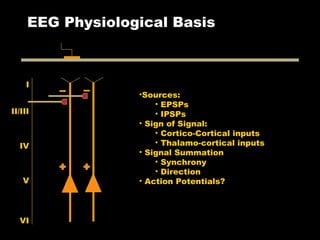
EEG Physiological Basis

I
II/III

IV

V

VI

•Sources:
• EPSPs
• IPSPs
• Sign of Signal:
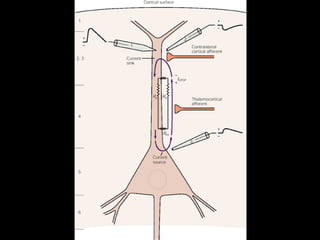
• Cortico-Cortical inputs
• Thalamo-cortical inputs
• Signal Summation
• Synchrony
• Direction
• Action Potentials?
Outline for the session
• History and Introduction
• Concept of field potentials and dipoles
• The net result !!
• Mechanisms of Synchronization
• Modulation of Synchronized rhythms – Why ?
• Summary
Outline for the session
• History and Introduction
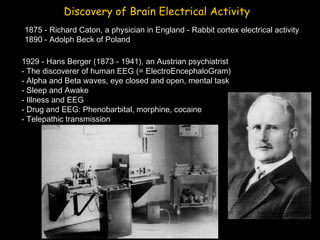
Discovery of Brain Electrical Activity
1875 - Richard Caton, a physician in England - Rabbit cortex electrical activity
1890 - Adolph Beck of Poland
1929 - Hans Berger (1873 - 1941), an Austrian psychiatrist
- The discoverer of human EEG (= ElectroEncephaloGram)
- Alpha and Beta waves, eye closed and open, mental task
- Sleep and Awake
- Illness and EEG
- Drug and EEG: Phenobarbital, morphine, cocaine
- Telepathic transmission
Outline for the session
• History and Introduction
• Concept of field potentials and dipoles
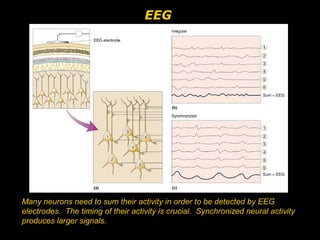
EEG

Many neurons need to sum their activity in order to be detected by EEG
electrodes. The timing of their activity is crucial. Synchronized neural activity
produces larger signals.
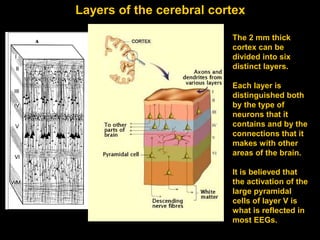
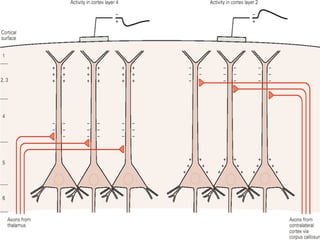
Layers of the cerebral cortex
The 2 mm thick
cortex can be
divided into six
distinct layers.
Each layer is
distinguished both
by the type of
neurons that it
contains and by the
connections that it
makes with other
areas of the brain.
It is believed that
the activation of the
large pyramidal
cells of layer V is
what is reflected in
most EEGs.
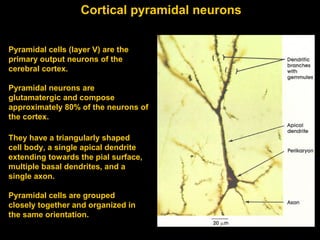
Cortical pyramidal neurons
Pyramidal cells (layer V) are the
primary output neurons of the
cerebral cortex.
Pyramidal neurons are
glutamatergic and compose
approximately 80% of the neurons of
the cortex.
They have a triangularly shaped
cell body, a single apical dendrite
extending towards the pial surface,
multiple basal dendrites, and a
single axon.
Pyramidal cells are grouped
closely together and organized in
the same orientation.
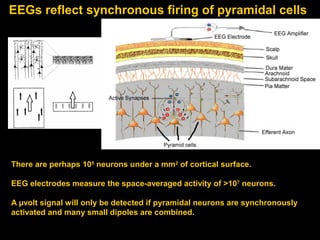
EEGs reflect synchronous firing of pyramidal cells

There are perhaps 105 neurons under a mm2 of cortical surface.
EEG electrodes measure the space-averaged activity of >107 neurons.
A µvolt signal will only be detected if pyramidal neurons are synchronously
activated and many small dipoles are combined.
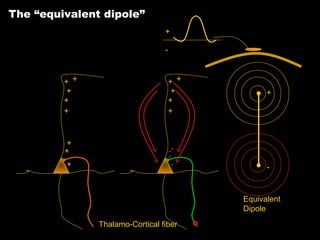
The “equivalent dipole”
+
-

+ +
+
+
+

+
+
+

+ +
+
+
+

--

+

-

Equivalent
Dipole
Thalamo-Cortical fiber
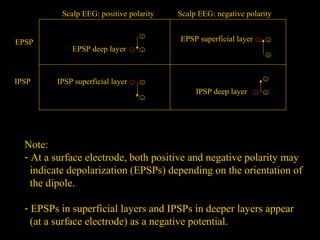
Scalp EEG: positive polarity
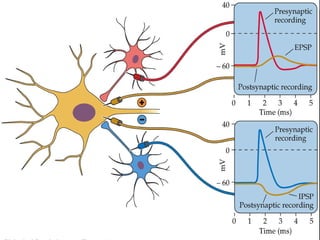
EPSP

IPSP

+

EPSP deep layer

+

-

EPSP superficial layer

+

+

-

-

IPSP superficial layer

Scalp EEG: negative polarity

-

+

-

IPSP deep layer

-

+

Note:
- At a surface electrode, both positive and negative polarity may
indicate depolarization (EPSPs) depending on the orientation of
the dipole.
- EPSPs in superficial layers and IPSPs in deeper layers appear
(at a surface electrode) as a negative potential.
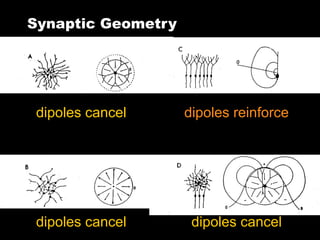
Synaptic Geometry

dipoles cancel

dipoles reinforce

dipoles cancel

dipoles cancel
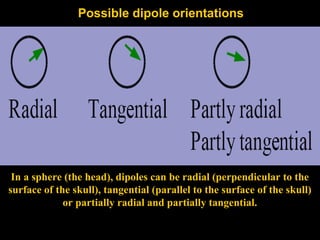
Possible dipole orientations

In a sphere (the head), dipoles can be radial (perpendicular to the
surface of the skull), tangential (parallel to the surface of the skull)
or partially radial and partially tangential.
detectable
electrical field

undetectable
electrical field

undetectable
magnetic field

detectable
magnetic field

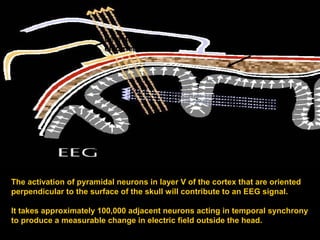
The activation of pyramidal neurons in layer V of the cortex that are oriented
perpendicular to the surface of the skull will contribute to an EEG signal.
It takes approximately 100,000 adjacent neurons acting in temporal synchrony
to produce a measurable change in electric field outside the head.
Outline for the session
• History and Introduction
• Concept of field potentials and dipoles
• The net result !!
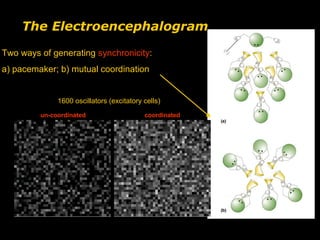
The Electroencephalogram
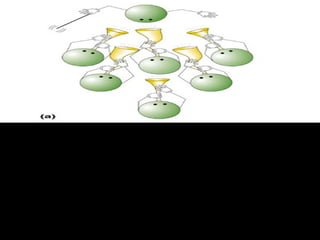
Two ways of generating synchronicity:
a) pacemaker; b) mutual coordination

1600 oscillators (excitatory cells)
un-coordinated

coordinated
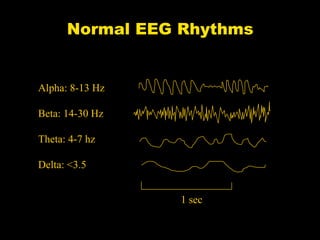
Normal EEG Rhythms

Alpha: 8-13 Hz
Beta: 14-30 Hz
Theta: 4-7 hz
Delta: <3.5
1 sec
Outline for the session
• History and Introduction
• Concept of field potentials and dipoles
• The net result !!
• Mechanisms of Synchronization
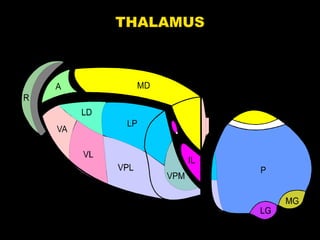
THALAMUS
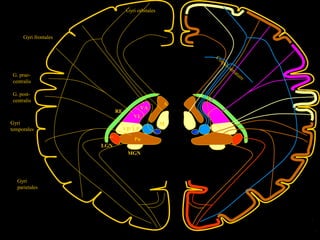
Gyri orbitales

Gyri frontales

Co
rp
u

G. praecentralis
G. postcentralis
RE
Gyri
temporales

VA
VL
VP LP
Pu

LGN
MGN

Gyri
parietales

A

M

ss

tri

atu

m
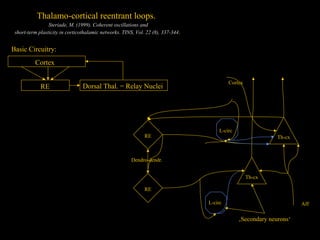
Thalamo-cortical reentrant loops.
Steriade, M. (1999). Coherent oscillations and
short-term plasticity in corticothalamic networks. TINS, Vol. 22 (8), 337-344.

Basic Circuitry:
Cortex
RE

Cortex

Dorsal Thal. = Relay Nuclei

RE

L-circ
Th-cx

Dendro-dendr.
Th-cx
RE
L-circ

Aff

‚Secondary neurons‘
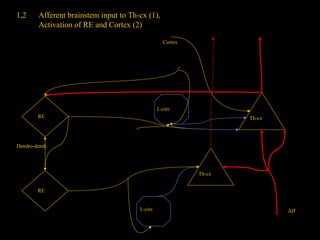
1,2

Afferent brainstem input to Th-cx (1),
Activation of RE and Cortex (2)
Cortex

L-circ
RE

Th-cx

Dendro-dendr.

Th-cx
RE
L-circ

Aff
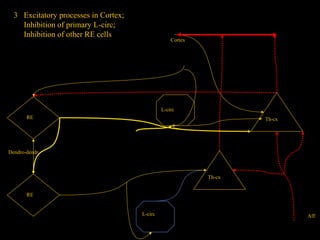
3 Excitatory processes in Cortex;
Inhibition of primary L-circ;
Inhibition of other RE cells

Cortex

L-circ
RE

Th-cx

Dendro-dendr.

Th-cx
RE

L-circ

Aff
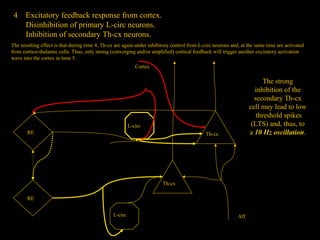
4

Excitatory feedback response from cortex.
Disinhibition of primary L-circ neurons.
Inhibition of secondary Th-cx neurons.

The resulting effect is that during time 4, Th-cx are again under inhibitory control from L-circ neurons and, at the same time are activated
from cortico-thalamic cells. Thus, only strong (converging and/or amplified) cortical feedback will trigger another excitatory activation
wave into the cortex in time 5.
Cortex

The strong
inhibition of the
secondary Th-cx
cell may lead to low
threshold spikes
(LTS) and, thus, to
a 10 Hz oscillation.

L-circ
RE

Th-cx

Th-cx
RE
L-circ

Aff
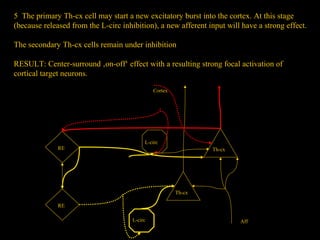
5 The primary Th-cx cell may start a new excitatory burst into the cortex. At this stage
(because released from the L-circ inhibition), a new afferent input will have a strong effect.
The secondary Th-cx cells remain under inhibition
RESULT: Center-surround ‚on-off‘ effect with a resulting strong focal activation of
cortical target neurons.
Cortex

RE

L-circ
Th-cx

Th-cx
RE
L-circ

Aff
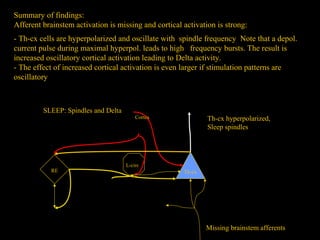
Summary of findings:
Afferent brainstem activation is missing and cortical activation is strong:
- Th-cx cells are hyperpolarized and oscillate with spindle frequency Note that a depol.
current pulse during maximal hyperpol. leads to high frequency bursts. The result is
increased oscillatory cortical activation leading to Delta activity.
- The effect of increased cortical activation is even larger if stimulation patterns are
oscillatory

SLEEP: Spindles and Delta

RE

Cortex

Th-cx hyperpolarized,
Sleep spindles

L-circ
Th-cx

Missing brainstem afferents
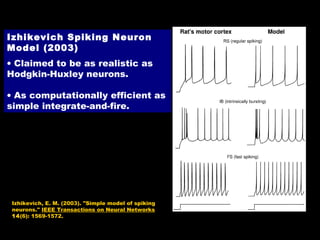
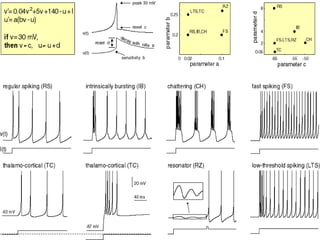
Izhikevich Spiking Neuron
Model (2003)
• Claimed to be as realistic as
Hodgkin-Huxley neurons.
• As computationally efficient as
simple integrate-and-fire.

Izhikevich, E. M. (2003). "Simple model of spiking
neurons." IEEE Transactions on Neural Networks
14(6): 1569-1572.
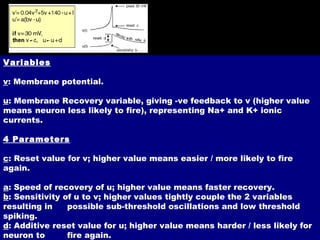
Variables
v: Membrane potential.
u: Membrane Recovery variable, giving -ve feedback to v (higher value
means neuron less likely to fire), representing Na+ and K+ ionic
currents.
4 Parameters
c: Reset value for v; higher value means easier / more likely to fire
again.
a: Speed of recovery of u; higher value means faster recovery.
b: Sensitivity of u to v; higher values tightly couple the 2 variables
resulting in
possible sub-threshold oscillations and low threshold
spiking.
d: Additive reset value for u; higher value means harder / less likely for
neuron to
fire again.
Figure 3.15 Two Representations of Neural Circuitry (Part 2)
Outline for the session
• History and Introduction
• Concept of field potentials and dipoles
• The net result !!
• Mechanisms of Synchronization
• Modulation of Synchronized rhythms – Why ?
Why do we need so many
oscillations ?
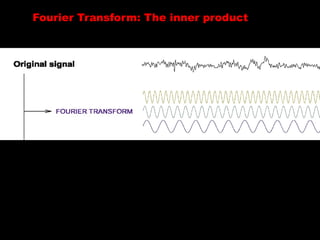
Fourier Transform: The inner product

Rodrigo Quian Quiroga
Sloan-Swartz Center for Theoretical Neurobiology
California Institute of Technology
http://www.vis.caltech.edu/~rodri
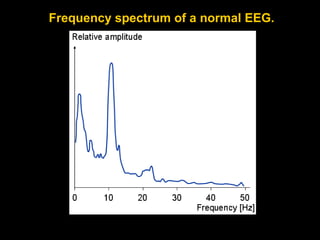
Frequency spectrum of a normal EEG.
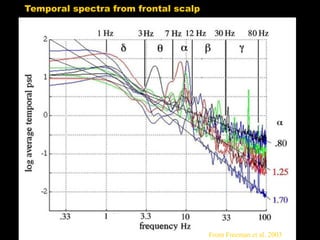
Temporal spectra from frontal scalp

From Freeman et al. 2003
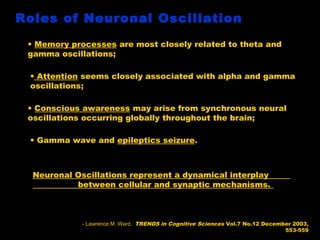
Roles of Neuronal Oscillation
• Memory processes are most closely related to theta and
gamma oscillations;
• Attention seems closely associated with alpha and gamma
oscillations;
• Conscious awareness may arise from synchronous neural
oscillations occurring globally throughout the brain;
• Gamma wave and epileptics seizure.

Neuronal Oscillations represent a dynamical interplay
between cellular and synaptic mechanisms.

- Lawrence M. Ward, TRENDS in Cognitive Sciences Vol.7 No.12 December 2003,
553-559
Rhythmic activity appears to play a major role in
information processing in the brain

Object recognition
Feature extraction/abstraction
Associative learning
Selective attention
Novelty detection
Outline for the session
• History and Introduction
• Concept of field potentials and dipoles
• The net result !!
• Mechanisms of Synchronization
• Modulation of Synchronized rhythms – Why ?
• Summary
To summarize…
• Alpha rhythm
• Spindles
• Delta rhythm
• Theta rhythm

• Beta, gamma rhythm
EEG Generators

EEG Generators

  • 1.
  • 2.
    EEG Physiological Basis I II/III IV V VI •Sources: •EPSPs • IPSPs • Sign of Signal: • Cortico-Cortical inputs • Thalamo-cortical inputs • Signal Summation • Synchrony • Direction • Action Potentials?
  • 3.
    Outline for thesession • History and Introduction • Concept of field potentials and dipoles • The net result !! • Mechanisms of Synchronization • Modulation of Synchronized rhythms – Why ? • Summary
  • 4.
    Outline for thesession • History and Introduction
  • 5.
    Discovery of BrainElectrical Activity 1875 - Richard Caton, a physician in England - Rabbit cortex electrical activity 1890 - Adolph Beck of Poland 1929 - Hans Berger (1873 - 1941), an Austrian psychiatrist - The discoverer of human EEG (= ElectroEncephaloGram) - Alpha and Beta waves, eye closed and open, mental task - Sleep and Awake - Illness and EEG - Drug and EEG: Phenobarbital, morphine, cocaine - Telepathic transmission
  • 6.
    Outline for thesession • History and Introduction • Concept of field potentials and dipoles
  • 7.
    EEG Many neurons needto sum their activity in order to be detected by EEG electrodes. The timing of their activity is crucial. Synchronized neural activity produces larger signals.
  • 8.
    Layers of thecerebral cortex The 2 mm thick cortex can be divided into six distinct layers. Each layer is distinguished both by the type of neurons that it contains and by the connections that it makes with other areas of the brain. It is believed that the activation of the large pyramidal cells of layer V is what is reflected in most EEGs.
  • 9.
    Cortical pyramidal neurons Pyramidalcells (layer V) are the primary output neurons of the cerebral cortex. Pyramidal neurons are glutamatergic and compose approximately 80% of the neurons of the cortex. They have a triangularly shaped cell body, a single apical dendrite extending towards the pial surface, multiple basal dendrites, and a single axon. Pyramidal cells are grouped closely together and organized in the same orientation.
  • 10.
    EEGs reflect synchronousfiring of pyramidal cells There are perhaps 105 neurons under a mm2 of cortical surface. EEG electrodes measure the space-averaged activity of >107 neurons. A µvolt signal will only be detected if pyramidal neurons are synchronously activated and many small dipoles are combined.
  • 13.
    The “equivalent dipole” + - ++ + + + + + + + + + + + -- + - Equivalent Dipole Thalamo-Cortical fiber
  • 15.
    Scalp EEG: positivepolarity EPSP IPSP + EPSP deep layer + - EPSP superficial layer + + - - IPSP superficial layer Scalp EEG: negative polarity - + - IPSP deep layer - + Note: - At a surface electrode, both positive and negative polarity may indicate depolarization (EPSPs) depending on the orientation of the dipole. - EPSPs in superficial layers and IPSPs in deeper layers appear (at a surface electrode) as a negative potential.
  • 16.
    Synaptic Geometry dipoles cancel dipolesreinforce dipoles cancel dipoles cancel
  • 17.
    Possible dipole orientations Ina sphere (the head), dipoles can be radial (perpendicular to the surface of the skull), tangential (parallel to the surface of the skull) or partially radial and partially tangential.
  • 18.
    detectable electrical field undetectable electrical field undetectable magneticfield detectable magnetic field The activation of pyramidal neurons in layer V of the cortex that are oriented perpendicular to the surface of the skull will contribute to an EEG signal. It takes approximately 100,000 adjacent neurons acting in temporal synchrony to produce a measurable change in electric field outside the head.
  • 19.
    Outline for thesession • History and Introduction • Concept of field potentials and dipoles • The net result !!
  • 20.
    The Electroencephalogram Two waysof generating synchronicity: a) pacemaker; b) mutual coordination 1600 oscillators (excitatory cells) un-coordinated coordinated
  • 21.
    Normal EEG Rhythms Alpha:8-13 Hz Beta: 14-30 Hz Theta: 4-7 hz Delta: <3.5 1 sec
  • 22.
    Outline for thesession • History and Introduction • Concept of field potentials and dipoles • The net result !! • Mechanisms of Synchronization
  • 24.
  • 25.
    Gyri orbitales Gyri frontales Co rp u G.praecentralis G. postcentralis RE Gyri temporales VA VL VP LP Pu LGN MGN Gyri parietales A M ss tri atu m
  • 26.
    Thalamo-cortical reentrant loops. Steriade,M. (1999). Coherent oscillations and short-term plasticity in corticothalamic networks. TINS, Vol. 22 (8), 337-344. Basic Circuitry: Cortex RE Cortex Dorsal Thal. = Relay Nuclei RE L-circ Th-cx Dendro-dendr. Th-cx RE L-circ Aff ‚Secondary neurons‘
  • 27.
    1,2 Afferent brainstem inputto Th-cx (1), Activation of RE and Cortex (2) Cortex L-circ RE Th-cx Dendro-dendr. Th-cx RE L-circ Aff
  • 28.
    3 Excitatory processesin Cortex; Inhibition of primary L-circ; Inhibition of other RE cells Cortex L-circ RE Th-cx Dendro-dendr. Th-cx RE L-circ Aff
  • 29.
    4 Excitatory feedback responsefrom cortex. Disinhibition of primary L-circ neurons. Inhibition of secondary Th-cx neurons. The resulting effect is that during time 4, Th-cx are again under inhibitory control from L-circ neurons and, at the same time are activated from cortico-thalamic cells. Thus, only strong (converging and/or amplified) cortical feedback will trigger another excitatory activation wave into the cortex in time 5. Cortex The strong inhibition of the secondary Th-cx cell may lead to low threshold spikes (LTS) and, thus, to a 10 Hz oscillation. L-circ RE Th-cx Th-cx RE L-circ Aff
  • 30.
    5 The primaryTh-cx cell may start a new excitatory burst into the cortex. At this stage (because released from the L-circ inhibition), a new afferent input will have a strong effect. The secondary Th-cx cells remain under inhibition RESULT: Center-surround ‚on-off‘ effect with a resulting strong focal activation of cortical target neurons. Cortex RE L-circ Th-cx Th-cx RE L-circ Aff
  • 31.
    Summary of findings: Afferentbrainstem activation is missing and cortical activation is strong: - Th-cx cells are hyperpolarized and oscillate with spindle frequency Note that a depol. current pulse during maximal hyperpol. leads to high frequency bursts. The result is increased oscillatory cortical activation leading to Delta activity. - The effect of increased cortical activation is even larger if stimulation patterns are oscillatory SLEEP: Spindles and Delta RE Cortex Th-cx hyperpolarized, Sleep spindles L-circ Th-cx Missing brainstem afferents
  • 33.
    Izhikevich Spiking Neuron Model(2003) • Claimed to be as realistic as Hodgkin-Huxley neurons. • As computationally efficient as simple integrate-and-fire. Izhikevich, E. M. (2003). "Simple model of spiking neurons." IEEE Transactions on Neural Networks 14(6): 1569-1572.
  • 35.
    Variables v: Membrane potential. u:Membrane Recovery variable, giving -ve feedback to v (higher value means neuron less likely to fire), representing Na+ and K+ ionic currents. 4 Parameters c: Reset value for v; higher value means easier / more likely to fire again. a: Speed of recovery of u; higher value means faster recovery. b: Sensitivity of u to v; higher values tightly couple the 2 variables resulting in possible sub-threshold oscillations and low threshold spiking. d: Additive reset value for u; higher value means harder / less likely for neuron to fire again.
  • 36.
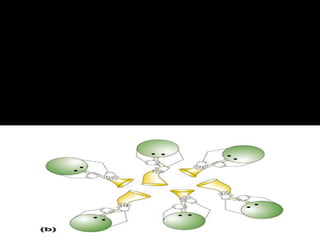
    Figure 3.15 TwoRepresentations of Neural Circuitry (Part 2)
  • 37.
    Outline for thesession • History and Introduction • Concept of field potentials and dipoles • The net result !! • Mechanisms of Synchronization • Modulation of Synchronized rhythms – Why ?
  • 38.
    Why do weneed so many oscillations ?
  • 39.
    Fourier Transform: Theinner product Rodrigo Quian Quiroga Sloan-Swartz Center for Theoretical Neurobiology California Institute of Technology http://www.vis.caltech.edu/~rodri
  • 40.
    Frequency spectrum ofa normal EEG.
  • 41.
    Temporal spectra fromfrontal scalp From Freeman et al. 2003
  • 42.
    Roles of NeuronalOscillation • Memory processes are most closely related to theta and gamma oscillations; • Attention seems closely associated with alpha and gamma oscillations; • Conscious awareness may arise from synchronous neural oscillations occurring globally throughout the brain; • Gamma wave and epileptics seizure. Neuronal Oscillations represent a dynamical interplay between cellular and synaptic mechanisms. - Lawrence M. Ward, TRENDS in Cognitive Sciences Vol.7 No.12 December 2003, 553-559
  • 43.
    Rhythmic activity appearsto play a major role in information processing in the brain Object recognition Feature extraction/abstraction Associative learning Selective attention Novelty detection
  • 44.
    Outline for thesession • History and Introduction • Concept of field potentials and dipoles • The net result !! • Mechanisms of Synchronization • Modulation of Synchronized rhythms – Why ? • Summary
  • 45.
    To summarize… • Alpharhythm • Spindles • Delta rhythm • Theta rhythm • Beta, gamma rhythm

Editor's Notes

  • #34 Diagram reproduced from Izhikevich (2003) without permission Shows close resemblance of model spike trains to real recorded neurons
  • #35 Diagram reproduced from Izhikevich (2003) with permission available from his website Shows what parameter values equate to which spiking behaviour. Input I(t) is shown below each spike train v(t). TC neurons have input above and below the baseline RS, IB, CH are cortical excitatory neurons and have equal (a,b) values, ie they vary only in their reset values (c,d) FS, LTS are cortical inhibitory with the same reset values (c,d), ie vary only in their scaling/recovery values (a,b) RZ is bistable – the initiating pulse must be timed correctly with the subthreshold oscillations
  • #36 Parameter c (reset value after a spike) is the only parameter that directly affects v c and d are reset values a and b are scaling values
  • #40 We introduce the first method of analysis of EEGs, the Fourier transform. It can be seen as the inner product of the signal with sinusoids of different frequencies. This gives a representation of the signal in the frequency domain. The problem of Fourier is that it has no time resolution. Moreover it assumes stationarity.
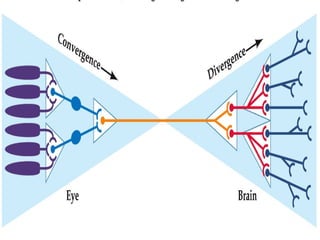
  • #42 The occurrence of wave sequences in the EEG time series is accompanied by peaks in the PSDt that provide the basis for labeling the waves in time series. The 1/fa form of the spectra is revealed in log log coordinates. The slopes of the spectra are highly variable between subjects and areas of scalp. These are spectra from the frontal area of nine subjects at rest with eyes closed. Intracranial spectra have the same form but steeper slopes.