Design and Implementation of
a Real-Time Vein Imaging
SALWAAARA KHAN - 1530707
TADIB CHOWDHURY - 1621553
Department of Electrical and
Electronic Engineering
Independent University, Bangladesh SUPERVISOR - DR. MD. KAFIUL ISLAM
Table of content
 Motivation
 Goals
 Background
 Objective
 Research Methodology
 Working Principle of the System
 System Analysis
 Prototype Testing
 Practical Usage
 Real-life Implementation
 Result Analysis
 Cost Analysis
 Limitations
 Future Works
 Conclusion
1
Motivation
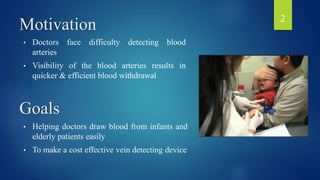
• Doctors face difficulty detecting blood
arteries
• Visibility of the blood arteries results in
quicker & efficient blood withdrawal
• Helping doctors draw blood from infants and
elderly patients easily
• To make a cost effective vein detecting device
Goals
2
Background
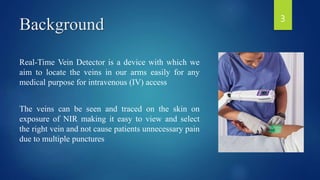
Real-Time Vein Detector is a device with which we
aim to locate the veins in our arms easily for any
medical purpose for intravenous (IV) access
The veins can be seen and traced on the skin on
exposure of NIR making it easy to view and select
the right vein and not cause patients unnecessary pain
due to multiple punctures
3
Background
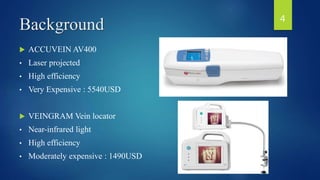
 ACCUVEIN AV400
• Laser projected
• High efficiency
• Very Expensive : 5540USD
 VEINGRAM Vein locator
• Near-infrared light
• High efficiency
• Moderately expensive : 1490USD
4
Objective
Constructing a vein detecting system
• Portable
• User friendly
• Cost effective
• Low Radiation & less harmful
5
Research Methodology
Initial steps of the project
6
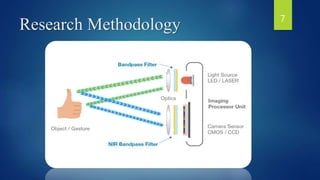
Research Methodology 7
Research Methodology
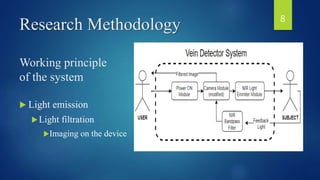
Working principle
of the system
 Light emission
Light filtration
Imaging on the device
8
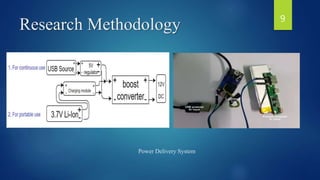
Research Methodology
Power Delivery System
9
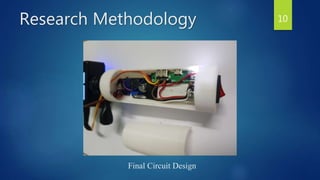
Research Methodology
Final Circuit Design
10
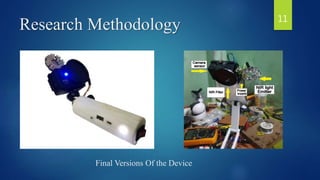
Research Methodology
Final Versions Of the Device
11
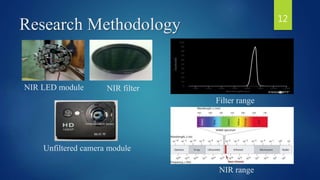
Research Methodology
Filter range
NIR range
NIR LED module NIR filter
Unfiltered camera module
12
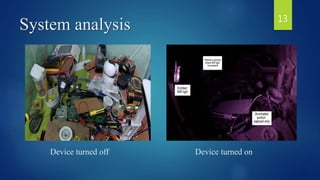
System analysis
Device turned off Device turned on
13
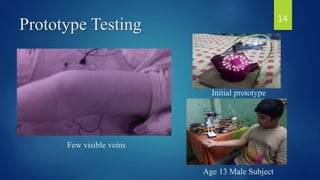
Prototype Testing
Few visible veins
Initial prototype
Age 13 Male Subject
14
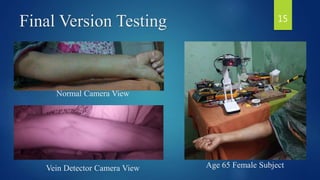
Final Version Testing
Normal Camera View
Vein Detector Camera View Age 65 Female Subject
15
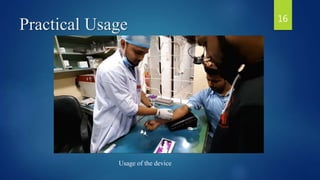
Practical Usage
Usage of the device
16
Real life implementation 17
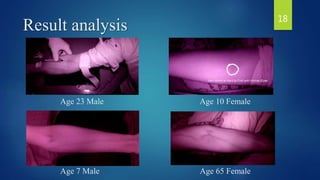
Age 23 Male
Result analysis
Age 7 Male
Age 10 Female
Age 65 Female
18
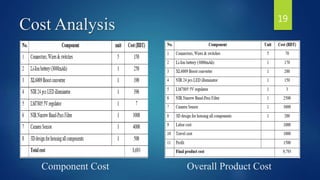
Cost Analysis
Component Cost Overall Product Cost
19
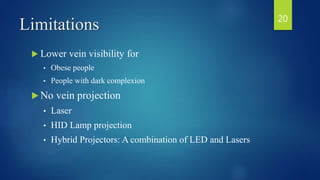
Limitations
 Lower vein visibility for
• Obese people
• People with dark complexion
 No vein projection
• Laser
• HID Lamp projection
• Hybrid Projectors: A combination of LED and Lasers
20
Future works
 To get clearer image for obese and people with dark complexion
 To display on the device directly not via external display
 To project directly on skin
 Making the vein detector more user friendly
 Making accessible to all medical service providers, big or small
 To develop a system for advanced detection
21
Conclusion
Vein detection technique is not a new invention in the medical
imaging system but even then, it falls under the gap in technology
which gives us an alternative to the current medical practices. A
simple low-cost vein finding system has been designed which can be
made readily available to patients in high end hospitals as well as
primary health care centers.
22
Thank you
23

Real-time Vein Imaging