Study of EMG Signal Classification using
Artificial Neural Network
TANVIR RAHMAN
1621311
SUPERVISED BY: DR. MD. KAFIUL ISLAM,
ASSISTANT PROFESSOR, EEE, IUB
1
Introduction
EMG is a procedure that
evaluates the condition of
muscles and the nervous system
that controls them.
Neural networks are a set of
algorithms, modeled loosely
after the human brain, that are
designed to recognize patterns.
2
Motivation
To work with Machine
learning and get some
basic knowledge about
classification.
Use classifying technique
and features those were
not used in the recent
works.
Try to create an easier and
faster way to distinguish
neuromuscular disorders
from healthy people.
3
Objective
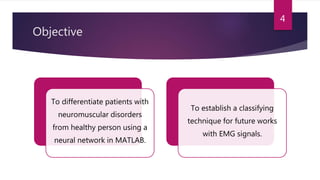
To differentiate patients with
neuromuscular disorders
from healthy person using a
neural network in MATLAB.
To establish a classifying
technique for future works
with EMG signals.
4
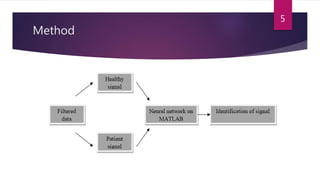
Method
5
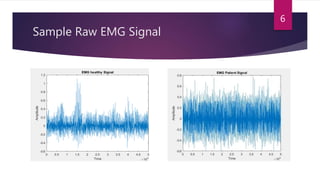
Sample Raw EMG Signal
s
6
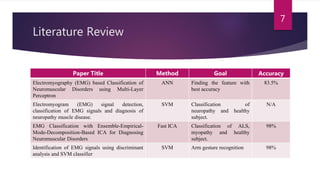
Literature Review
Paper Title Method Goal Accuracy
Electromyography (EMG) based Classification of
Neuromuscular Disorders using Multi-Layer
Perceptron
ANN Finding the feature with
best accuracy
83.5%
Electromyogram (EMG) signal detection,
classification of EMG signals and diagnosis of
neuropathy muscle disease.
SVM Classification of
neuropathy and healthy
subject.
N/A
EMG Classification with Ensemble-Empirical-
Mode-Decomposition-Based ICA for Diagnosing
Neuromuscular Disorders
Fast ICA Classification of ALS,
myopathy and healthy
subject.
98%
Identification of EMG signals using discriminant
analysis and SVM classifier
SVM Arm gesture recognition 98%
7
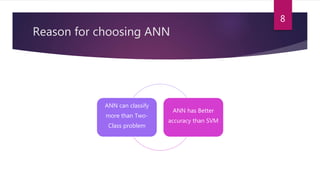
Reason for choosing ANN
ANN can classify
more than Two-
Class problem
ANN has Better
accuracy than SVM
8
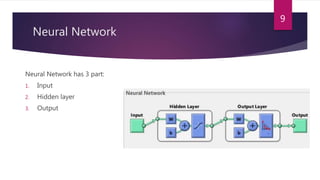
Neural Network
Neural Network has 3 part:
1. Input
2. Hidden layer
3. Output
9
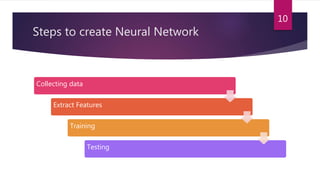
Steps to create Neural Network
Collecting data
Extract Features
Training
Testing
10
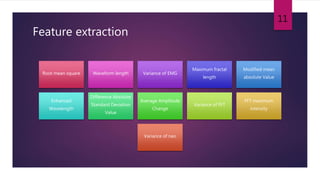
Feature extraction
Root mean square Waveform length Variance of EMG
Maximum fractal
length
Modified mean
absolute Value
Enhanced
Wavelength
Difference Absolute
Standard Deviation
Value
Average Amplitude
Change
Variance of FFT
FFT maximum
intensity
Variance of neo
11
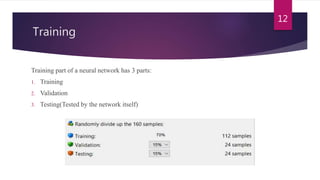
Training
Training part of a neural network has 3 parts:
1. Training
2. Validation
3. Testing(Tested by the network itself)
12
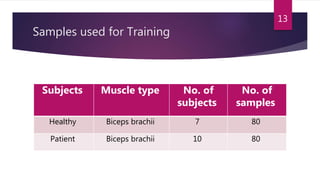
Samples used for Training
Subjects Muscle type No. of
subjects
No. of
samples
Healthy Biceps brachii 7 80
Patient Biceps brachii 10 80
13
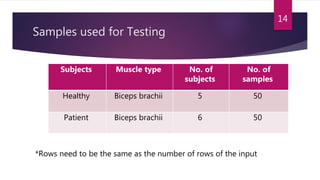
Samples used for Testing
Subjects Muscle type No. of
subjects
No. of
samples
Healthy Biceps brachii 5 50
Patient Biceps brachii 6 50
14
*Rows need to be the same as the number of rows of the input
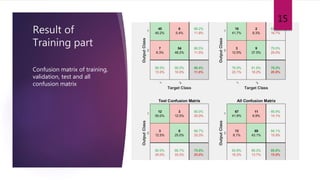
Result of
Training part
Confusion matrix of training,
validation, test and all
confusion matrix
15
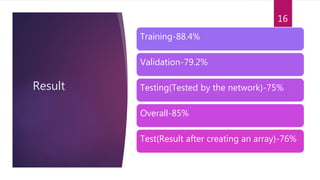
Result
Training-88.4%
Validation-79.2%
Testing(Tested by the network)-75%
Overall-85%
Test(Result after creating an array)-76%
16
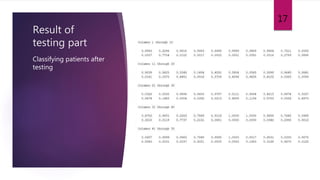
Result of
testing part
Classifying patients after
testing
17
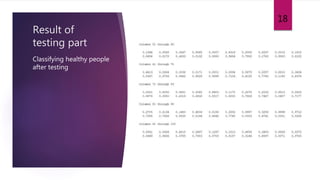
Result of
testing part
Classifying healthy people
after testing
18
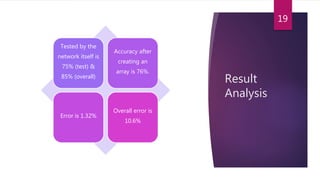
Result
Analysis
Tested by the
network itself is
75% (test) &
85% (overall)
Accuracy after
creating an
array is 76%.
Error is 1.32%
Overall error is
10.6%
19
Conclusion
We successfully created an
NN to classify EMG signals.
The accuracy we found is
good but needs improvment.
20
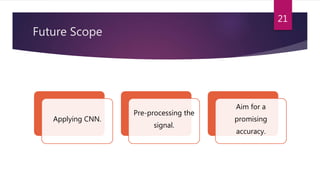
Future Scope
Applying CNN.
Pre-processing the
signal.
Aim for a
promising
accuracy.
21
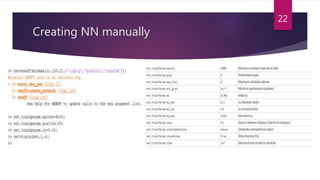
Creating NN manually
22
23

EMG classification using ANN

  • 1.
    Study of EMGSignal Classification using Artificial Neural Network TANVIR RAHMAN 1621311 SUPERVISED BY: DR. MD. KAFIUL ISLAM, ASSISTANT PROFESSOR, EEE, IUB 1
  • 2.
    Introduction EMG is aprocedure that evaluates the condition of muscles and the nervous system that controls them. Neural networks are a set of algorithms, modeled loosely after the human brain, that are designed to recognize patterns. 2
  • 3.
    Motivation To work withMachine learning and get some basic knowledge about classification. Use classifying technique and features those were not used in the recent works. Try to create an easier and faster way to distinguish neuromuscular disorders from healthy people. 3
  • 4.
    Objective To differentiate patientswith neuromuscular disorders from healthy person using a neural network in MATLAB. To establish a classifying technique for future works with EMG signals. 4
  • 5.
  • 6.
    Sample Raw EMGSignal s 6
  • 7.
    Literature Review Paper TitleMethod Goal Accuracy Electromyography (EMG) based Classification of Neuromuscular Disorders using Multi-Layer Perceptron ANN Finding the feature with best accuracy 83.5% Electromyogram (EMG) signal detection, classification of EMG signals and diagnosis of neuropathy muscle disease. SVM Classification of neuropathy and healthy subject. N/A EMG Classification with Ensemble-Empirical- Mode-Decomposition-Based ICA for Diagnosing Neuromuscular Disorders Fast ICA Classification of ALS, myopathy and healthy subject. 98% Identification of EMG signals using discriminant analysis and SVM classifier SVM Arm gesture recognition 98% 7
  • 8.
    Reason for choosingANN ANN can classify more than Two- Class problem ANN has Better accuracy than SVM 8
  • 9.
    Neural Network Neural Networkhas 3 part: 1. Input 2. Hidden layer 3. Output 9
  • 10.
    Steps to createNeural Network Collecting data Extract Features Training Testing 10
  • 11.
    Feature extraction Root meansquare Waveform length Variance of EMG Maximum fractal length Modified mean absolute Value Enhanced Wavelength Difference Absolute Standard Deviation Value Average Amplitude Change Variance of FFT FFT maximum intensity Variance of neo 11
  • 12.
    Training Training part ofa neural network has 3 parts: 1. Training 2. Validation 3. Testing(Tested by the network itself) 12
  • 13.
    Samples used forTraining Subjects Muscle type No. of subjects No. of samples Healthy Biceps brachii 7 80 Patient Biceps brachii 10 80 13
  • 14.
    Samples used forTesting Subjects Muscle type No. of subjects No. of samples Healthy Biceps brachii 5 50 Patient Biceps brachii 6 50 14 *Rows need to be the same as the number of rows of the input
  • 15.
    Result of Training part Confusionmatrix of training, validation, test and all confusion matrix 15
  • 16.
    Result Training-88.4% Validation-79.2% Testing(Tested by thenetwork)-75% Overall-85% Test(Result after creating an array)-76% 16
  • 17.
    Result of testing part Classifyingpatients after testing 17
  • 18.
    Result of testing part Classifyinghealthy people after testing 18
  • 19.
    Result Analysis Tested by the networkitself is 75% (test) & 85% (overall) Accuracy after creating an array is 76%. Error is 1.32% Overall error is 10.6% 19
  • 20.
    Conclusion We successfully createdan NN to classify EMG signals. The accuracy we found is good but needs improvment. 20
  • 21.
    Future Scope Applying CNN. Pre-processingthe signal. Aim for a promising accuracy. 21
  • 22.
  • 23.