ZHOU Changsong (周昌松)
Department of Physics
Centre for Nonlinear Studies
Institute of Computational and Theoretical Studies
Hong Kong Baptist University
0
From Sparse Irregular Spikes to Critical Avalanches:
Cost-Efficient Neural Dynamics
1
Outline
Brain as complex dynamical network system;
cost-efficiency trade-off
Reconcile irregular neuronal spiking and neural
avalanches
Less is more
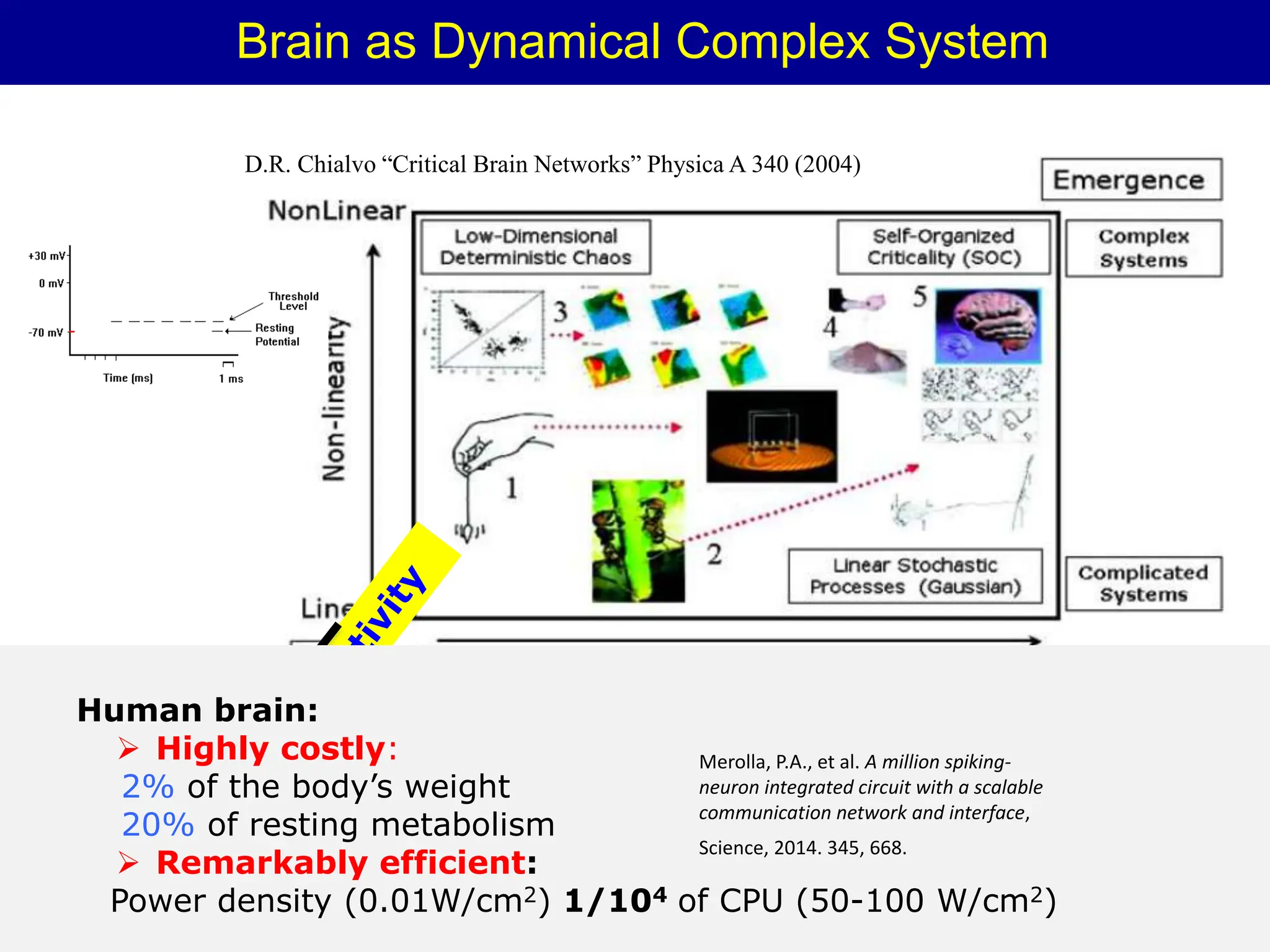
Brain as Dynamical Complex System
D.R. Chialvo “Critical Brain Networks” Physica A 340 (2004)
 High degree of freedom
 Strong nonlinearity
 Complex Connectivity
2
Human brain:
 Highly costly:
2% of the body’s weight
20% of resting metabolism
 Remarkably efficient:
Power density (0.01W/cm2) 1/104 of CPU (50-100 W/cm2)
Merolla, P.A., et al. A million spiking-
neuron integrated circuit with a scalable
communication network and interface,
Science, 2014. 345, 668.
Brain is a functional Complex System:
Designed by Great Nature through evolution
Subject to multiple constraints
Optimization of multiple functions
The trade-off must be reflected in the architecture,
activity and their interactions
Shall brain-inspired intelligence be constrained by
cost/function as in neural system?
Cost-efficiency trade-off
3
Energy cost of communication in the brain
Energy demands (50—80%) of spiking:
• Restoration of ion movements
• Propagation of action potentials
• Neurotransmitter uptake
Energy constraint: low firing rate (1~5Hz);
minimizing fiber length
4
Laughlin, S.B., Energy as a constraint on the coding and processing
of sensory information. Current opinion in neurobiology, 2001.
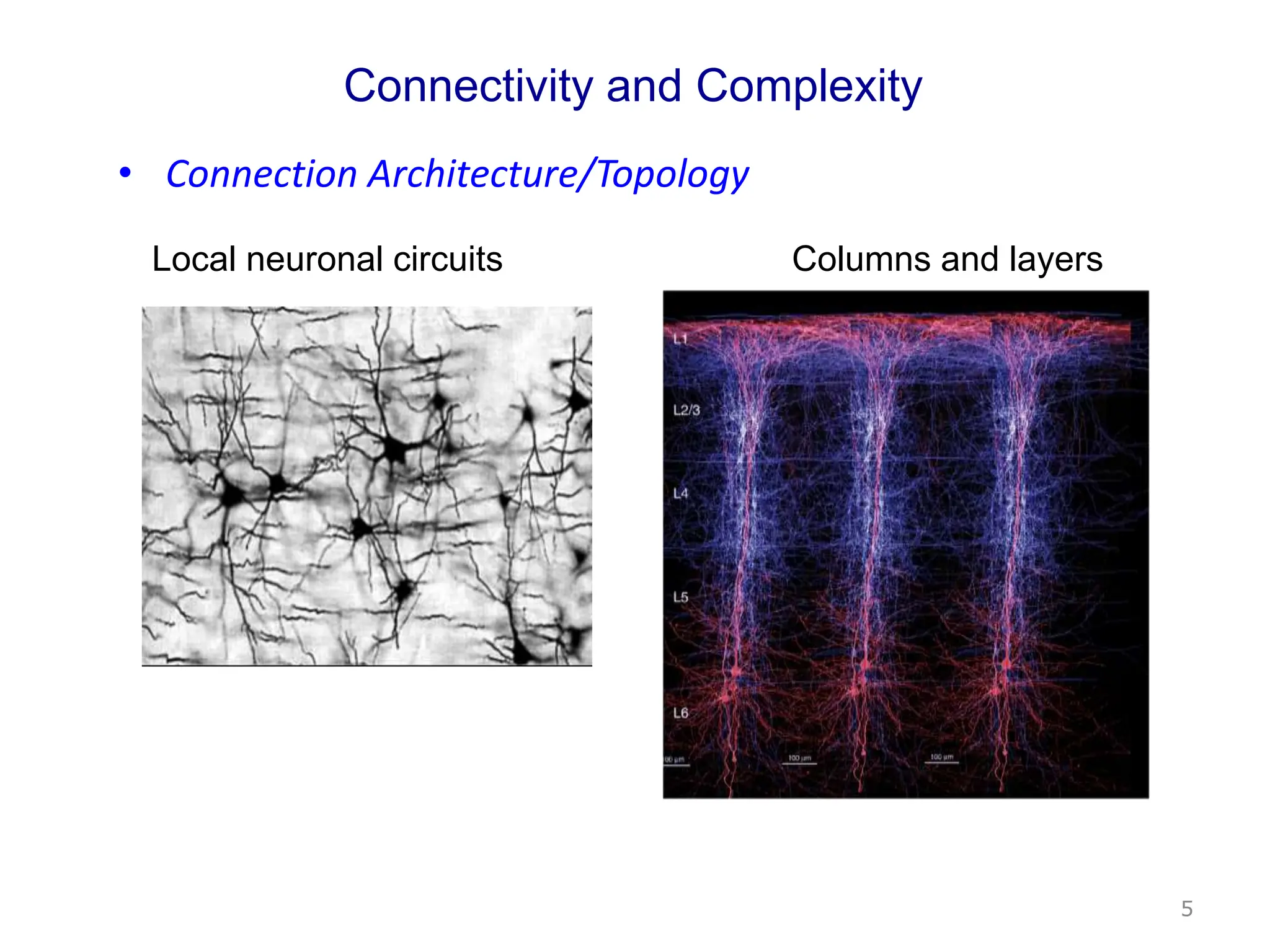
Columns and layers
Local neuronal circuits
Connectivity and Complexity
5
• Connection Architecture/Topology
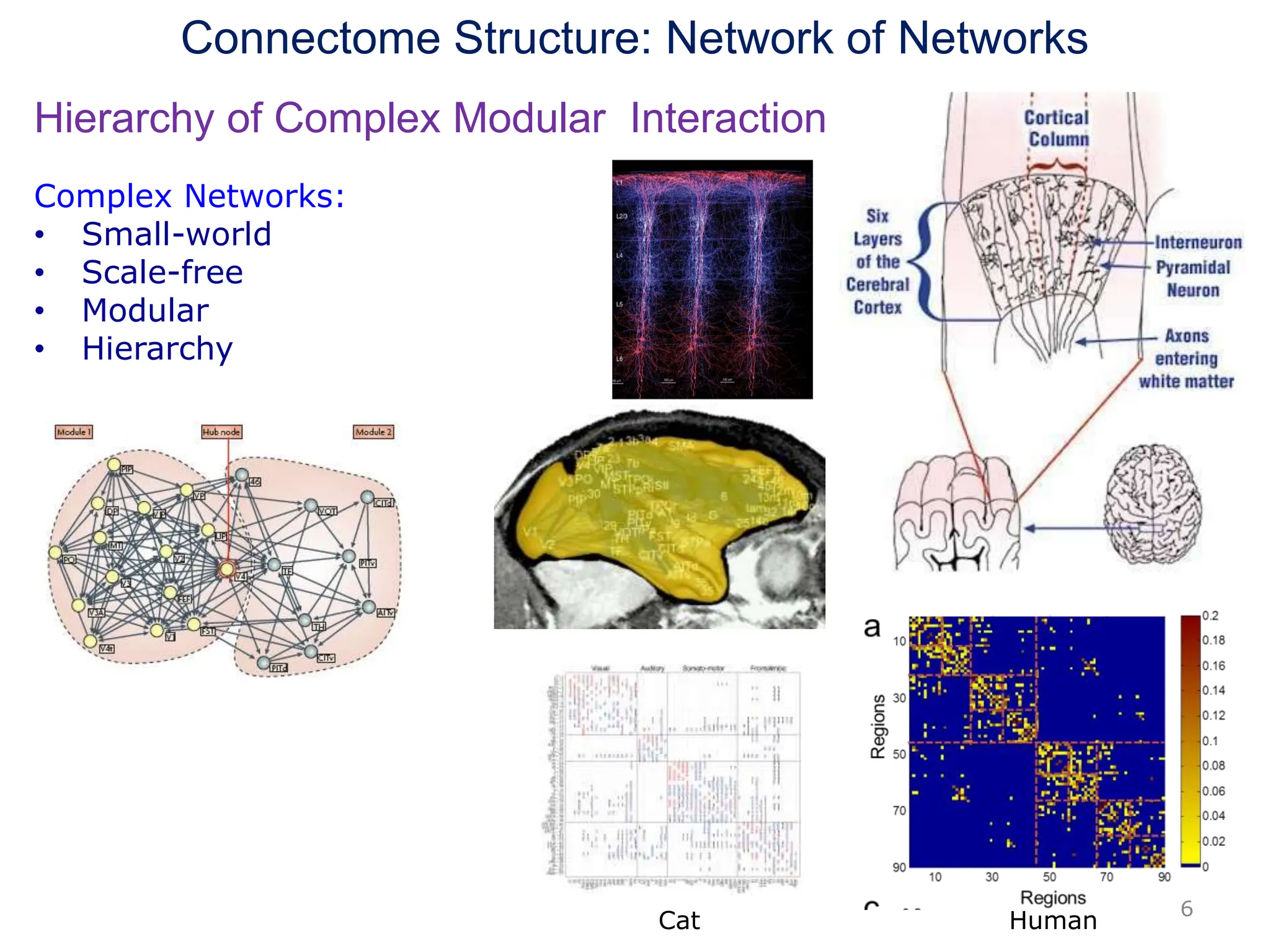
Connectome Structure: Network of Networks
Hierarchy of Complex Modular Interaction
6
Complex Networks:
• Small-world
• Scale-free
• Modular
• Hierarchy
Cat Human
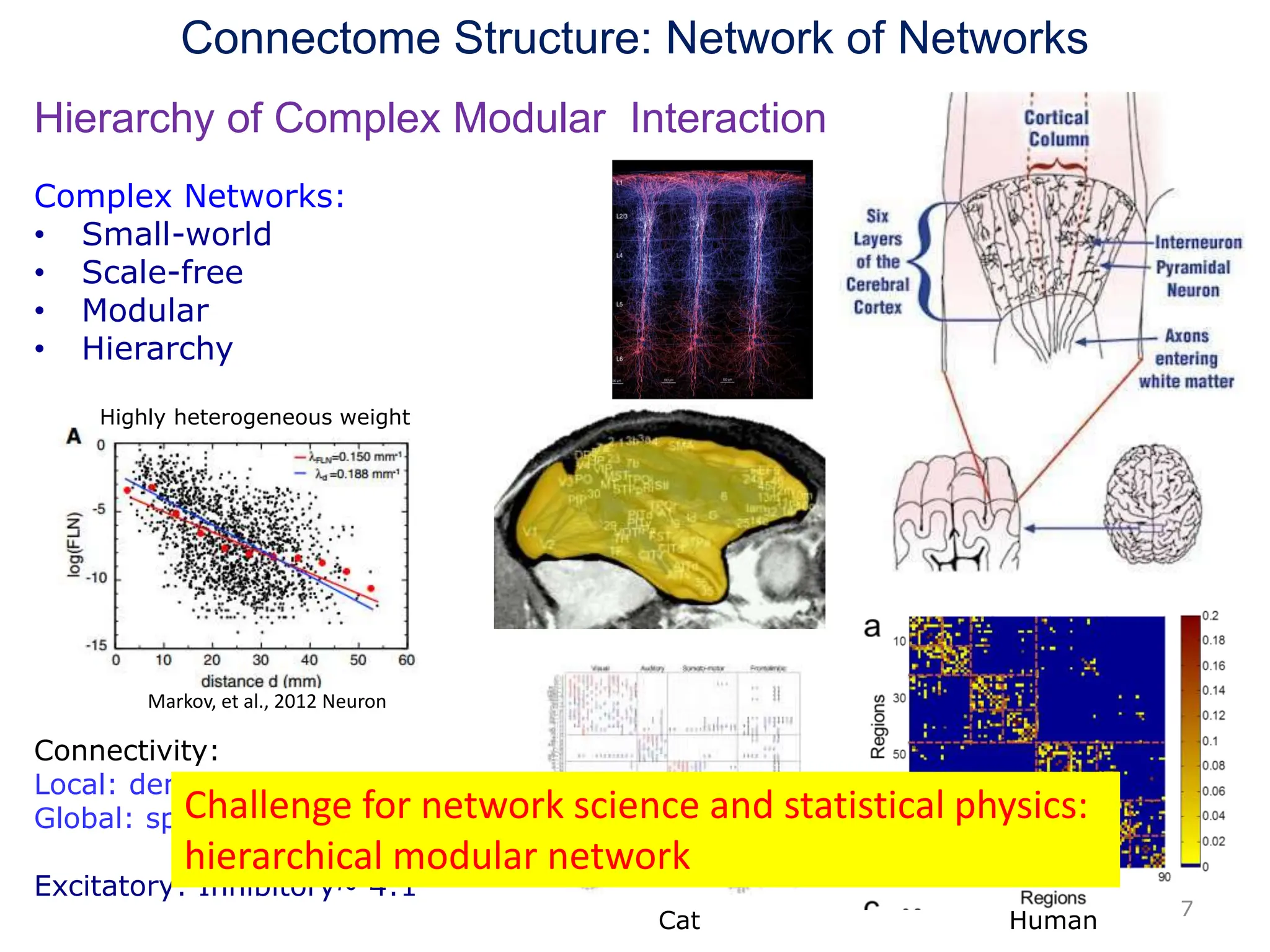
Connectome Structure: Network of Networks
Connectivity:
Local: dense (0.1-0.2)
Global: sparse (10-7-10-6)
Excitatory: Inhibitory~ 4:1
Hierarchy of Complex Modular Interaction
7
Complex Networks:
• Small-world
• Scale-free
• Modular
• Hierarchy
Cat Human
Challenge for network science and statistical physics:
hierarchical modular network
Markov, et al., 2012 Neuron
Highly heterogeneous weight
– Individual activity:
• low-rate firing
• irregularity
– Collective dynamics:
• network oscillations
• Critical neuronal avalanches
8
Salient features in brain activity
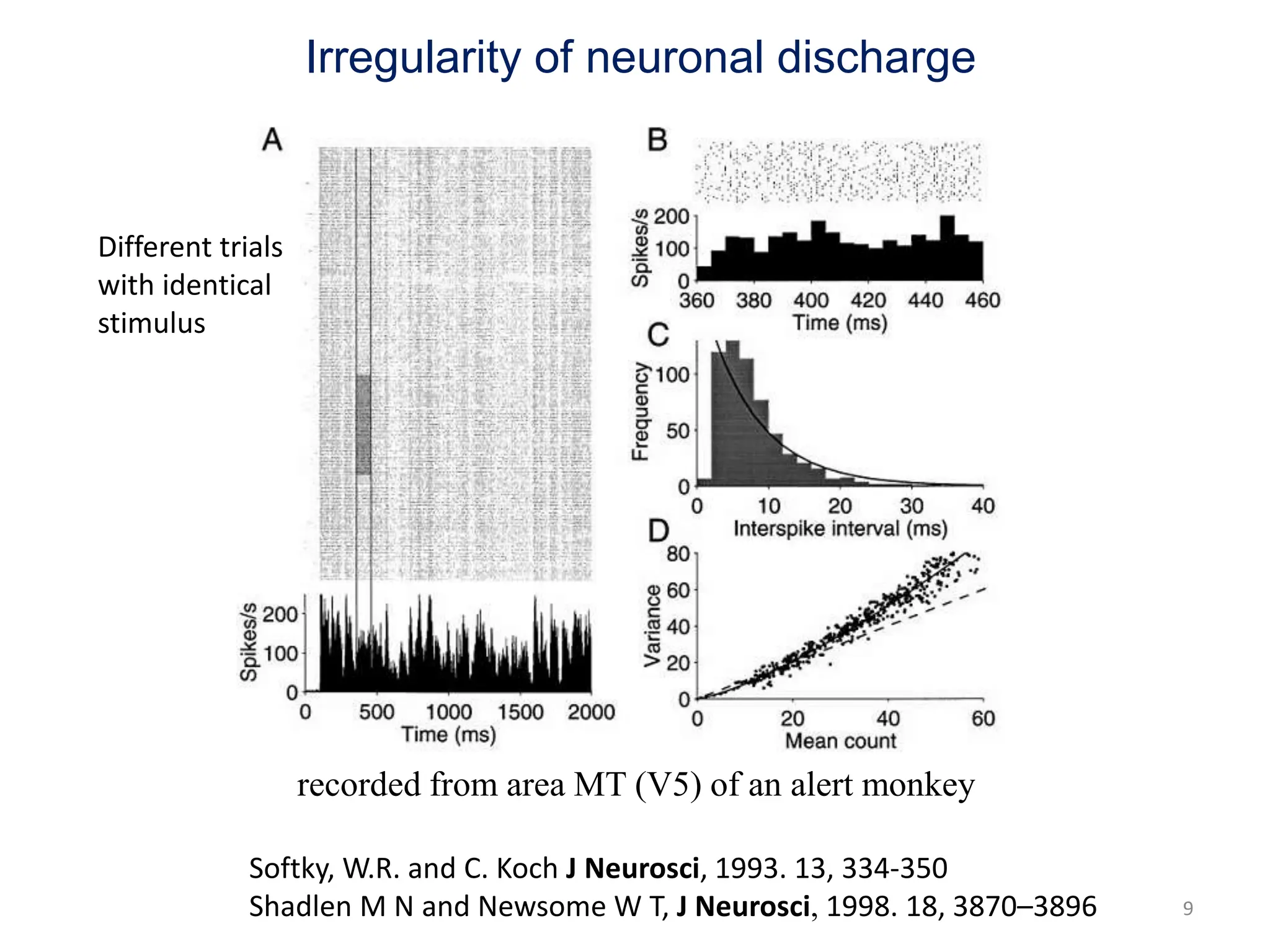
Irregularity of neuronal discharge
9
recorded from area MT (V5) of an alert monkey
Softky, W.R. and C. Koch J Neurosci, 1993. 13, 334-350
Shadlen M N and Newsome W T, J Neurosci, 1998. 18, 3870–3896
Different trials
with identical
stimulus
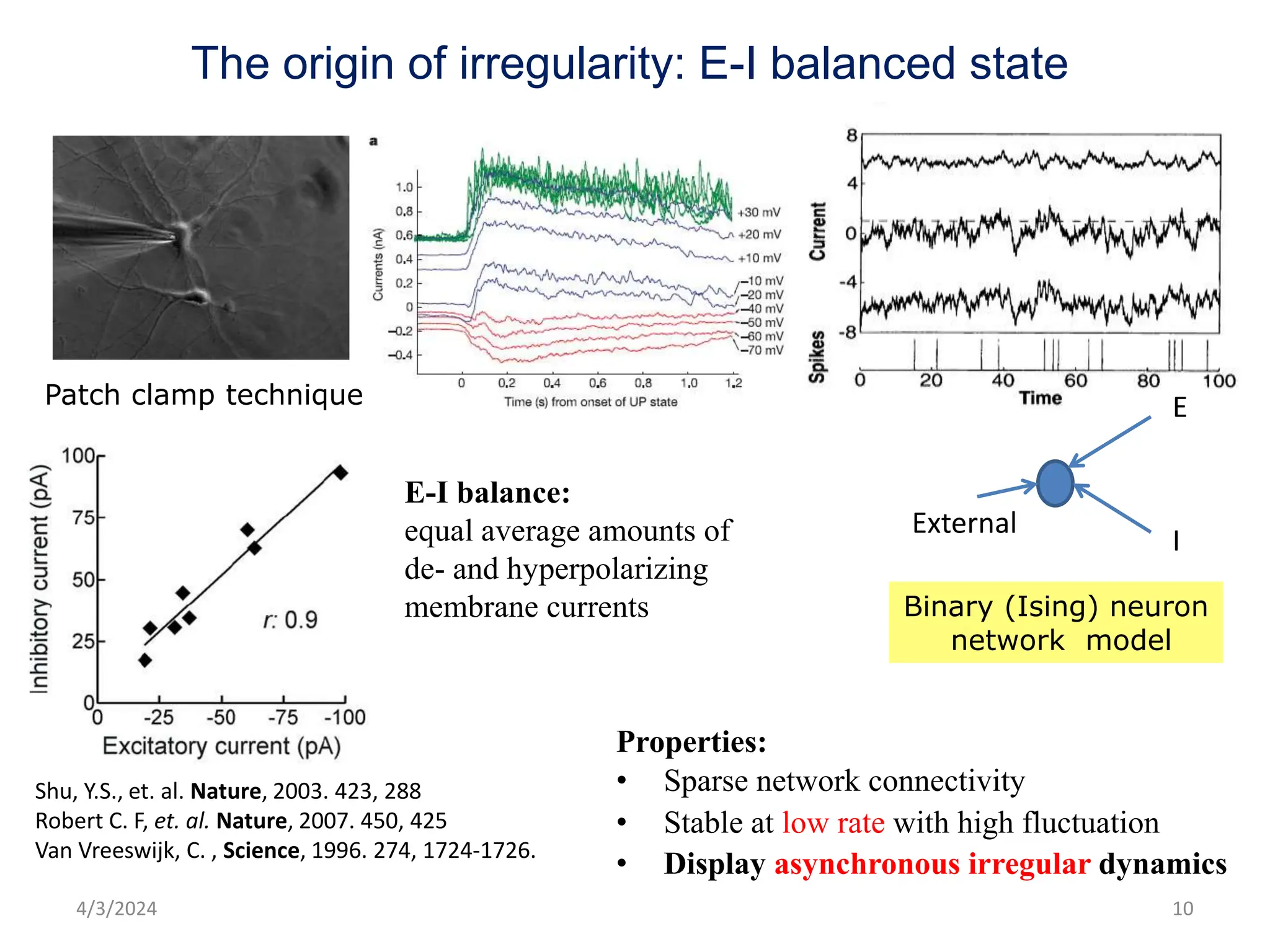
The origin of irregularity: E-I balanced state
E-I balance:
equal average amounts of
de- and hyperpolarizing
membrane currents
Shu, Y.S., et. al. Nature, 2003. 423, 288
Robert C. F, et. al. Nature, 2007. 450, 425
Van Vreeswijk, C. , Science, 1996. 274, 1724-1726.
Properties:
• Sparse network connectivity
• Stable at low rate with high fluctuation
• Display asynchronous irregular dynamics
10
Patch clamp technique
External
E
I
Binary (Ising) neuron
network model
4/3/2024
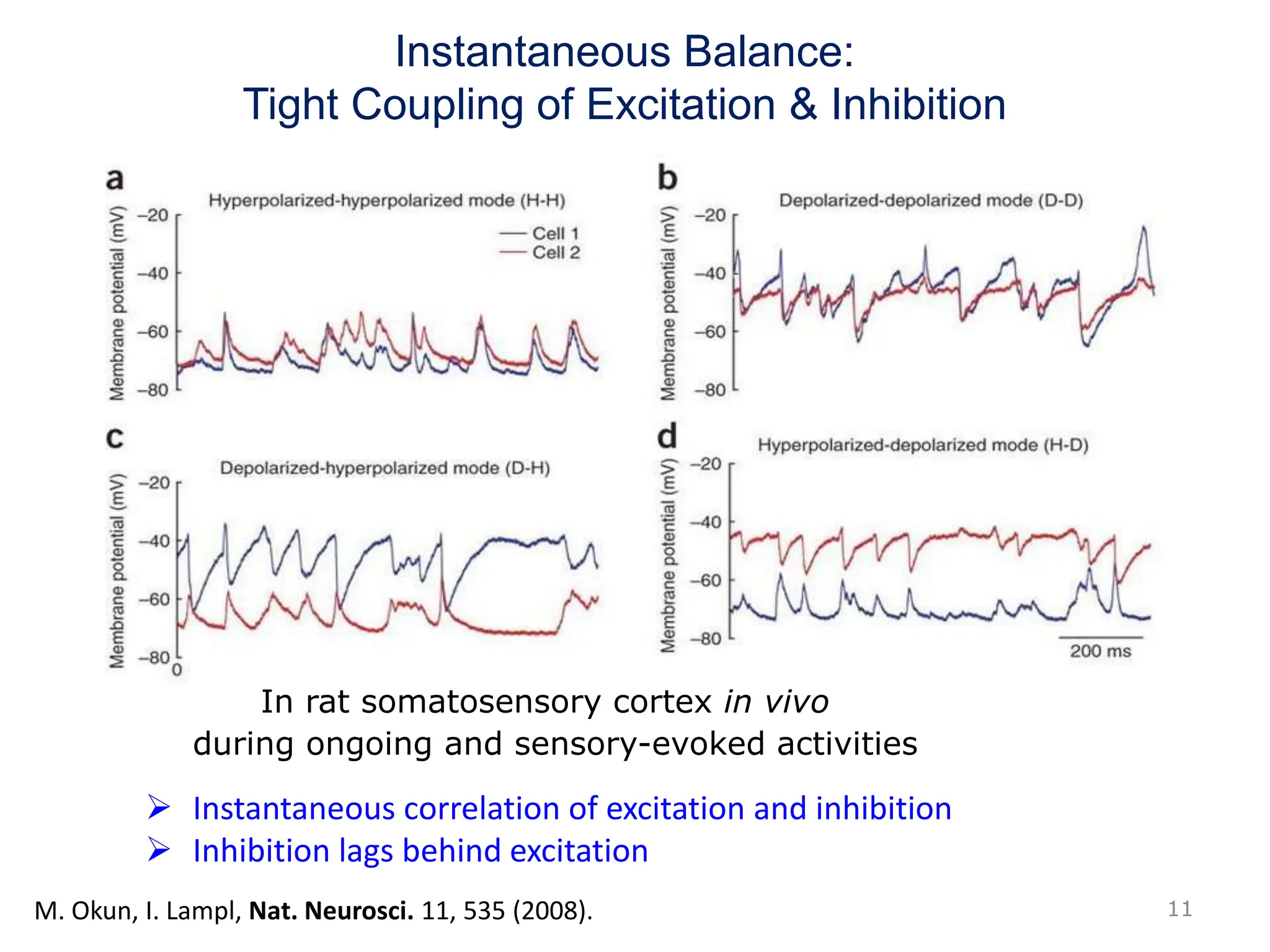
Instantaneous Balance:
Tight Coupling of Excitation & Inhibition
 Instantaneous correlation of excitation and inhibition
 Inhibition lags behind excitation
In rat somatosensory cortex in vivo
M. Okun, I. Lampl, Nat. Neurosci. 11, 535 (2008).
during ongoing and sensory-evoked activities
11
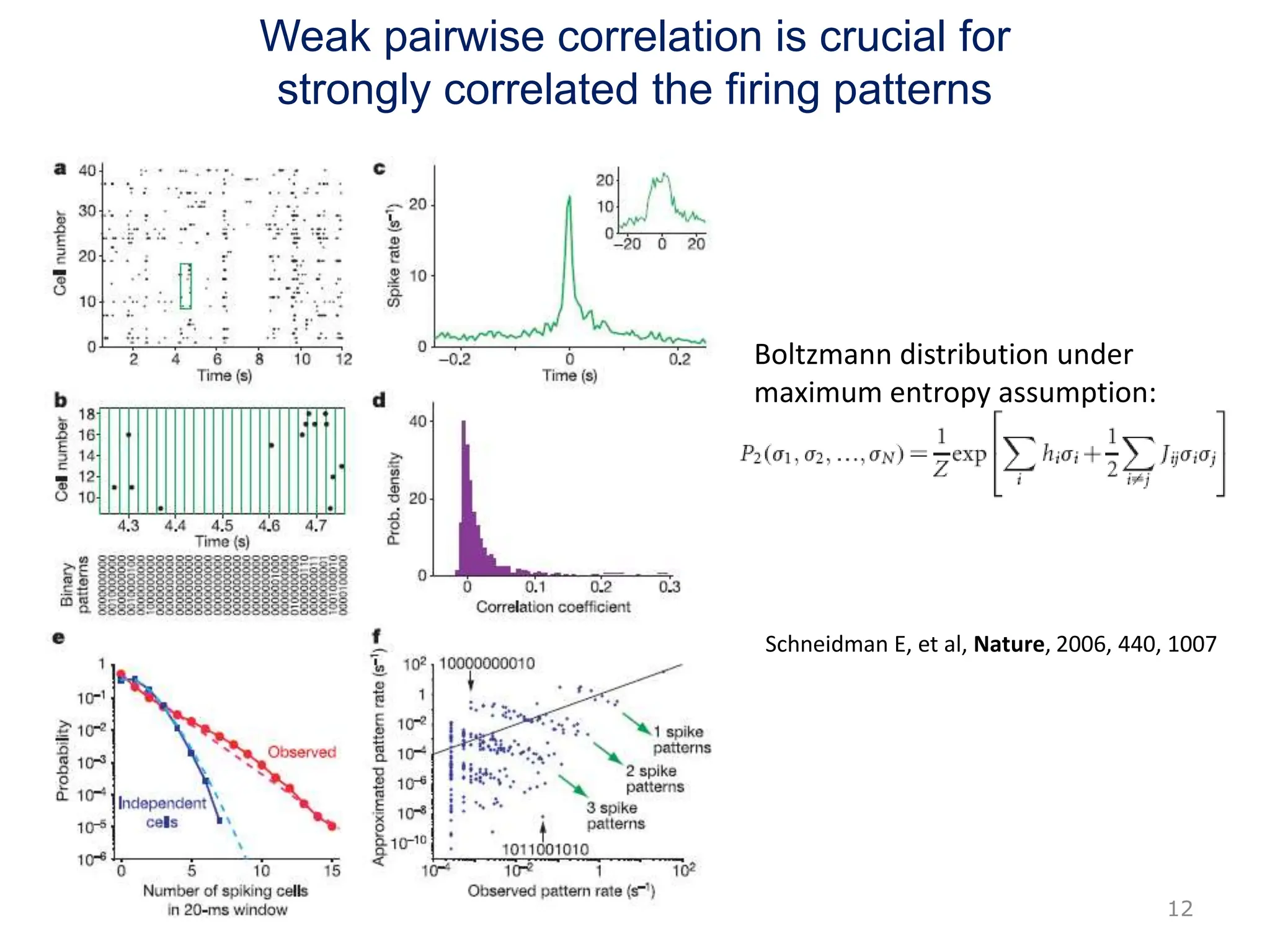
Weak pairwise correlation is crucial for
strongly correlated the firing patterns
Boltzmann distribution under
maximum entropy assumption:
Schneidman E, et al, Nature, 2006, 440, 1007
12
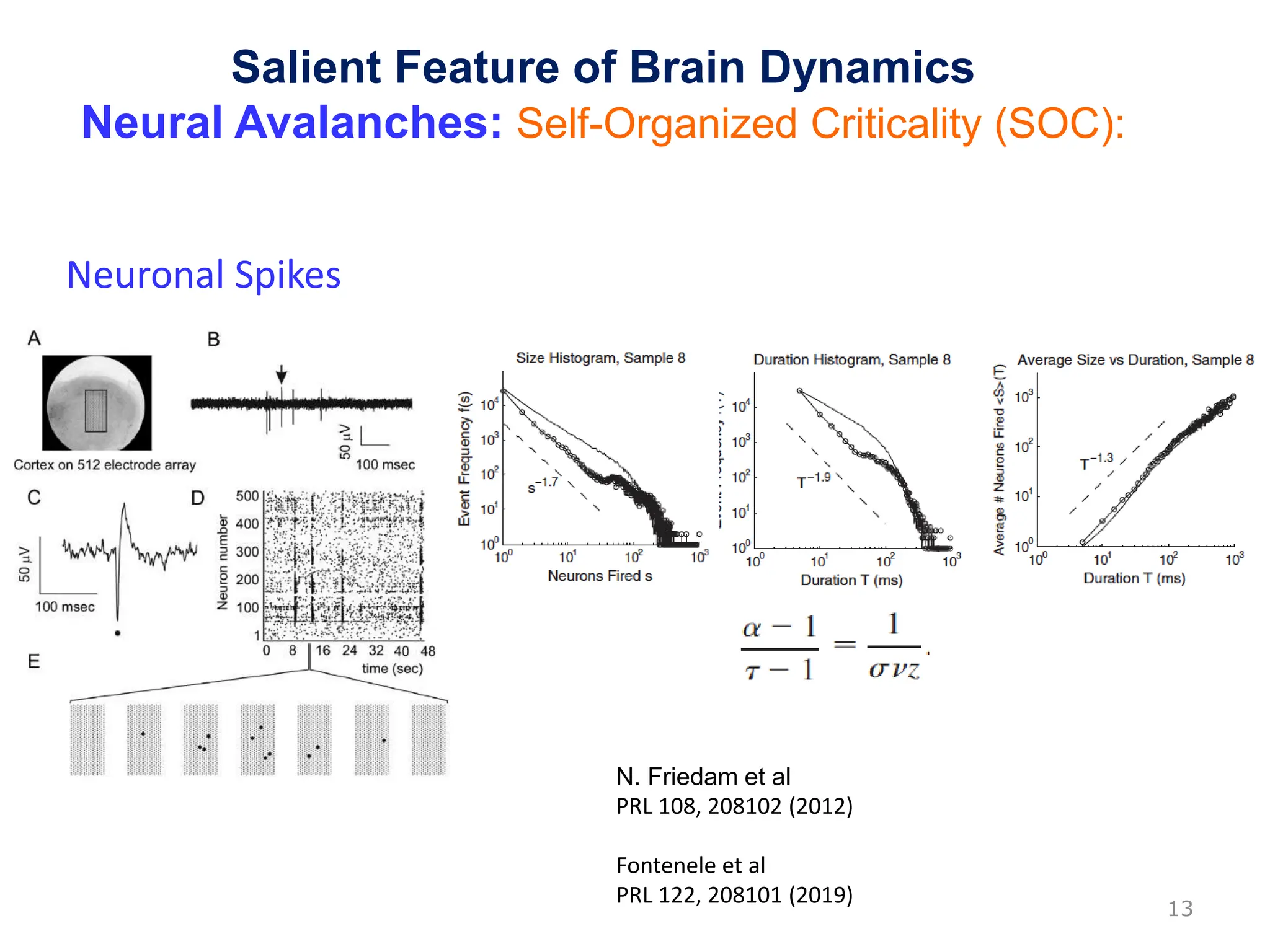
N. Friedam et al
PRL 108, 208102 (2012)
Fontenele et al
PRL 122, 208101 (2019)
Salient Feature of Brain Dynamics
Neural Avalanches: Self-Organized Criticality (SOC):
13
Neuronal Spikes
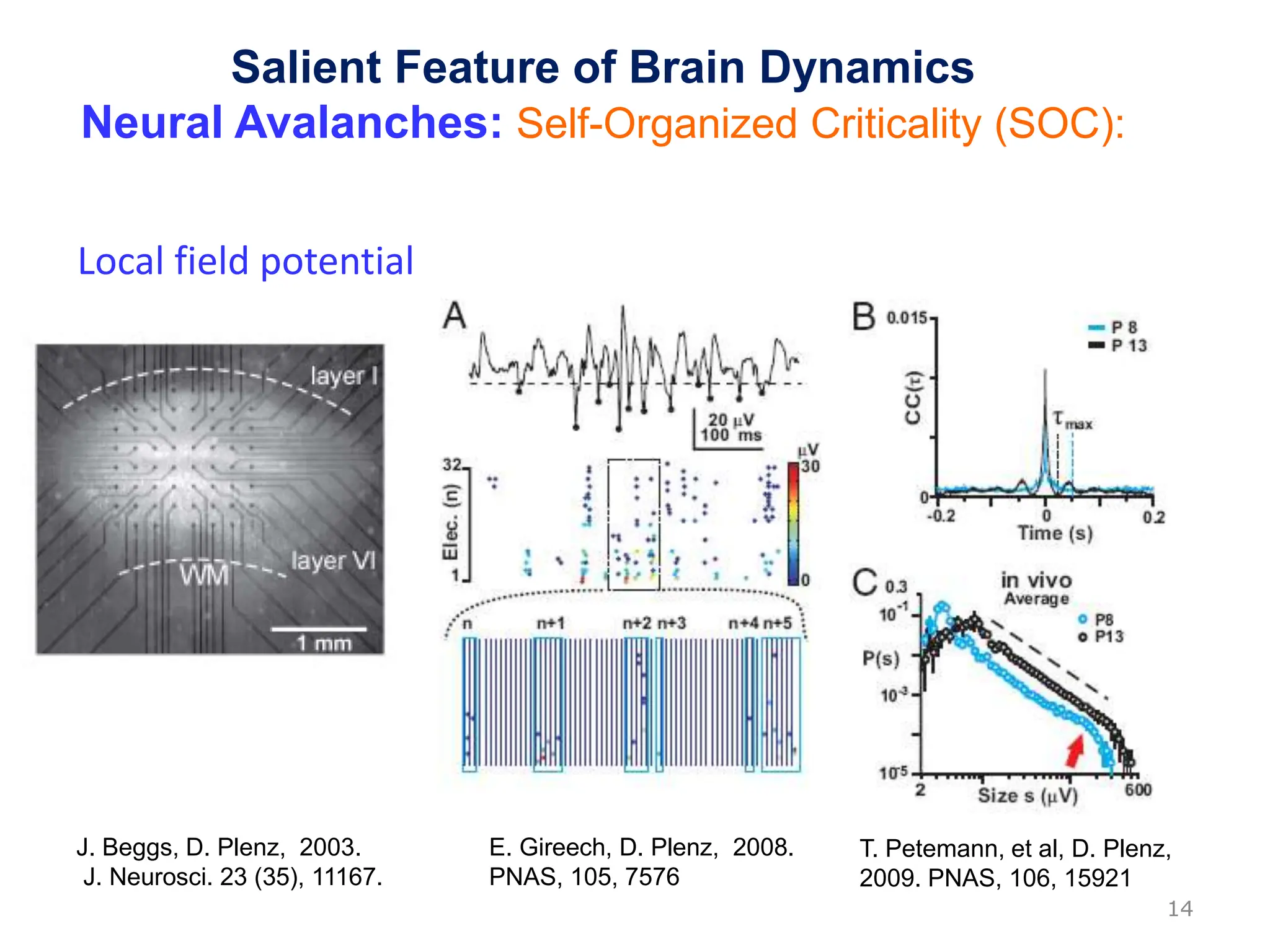
J. Beggs, D. Plenz, 2003.
J. Neurosci. 23 (35), 11167.
Salient Feature of Brain Dynamics
Neural Avalanches: Self-Organized Criticality (SOC):
E. Gireech, D. Plenz, 2008.
PNAS, 105, 7576
T. Petemann, et al, D. Plenz,
2009. PNAS, 106, 15921
14
Local field potential
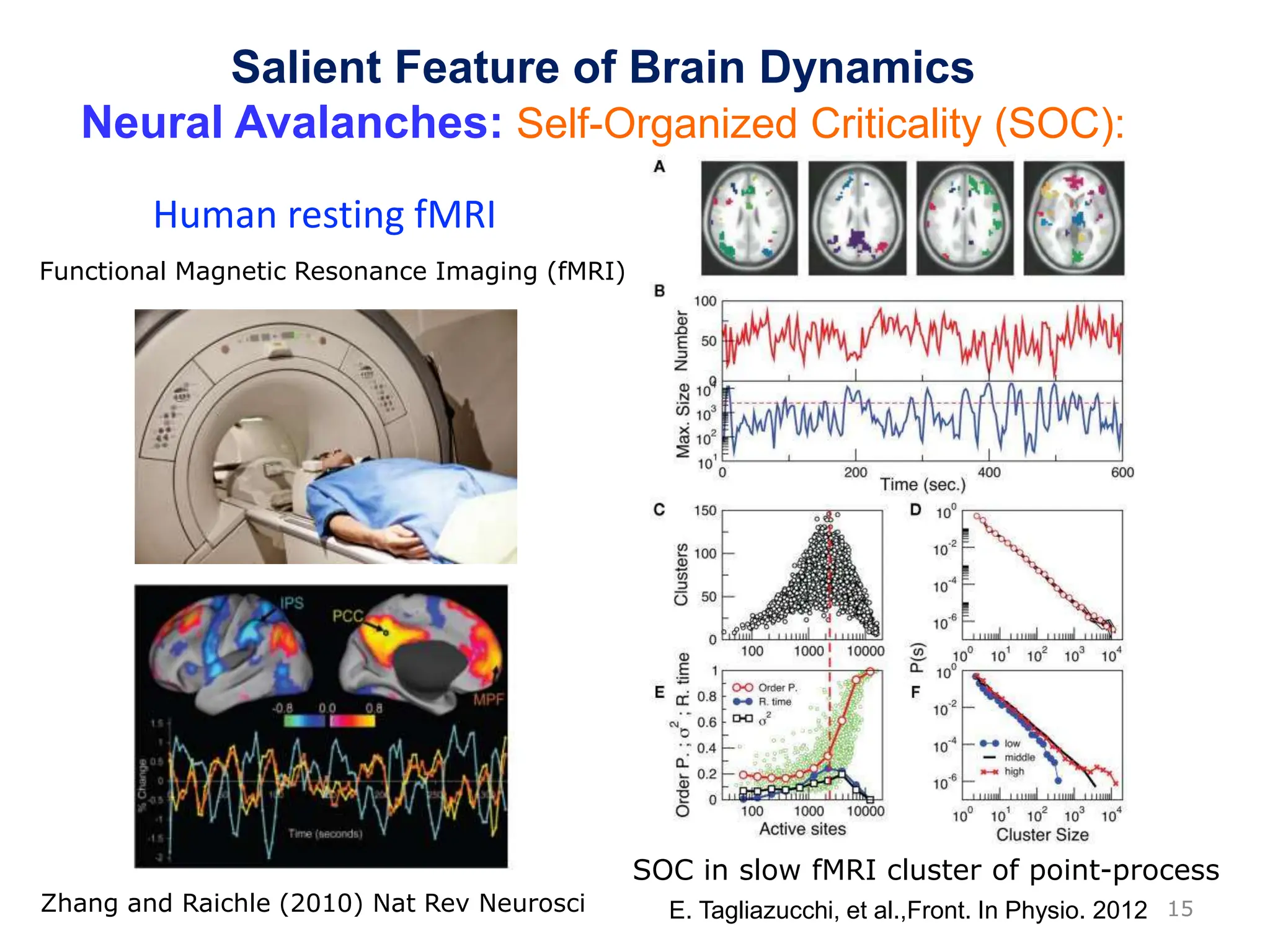
15
SOC in slow fMRI cluster of point-process
E. Tagliazucchi, et al.,Front. In Physio. 2012
Zhang and Raichle (2010) Nat Rev Neurosci
Functional Magnetic Resonance Imaging (fMRI)
Human resting fMRI
Salient Feature of Brain Dynamics
Neural Avalanches: Self-Organized Criticality (SOC):
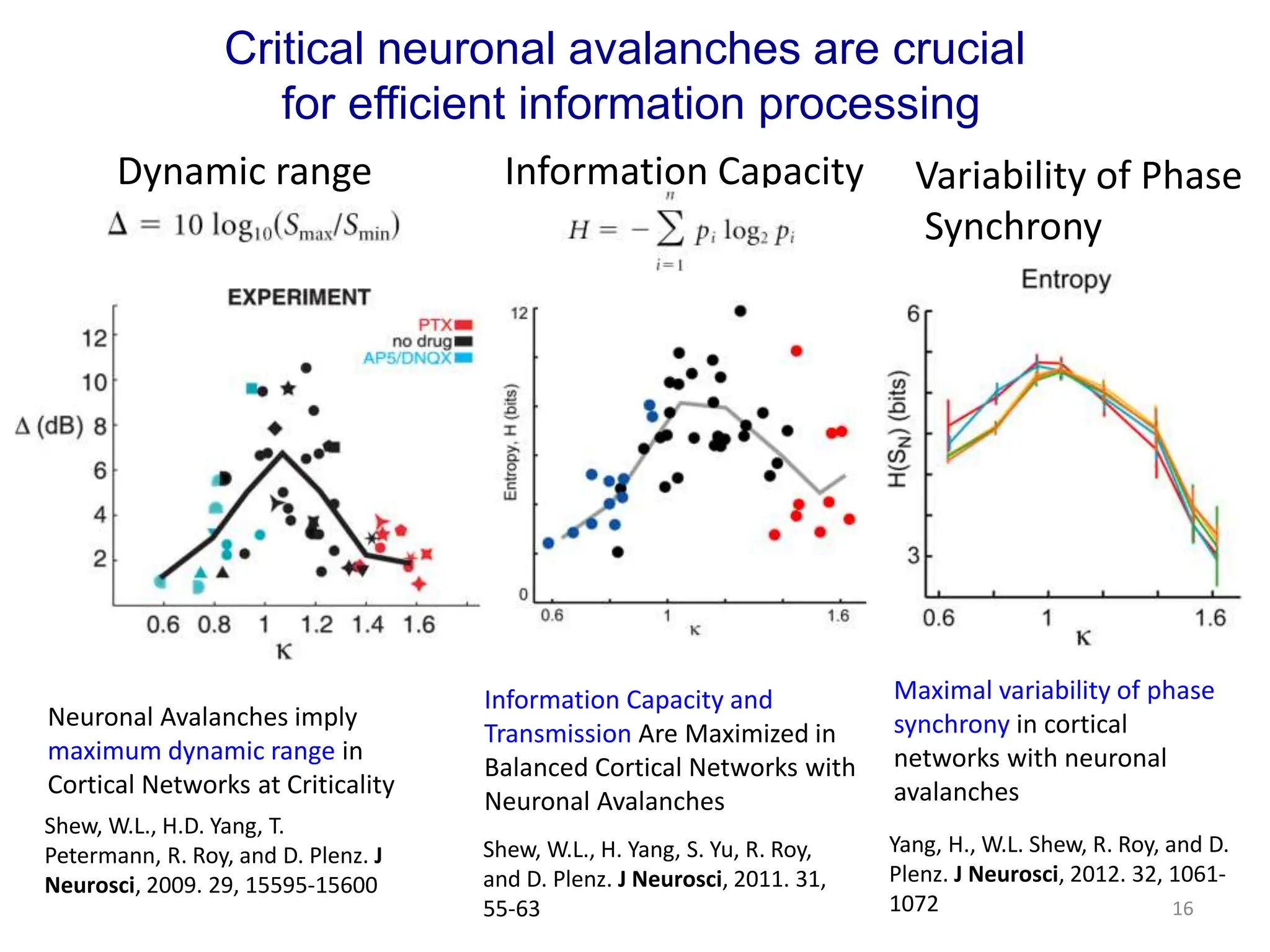
Critical neuronal avalanches are crucial
for efficient information processing
Dynamic range Information Capacity Variability of Phase
Synchrony
Neuronal Avalanches imply
maximum dynamic range in
Cortical Networks at Criticality
Shew, W.L., H.D. Yang, T.
Petermann, R. Roy, and D. Plenz. J
Neurosci, 2009. 29, 15595-15600
Information Capacity and
Transmission Are Maximized in
Balanced Cortical Networks with
Neuronal Avalanches
Shew, W.L., H. Yang, S. Yu, R. Roy,
and D. Plenz. J Neurosci, 2011. 31,
55-63
Maximal variability of phase
synchrony in cortical
networks with neuronal
avalanches
Yang, H., W.L. Shew, R. Roy, and D.
Plenz. J Neurosci, 2012. 32, 1061-
1072 16
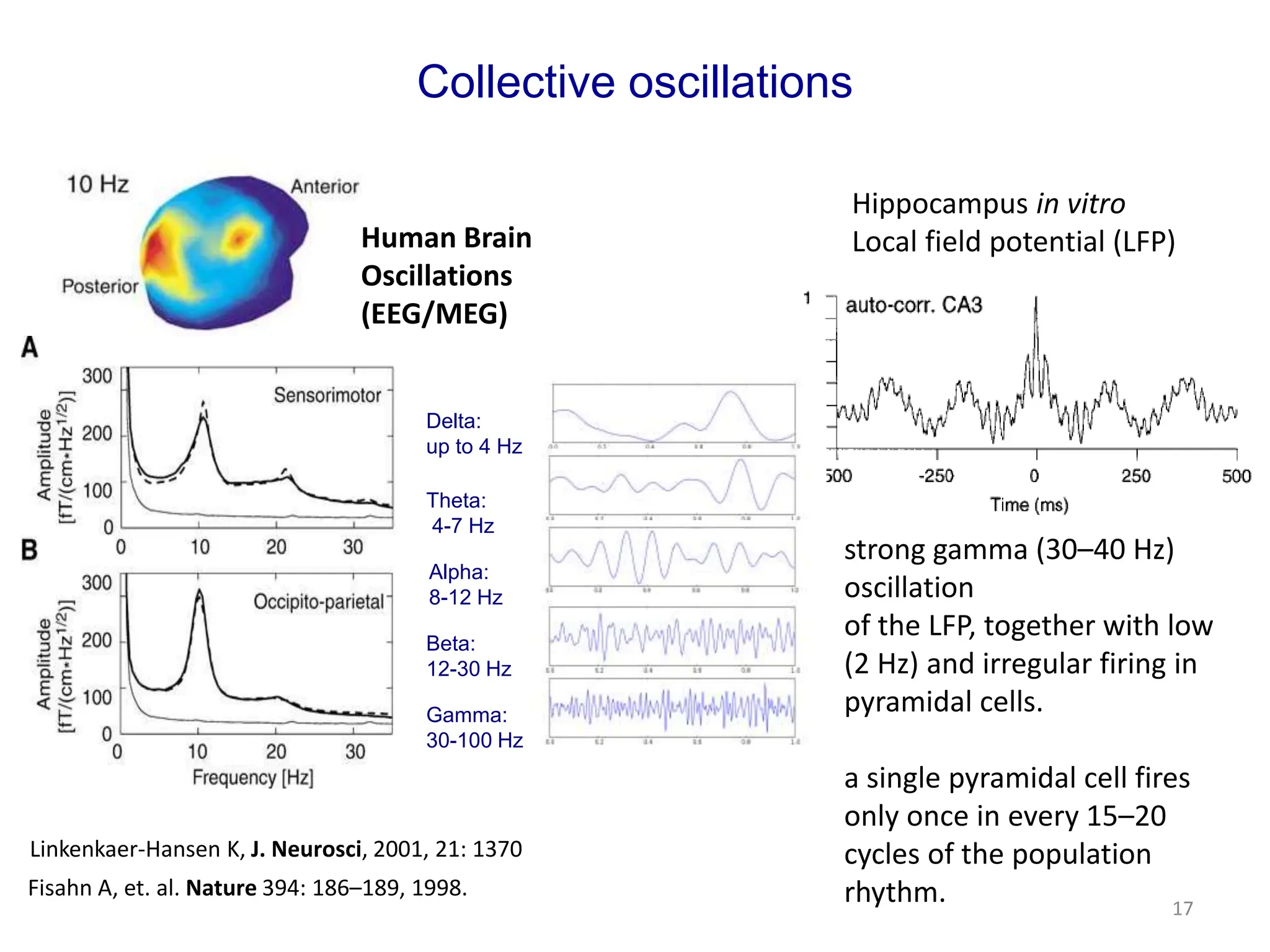
Collective oscillations
17
strong gamma (30–40 Hz)
oscillation
of the LFP, together with low
(2 Hz) and irregular firing in
pyramidal cells.
a single pyramidal cell fires
only once in every 15–20
cycles of the population
rhythm.
Fisahn A, et. al. Nature 394: 186–189, 1998.
Human Brain
Oscillations
(EEG/MEG)
Hippocampus in vitro
Local field potential (LFP)
Linkenkaer-Hansen K, J. Neurosci, 2001, 21: 1370
Theta:
4-7 Hz
Alpha:
8-12 Hz
Beta:
12-30 Hz
Gamma:
30-100 Hz
Delta:
up to 4 Hz
18
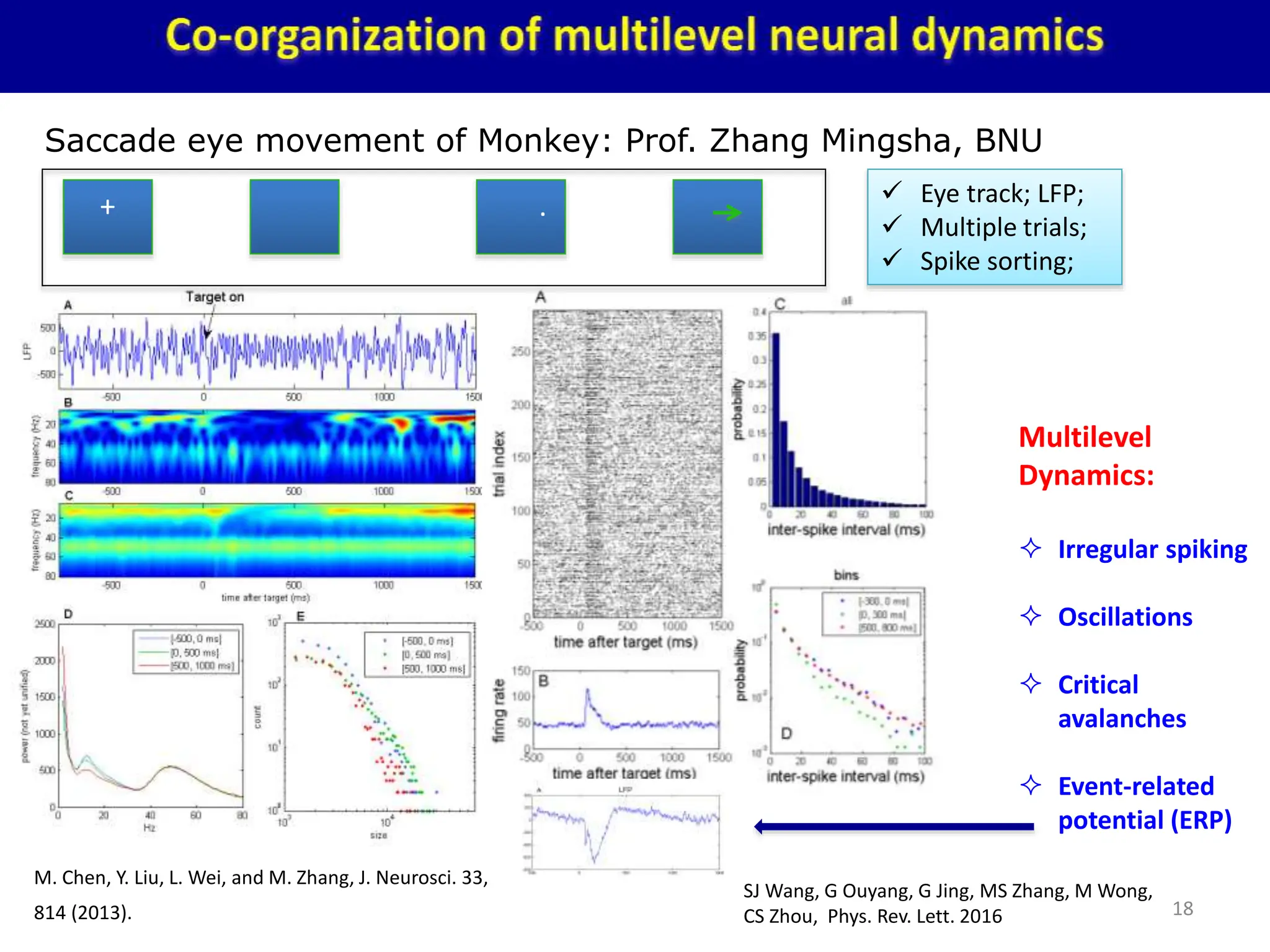
Saccade eye movement of Monkey: Prof. Zhang Mingsha, BNU
+ .  Eye track; LFP;
 Multiple trials;
 Spike sorting;
Multilevel
Dynamics:
 Irregular spiking
 Oscillations
 Critical
avalanches
 Event-related
potential (ERP)
M. Chen, Y. Liu, L. Wei, and M. Zhang, J. Neurosci. 33,
814 (2013).
SJ Wang, G Ouyang, G Jing, MS Zhang, M Wong,
CS Zhou, Phys. Rev. Lett. 2016
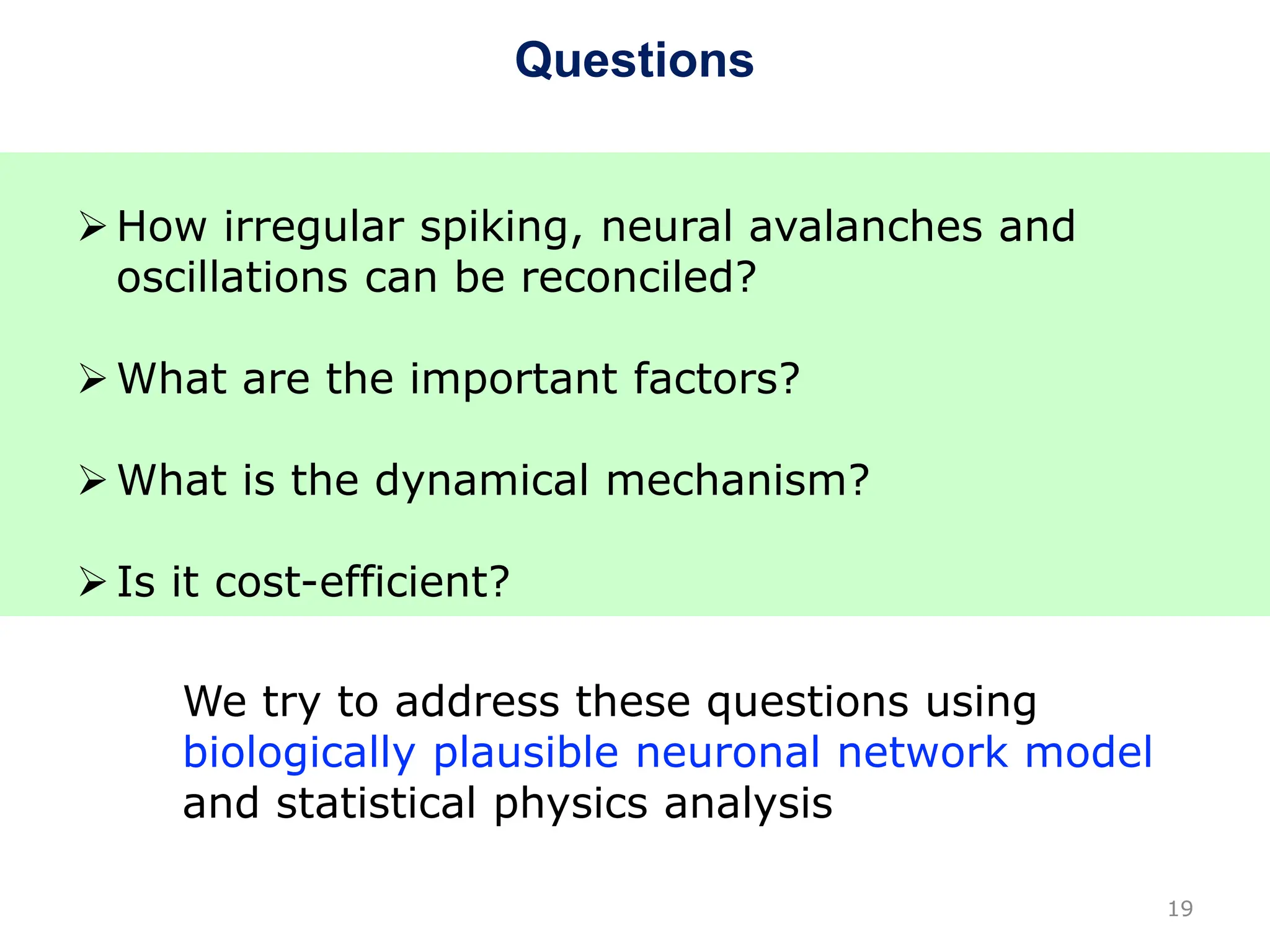
Questions
19
How irregular spiking, neural avalanches and
oscillations can be reconciled?
What are the important factors?
What is the dynamical mechanism?
Is it cost-efficient?
We try to address these questions using
biologically plausible neuronal network model
and statistical physics analysis
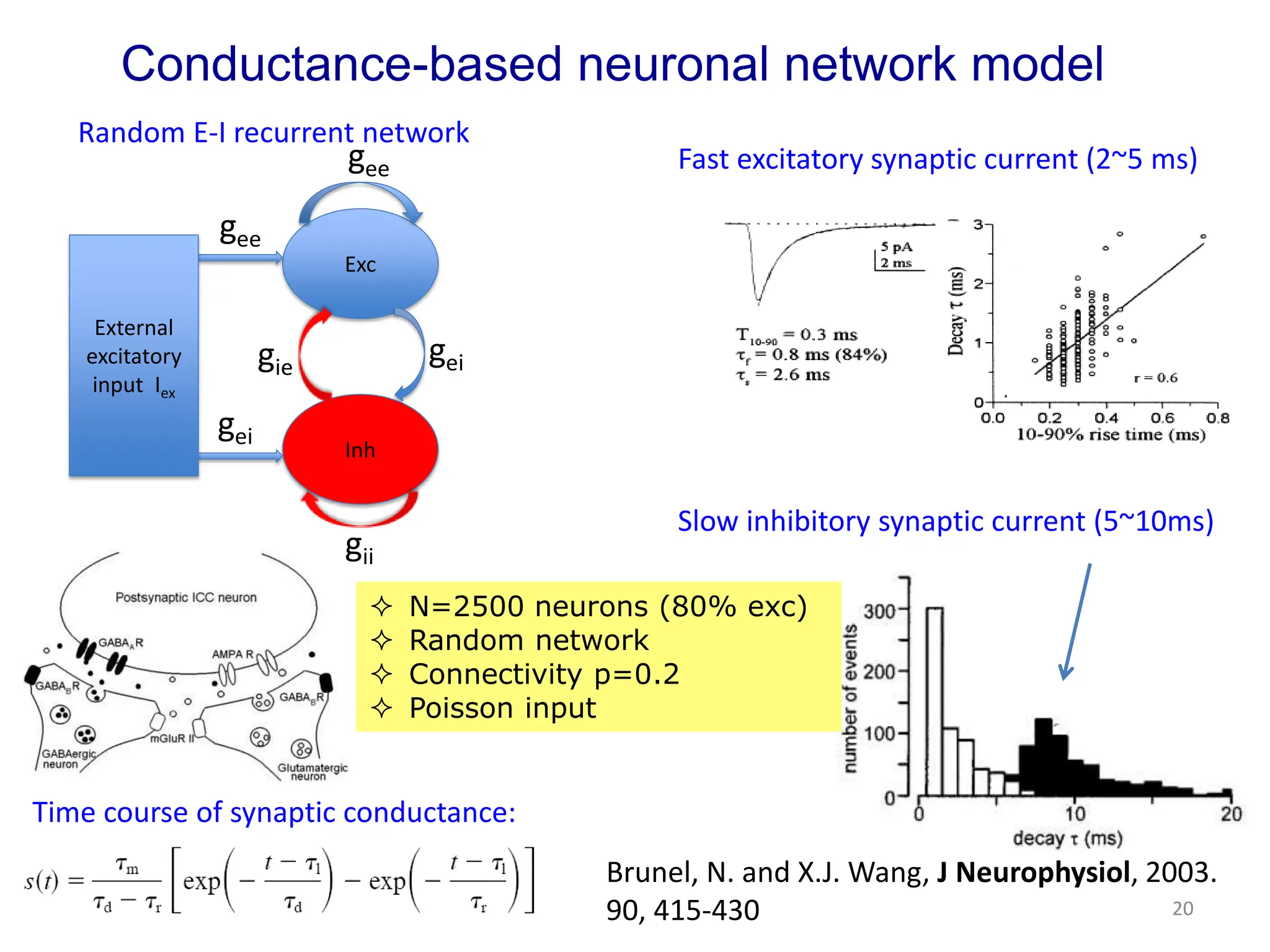
Conductance-based neuronal network model
Brunel, N. and X.J. Wang, J Neurophysiol, 2003.
90, 415-430
Random E-I recurrent network
Time course of synaptic conductance:
Slow inhibitory synaptic current (5~10ms)
Exc
Inh
External
excitatory
input Iex
=( )+ ( ) ( )
+ ( )
=( )+ ( ) ( )
+ ( )
gee
gii
gei
gie
gee
gei
Evolving Equations for potentials:
(t)=
(t)=
Time courses of synaptic conductance:
Fast excitatory synaptic current (2~5 ms)
 N=2500 neurons (80% exc)
 Random network
 Connectivity p=0.2
 Poisson input
20
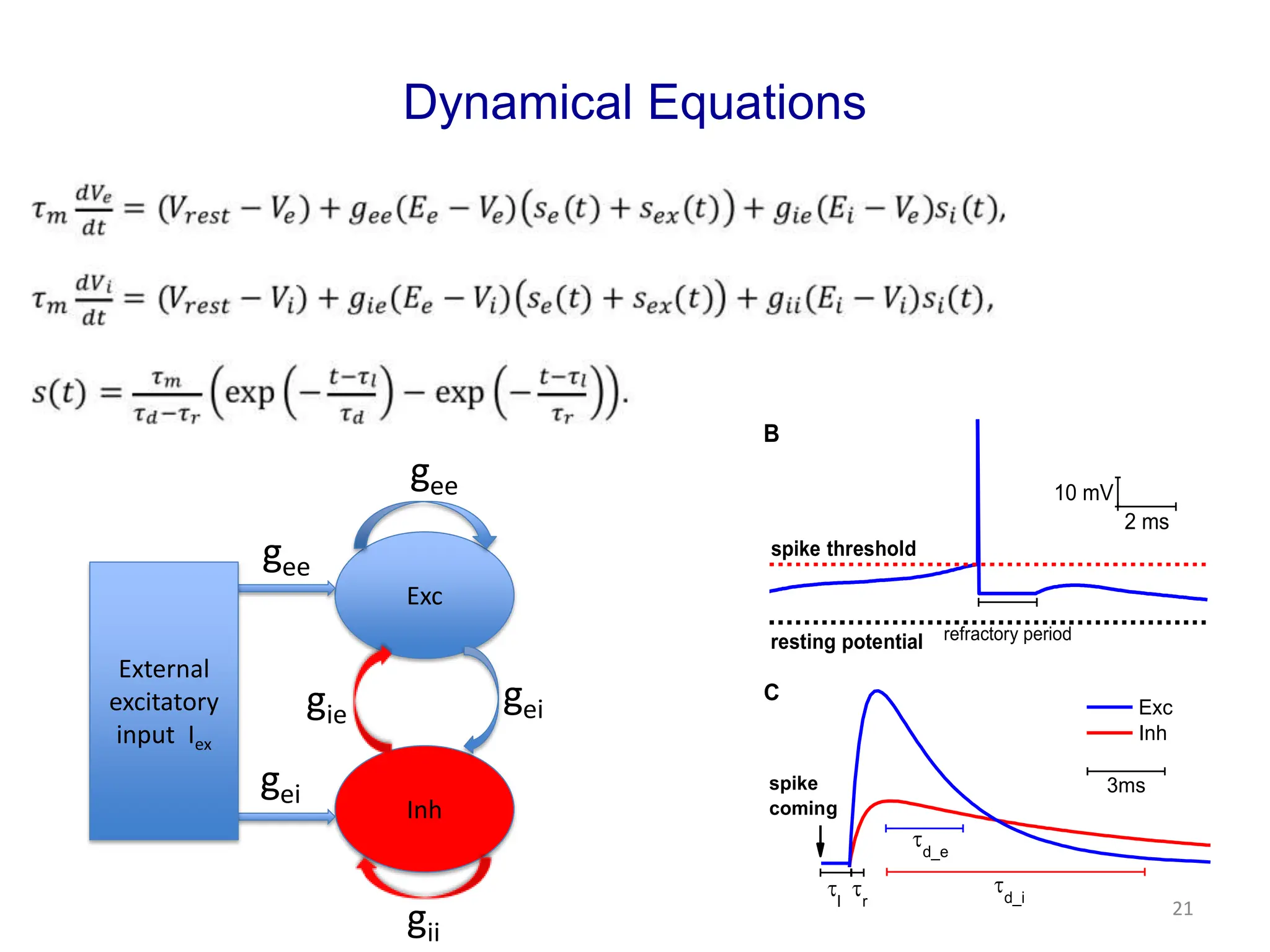
Dynamical Equations
Exc
Inh
External
excitatory
input Iex
=( )+ ( ) ( )
+ ( )
=( )+ ( ) ( )
+ ( )
gee
gii
gei
gie
gee
gei
Evolving Equations for potentials:
(t)=
(t)=
Time courses of synaptic conductance:
Exc
Inh
3ms
C
spike
coming
l r
d_e
d_i
spike threshold
resting potential
2 ms
10 mV
B
refractory period
21
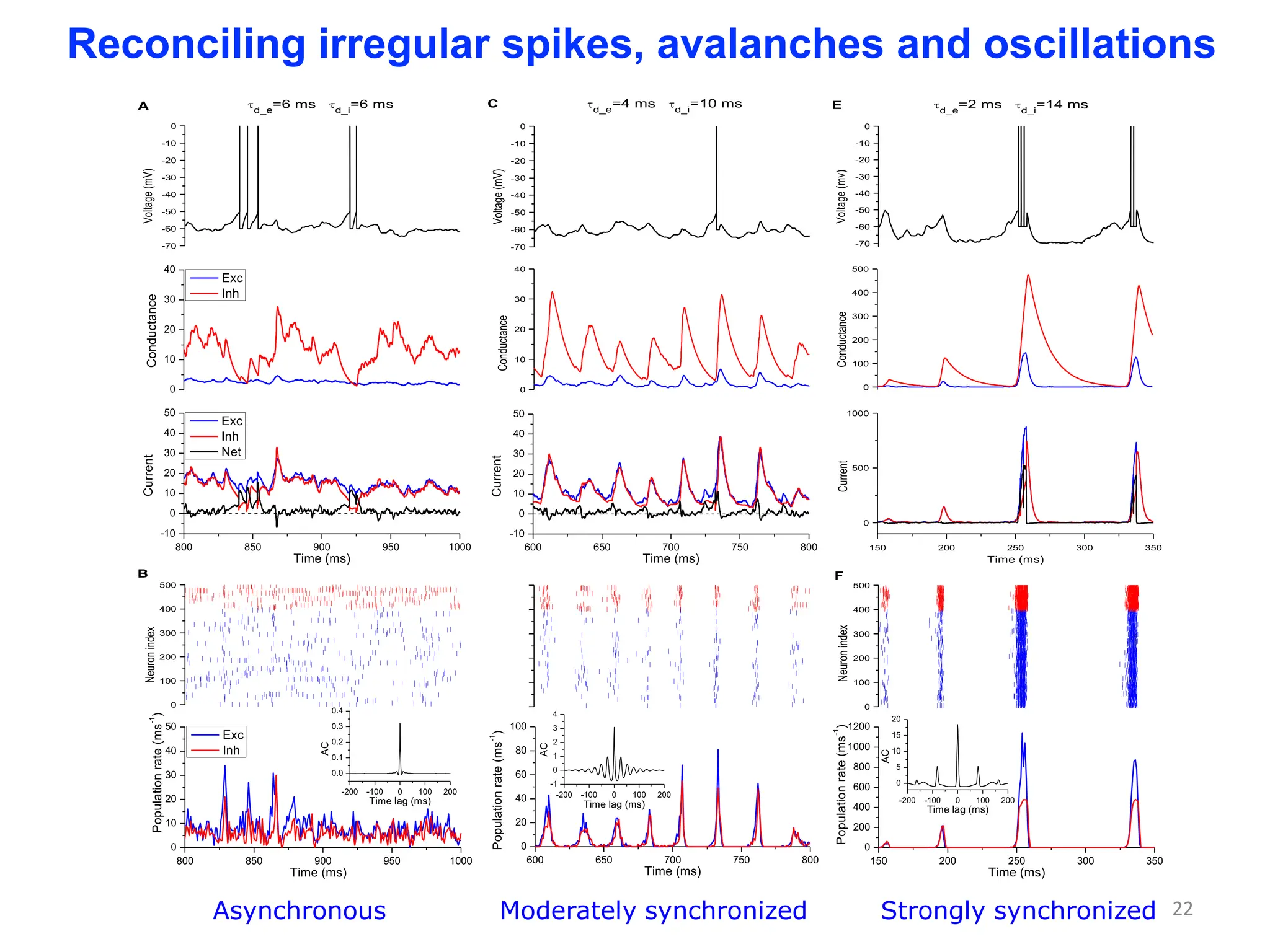
Reconciling irregular spikes, avalanches and oscillations
Asynchronous Moderately synchronized Strongly synchronized 22
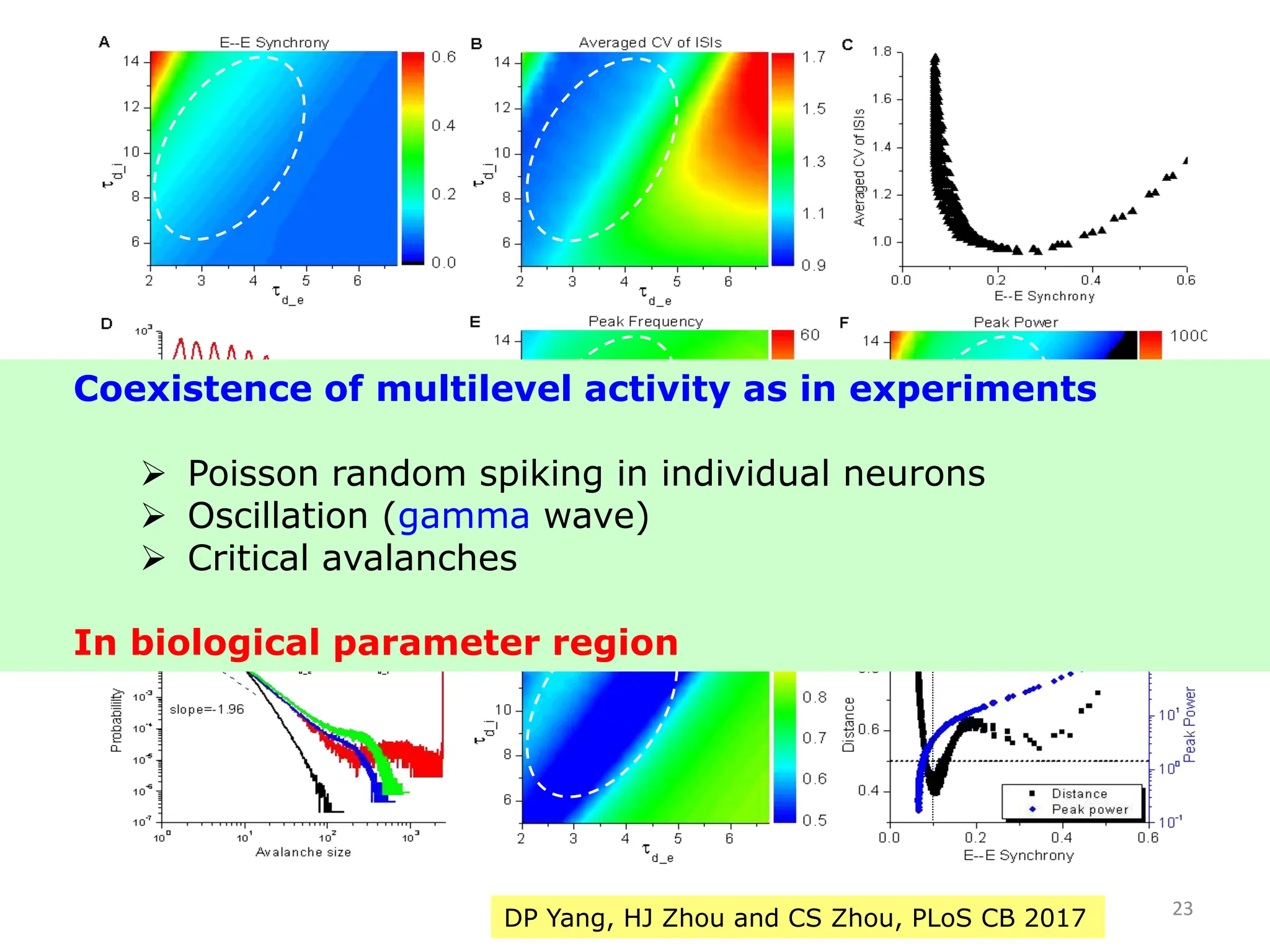
Coexistence of multilevel activity as in experiments
 Poisson random spiking in individual neurons
 Oscillation (gamma wave)
 Critical avalanches
In biological parameter region
23
DP Yang, HJ Zhou and CS Zhou, PLoS CB 2017
24
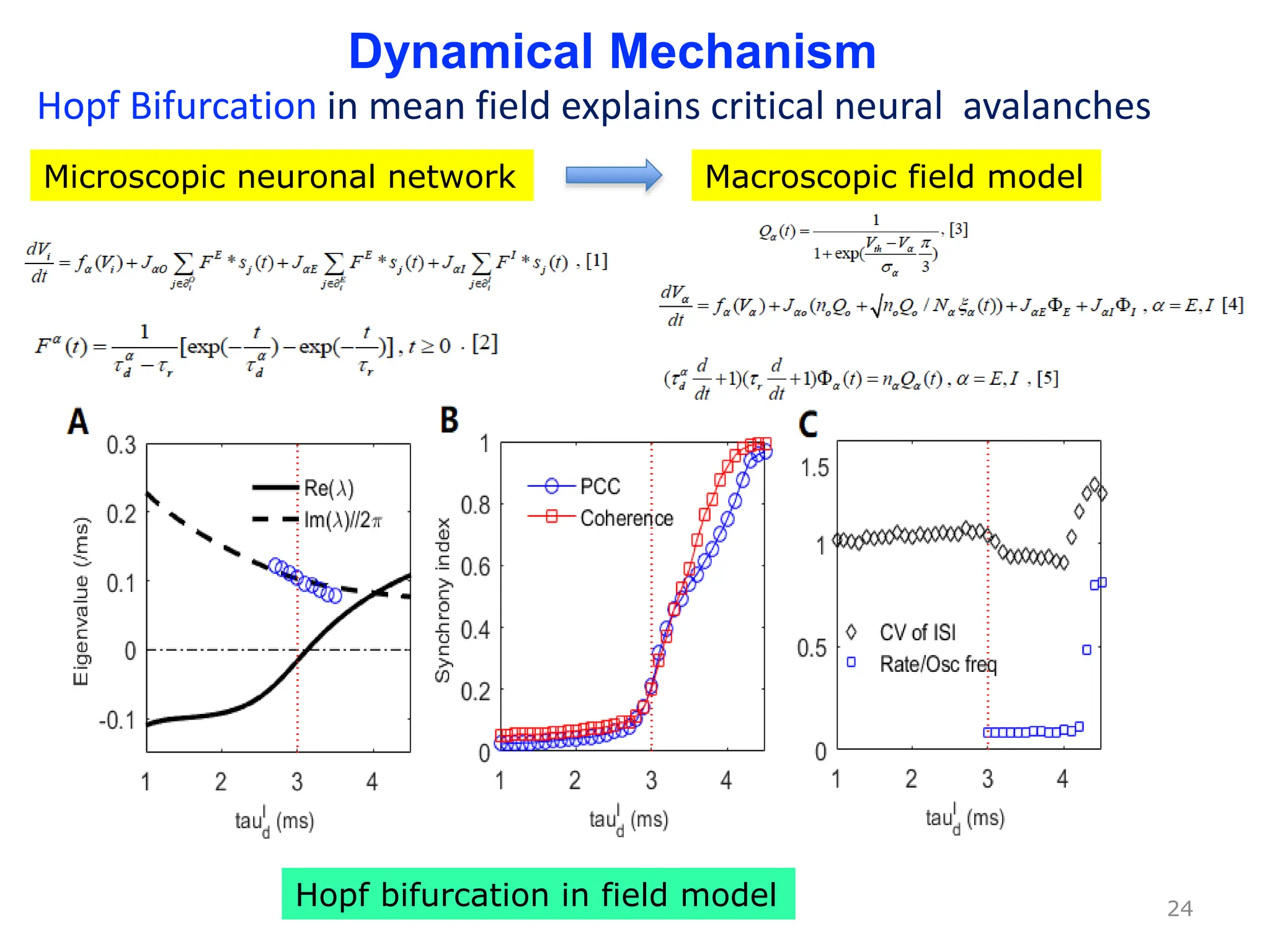
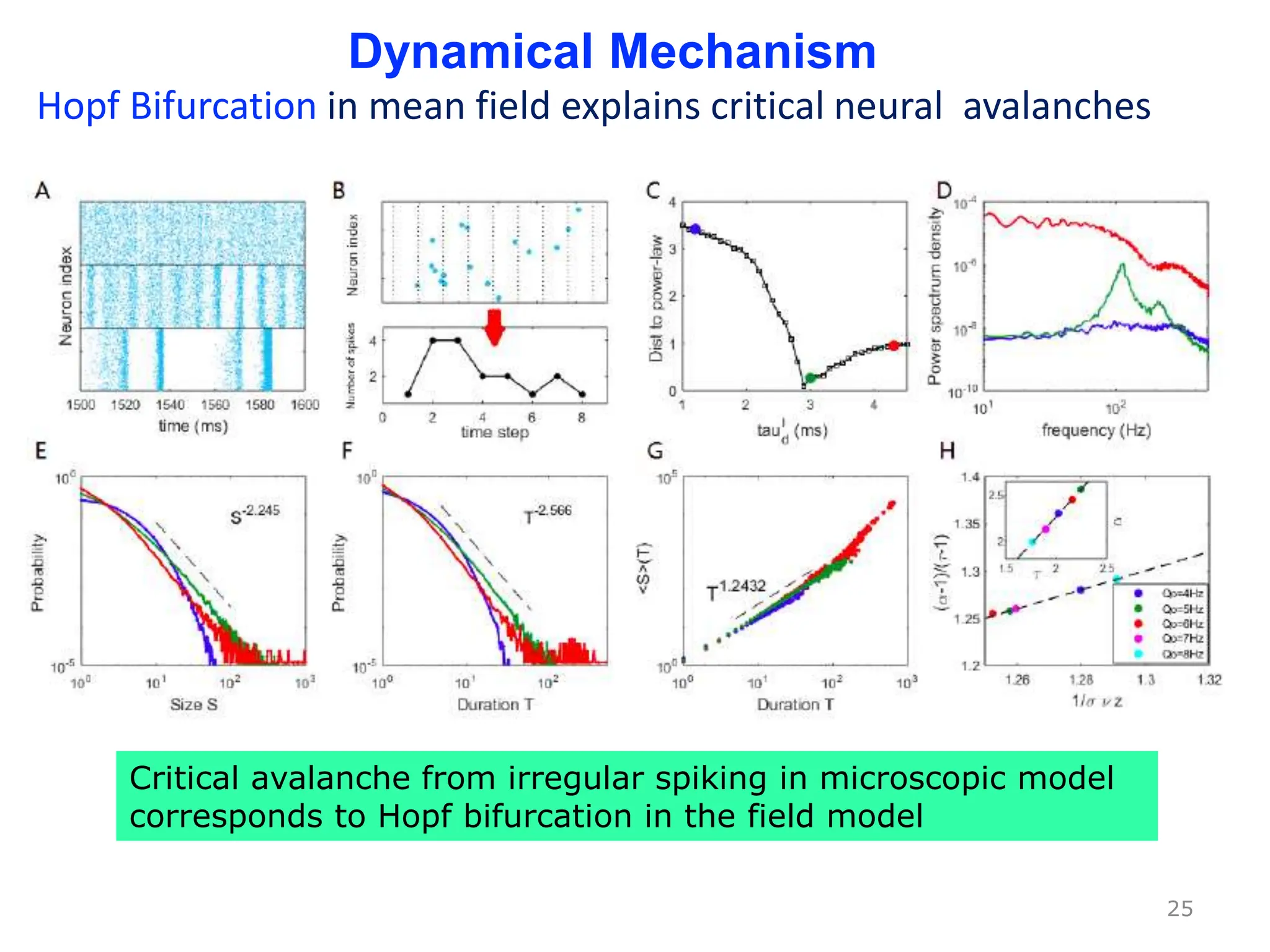
Dynamical Mechanism
Hopf Bifurcation in mean field explains critical neural avalanches
Microscopic neuronal network Macroscopic field model
Hopf bifurcation in field model
25
Critical avalanche from irregular spiking in microscopic model
corresponds to Hopf bifurcation in the field model
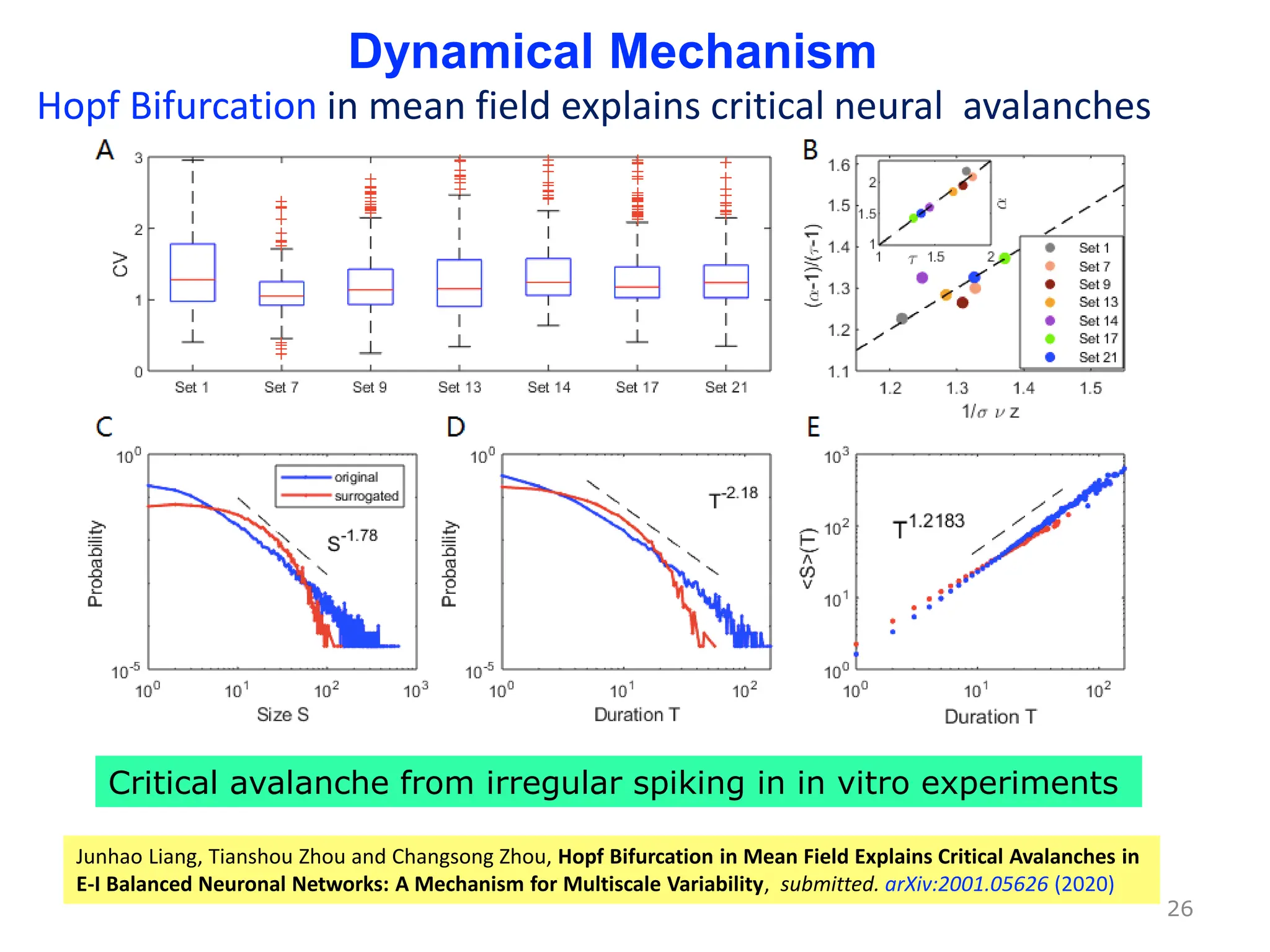
Dynamical Mechanism
Hopf Bifurcation in mean field explains critical neural avalanches
26
Critical avalanche from irregular spiking in in vitro experiments
Junhao Liang, Tianshou Zhou and Changsong Zhou, Hopf Bifurcation in Mean Field Explains Critical Avalanches in
E-I Balanced Neuronal Networks: A Mechanism for Multiscale Variability, submitted. arXiv:2001.05626 (2020)
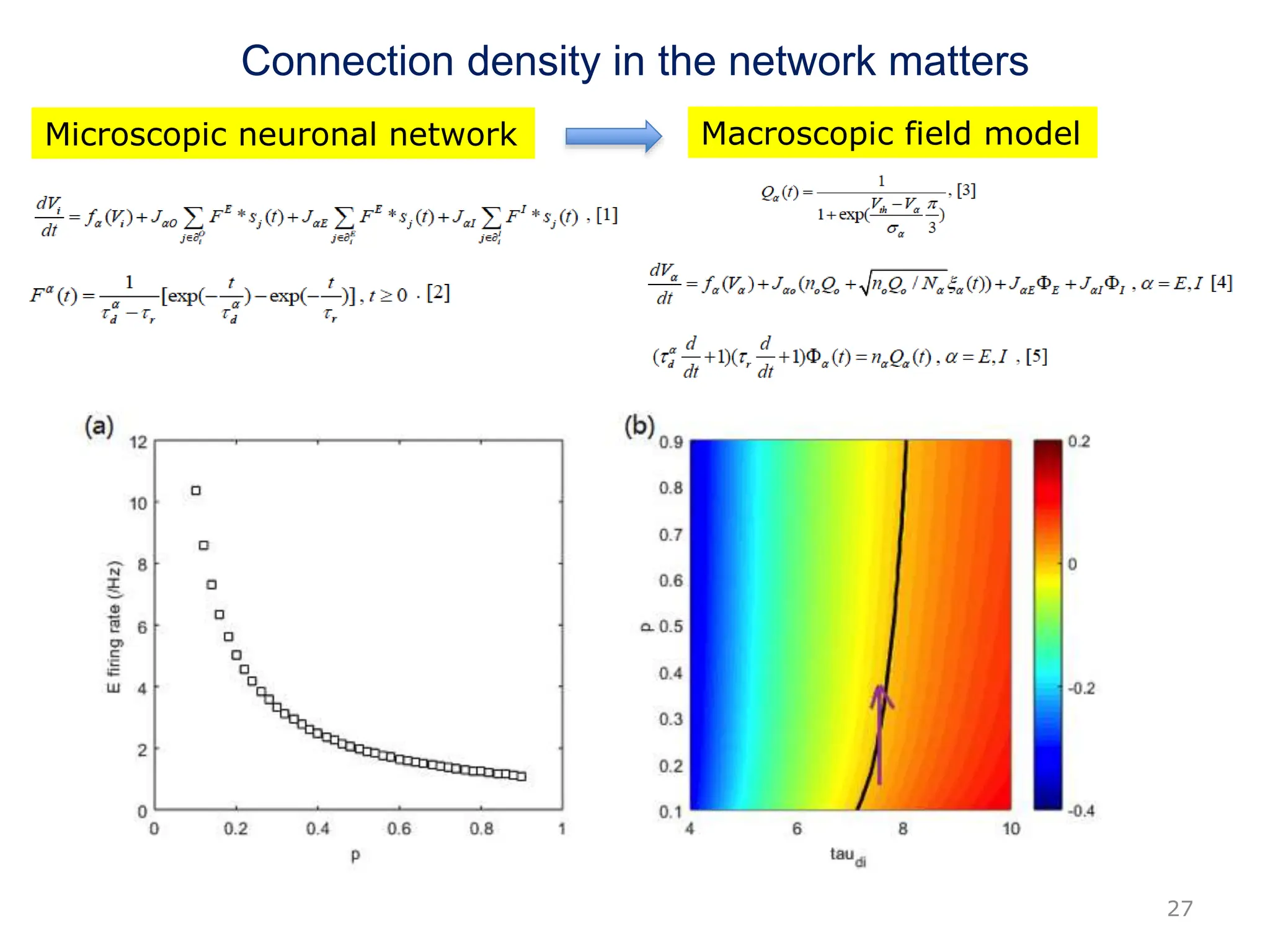
Dynamical Mechanism
Hopf Bifurcation in mean field explains critical neural avalanches
27
Connection density in the network matters
Microscopic neuronal network Macroscopic field model
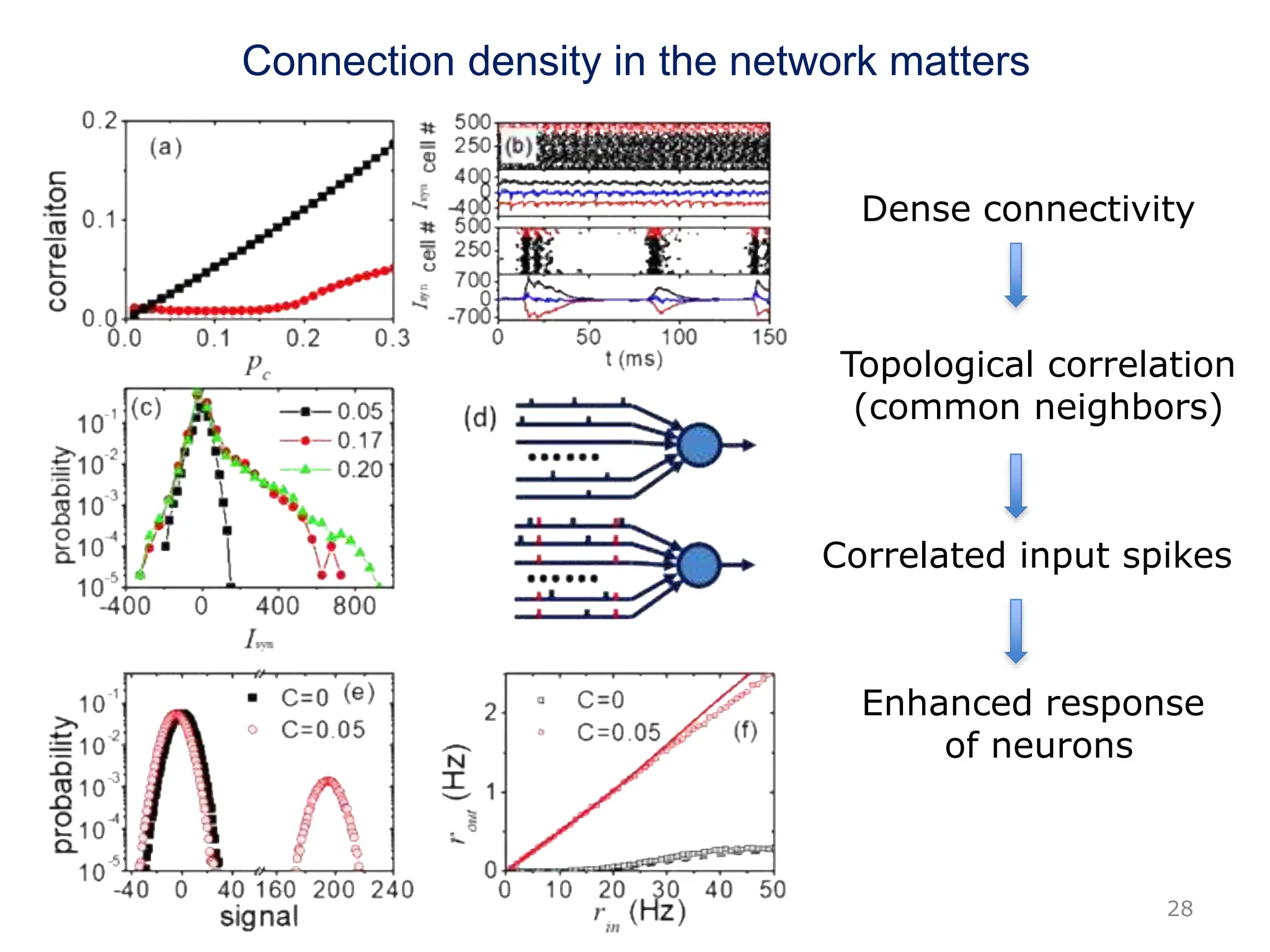
28
Connection density in the network matters
Dense connectivity
Topological correlation
(common neighbors)
Correlated input spikes
Enhanced response
of neurons
Time
Neuron
#
Δt
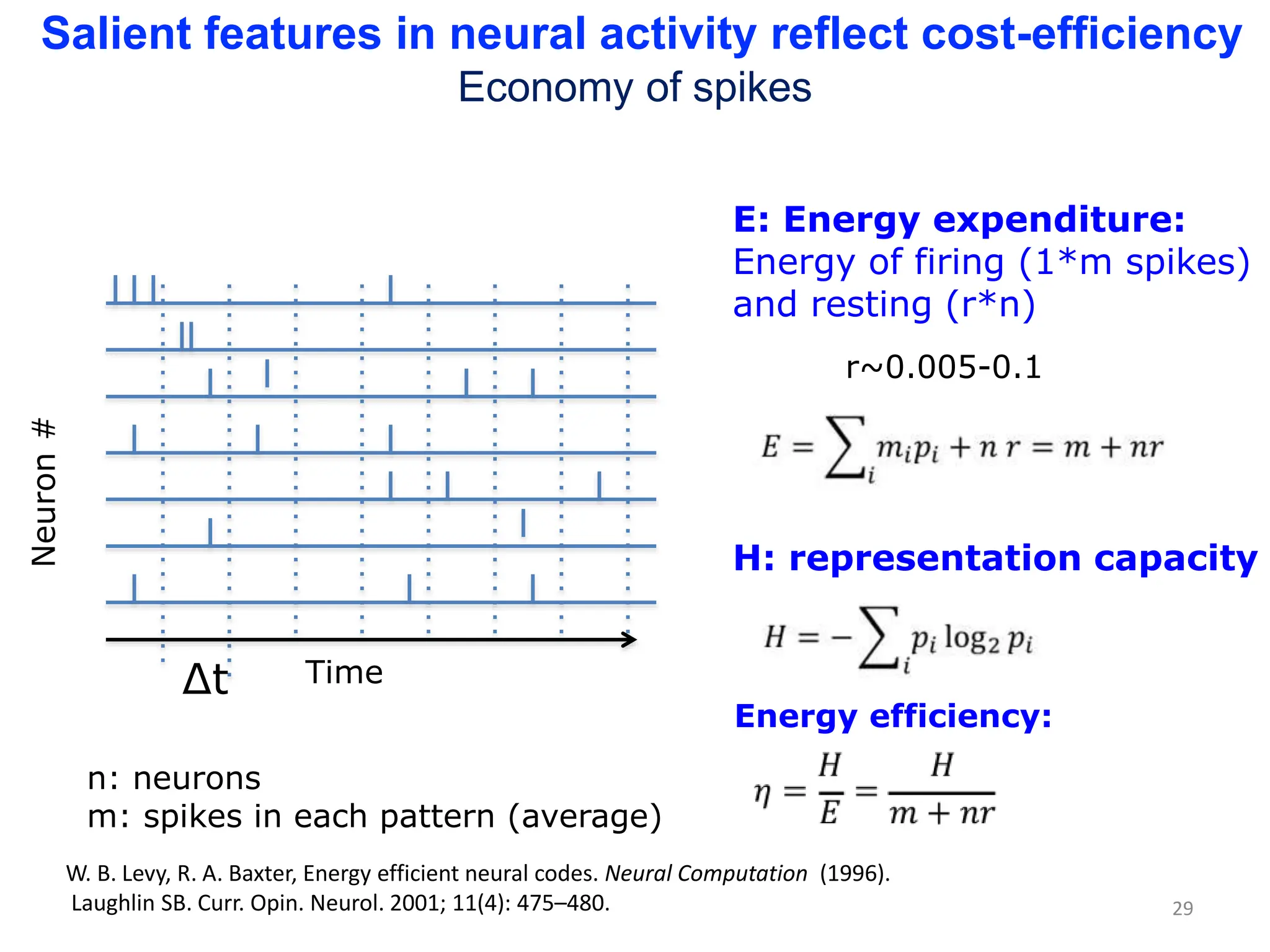
E: Energy expenditure:
Energy of firing (1*m spikes)
and resting (r*n)
H: representation capacity
n: neurons
m: spikes in each pattern (average)
Energy efficiency:
r~0.005-0.1
W. B. Levy, R. A. Baxter, Energy efficient neural codes. Neural Computation (1996).
Laughlin SB. Curr. Opin. Neurol. 2001; 11(4): 475–480. 29
Salient features in neural activity reflect cost-efficiency
Economy of spikes
Time
Neuron
#
Δt
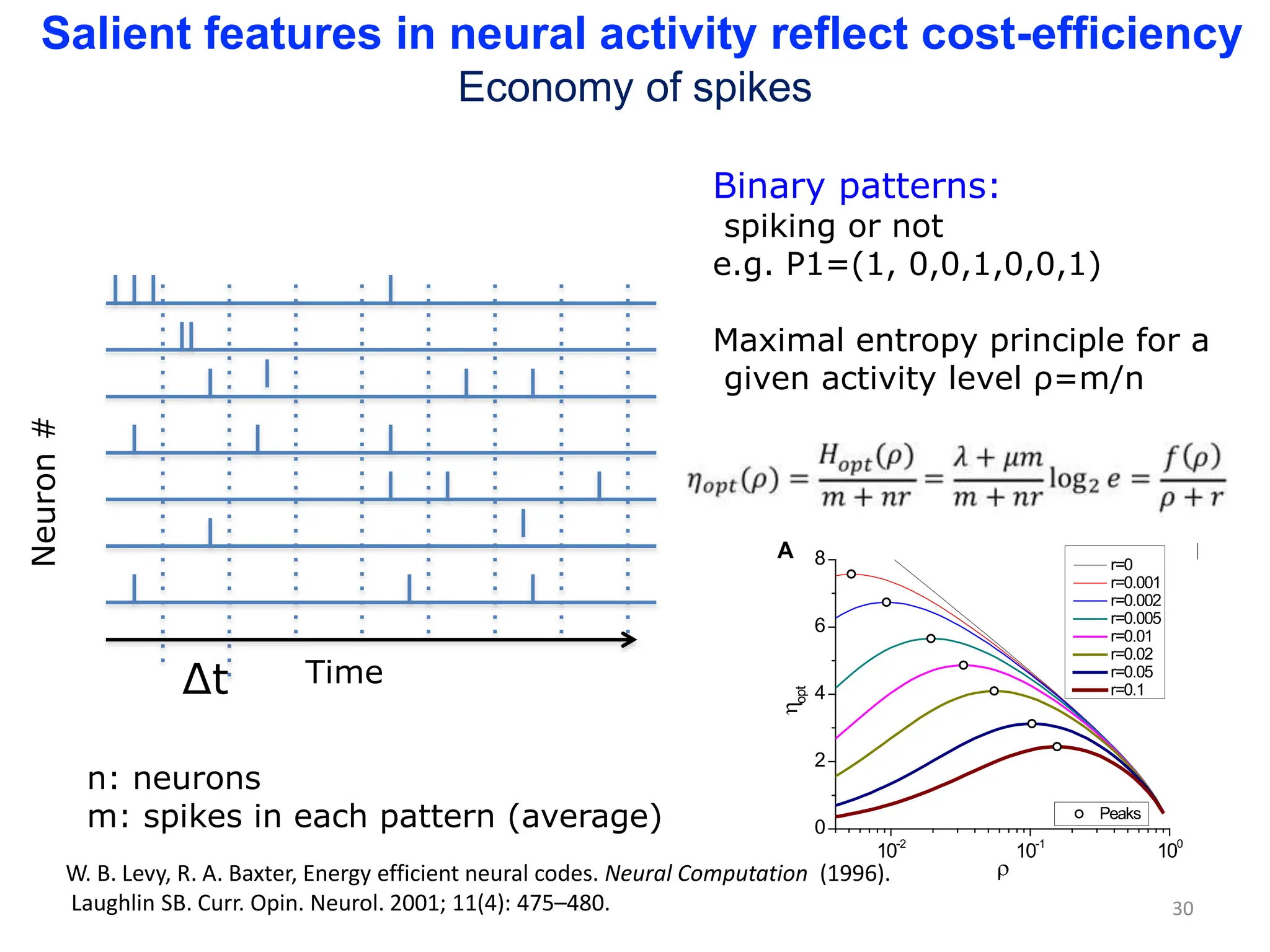
n: neurons
m: spikes in each pattern (average)
W. B. Levy, R. A. Baxter, Energy efficient neural codes. Neural Computation (1996).
Laughlin SB. Curr. Opin. Neurol. 2001; 11(4): 475–480. 30
Salient features in neural activity reflect cost-efficiency
Economy of spikes
Binary patterns:
spiking or not
e.g. P1=(1, 0,0,1,0,0,1)
Maximal entropy principle for a
given activity level ρ=m/n
31
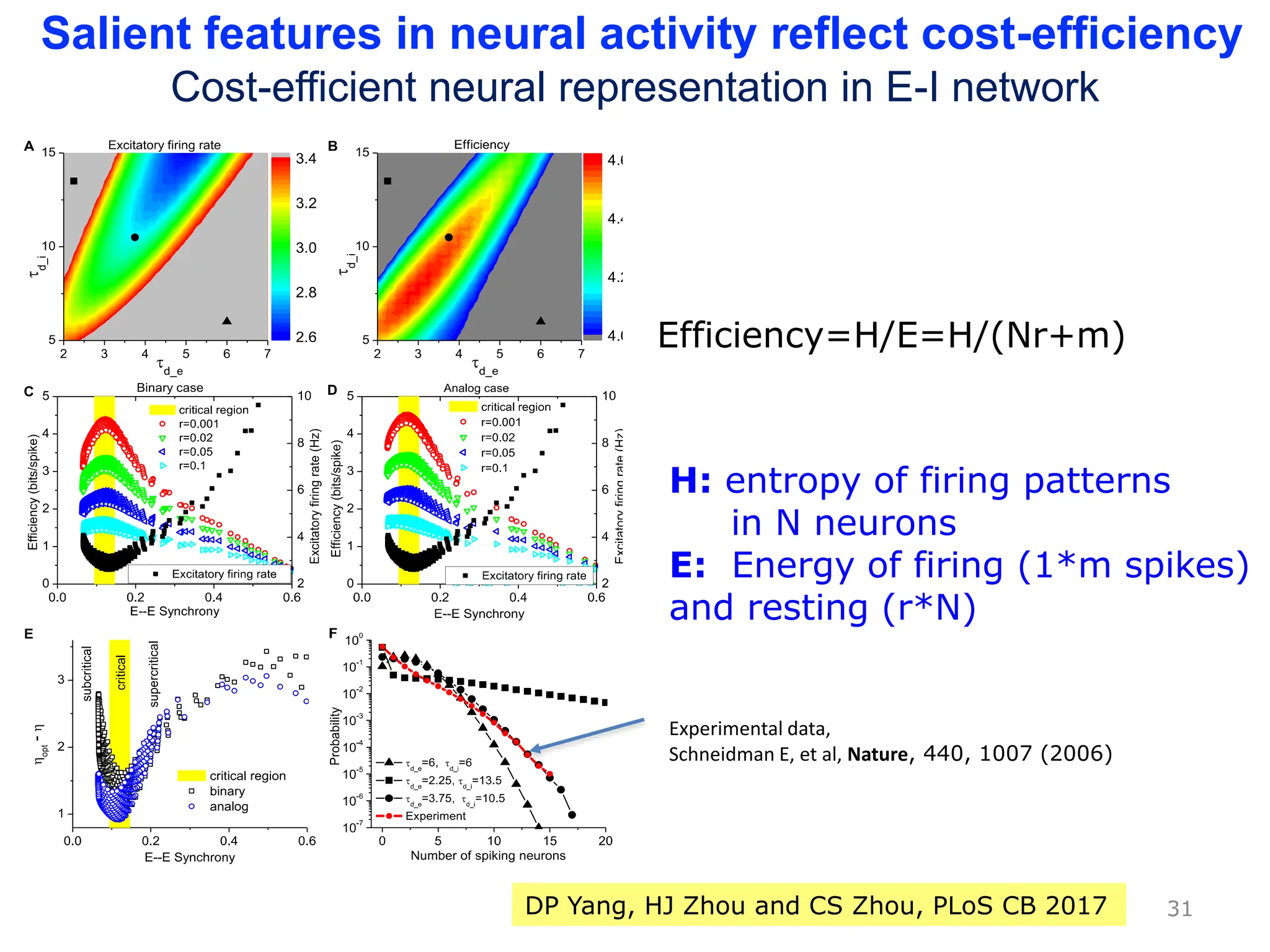
H: entropy of firing patterns
in N neurons
E: Energy of firing (1*m spikes)
and resting (r*N)
Efficiency=H/E=H/(Nr+m)
DP Yang, HJ Zhou and CS Zhou, PLoS CB 2017
Salient features in neural activity reflect cost-efficiency
Cost-efficient neural representation in E-I network
Experimental data,
Schneidman E, et al, Nature, 440, 1007 (2006)
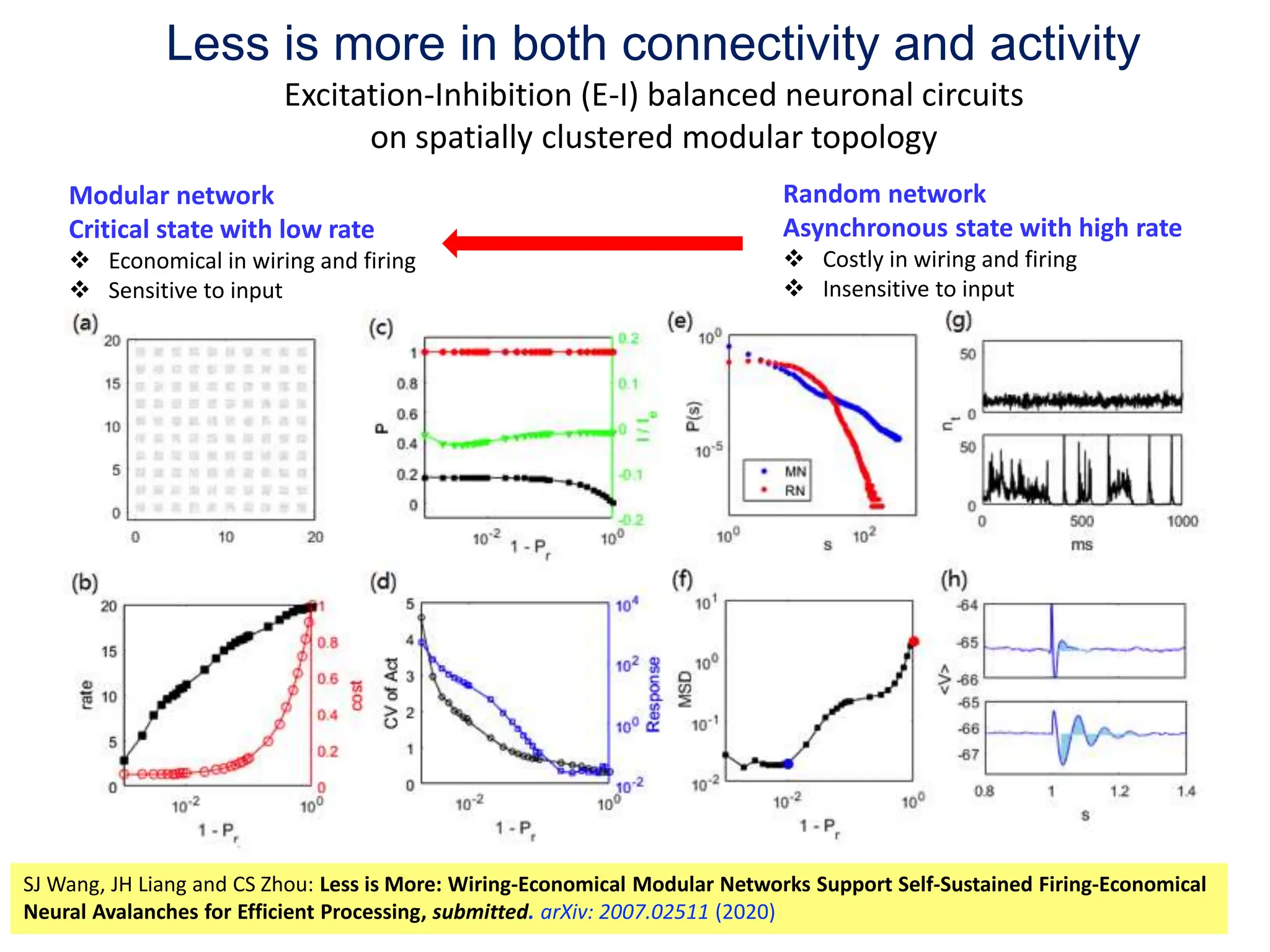
Less is more in both connectivity and activity
Excitation-Inhibition (E-I) balanced neuronal circuits
on spatially clustered modular topology
Random network
Asynchronous state with high rate
 Costly in wiring and firing
 Insensitive to input
Modular network
Critical state with low rate
 Economical in wiring and firing
 Sensitive to input
32
SJ Wang, JH Liang and CS Zhou: Less is More: Wiring-Economical Modular Networks Support Self-Sustained Firing-Economical
Neural Avalanches for Efficient Processing, submitted. arXiv: 2007.02511 (2020)
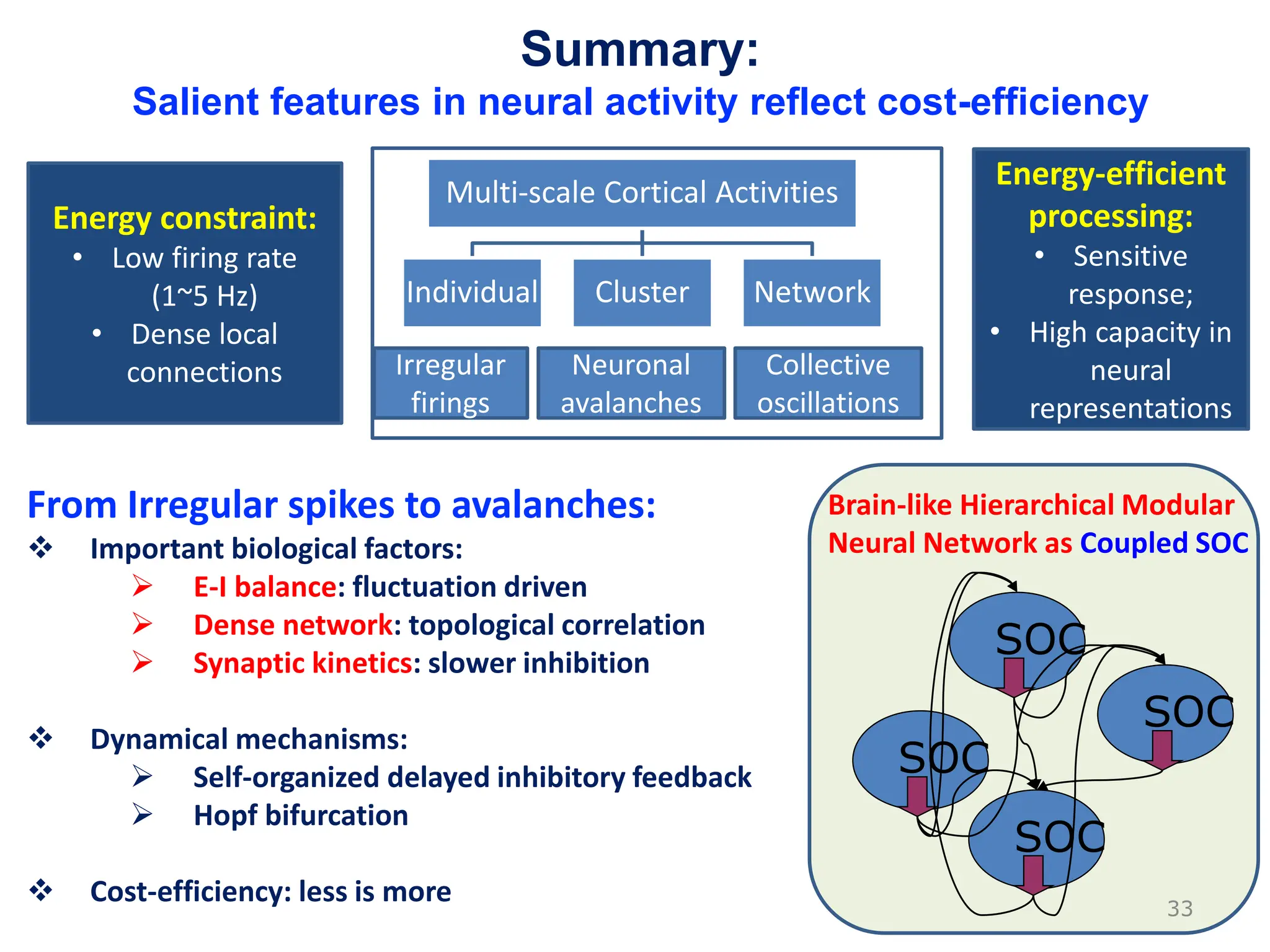
Summary:
Salient features in neural activity reflect cost-efficiency
33
Energy constraint:
• Low firing rate
(1~5 Hz)
• Dense local
connections
Energy-efficient
processing:
• Sensitive
response;
• High capacity in
neural
representations
Multi-scale Cortical Activities
Individual Cluster Network
Irregular
firings
Neuronal
avalanches
Collective
oscillations
From Irregular spikes to avalanches:
 Important biological factors:
 E-I balance: fluctuation driven
 Dense network: topological correlation
 Synaptic kinetics: slower inhibition
 Dynamical mechanisms:
 Self-organized delayed inhibitory feedback
 Hopf bifurcation
 Cost-efficiency: less is more
SOC
SOC
SOC
SOC
Brain-like Hierarchical Modular
Neural Network as Coupled SOC
Thank you for your
attention!
Thanks to collaborators:
Dongping Yang; Haijun Zhou;
Shengjun Wang; Junhao Liang
Funding:
Hong Kong RGC
NSFC
NSFC-RGC Joint Scheme
34
Our works on neural avalanches, brain criticality and signal complexity:
• JH Liang, TS Zhou and CS Zhou, arXiv:2001.05626 (2020)
• SJ Wang, JH Liang and CS Zhou, arXiv: 2007.02511 (2020)
• MX Liu, XY Liu, A Hildebrandt and CS Zhou, Cerebral Cortex Communication (2020)
• R Wang, P Lin, MX Liu, Y Wu, T Zhou and CS Zhou, Physical Review Letters (2019)
• MX Liu, CC Song, T Knopfel and CS Zhou, NeuroImage (2019)
• DP Yang, HJ Zhou and CS Zhou, PLoS Computational Biology (2017)
• SJ Wang, G Ouyang, G Jing, MS Zhang, M Wong, CS Zhou, Physical Review Letters (2016).
• SJ Wang, CS Zhou, New Journal Physics (2012 Highlight)
• SJ Wang, C Hilgetag, CS Zhou, Frontiers in Computational Neuroscience (2010)

neuronal network of NS systems short.ppt

  • 1.
    ZHOU Changsong (周昌松) Departmentof Physics Centre for Nonlinear Studies Institute of Computational and Theoretical Studies Hong Kong Baptist University 0 From Sparse Irregular Spikes to Critical Avalanches: Cost-Efficient Neural Dynamics
  • 2.
    1 Outline Brain as complexdynamical network system; cost-efficiency trade-off Reconcile irregular neuronal spiking and neural avalanches Less is more
  • 3.
    Brain as DynamicalComplex System D.R. Chialvo “Critical Brain Networks” Physica A 340 (2004)  High degree of freedom  Strong nonlinearity  Complex Connectivity 2 Human brain:  Highly costly: 2% of the body’s weight 20% of resting metabolism  Remarkably efficient: Power density (0.01W/cm2) 1/104 of CPU (50-100 W/cm2) Merolla, P.A., et al. A million spiking- neuron integrated circuit with a scalable communication network and interface, Science, 2014. 345, 668.
  • 4.
    Brain is afunctional Complex System: Designed by Great Nature through evolution Subject to multiple constraints Optimization of multiple functions The trade-off must be reflected in the architecture, activity and their interactions Shall brain-inspired intelligence be constrained by cost/function as in neural system? Cost-efficiency trade-off 3
  • 5.
    Energy cost ofcommunication in the brain Energy demands (50—80%) of spiking: • Restoration of ion movements • Propagation of action potentials • Neurotransmitter uptake Energy constraint: low firing rate (1~5Hz); minimizing fiber length 4 Laughlin, S.B., Energy as a constraint on the coding and processing of sensory information. Current opinion in neurobiology, 2001.
  • 6.
    Columns and layers Localneuronal circuits Connectivity and Complexity 5 • Connection Architecture/Topology
  • 7.
    Connectome Structure: Networkof Networks Hierarchy of Complex Modular Interaction 6 Complex Networks: • Small-world • Scale-free • Modular • Hierarchy Cat Human
  • 8.
    Connectome Structure: Networkof Networks Connectivity: Local: dense (0.1-0.2) Global: sparse (10-7-10-6) Excitatory: Inhibitory~ 4:1 Hierarchy of Complex Modular Interaction 7 Complex Networks: • Small-world • Scale-free • Modular • Hierarchy Cat Human Challenge for network science and statistical physics: hierarchical modular network Markov, et al., 2012 Neuron Highly heterogeneous weight
  • 9.
    – Individual activity: •low-rate firing • irregularity – Collective dynamics: • network oscillations • Critical neuronal avalanches 8 Salient features in brain activity
  • 10.
    Irregularity of neuronaldischarge 9 recorded from area MT (V5) of an alert monkey Softky, W.R. and C. Koch J Neurosci, 1993. 13, 334-350 Shadlen M N and Newsome W T, J Neurosci, 1998. 18, 3870–3896 Different trials with identical stimulus
  • 11.
    The origin ofirregularity: E-I balanced state E-I balance: equal average amounts of de- and hyperpolarizing membrane currents Shu, Y.S., et. al. Nature, 2003. 423, 288 Robert C. F, et. al. Nature, 2007. 450, 425 Van Vreeswijk, C. , Science, 1996. 274, 1724-1726. Properties: • Sparse network connectivity • Stable at low rate with high fluctuation • Display asynchronous irregular dynamics 10 Patch clamp technique External E I Binary (Ising) neuron network model 4/3/2024
  • 12.
    Instantaneous Balance: Tight Couplingof Excitation & Inhibition  Instantaneous correlation of excitation and inhibition  Inhibition lags behind excitation In rat somatosensory cortex in vivo M. Okun, I. Lampl, Nat. Neurosci. 11, 535 (2008). during ongoing and sensory-evoked activities 11
  • 13.
    Weak pairwise correlationis crucial for strongly correlated the firing patterns Boltzmann distribution under maximum entropy assumption: Schneidman E, et al, Nature, 2006, 440, 1007 12
  • 14.
    N. Friedam etal PRL 108, 208102 (2012) Fontenele et al PRL 122, 208101 (2019) Salient Feature of Brain Dynamics Neural Avalanches: Self-Organized Criticality (SOC): 13 Neuronal Spikes
  • 15.
    J. Beggs, D.Plenz, 2003. J. Neurosci. 23 (35), 11167. Salient Feature of Brain Dynamics Neural Avalanches: Self-Organized Criticality (SOC): E. Gireech, D. Plenz, 2008. PNAS, 105, 7576 T. Petemann, et al, D. Plenz, 2009. PNAS, 106, 15921 14 Local field potential
  • 16.
    15 SOC in slowfMRI cluster of point-process E. Tagliazucchi, et al.,Front. In Physio. 2012 Zhang and Raichle (2010) Nat Rev Neurosci Functional Magnetic Resonance Imaging (fMRI) Human resting fMRI Salient Feature of Brain Dynamics Neural Avalanches: Self-Organized Criticality (SOC):
  • 17.
    Critical neuronal avalanchesare crucial for efficient information processing Dynamic range Information Capacity Variability of Phase Synchrony Neuronal Avalanches imply maximum dynamic range in Cortical Networks at Criticality Shew, W.L., H.D. Yang, T. Petermann, R. Roy, and D. Plenz. J Neurosci, 2009. 29, 15595-15600 Information Capacity and Transmission Are Maximized in Balanced Cortical Networks with Neuronal Avalanches Shew, W.L., H. Yang, S. Yu, R. Roy, and D. Plenz. J Neurosci, 2011. 31, 55-63 Maximal variability of phase synchrony in cortical networks with neuronal avalanches Yang, H., W.L. Shew, R. Roy, and D. Plenz. J Neurosci, 2012. 32, 1061- 1072 16
  • 18.
    Collective oscillations 17 strong gamma(30–40 Hz) oscillation of the LFP, together with low (2 Hz) and irregular firing in pyramidal cells. a single pyramidal cell fires only once in every 15–20 cycles of the population rhythm. Fisahn A, et. al. Nature 394: 186–189, 1998. Human Brain Oscillations (EEG/MEG) Hippocampus in vitro Local field potential (LFP) Linkenkaer-Hansen K, J. Neurosci, 2001, 21: 1370 Theta: 4-7 Hz Alpha: 8-12 Hz Beta: 12-30 Hz Gamma: 30-100 Hz Delta: up to 4 Hz
  • 19.
    18 Saccade eye movementof Monkey: Prof. Zhang Mingsha, BNU + .  Eye track; LFP;  Multiple trials;  Spike sorting; Multilevel Dynamics:  Irregular spiking  Oscillations  Critical avalanches  Event-related potential (ERP) M. Chen, Y. Liu, L. Wei, and M. Zhang, J. Neurosci. 33, 814 (2013). SJ Wang, G Ouyang, G Jing, MS Zhang, M Wong, CS Zhou, Phys. Rev. Lett. 2016
  • 20.
    Questions 19 How irregular spiking,neural avalanches and oscillations can be reconciled? What are the important factors? What is the dynamical mechanism? Is it cost-efficient? We try to address these questions using biologically plausible neuronal network model and statistical physics analysis
  • 21.
    Conductance-based neuronal networkmodel Brunel, N. and X.J. Wang, J Neurophysiol, 2003. 90, 415-430 Random E-I recurrent network Time course of synaptic conductance: Slow inhibitory synaptic current (5~10ms) Exc Inh External excitatory input Iex =( )+ ( ) ( ) + ( ) =( )+ ( ) ( ) + ( ) gee gii gei gie gee gei Evolving Equations for potentials: (t)= (t)= Time courses of synaptic conductance: Fast excitatory synaptic current (2~5 ms)  N=2500 neurons (80% exc)  Random network  Connectivity p=0.2  Poisson input 20
  • 22.
    Dynamical Equations Exc Inh External excitatory input Iex =()+ ( ) ( ) + ( ) =( )+ ( ) ( ) + ( ) gee gii gei gie gee gei Evolving Equations for potentials: (t)= (t)= Time courses of synaptic conductance: Exc Inh 3ms C spike coming l r d_e d_i spike threshold resting potential 2 ms 10 mV B refractory period 21
  • 23.
    Reconciling irregular spikes,avalanches and oscillations Asynchronous Moderately synchronized Strongly synchronized 22
  • 24.
    Coexistence of multilevelactivity as in experiments  Poisson random spiking in individual neurons  Oscillation (gamma wave)  Critical avalanches In biological parameter region 23 DP Yang, HJ Zhou and CS Zhou, PLoS CB 2017
  • 25.
    24 Dynamical Mechanism Hopf Bifurcationin mean field explains critical neural avalanches Microscopic neuronal network Macroscopic field model Hopf bifurcation in field model
  • 26.
    25 Critical avalanche fromirregular spiking in microscopic model corresponds to Hopf bifurcation in the field model Dynamical Mechanism Hopf Bifurcation in mean field explains critical neural avalanches
  • 27.
    26 Critical avalanche fromirregular spiking in in vitro experiments Junhao Liang, Tianshou Zhou and Changsong Zhou, Hopf Bifurcation in Mean Field Explains Critical Avalanches in E-I Balanced Neuronal Networks: A Mechanism for Multiscale Variability, submitted. arXiv:2001.05626 (2020) Dynamical Mechanism Hopf Bifurcation in mean field explains critical neural avalanches
  • 28.
    27 Connection density inthe network matters Microscopic neuronal network Macroscopic field model
  • 29.
    28 Connection density inthe network matters Dense connectivity Topological correlation (common neighbors) Correlated input spikes Enhanced response of neurons
  • 30.
    Time Neuron # Δt E: Energy expenditure: Energyof firing (1*m spikes) and resting (r*n) H: representation capacity n: neurons m: spikes in each pattern (average) Energy efficiency: r~0.005-0.1 W. B. Levy, R. A. Baxter, Energy efficient neural codes. Neural Computation (1996). Laughlin SB. Curr. Opin. Neurol. 2001; 11(4): 475–480. 29 Salient features in neural activity reflect cost-efficiency Economy of spikes
  • 31.
    Time Neuron # Δt n: neurons m: spikesin each pattern (average) W. B. Levy, R. A. Baxter, Energy efficient neural codes. Neural Computation (1996). Laughlin SB. Curr. Opin. Neurol. 2001; 11(4): 475–480. 30 Salient features in neural activity reflect cost-efficiency Economy of spikes Binary patterns: spiking or not e.g. P1=(1, 0,0,1,0,0,1) Maximal entropy principle for a given activity level ρ=m/n
  • 32.
    31 H: entropy offiring patterns in N neurons E: Energy of firing (1*m spikes) and resting (r*N) Efficiency=H/E=H/(Nr+m) DP Yang, HJ Zhou and CS Zhou, PLoS CB 2017 Salient features in neural activity reflect cost-efficiency Cost-efficient neural representation in E-I network Experimental data, Schneidman E, et al, Nature, 440, 1007 (2006)
  • 33.
    Less is morein both connectivity and activity Excitation-Inhibition (E-I) balanced neuronal circuits on spatially clustered modular topology Random network Asynchronous state with high rate  Costly in wiring and firing  Insensitive to input Modular network Critical state with low rate  Economical in wiring and firing  Sensitive to input 32 SJ Wang, JH Liang and CS Zhou: Less is More: Wiring-Economical Modular Networks Support Self-Sustained Firing-Economical Neural Avalanches for Efficient Processing, submitted. arXiv: 2007.02511 (2020)
  • 34.
    Summary: Salient features inneural activity reflect cost-efficiency 33 Energy constraint: • Low firing rate (1~5 Hz) • Dense local connections Energy-efficient processing: • Sensitive response; • High capacity in neural representations Multi-scale Cortical Activities Individual Cluster Network Irregular firings Neuronal avalanches Collective oscillations From Irregular spikes to avalanches:  Important biological factors:  E-I balance: fluctuation driven  Dense network: topological correlation  Synaptic kinetics: slower inhibition  Dynamical mechanisms:  Self-organized delayed inhibitory feedback  Hopf bifurcation  Cost-efficiency: less is more SOC SOC SOC SOC Brain-like Hierarchical Modular Neural Network as Coupled SOC
  • 35.
    Thank you foryour attention! Thanks to collaborators: Dongping Yang; Haijun Zhou; Shengjun Wang; Junhao Liang Funding: Hong Kong RGC NSFC NSFC-RGC Joint Scheme 34 Our works on neural avalanches, brain criticality and signal complexity: • JH Liang, TS Zhou and CS Zhou, arXiv:2001.05626 (2020) • SJ Wang, JH Liang and CS Zhou, arXiv: 2007.02511 (2020) • MX Liu, XY Liu, A Hildebrandt and CS Zhou, Cerebral Cortex Communication (2020) • R Wang, P Lin, MX Liu, Y Wu, T Zhou and CS Zhou, Physical Review Letters (2019) • MX Liu, CC Song, T Knopfel and CS Zhou, NeuroImage (2019) • DP Yang, HJ Zhou and CS Zhou, PLoS Computational Biology (2017) • SJ Wang, G Ouyang, G Jing, MS Zhang, M Wong, CS Zhou, Physical Review Letters (2016). • SJ Wang, CS Zhou, New Journal Physics (2012 Highlight) • SJ Wang, C Hilgetag, CS Zhou, Frontiers in Computational Neuroscience (2010)