Kingdom Monera
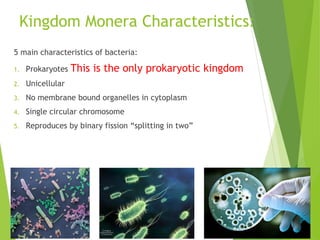
Kingdom Monera Characteristics:
5 main characteristics of bacteria:
1. Prokaryotes This is the only prokaryotic kingdom
2. Unicellular
3. No membrane bound organelles in cytoplasm
4. Single circular chromosome
5. Reproduces by binary fission “splitting in two”
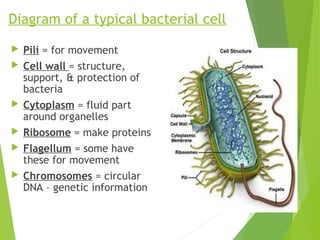
Diagram of a typical bacterial cell
 Pili = for movement
 Cell wall = structure,
support, & protection of
bacteria
 Cytoplasm = fluid part
around organelles
 Ribosome = make proteins
 Flagellum = some have
these for movement
 Chromosomes = circular
DNA – genetic information
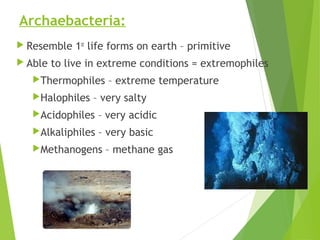
Archaebacteria:
 Resemble 1st
life forms on earth – primitive
 Able to live in extreme conditions = extremophiles
Thermophiles – extreme temperature
Halophiles – very salty
Acidophiles – very acidic
Alkaliphiles – very basic
Methanogens – methane gas
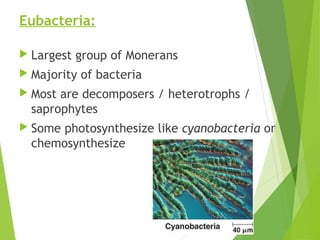
Eubacteria:
 Largest group of Monerans
 Majority of bacteria
 Most are decomposers / heterotrophs /
saprophytes
 Some photosynthesize like cyanobacteria or
chemosynthesize
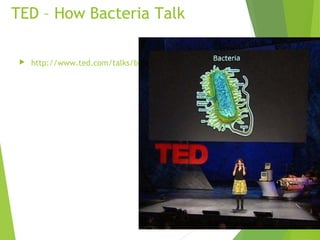
TED – How Bacteria Talk
 http://www.ted.com/talks/bonnie_bassler_on_how_bacteria_communicate
Define the following in your own words.
Record into your notes.
 Obligate aerobe & give an example
 Obligate anaerobe & give an example
 Facultative anaerobe
 Fermentation
 Parasite
 Saprophyte
 Decomposers
 Symbiosis
 Photosynthesis
 Chemosynthesis

Kingdom monera characteristics

  • 1.
  • 2.
    Kingdom Monera Characteristics: 5main characteristics of bacteria: 1. Prokaryotes This is the only prokaryotic kingdom 2. Unicellular 3. No membrane bound organelles in cytoplasm 4. Single circular chromosome 5. Reproduces by binary fission “splitting in two”
  • 3.
    Diagram of atypical bacterial cell  Pili = for movement  Cell wall = structure, support, & protection of bacteria  Cytoplasm = fluid part around organelles  Ribosome = make proteins  Flagellum = some have these for movement  Chromosomes = circular DNA – genetic information
  • 4.
    Archaebacteria:  Resemble 1st lifeforms on earth – primitive  Able to live in extreme conditions = extremophiles Thermophiles – extreme temperature Halophiles – very salty Acidophiles – very acidic Alkaliphiles – very basic Methanogens – methane gas
  • 5.
    Eubacteria:  Largest groupof Monerans  Majority of bacteria  Most are decomposers / heterotrophs / saprophytes  Some photosynthesize like cyanobacteria or chemosynthesize
  • 6.
    TED – HowBacteria Talk  http://www.ted.com/talks/bonnie_bassler_on_how_bacteria_communicate
  • 7.
    Define the followingin your own words. Record into your notes.  Obligate aerobe & give an example  Obligate anaerobe & give an example  Facultative anaerobe  Fermentation  Parasite  Saprophyte  Decomposers  Symbiosis  Photosynthesis  Chemosynthesis