©
www.bankofbiology.com
bankofbiology.com
Aristotle’s classification
• Aristotle was the earliest to attempt a more scientific basis for classification
of organisms.
• He classified plants to trees, shrubs & herbs and animals into 2 groups, those
with red blood and without red blood.
bankofbiology.co
ANIMALS
Red
Blood
Mammals,
lizards,
birds, fish
No Red
Blood
Hard bodied insects
Soft bodied
Shell Shellfish
No shell Jellyfish
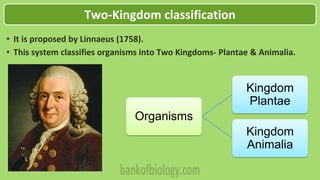
• It is proposed by Linnaeus (1758).
• This system classifies organisms into Two Kingdoms- Plantae & Animalia.
Organisms
Kingdom
Plantae
Kingdom
Animalia
Two-Kingdom classification
• Prokaryotes (Bacteria, cyanobacteria) &
eukaryotes (fungi, mosses, ferns, gymnosperms
& angiosperms) were included under ‘Plants’
based on the presence of cell wall. But they are
widely differed in other features.
• It included unicellular & multicellular organisms
in same group. E.g. Chlamydomonas &
Spirogyra were placed under algae.
• It did not differentiate between heterotrophic
fungi and autotrophic green plants. Fungi have
chitinous cell wall while the green plants have
cellulosic cell wall.
Drawbacks of 2-kingdom classification
Two-Kingdom classification
Chlamydomonas Spirogyra
bankofbiology.co
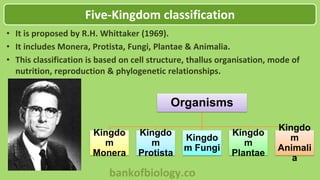
• It is proposed by R.H. Whittaker (1969).
• It includes Monera, Protista, Fungi, Plantae & Animalia.
• This classification is based on cell structure, thallus organisation, mode of
nutrition, reproduction & phylogenetic relationships.
Five-Kingdom classification
Organisms
Kingdo
m
Monera
Kingdo
m
Protista
Kingdo
m Fungi
Kingdo
m
Plantae
Kingdo
m
Animali
a
bankofbiology.co
Characters Monera Protista Fungi Plantae Animalia
Cell type Prokaryotic Eukaryotic Eukaryotic Eukaryotic Eukaryotic
Cell wall
Non-cellulosic
(polysaccharide +
amino acid)
Present in some
Present
(Chitin & poly-
saccharides)
Present
(cellulose)
Absent
Nuclear
membrane
Absent Present Present Present Present
Body
organization
Cellular Cellular
Multicellular,
loose tissue
Tissue/organ
Tissue/organ/
organ system
Mode of
nutrition
Autotrophic
(photosynthetic &
chemosynthetic)
and heterotrophic
(saprophyte/
parasite)
Autotrophic
(photosynthetic)
& heterotrophic
Heterotrophic
(saprophytic
or parasitic)
Autotrophic
(photo-
synthetic)
Heterotrophic
(holozoic,
saprophytic etc)
Characteristics of the five Kingdom
bankofbiology.co
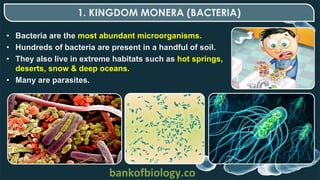
1. KINGDOM MONERA (BACTERIA)
• Bacteria are the most abundant microorganisms.
• Hundreds of bacteria are present in a handful of soil.
• They also live in extreme habitats such as hot springs,
deserts, snow & deep oceans.
• Many are parasites.
bankofbiology.co
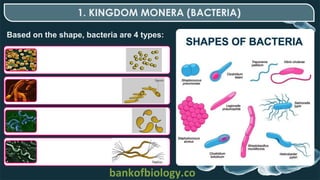
Coccus (Spherical)
Bacillus (Rod-shaped)
Vibrium (Comma-shaped)
Spirillum (Spiral)
Based on the shape, bacteria are 4 types:
1. KINGDOM MONERA (BACTERIA)
bankofbiology.co
• Bacterial structure is very simple
but they are complex in
behaviour and show metabolic
diversity.
• Some bacteria are autotrophic
(synthesize food from inorganic
substrates).
• Majority are heterotrophs (they
do not synthesize the food but
depend on other organisms or on
dead organic matter for food).
1. KINGDOM MONERA (BACTERIA)
bankofbiology.co
Bacteria
Archaebacteri
a
Halophiles
Thermo-
acidophiles
Methanogens
Eubacteria
Autotrophs
Photosynthetic
autotrophs
Chemosynthetic
autotrophs
Heterotrophs
Parasitic
Saprophytic
bankofbiology.com
1. KINGDOM MONERA (BACTERIA) CLASSIFICATION
• They live in harshest habitats such as extreme salty areas (halophiles), hot springs
(thermoacidophiles) and marshy areas (methanogens).
• Archaebacteria have a different cell wall structure for their survival in extreme
conditions.
• Methanogens are present in the guts of ruminant animals (cows, buffaloes etc). They
produce methane (biogas) from the dung of these animals.
1. KINGDOM MONERA (BACTERIA) 1. ARCHAEBACTERIA
bankofbiology.com
• They are True Bacteria having a rigid cell wall and a flagellum (if motile).
• They include Autotrophs (photosynthetic & chemosynthetic) and Heterotrophs.
1. KINGDOM MONERA (BACTERIA) 2. EUBACTERIA
bankofbiology.com
Nostoc
• They have chlorophyll a similar to that of
green plants.
Cyanobacteria (blue-green algae)
• Unicellular, colonial or filamentous,
marine or terrestrial algae.
• The colonies are generally surrounded by
gelatinous sheath.
• They often form blooms in polluted water
bodies.
• Some of them fix atmospheric N2 in
specialized cells called heterocysts.
• E.g. Nostoc & Anabaena.
Anabaena
A. Photosynthetic autotrophs (E.g. Cyanobacteria)
1. KINGDOM MONERA (BACTERIA) 2. EUBACTERIA
bankofbiology.com
• They oxidize inorganic substances such as
nitrates, nitrites & ammonia and use the
released energy for ATP production.
• They help in recycling nutrients like nitrogen,
phosphorous, iron & sulphur.
B. Chemosynthetic autotrophs
1. KINGDOM MONERA (BACTERIA) 2. EUBACTERIA
Venenivibrio stagnispumantis
Green sulphur bacteria Purple sulphur bacteria
bankofbiology.com
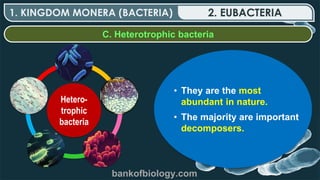
Hetero-
trophic
bacteria
C. Heterotrophic bacteria
1. KINGDOM MONERA (BACTERIA) 2. EUBACTERIA
• They are the most
abundant in nature.
• The majority are important
decomposers.
bankofbiology.com
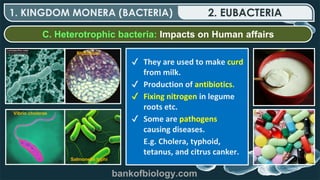
✔ They are used to make curd
from milk.
✔ Production of antibiotics.
✔ Fixing nitrogen in legume
roots etc.
✔ Some are pathogens
causing diseases.
E.g. Cholera, typhoid,
tetanus, and citrus canker.
Salmonella typhi
Vibrio cholerae
Rhizobium
1. KINGDOM MONERA (BACTERIA) 2. EUBACTERIA
C. Heterotrophic bacteria: Impacts on Human affairs
bankofbiology.com
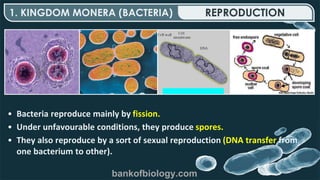
• Bacteria reproduce mainly by fission.
• Under unfavourable conditions, they produce spores.
• They also reproduce by a sort of sexual reproduction (DNA transfer from
one bacterium to other).
1. KINGDOM MONERA (BACTERIA) REPRODUCTION
bankofbiology.com
• They are organisms without a cell wall.
• They are the smallest living cells known.
• They can survive without oxygen.
• Many are pathogenic in animals and plants.
1. KINGDOM MONERA (BACTERIA) MYCOPLASMAS
bankofbiology.com
Need Full Version...?
WhatsApp: 89215 10476

2 biological classification.ppsx.pptx

  • 1.
  • 2.
  • 3.
    Aristotle’s classification • Aristotlewas the earliest to attempt a more scientific basis for classification of organisms. • He classified plants to trees, shrubs & herbs and animals into 2 groups, those with red blood and without red blood. bankofbiology.co ANIMALS Red Blood Mammals, lizards, birds, fish No Red Blood Hard bodied insects Soft bodied Shell Shellfish No shell Jellyfish
  • 4.
    • It isproposed by Linnaeus (1758). • This system classifies organisms into Two Kingdoms- Plantae & Animalia. Organisms Kingdom Plantae Kingdom Animalia Two-Kingdom classification
  • 5.
    • Prokaryotes (Bacteria,cyanobacteria) & eukaryotes (fungi, mosses, ferns, gymnosperms & angiosperms) were included under ‘Plants’ based on the presence of cell wall. But they are widely differed in other features. • It included unicellular & multicellular organisms in same group. E.g. Chlamydomonas & Spirogyra were placed under algae. • It did not differentiate between heterotrophic fungi and autotrophic green plants. Fungi have chitinous cell wall while the green plants have cellulosic cell wall. Drawbacks of 2-kingdom classification Two-Kingdom classification Chlamydomonas Spirogyra bankofbiology.co
  • 6.
    • It isproposed by R.H. Whittaker (1969). • It includes Monera, Protista, Fungi, Plantae & Animalia. • This classification is based on cell structure, thallus organisation, mode of nutrition, reproduction & phylogenetic relationships. Five-Kingdom classification Organisms Kingdo m Monera Kingdo m Protista Kingdo m Fungi Kingdo m Plantae Kingdo m Animali a bankofbiology.co
  • 7.
    Characters Monera ProtistaFungi Plantae Animalia Cell type Prokaryotic Eukaryotic Eukaryotic Eukaryotic Eukaryotic Cell wall Non-cellulosic (polysaccharide + amino acid) Present in some Present (Chitin & poly- saccharides) Present (cellulose) Absent Nuclear membrane Absent Present Present Present Present Body organization Cellular Cellular Multicellular, loose tissue Tissue/organ Tissue/organ/ organ system Mode of nutrition Autotrophic (photosynthetic & chemosynthetic) and heterotrophic (saprophyte/ parasite) Autotrophic (photosynthetic) & heterotrophic Heterotrophic (saprophytic or parasitic) Autotrophic (photo- synthetic) Heterotrophic (holozoic, saprophytic etc) Characteristics of the five Kingdom bankofbiology.co
  • 9.
    1. KINGDOM MONERA(BACTERIA) • Bacteria are the most abundant microorganisms. • Hundreds of bacteria are present in a handful of soil. • They also live in extreme habitats such as hot springs, deserts, snow & deep oceans. • Many are parasites. bankofbiology.co
  • 10.
    Coccus (Spherical) Bacillus (Rod-shaped) Vibrium(Comma-shaped) Spirillum (Spiral) Based on the shape, bacteria are 4 types: 1. KINGDOM MONERA (BACTERIA) bankofbiology.co
  • 11.
    • Bacterial structureis very simple but they are complex in behaviour and show metabolic diversity. • Some bacteria are autotrophic (synthesize food from inorganic substrates). • Majority are heterotrophs (they do not synthesize the food but depend on other organisms or on dead organic matter for food). 1. KINGDOM MONERA (BACTERIA) bankofbiology.co
  • 12.
  • 13.
    • They livein harshest habitats such as extreme salty areas (halophiles), hot springs (thermoacidophiles) and marshy areas (methanogens). • Archaebacteria have a different cell wall structure for their survival in extreme conditions. • Methanogens are present in the guts of ruminant animals (cows, buffaloes etc). They produce methane (biogas) from the dung of these animals. 1. KINGDOM MONERA (BACTERIA) 1. ARCHAEBACTERIA bankofbiology.com
  • 14.
    • They areTrue Bacteria having a rigid cell wall and a flagellum (if motile). • They include Autotrophs (photosynthetic & chemosynthetic) and Heterotrophs. 1. KINGDOM MONERA (BACTERIA) 2. EUBACTERIA bankofbiology.com
  • 15.
    Nostoc • They havechlorophyll a similar to that of green plants. Cyanobacteria (blue-green algae) • Unicellular, colonial or filamentous, marine or terrestrial algae. • The colonies are generally surrounded by gelatinous sheath. • They often form blooms in polluted water bodies. • Some of them fix atmospheric N2 in specialized cells called heterocysts. • E.g. Nostoc & Anabaena. Anabaena A. Photosynthetic autotrophs (E.g. Cyanobacteria) 1. KINGDOM MONERA (BACTERIA) 2. EUBACTERIA bankofbiology.com
  • 16.
    • They oxidizeinorganic substances such as nitrates, nitrites & ammonia and use the released energy for ATP production. • They help in recycling nutrients like nitrogen, phosphorous, iron & sulphur. B. Chemosynthetic autotrophs 1. KINGDOM MONERA (BACTERIA) 2. EUBACTERIA Venenivibrio stagnispumantis Green sulphur bacteria Purple sulphur bacteria bankofbiology.com
  • 17.
    Hetero- trophic bacteria C. Heterotrophic bacteria 1.KINGDOM MONERA (BACTERIA) 2. EUBACTERIA • They are the most abundant in nature. • The majority are important decomposers. bankofbiology.com
  • 18.
    ✔ They areused to make curd from milk. ✔ Production of antibiotics. ✔ Fixing nitrogen in legume roots etc. ✔ Some are pathogens causing diseases. E.g. Cholera, typhoid, tetanus, and citrus canker. Salmonella typhi Vibrio cholerae Rhizobium 1. KINGDOM MONERA (BACTERIA) 2. EUBACTERIA C. Heterotrophic bacteria: Impacts on Human affairs bankofbiology.com
  • 19.
    • Bacteria reproducemainly by fission. • Under unfavourable conditions, they produce spores. • They also reproduce by a sort of sexual reproduction (DNA transfer from one bacterium to other). 1. KINGDOM MONERA (BACTERIA) REPRODUCTION bankofbiology.com
  • 20.
    • They areorganisms without a cell wall. • They are the smallest living cells known. • They can survive without oxygen. • Many are pathogenic in animals and plants. 1. KINGDOM MONERA (BACTERIA) MYCOPLASMAS bankofbiology.com
  • 21.