Angiosperm
Presented By
Group – 07
• Imran Hossen - ASH1819017M
• Mita Mahmuda - BKH1819015F
• Wahida Nusrat - MUH1819037F
• Aysha Subrina Ifti - BKH1819044F
• Kaynat Fatema – BKH1819018F
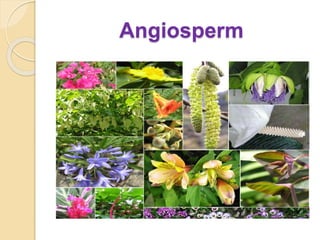
Angiosperm
 The term ‘angiosperm’ derives
from the two Greek words:
angeion meaning ‘Vessel’ and
sperma meaning ‘seed’.
 Angiosperms (flowering plants)
are the largest group of plants on
Earth. Approximately 270,000
known species alive today.
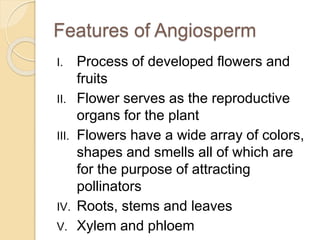
Features of Angiosperm
I. Process of developed flowers and
fruits
II. Flower serves as the reproductive
organs for the plant
III. Flowers have a wide array of colors,
shapes and smells all of which are
for the purpose of attracting
pollinators
IV. Roots, stems and leaves
V. Xylem and phloem
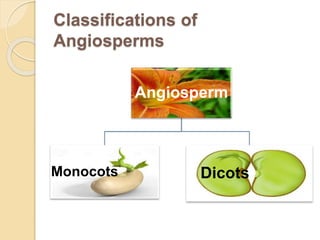
Classifications of
Angiosperms
Angiosperm
Monocots Dicots
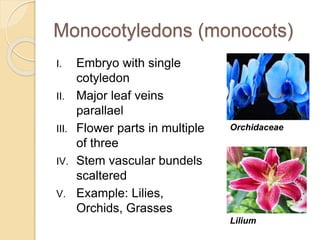
Monocotyledons (monocots)
I. Embryo with single
cotyledon
II. Major leaf veins
parallael
III. Flower parts in multiple
of three
IV. Stem vascular bundels
scaltered
V. Example: Lilies,
Orchids, Grasses
Orchidaceae
Lilium
Dicotyledons (dicots)
I. Embryo with two
cotyledons
II. Major leaf veins
reticulated
III. Flower parts in multiples
of foure or five
IV. Stem vascular bundles
in a ring
V. Example: Roses,
Cactus, Tobacco,
Pumpkin
Cactaceae
Cucurbita
Reproduction of Angiosperms
Xylem’s Structure and Function
I. Transports water and
mineral salt from
Roots Stem
Leaves
II. Unidirectional
III. Composed of hollow,
nonliving cells
(Continuous lumen)
IV. Provides mechanical
support to plant
because of lignified
Phloem’s Structure and Function
I. The function of phloem
tissue is to transport
dissolved sugars
(usually sucrose) from
where they are made-
the leaves- to where
they are needed- the
rest of the plant
II. In particular –
Growing point where
new cells are made
storage organs, often in
the roots ( think of
Importance of Angiosperm
I. Provide food and shelter for land
animals
II. Provide nearly all of our food,
directly or indirectly
III. Thier fibers are used to make
clothing
IV. Furniture comes from their wood
V. We extract medicines and
psychoactive drugs from them
Reference:
 ননমেজর ব োটোনন - বে োশীষ রোয়
www.wikipedia.org
www.sciencedirect.com
https://biologydictionary.net
www.youtube.com
Any Question ??
Thank You
Angiosperm

Angiosperm.ppt

  • 1.
  • 2.
    Presented By Group –07 • Imran Hossen - ASH1819017M • Mita Mahmuda - BKH1819015F • Wahida Nusrat - MUH1819037F • Aysha Subrina Ifti - BKH1819044F • Kaynat Fatema – BKH1819018F
  • 3.
    Angiosperm  The term‘angiosperm’ derives from the two Greek words: angeion meaning ‘Vessel’ and sperma meaning ‘seed’.  Angiosperms (flowering plants) are the largest group of plants on Earth. Approximately 270,000 known species alive today.
  • 4.
    Features of Angiosperm I.Process of developed flowers and fruits II. Flower serves as the reproductive organs for the plant III. Flowers have a wide array of colors, shapes and smells all of which are for the purpose of attracting pollinators IV. Roots, stems and leaves V. Xylem and phloem
  • 5.
  • 6.
    Monocotyledons (monocots) I. Embryowith single cotyledon II. Major leaf veins parallael III. Flower parts in multiple of three IV. Stem vascular bundels scaltered V. Example: Lilies, Orchids, Grasses Orchidaceae Lilium
  • 7.
    Dicotyledons (dicots) I. Embryowith two cotyledons II. Major leaf veins reticulated III. Flower parts in multiples of foure or five IV. Stem vascular bundles in a ring V. Example: Roses, Cactus, Tobacco, Pumpkin Cactaceae Cucurbita
  • 8.
  • 9.
    Xylem’s Structure andFunction I. Transports water and mineral salt from Roots Stem Leaves II. Unidirectional III. Composed of hollow, nonliving cells (Continuous lumen) IV. Provides mechanical support to plant because of lignified
  • 10.
    Phloem’s Structure andFunction I. The function of phloem tissue is to transport dissolved sugars (usually sucrose) from where they are made- the leaves- to where they are needed- the rest of the plant II. In particular – Growing point where new cells are made storage organs, often in the roots ( think of
  • 11.
    Importance of Angiosperm I.Provide food and shelter for land animals II. Provide nearly all of our food, directly or indirectly III. Thier fibers are used to make clothing IV. Furniture comes from their wood V. We extract medicines and psychoactive drugs from them
  • 12.
    Reference:  ননমেজর বোটোনন - বে োশীষ রোয় www.wikipedia.org www.sciencedirect.com https://biologydictionary.net www.youtube.com
  • 13.
  • 14.