CHARA
Dr SHEEJA T THARAKAN
Assistant Professor
Department of Botany
Vimala College (Autonomous)
Thrissur, Kerala
CHARA
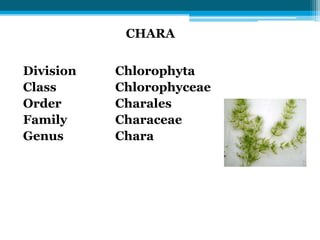
Division Chlorophyta
Class Chlorophyceae
Order Charales
Family Characeae
Genus Chara
Occurrence
Freshwater
Plants encrusted with calcium carbonate - Stone
warts
Vegetative structure
Multicellular, macrosopic
filamentous, branched
Main axis , rhizoids
Rhizoids
- lower end, branched, multicellular,
uniseriate, obliquely septate,
no nodes and internodes,
Arise from rhizoidal plates
fixation
Main axis
Erect, branched
Differentiated into nodes and internodes
Internodes – long, single celled, enveloped
by corticating threads
Nodes – short, regularly arranged cells
Bears branches
- Branches of limited growth (short laterals)
- Branches of unlimited growth (long laterals)
Branches of limited growth (short laterals)
primary laterals, leaves or branchlets
Arise from peripheral cell of the node
Limited growth
Limited number of nodes and internodes
Arise shorter, unicellular branches from nodes -
--secondary laterals
bear stipules
Fertile branches bear sex organs
Branches of unlimited growth (long laterals)
arise from axils of primary laterals
Arise singly
unlimited growth/indefinitely
nodes and internodes, cortication
bears primary laterals
Cell structure
Two types of cells
At the apex- & at the nodes
Small & isodiametric
Central nucleus
Granular cytoplasm
Chloroplst- numerous, discoid, evenly distributed,
no pyrenoids
Cell structure
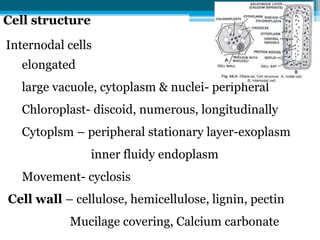
Internodal cells
elongated
large vacuole, cytoplasm & nuclei- peripheral
Chloroplast- discoid, numerous, longitudinally
Cytoplsm – peripheral stationary layer-exoplasm
inner fluidy endoplasm
Movement- cyclosis
Cell wall – cellulose, hemicellulose, lignin, pectin
Mucilage covering, Calcium carbonate
Cortication
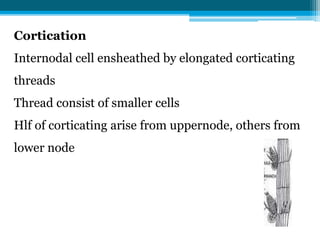
Internodal cell ensheathed by elongated corticating
threads
Thread consist of smaller cells
Hlf of corticating arise from uppernode, others from
lower node
Reproduction
Vegetative & sexual methods
Vegetative – amylum stars, bulbils, 20protenema
a)Amylum stars
star shaped aggregate of vegetative cells
Lower nodes
Store reserve food
Detach from parent ----- new plants
Vegetative reproduction
b)Bulbils
Small, rounded, tuber-like structures, develop on
rhizoids
c) Secondary protenema
nodes/rhizoids
Protenema like structures ----new plants
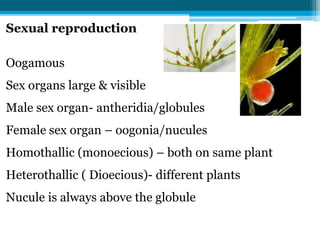
Sexual reproduction
Oogamous
Sex organs large & visible
Male sex organ- antheridia/globules
Female sex organ – oogonia/nucules
Homothallic (monoecious) – both on same plant
Heterothallic ( Dioecious)- different plants
Nucule is always above the globule
Globule/antheridium
Large, spherical, Red/bright orange coloured
Stalk – pedicel
Outermost wall -8 large closely fitted curved cells-shield
cells encloses an internal cavity
Globule/antheridium
Manubrium
– center of shield cell- rod shaped handle like cell
1o capitula- more or less rounded cells at the end
Inturn posess 2o capitula
branched or unbranched antheridial filaments/
spermatogenous filaments
Matre Globule/antheridium
Schield cells move apart
Expose antheridial filaments
200 androytes
Elongated coiled biflagellated antherozoid
OOGONIUM (Nucule)
Macroscopic
Short stalk
Node
Homothallic-Nucule is always above the globule
Tube cell- 5 , spirally twisted, cover, except at the tip
Corona cell- 5, at the tip
Egg- center, uninucleate
Rich of food materials- oil drops & starch grains
Receptive spot- tip of the egg, hyaline
Fertilization
Numerous biflagellate antherozoids liberated outside
Swim- -water –reach nucule
Tube cells elongate near the tip- form neck
Narrow central slit in the corona – passage for
antherozoids
Only one penetrate the wall- fuse with the egg-zygote
Germination
Diploid nucleus migrate towards apex
Secrete cellulosic cell wall
Yellow/ brown
Wall of the tube cell & oogonium -thick & sculpturing
Zygote settles at the bottom
Undergo resting period
Germination of Zygote
Pictures – google.com

Chara