T- 1-855-694-8886
Email- info@iTutor.com
By iTutor.com
What is an animal?
 Kingdom Animalia divided into two major groups:
– invertebrates
– vertebrates
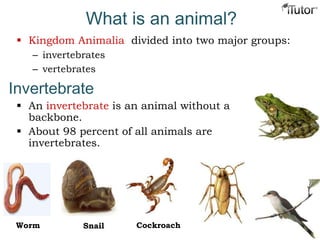
Worm Snail Cockroach
 An invertebrate is an animal without a
backbone.
 About 98 percent of all animals are
invertebrates.
Invertebrate
Vertebrates
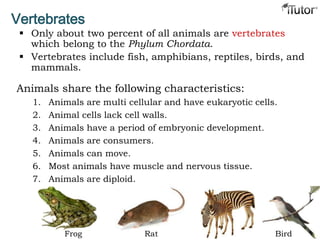
 Only about two percent of all animals are vertebrates
which belong to the Phylum Chordata.
 Vertebrates include fish, amphibians, reptiles, birds, and
mammals.
BirdFrog Rat
Animals share the following characteristics:
1. Animals are multi cellular and have eukaryotic cells.
2. Animal cells lack cell walls.
3. Animals have a period of embryonic development.
4. Animals are consumers.
5. Animals can move.
6. Most animals have muscle and nervous tissue.
7. Animals are diploid.
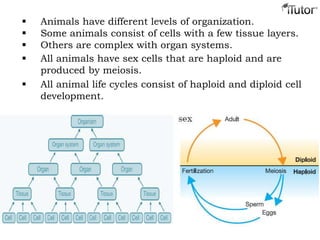
 Animals have different levels of organization.
 Some animals consist of cells with a few tissue layers.
 Others are complex with organ systems.
 All animals have sex cells that are haploid and are
produced by meiosis.
 All animal life cycles consist of haploid and diploid cell
development.
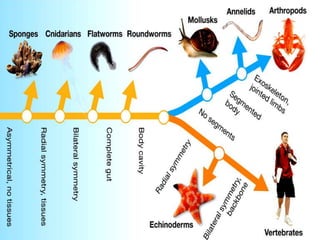
Animal body plan and Symmetry
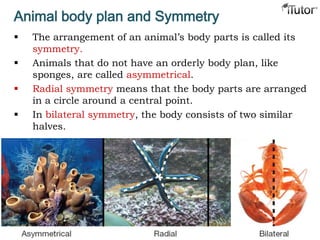
 The arrangement of an animal’s body parts is called its
symmetry.
 Animals that do not have an orderly body plan, like
sponges, are called asymmetrical.
 Radial symmetry means that the body parts are arranged
in a circle around a central point.
 In bilateral symmetry, the body consists of two similar
halves.
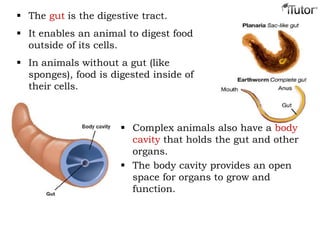
 The gut is the digestive tract.
 It enables an animal to digest food
outside of its cells.
 In animals without a gut (like
sponges), food is digested inside of
their cells.
 Complex animals also have a body
cavity that holds the gut and other
organs.
 The body cavity provides an open
space for organs to grow and
function.
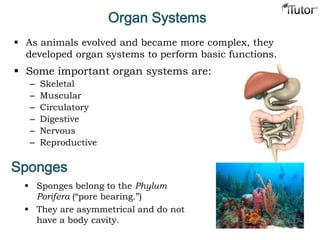
 As animals evolved and became more complex, they
developed organ systems to perform basic functions.
Organ Systems
 Some important organ systems are:
– Skeletal
– Muscular
– Circulatory
– Digestive
– Nervous
– Reproductive
 Sponges belong to the Phylum
Porifera (“pore bearing.”)
 They are asymmetrical and do not
have a body cavity.
Sponges
 Adult sponges do not move around.
 They feed by pulling water into the
pores of their bodies and filtering out
food particles.
 They have specialized collar cells that
move water and collect and digest food.
Cnidarians
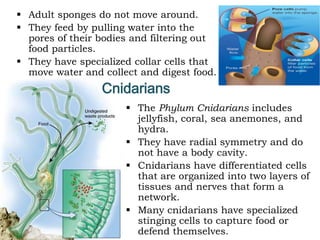
 The Phylum Cnidarians includes
jellyfish, coral, sea anemones, and
hydra.
 They have radial symmetry and do
not have a body cavity.
 Cnidarians have differentiated cells
that are organized into two layers of
tissues and nerves that form a
network.
 Many cnidarians have specialized
stinging cells to capture food or
defend themselves.
Flatworms
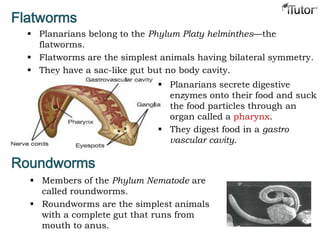
 Planarians belong to the Phylum Platy helminthes—the
flatworms.
 Flatworms are the simplest animals having bilateral symmetry.
 They have a sac-like gut but no body cavity.
 Planarians secrete digestive
enzymes onto their food and suck
the food particles through an
organ called a pharynx.
 They digest food in a gastro
vascular cavity.
Roundworms
 Members of the Phylum Nematode are
called roundworms.
 Roundworms are the simplest animals
with a complete gut that runs from
mouth to anus.
Annelids
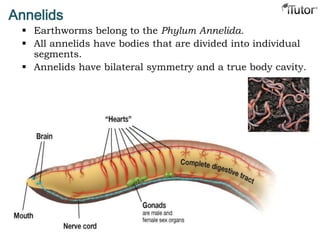
 Earthworms belong to the Phylum Annelida.
 All annelids have bodies that are divided into individual
segments.
 Annelids have bilateral symmetry and a true body cavity.
Mollusks
 Snails, clams, and squids are all
members of the Phylum Mollusca.
 Mollusks have bilateral symmetry and a
true body cavity.
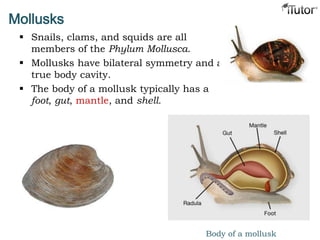
 The body of a mollusk typically has a
foot, gut, mantle, and shell.
Body of a mollusk
Mollusks
 Clams and their relatives have a simple nervous system with
nerve cords and a few ganglia.
 Octopi and their relatives have a more advanced nervous
system.
 An octopus has a well-developed brain and eyes.
 Most mollusks have a sense of touch and taste.
Arthropods
 The Phylum Arthropod includes
insects, spiders, and crustaceans such
as lobsters and crabs.
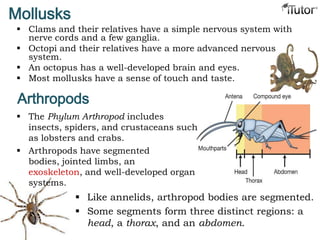
 Arthropods have segmented
bodies, jointed limbs, an
exoskeleton, and well-developed organ
systems.
 Like annelids, arthropod bodies are segmented.
 Some segments form three distinct regions: a
head, a thorax, and an abdomen.
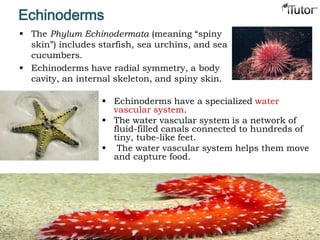
Echinoderms
 The Phylum Echinodermata (meaning “spiny
skin”) includes starfish, sea urchins, and sea
cucumbers.
 Echinoderms have radial symmetry, a body
cavity, an internal skeleton, and spiny skin.
 Echinoderms have a specialized water
vascular system.
 The water vascular system is a network of
fluid-filled canals connected to hundreds of
tiny, tube-like feet.
 The water vascular system helps them move
and capture food.
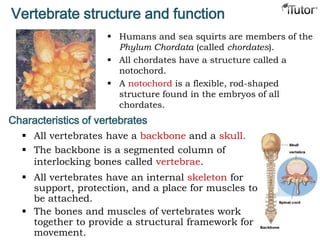
Vertebrate structure and function
 Humans and sea squirts are members of the
Phylum Chordata (called chordates).
 All chordates have a structure called a
notochord.
 A notochord is a flexible, rod-shaped
structure found in the embryos of all
chordates.
Characteristics of vertebrates
 All vertebrates have a backbone and a skull.
 The backbone is a segmented column of
interlocking bones called vertebrae.
 All vertebrates have an internal skeleton for
support, protection, and a place for muscles to
be attached.
 The bones and muscles of vertebrates work
together to provide a structural framework for
movement.
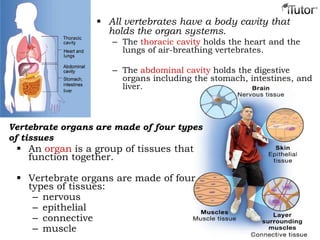
 All vertebrates have a body cavity that
holds the organ systems.
– The thoracic cavity holds the heart and the
lungs of air-breathing vertebrates.
– The abdominal cavity holds the digestive
organs including the stomach, intestines, and
liver.
Vertebrate organs are made of four types
of tissues
 An organ is a group of tissues that
function together.
 Vertebrate organs are made of four
types of tissues:
– nervous
– epithelial
– connective
– muscle
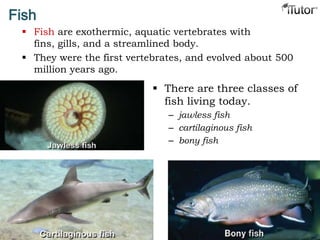
Fish
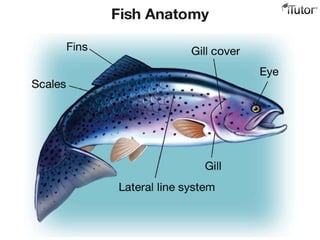
 Fish are exothermic, aquatic vertebrates with
fins, gills, and a streamlined body.
 They were the first vertebrates, and evolved about 500
million years ago.
 There are three classes of
fish living today.
– jawless fish
– cartilaginous fish
– bony fish
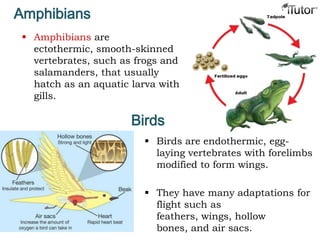
Amphibians
 Amphibians are
ectothermic, smooth-skinned
vertebrates, such as frogs and
salamanders, that usually
hatch as an aquatic larva with
gills.
Birds
 Birds are endothermic, egg-
laying vertebrates with forelimbs
modified to form wings.
 They have many adaptations for
flight such as
feathers, wings, hollow
bones, and air sacs.
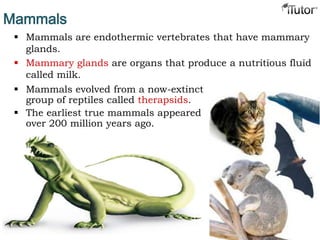
 Mammals are endothermic vertebrates that have mammary
glands.
 Mammary glands are organs that produce a nutritious fluid
called milk.
Mammals
 Mammals evolved from a now-extinct
group of reptiles called therapsids.
 The earliest true mammals appeared
over 200 million years ago.
The end
Call us for more
Information:
www.iTutor.com
1-855-694-8886
Visit

Animal Kingdom

  • 1.
  • 2.
    What is ananimal?  Kingdom Animalia divided into two major groups: – invertebrates – vertebrates Worm Snail Cockroach  An invertebrate is an animal without a backbone.  About 98 percent of all animals are invertebrates. Invertebrate
  • 3.
    Vertebrates  Only abouttwo percent of all animals are vertebrates which belong to the Phylum Chordata.  Vertebrates include fish, amphibians, reptiles, birds, and mammals. BirdFrog Rat Animals share the following characteristics: 1. Animals are multi cellular and have eukaryotic cells. 2. Animal cells lack cell walls. 3. Animals have a period of embryonic development. 4. Animals are consumers. 5. Animals can move. 6. Most animals have muscle and nervous tissue. 7. Animals are diploid.
  • 4.
     Animals havedifferent levels of organization.  Some animals consist of cells with a few tissue layers.  Others are complex with organ systems.  All animals have sex cells that are haploid and are produced by meiosis.  All animal life cycles consist of haploid and diploid cell development.
  • 5.
    Animal body planand Symmetry  The arrangement of an animal’s body parts is called its symmetry.  Animals that do not have an orderly body plan, like sponges, are called asymmetrical.  Radial symmetry means that the body parts are arranged in a circle around a central point.  In bilateral symmetry, the body consists of two similar halves.
  • 6.
     The gutis the digestive tract.  It enables an animal to digest food outside of its cells.  In animals without a gut (like sponges), food is digested inside of their cells.  Complex animals also have a body cavity that holds the gut and other organs.  The body cavity provides an open space for organs to grow and function.
  • 7.
     As animalsevolved and became more complex, they developed organ systems to perform basic functions. Organ Systems  Some important organ systems are: – Skeletal – Muscular – Circulatory – Digestive – Nervous – Reproductive  Sponges belong to the Phylum Porifera (“pore bearing.”)  They are asymmetrical and do not have a body cavity. Sponges
  • 8.
     Adult spongesdo not move around.  They feed by pulling water into the pores of their bodies and filtering out food particles.  They have specialized collar cells that move water and collect and digest food. Cnidarians  The Phylum Cnidarians includes jellyfish, coral, sea anemones, and hydra.  They have radial symmetry and do not have a body cavity.  Cnidarians have differentiated cells that are organized into two layers of tissues and nerves that form a network.  Many cnidarians have specialized stinging cells to capture food or defend themselves.
  • 9.
    Flatworms  Planarians belongto the Phylum Platy helminthes—the flatworms.  Flatworms are the simplest animals having bilateral symmetry.  They have a sac-like gut but no body cavity.  Planarians secrete digestive enzymes onto their food and suck the food particles through an organ called a pharynx.  They digest food in a gastro vascular cavity. Roundworms  Members of the Phylum Nematode are called roundworms.  Roundworms are the simplest animals with a complete gut that runs from mouth to anus.
  • 10.
    Annelids  Earthworms belongto the Phylum Annelida.  All annelids have bodies that are divided into individual segments.  Annelids have bilateral symmetry and a true body cavity.
  • 11.
    Mollusks  Snails, clams,and squids are all members of the Phylum Mollusca.  Mollusks have bilateral symmetry and a true body cavity.  The body of a mollusk typically has a foot, gut, mantle, and shell. Body of a mollusk
  • 12.
    Mollusks  Clams andtheir relatives have a simple nervous system with nerve cords and a few ganglia.  Octopi and their relatives have a more advanced nervous system.  An octopus has a well-developed brain and eyes.  Most mollusks have a sense of touch and taste. Arthropods  The Phylum Arthropod includes insects, spiders, and crustaceans such as lobsters and crabs.  Arthropods have segmented bodies, jointed limbs, an exoskeleton, and well-developed organ systems.  Like annelids, arthropod bodies are segmented.  Some segments form three distinct regions: a head, a thorax, and an abdomen.
  • 13.
    Echinoderms  The PhylumEchinodermata (meaning “spiny skin”) includes starfish, sea urchins, and sea cucumbers.  Echinoderms have radial symmetry, a body cavity, an internal skeleton, and spiny skin.  Echinoderms have a specialized water vascular system.  The water vascular system is a network of fluid-filled canals connected to hundreds of tiny, tube-like feet.  The water vascular system helps them move and capture food.
  • 15.
    Vertebrate structure andfunction  Humans and sea squirts are members of the Phylum Chordata (called chordates).  All chordates have a structure called a notochord.  A notochord is a flexible, rod-shaped structure found in the embryos of all chordates. Characteristics of vertebrates  All vertebrates have a backbone and a skull.  The backbone is a segmented column of interlocking bones called vertebrae.  All vertebrates have an internal skeleton for support, protection, and a place for muscles to be attached.  The bones and muscles of vertebrates work together to provide a structural framework for movement.
  • 16.
     All vertebrateshave a body cavity that holds the organ systems. – The thoracic cavity holds the heart and the lungs of air-breathing vertebrates. – The abdominal cavity holds the digestive organs including the stomach, intestines, and liver. Vertebrate organs are made of four types of tissues  An organ is a group of tissues that function together.  Vertebrate organs are made of four types of tissues: – nervous – epithelial – connective – muscle
  • 17.
    Fish  Fish areexothermic, aquatic vertebrates with fins, gills, and a streamlined body.  They were the first vertebrates, and evolved about 500 million years ago.  There are three classes of fish living today. – jawless fish – cartilaginous fish – bony fish
  • 19.
    Amphibians  Amphibians are ectothermic,smooth-skinned vertebrates, such as frogs and salamanders, that usually hatch as an aquatic larva with gills. Birds  Birds are endothermic, egg- laying vertebrates with forelimbs modified to form wings.  They have many adaptations for flight such as feathers, wings, hollow bones, and air sacs.
  • 20.
     Mammals areendothermic vertebrates that have mammary glands.  Mammary glands are organs that produce a nutritious fluid called milk. Mammals  Mammals evolved from a now-extinct group of reptiles called therapsids.  The earliest true mammals appeared over 200 million years ago.
  • 21.
    The end Call usfor more Information: www.iTutor.com 1-855-694-8886 Visit