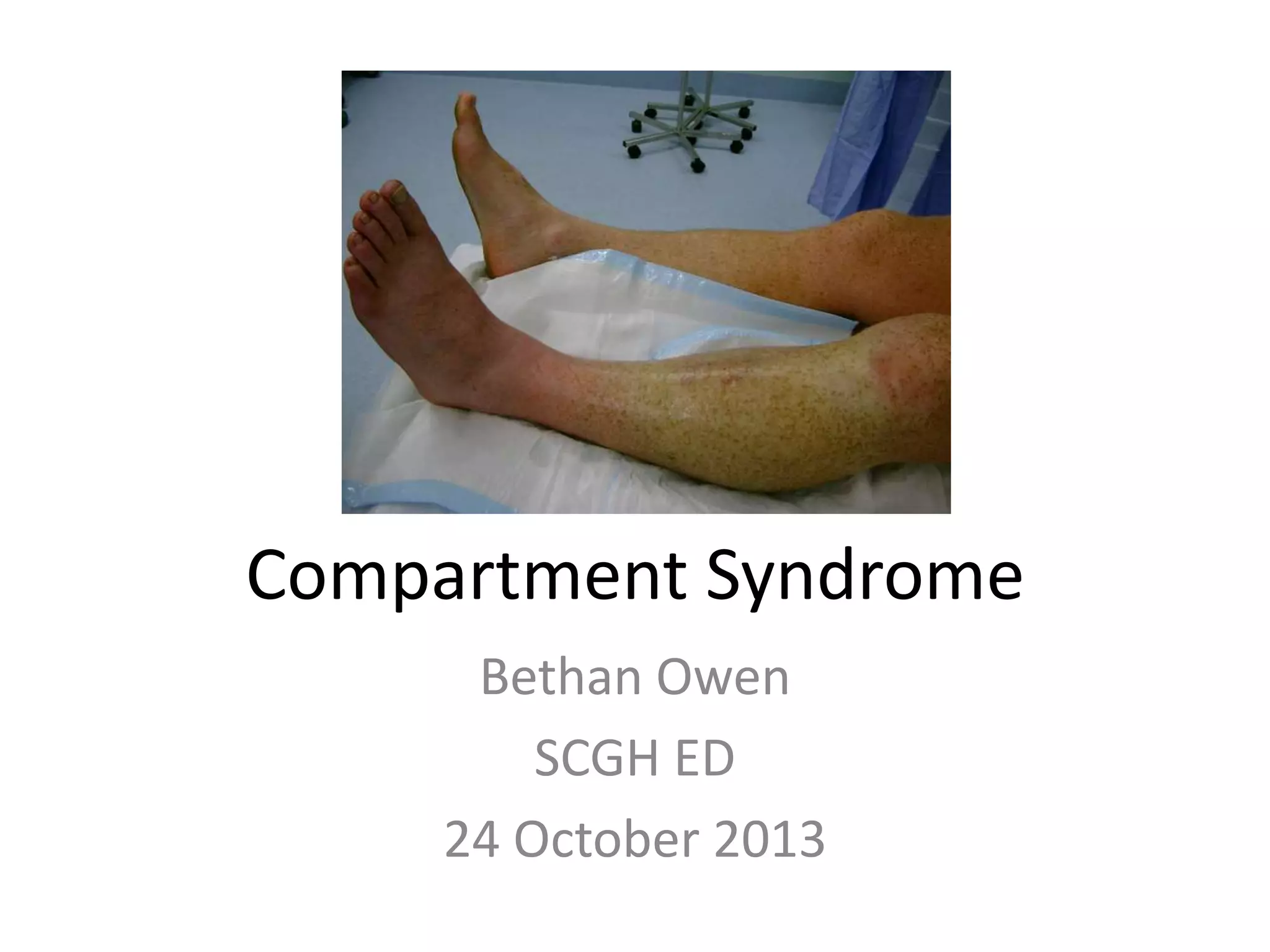
Compartment Syndrome
Bethan Owen
SCGH ED
24 October 2013
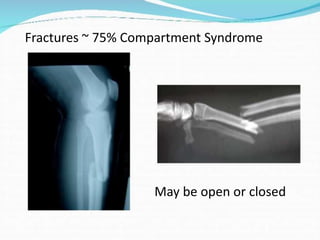
Fractures ~ 75% Compartment Syndrome

May be open or closed
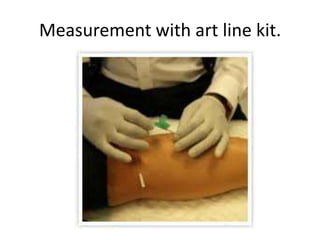
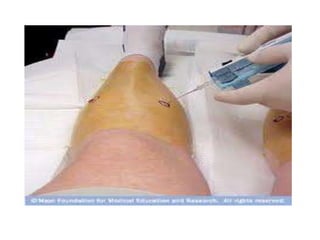
Measurement with art line kit.
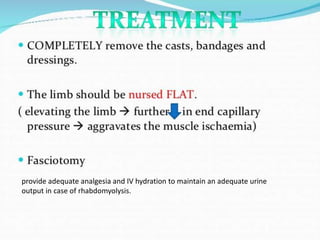
provide adequate analgesia and IV hydration to maintain an adequate urine
output in case of rhabdomyolysis.
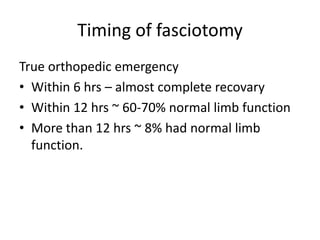
Timing of fasciotomy
True orthopedic emergency
• Within 6 hrs – almost complete recovary
• Within 12 hrs ~ 60-70% normal limb function
• More than 12 hrs ~ 8% had normal limb
function.
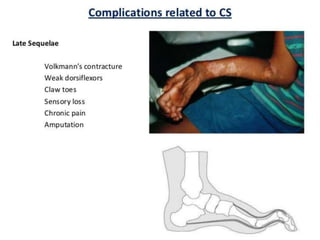
Serious Complications
• gangrene or loss of limb viability requiring
amputation
• ischemic contracture and loss of function
• rhabdomyolysis and renal failure
References
• Marx JA, Hockberger R, Walls RM. Rosen’s Emergency
Medicine: Concepts and Clinical Practice, 7th edition
(2009) Mosby, Inc. [mdconsult.com]
• Newton EJ, Love J. Acute complications of extremity
trauma. Emerg Med Clin North Am. 2007
Aug;25(3):751-61, iv. PMID: 17826216.
• Perron AD, Brady WJ, Keats TE. Orthopedic pitfalls in
the ED: acute compartment syndrome. Am J Emerg
Med. 2001 Sep;19(5):413-6. PMID: 11555801.
• Simon RR, Sherman SC, Koenigsknecht SJ. Emergency
Orthopedics — The Extremities (5th edition), McGrawHill, 2007.

Compartment Syndrome

  • 1.
  • 5.
    Fractures ~ 75%Compartment Syndrome May be open or closed
  • 15.
  • 21.
    provide adequate analgesiaand IV hydration to maintain an adequate urine output in case of rhabdomyolysis.
  • 24.
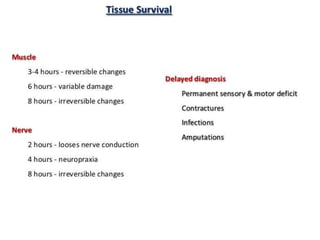
    Timing of fasciotomy Trueorthopedic emergency • Within 6 hrs – almost complete recovary • Within 12 hrs ~ 60-70% normal limb function • More than 12 hrs ~ 8% had normal limb function.
  • 25.
    Serious Complications • gangreneor loss of limb viability requiring amputation • ischemic contracture and loss of function • rhabdomyolysis and renal failure
  • 32.
    References • Marx JA,Hockberger R, Walls RM. Rosen’s Emergency Medicine: Concepts and Clinical Practice, 7th edition (2009) Mosby, Inc. [mdconsult.com] • Newton EJ, Love J. Acute complications of extremity trauma. Emerg Med Clin North Am. 2007 Aug;25(3):751-61, iv. PMID: 17826216. • Perron AD, Brady WJ, Keats TE. Orthopedic pitfalls in the ED: acute compartment syndrome. Am J Emerg Med. 2001 Sep;19(5):413-6. PMID: 11555801. • Simon RR, Sherman SC, Koenigsknecht SJ. Emergency Orthopedics — The Extremities (5th edition), McGrawHill, 2007.

Editor's Notes

  • #2 Rorabeck and Macnab reported almost complete recovery of limb function if fasciotomy was performed within 6 hours.[42] Matsen found necrosis after 6 hours of ischemia, which currently is the accepted upper limit of viability.[43] When fasciotomy was performed within 12 hours after the onset of acute compartment syndrome, Sheridan and Matsen reported that normal limb function was regained in 68% of patients.[44] However, when fasciotomy was delayed 12 hours or longer, only 8% of patients had normal function. Thus, little or no return of function can be expected when the diagnosis and treatment are delayed. Sensory nerves tend to be affected before the motor nerves, and selected nerves may be more susceptible than others in the same compartment. For example, in acute anterior lower leg compartment syndrome, the first sign to develop may be numbness between the first 2 toes (superficial peroneal nerve). Decreased 2-point discrimination is the most consistent early finding, and correlation has also been reported between diminished vibration sense (as measured with a 256 cycle per second tuning fork). If objective evidence of a major sensory deficit, a motor deficit, or loss of peripheral pulse is found, the syndrome is far advanced.
  • #5 Ivf – IV fluid
  • #6 Fractures
  • #9 Sensory nerves tend to be affected before the motor nerves, and selected nerves may be more susceptible than others in the same compartment. For example, in acute anterior lower leg compartment syndrome, the first sign to develop may be numbness between the first 2 toes (superficial peroneal nerve). Decreased 2-point discrimination is the most consistent early finding, and correlation has also been reported between diminished vibration sense (as measured with a 256 cycle per second tuning fork). If objective evidence of a major sensory deficit, a motor deficit, or loss of peripheral pulse is found, the syndrome is far advanced
  • #11 Rorabeck and Macnab reported almost complete recovery of limb function if fasciotomy was performed within 6 hours.[42] Matsen found necrosis after 6 hours of ischemia, which currently is the accepted upper limit of viability.[43] When fasciotomy was performed within 12 hours after the onset of acute compartment syndrome, Sheridan and Matsen reported that normal limb function was regained in 68% of patients.[44] However, when fasciotomy was delayed 12 hours or longer, only 8% of patients had normal function. Thus, little or no return of function can be expected when the diagnosis and treatment are delayed.
  • #14 19% when the pressure was 20 mm Hg, 28% when it was 40 mm Hg, 50% when it was 60 mm Hg, and 60% when it was 80 mm Hg for fasiotomy in fresh cadavars
  • #16 Bit about how unreliable clinician
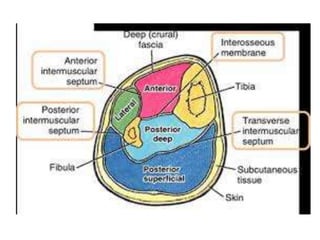
  • #18 Deep posterior compartment
  • #25 Rorabeck and Macnab reported almost complete recovery of limb function if fasciotomy was performed within 6 hours.[42] Matsen found necrosis after 6 hours of ischemia, which currently is the accepted upper limit of viability.[43] When fasciotomy was performed within 12 hours after the onset of acute compartment syndrome, Sheridan and Matsen reported that normal limb function was regained in 68% of patients.[44] However, when fasciotomy was delayed 12 hours or longer, only 8% of patients had normal function. Thus, little or no return of function can be expected when the diagnosis and treatment are delayed. Sensory nerves tend to be affected before the motor nerves, and selected nerves may be more susceptible than others in the same compartment. For example, in acute anterior lower leg compartment syndrome, the first sign to develop may be numbness between the first 2 toes (superficial peroneal nerve). Decreased 2-point discrimination is the most consistent early finding, and correlation has also been reported between diminished vibration sense (as measured with a 256 cycle per second tuning fork). If objective evidence of a major sensory deficit, a motor deficit, or loss of peripheral pulse is found, the syndrome is far advanced