DR. SIDHARTH YADAV
DEPT. OF ORTHOPAEDICS
NKPSIMS
ACUTE COMPARTMENT SYNDROME
Compartment Syndrome
Definition
Elevated tissue pressure within a closed osteofascial
space
Reduces tissue perfusion – ischemia
Results in cell death - necrosis
History
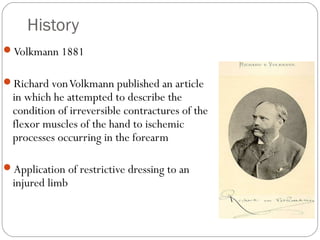
Volkmann 1881
Richard vonVolkmann published an article
in which he attempted to describe the
condition of irreversible contractures of the
flexor muscles of the hand to ischemic
processes occurring in the forearm
Application of restrictive dressing to an
injured limb
History
Hildebrand 1906
First used the term Volkmann ischemic
contracture to describe the final result of any
untreated compartment syndrome.
First to suggest that elevated tissue pressure may
be related to ischemic contracture.
History
Thomas 1909
Reviewed the 112 published cases of Volkmann ischemic
contracture and found fractures to be the predominant
cause.
Also, noted that tight bandages, an arterial embolus, or
arterial insufficiency could also lead to the problem
History
Murphy 1914
First to suggest that fasciotomy might prevent the
contracture.
Also, suggested that tissue pressure and fasciotomy were
related to the development of contracture
History
Ellis 1958
Reported a 2% incidence of compartment syndrome with
tibia fractures, and increased attention was paid to
contractures involving the lower extremities
History
Seddon, Kelly, and Whitesides 1967
Demonstrated the existence of 4 compartments in the leg
and to the need to decompress more than just the anterior
compartment. Since then, compartment syndrome has
been shown to affect many areas of the body, including the
hand, foot, thigh, and buttocks
Types of compartment syndrome
9
Compartment syndromes can be classified as :
Acute compartment syndrome (ACS)
Chronic compartment syndrome (CCS) depending
on the cause of increased intra-compartmental
pressure and the duration of symptoms
Sites of Acute Compartment Syndrome
10
Acute compartment syndrome can develop anywhere
a skeletal muscle is surrounded by a substantial fascia.
ACS may occur in foot, leg, thigh, buttocks, lumbar
paraspinous muscles, hand, forearm, arm and
shoulder.
Compartments
11
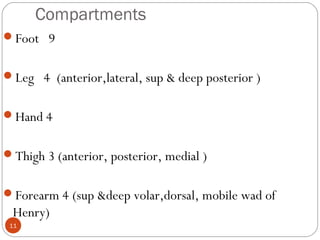
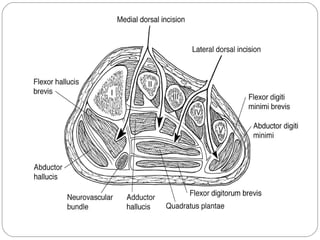
Foot 9
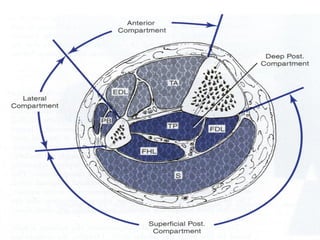
Leg 4 (anterior,lateral, sup & deep posterior )
Hand 4
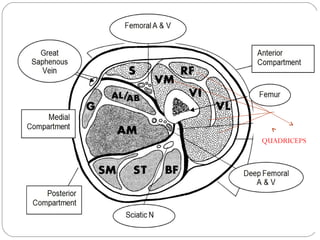
Thigh 3 (anterior, posterior, medial )
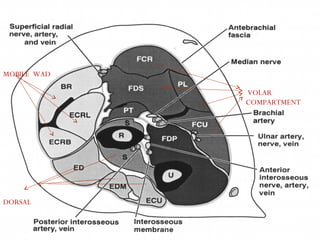
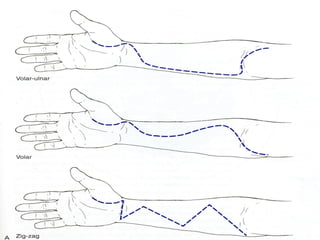
Forearm 4 (sup &deep volar,dorsal, mobile wad of
Henry)
QUADRICEPS
MOBILE WAD
VOLAR
COMPARTMENT
DORSAL
Pathophysiology of ACS
16
CS develops after prolonged elevated intra-compartmental
pressure , which results from either externally applied or
internally expanding pressure forces.
Increased tissue pressure will decrease capillary blood
flow leading to local tissue necrosis caused by O2
deprivation .
Local blood flow (LBF) =Pa-Pv/R.
Pathophysiology of ACS
17
The elevated intra-compartmental pressure increases the
local venous pressure leading to narrowed arteriovenous
perfusion gradient and compartment tamponade,
resulting -if uncontrolled - in nerve injury and muscle
ischemia
Etiology of ACS
 External Restriction of Compartment Size :
- casts
- tight dressings
- splints
- lying on limb for long period
- burn eschar
- closure of fascial defect
- lithotomy position
Etiology of ACS
19
• Factures (the most common are) :
In adults --- closed and open tibial shaft fracture ,
distal radial fracture
In children --- radial head or neck fracture ,
supracondylar fracture , forearm fractures
Etiology of ACS
20
Hemorrhage (e.g. due to vascular injury )
Coagulopathy (e.g. hemophilia , thrombolytics , sickle cell
disease or trait )
Muscle edema (e.g. severe exercise , crush injury, trauma
with or without fx )
Etiology of ACS
21
Surgically related (e.g. knee arthroscopy , tibial
osteotomy without drainage , after epidural anesthesia )
Massive crystalloid infusion
Ruptured Backer’s cyst
Muscle hypertrophy ( androgens )
Etiology of ACS
22
Intracompartmental fluid infusion (interosseosus
infusion)
Capillary leak syndrome
Intra-arterial injections of sclerosing agents
Post –ischemic reperfusion
Compartment Syndrome
Tissue Survival
Muscle
 3-4 hours - reversible changes
6 hours - variable damage
8 hours - irreversible changes
Nerve
2 hours - looses nerve conduction
4 hours - neuropraxia
8 hours - irreversible changes
Compartment Syndrome
Pathophysiology
Normal tissue pressure
 0-4 mm Hg
8-10 with exertion
Absolute pressure theory
30 mm Hg - Mubarak
45 mm Hg - Matsen
Pressure gradient theory
< 20 mm Hg of diastolic pressure –
Whitesides
McQueen, et al
Compartment Syndrome Diagnosis
Pain out of proportion
Palpably tense compartment
Pain with passive stretch
Paresthesia/hypoesthesia
Paralysis
Pulselessness/pallor
Pain
Classically out of portion to injury
Exaggerated with passive stretch of the involved
muscles in compartment
Earliest symptom
Paresthesia
Also early sign
Peripheral nerve tissue is more sensitive than
muscle to ischemia
Permanent damage may occur in 75 minutes
Difficult to interpret
Will progress to anesthesia if pressure not
relieved
Paralysis
Very late finding
Irreversible nerve and muscle damage present
Paresis may be present early
Difficult to evaluate because of pain
Pallor & Pulselessness
Rarely present
Indicates direct damage to vessels rather than
compartment syndrome
Vascular injury may be more of contributing
factor to syndrome rather than result
Compartment Pressure
Technique
Whiteside infusion
Stic technique: side port needle
Wick catheter
Slit catheter
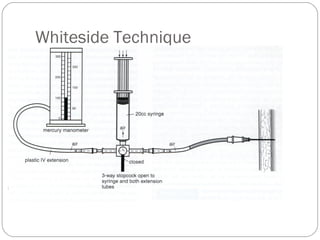
Whiteside Technique
Simple technique
Readily available supplies
With 18 gauge needle least accurate
More accurate if use side port needle
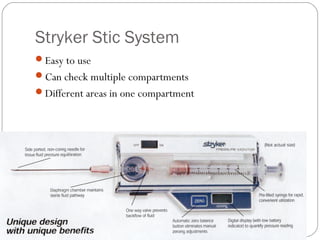
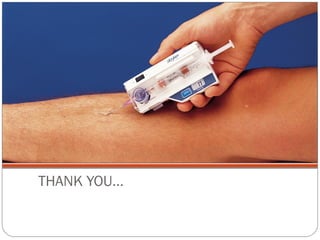
Stryker Stic System
Easy to use
Can check multiple compartments
Different areas in one compartment
Management of ACS
33
 Removal of the possible cause (release of tight dressings
or circular constrictive bandages, splitting of casts)
 Correction of coagulopathy
 Positioning of the limb at the level of the heart
Management of ACS
34
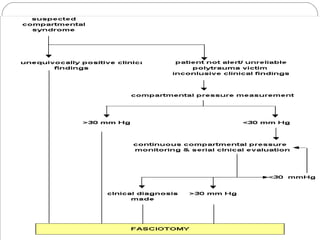
If symptoms don’t resolve in 30 to 60 min after
appropriate treatment ,pressure measurement
should be repeated,and,if equivocal, fasciotomy is
indicated
Management of ACS
36
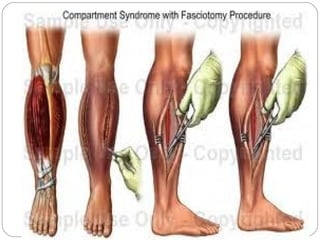
The definitive treatment of acute compartment syndrome
is FASCIOTOMY
Procedure is done without a tourniquet,each potentially
limiting envelope is opened over the entire length of the
compartment, all muscle groups should be soft to
palpation at the end of the procedure
Muscle debridement should be kept to a minimum
FACIOTOMY OF LOWER LIMB
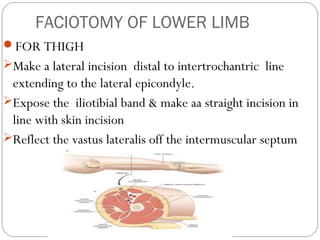
FOR THIGH
Make a lateral incision distal to intertrochantric line
extending to the lateral epicondyle.
Expose the iliotibial band & make aa straight incision in
line with skin incision
Reflect the vastus lateralis off the intermuscular septum
• FOR LEG
Single incision faciotomy
Double incision faciotomy
fibuloectomy
Chronic Compartment Syndrome
41
Also known as exertional CS, recurrent CS and subacute CS
 Exercise –induced pain
Occur mainly in the lower limb
Typical patient is young (20-30s) athlete (long distance
runner)or military recruits pushed past normal limits of
functional tolerance
Pathophysiology of CCS
42
Not yet fully understood
Probably occurs from increased muscle relaxation
pressure during exercise , which causes decreased
muscle blood flow, leading to ischemic pain and
impaired muscle function
COMPLICATION OF COMPARTMENT
SYNDROME
Reperfusion injury
Volkmann’s contracture
Weak dorsiflxors
Claw toe
Sensory loss
Chronic pain
Amputation
THANK YOU…

Acute compartment syndrome

  • 1.
    DR. SIDHARTH YADAV DEPT.OF ORTHOPAEDICS NKPSIMS ACUTE COMPARTMENT SYNDROME
  • 2.
    Compartment Syndrome Definition Elevated tissuepressure within a closed osteofascial space Reduces tissue perfusion – ischemia Results in cell death - necrosis
  • 3.
    History Volkmann 1881 Richard vonVolkmannpublished an article in which he attempted to describe the condition of irreversible contractures of the flexor muscles of the hand to ischemic processes occurring in the forearm Application of restrictive dressing to an injured limb
  • 4.
    History Hildebrand 1906 First usedthe term Volkmann ischemic contracture to describe the final result of any untreated compartment syndrome. First to suggest that elevated tissue pressure may be related to ischemic contracture.
  • 5.
    History Thomas 1909 Reviewed the112 published cases of Volkmann ischemic contracture and found fractures to be the predominant cause. Also, noted that tight bandages, an arterial embolus, or arterial insufficiency could also lead to the problem
  • 6.
    History Murphy 1914 First tosuggest that fasciotomy might prevent the contracture. Also, suggested that tissue pressure and fasciotomy were related to the development of contracture
  • 7.
    History Ellis 1958 Reported a2% incidence of compartment syndrome with tibia fractures, and increased attention was paid to contractures involving the lower extremities
  • 8.
    History Seddon, Kelly, andWhitesides 1967 Demonstrated the existence of 4 compartments in the leg and to the need to decompress more than just the anterior compartment. Since then, compartment syndrome has been shown to affect many areas of the body, including the hand, foot, thigh, and buttocks
  • 9.
    Types of compartmentsyndrome 9 Compartment syndromes can be classified as : Acute compartment syndrome (ACS) Chronic compartment syndrome (CCS) depending on the cause of increased intra-compartmental pressure and the duration of symptoms
  • 10.
    Sites of AcuteCompartment Syndrome 10 Acute compartment syndrome can develop anywhere a skeletal muscle is surrounded by a substantial fascia. ACS may occur in foot, leg, thigh, buttocks, lumbar paraspinous muscles, hand, forearm, arm and shoulder.
  • 11.
    Compartments 11 Foot 9 Leg 4(anterior,lateral, sup & deep posterior ) Hand 4 Thigh 3 (anterior, posterior, medial ) Forearm 4 (sup &deep volar,dorsal, mobile wad of Henry)
  • 12.
  • 15.
  • 16.
    Pathophysiology of ACS 16 CSdevelops after prolonged elevated intra-compartmental pressure , which results from either externally applied or internally expanding pressure forces. Increased tissue pressure will decrease capillary blood flow leading to local tissue necrosis caused by O2 deprivation . Local blood flow (LBF) =Pa-Pv/R.
  • 17.
    Pathophysiology of ACS 17 Theelevated intra-compartmental pressure increases the local venous pressure leading to narrowed arteriovenous perfusion gradient and compartment tamponade, resulting -if uncontrolled - in nerve injury and muscle ischemia
  • 18.
    Etiology of ACS External Restriction of Compartment Size : - casts - tight dressings - splints - lying on limb for long period - burn eschar - closure of fascial defect - lithotomy position
  • 19.
    Etiology of ACS 19 •Factures (the most common are) : In adults --- closed and open tibial shaft fracture , distal radial fracture In children --- radial head or neck fracture , supracondylar fracture , forearm fractures
  • 20.
    Etiology of ACS 20 Hemorrhage(e.g. due to vascular injury ) Coagulopathy (e.g. hemophilia , thrombolytics , sickle cell disease or trait ) Muscle edema (e.g. severe exercise , crush injury, trauma with or without fx )
  • 21.
    Etiology of ACS 21 Surgicallyrelated (e.g. knee arthroscopy , tibial osteotomy without drainage , after epidural anesthesia ) Massive crystalloid infusion Ruptured Backer’s cyst Muscle hypertrophy ( androgens )
  • 22.
    Etiology of ACS 22 Intracompartmentalfluid infusion (interosseosus infusion) Capillary leak syndrome Intra-arterial injections of sclerosing agents Post –ischemic reperfusion
  • 23.
    Compartment Syndrome Tissue Survival Muscle 3-4 hours - reversible changes 6 hours - variable damage 8 hours - irreversible changes Nerve 2 hours - looses nerve conduction 4 hours - neuropraxia 8 hours - irreversible changes
  • 24.
    Compartment Syndrome Pathophysiology Normal tissuepressure  0-4 mm Hg 8-10 with exertion Absolute pressure theory 30 mm Hg - Mubarak 45 mm Hg - Matsen Pressure gradient theory < 20 mm Hg of diastolic pressure – Whitesides McQueen, et al
  • 25.
    Compartment Syndrome Diagnosis Painout of proportion Palpably tense compartment Pain with passive stretch Paresthesia/hypoesthesia Paralysis Pulselessness/pallor
  • 26.
    Pain Classically out ofportion to injury Exaggerated with passive stretch of the involved muscles in compartment Earliest symptom
  • 27.
    Paresthesia Also early sign Peripheralnerve tissue is more sensitive than muscle to ischemia Permanent damage may occur in 75 minutes Difficult to interpret Will progress to anesthesia if pressure not relieved
  • 28.
    Paralysis Very late finding Irreversiblenerve and muscle damage present Paresis may be present early Difficult to evaluate because of pain
  • 29.
    Pallor & Pulselessness Rarelypresent Indicates direct damage to vessels rather than compartment syndrome Vascular injury may be more of contributing factor to syndrome rather than result
  • 30.
    Compartment Pressure Technique Whiteside infusion Stictechnique: side port needle Wick catheter Slit catheter
  • 31.
    Whiteside Technique Simple technique Readilyavailable supplies With 18 gauge needle least accurate More accurate if use side port needle
  • 32.
    Stryker Stic System Easyto use Can check multiple compartments Different areas in one compartment
  • 33.
    Management of ACS 33 Removal of the possible cause (release of tight dressings or circular constrictive bandages, splitting of casts)  Correction of coagulopathy  Positioning of the limb at the level of the heart
  • 34.
    Management of ACS 34 Ifsymptoms don’t resolve in 30 to 60 min after appropriate treatment ,pressure measurement should be repeated,and,if equivocal, fasciotomy is indicated
  • 36.
    Management of ACS 36 Thedefinitive treatment of acute compartment syndrome is FASCIOTOMY Procedure is done without a tourniquet,each potentially limiting envelope is opened over the entire length of the compartment, all muscle groups should be soft to palpation at the end of the procedure Muscle debridement should be kept to a minimum
  • 37.
    FACIOTOMY OF LOWERLIMB FOR THIGH Make a lateral incision distal to intertrochantric line extending to the lateral epicondyle. Expose the iliotibial band & make aa straight incision in line with skin incision Reflect the vastus lateralis off the intermuscular septum
  • 38.
    • FOR LEG Singleincision faciotomy Double incision faciotomy fibuloectomy
  • 41.
    Chronic Compartment Syndrome 41 Alsoknown as exertional CS, recurrent CS and subacute CS  Exercise –induced pain Occur mainly in the lower limb Typical patient is young (20-30s) athlete (long distance runner)or military recruits pushed past normal limits of functional tolerance
  • 42.
    Pathophysiology of CCS 42 Notyet fully understood Probably occurs from increased muscle relaxation pressure during exercise , which causes decreased muscle blood flow, leading to ischemic pain and impaired muscle function
  • 43.
    COMPLICATION OF COMPARTMENT SYNDROME Reperfusioninjury Volkmann’s contracture Weak dorsiflxors Claw toe Sensory loss Chronic pain Amputation
  • 44.

Editor's Notes

  • #12 Mobile wad of Henry (brachioradials,ECRL &amp; ECRB)
  • #16 —Forearm compartments. ECRB = extensor carpi radialis brevis, ECRL = extensor carpi radialis longus, BR = brachioradialis, FCU = flexor carpi ulnaris, PL = palmaris longus, FCR = flexor carpi radialis, FDS = flexor digitorum superficialis, ED = extensor digitorum, EDM = extensor digiti minimi, ECU = extensor carpi ulnaris, FDP = flexor digitorum profundus, FPL = flexor pollicis longus, PT = pronator teres, S = supinator, APL = abductor pollicis longus, EPB = extensor pollicis brevis, EPL = extensor pollicis longus, EI = extensor indices, R = radius, U = ulna.A, Drawing of proximal forearm.
  • #24 Studies have shown that nerve tissue is the most sensitive to ischemic changes. Nerve conduction is lost in 1-2 hours of total ischemia and survive up to 4 hrs with only neuropraxia changes, while axonotmesis and irreversible changes occur after 8 hrs. Muscle may survive up to 4 hours with reversible changes, variable damage occurs by 6 hrs, and irreversible changes after 8 hrs under conditions of warm ischemia.
  • #25 Normal resting muscle tissue pressure is up to 4 mm Hg and 8-10 with exertion. Exercise induced CS may have a resting based line of 10-15 mmHg. Many studies utilizing clinical evaluations and animal models by Whitesides, Mubarak, Matsen, Heckman, Heppenstall and Matava have help to establish a better understanding of the pathophysiology and thresholds of ischemia. Two schools of though prevail: 1. The Absolute Pressure Theory of Murbarak and Matsen who suggest surgical decompression in CS with pressures that reach or exceed these thresholds. 2. The Perfusion Theory of Whitesides who demonstrated in animal models and human subjects the relationship of tissue perfusion and diastolic blood pressure. His group recommends surgical decompression when the tissue pressure is within 20mm Hg of the DBP. McQueen suggested a differential &amp;lt;30mmHg of the diastolic pressure and the intramuscular pressure as a threshold for release as being more reliable. Mean arterial pressure can also serve as a benchmark with a release suggested when intramuscular pressure is within 45 mm Hg. Caution must be exercised in traumatized tissue and especially in hypotensive patients
  • #26 These physical findings have been described as the clinical hallmarks of CS. They are not very sensitive and if seen in the later stages it may be too late to change the underlying pathology. CS may be present with good pulses and no pallor and loss of pulses rarely occur unless arterial damage is present. Pain out of proportion and pain with passive stretch of a muscle in the compartment in question may be the most sensitive clinical finding before the onset of ischemic dysfunction of the nerves and muscles. These findings are useful only in a conscious cooperative patient and once paresthesia begin the pain may decrease. One important point to make is of CS is a possibility then regional anesthesia, continuous epidurals and PCA intravenous opiate analgesia should be avoided since they may mask the symptoms of compartment syndrome. Otherwise monitoring of the tissue pressure is warranted. There exist reports of missed compartment syndrome in tibia fracture and other surgical patients at risk managed postoperatively with these techniques and therefore they are generally avoided.
  • #31 Confirm clinical exam Regional anesthetic Vascular injury
  • #34 By colloid infusion,blood replacement,platelet transfusion. Because this position will produce the highest arteriovenous gradient .on the other hand elevation of the limb decreases the arterial inflow without significantly increasing the venous outflow,thus increasing local ischemia.
  • #35 Removal of one side of the cast can reduce the ICP by 30% , bivalving can produce additional 35% &amp; cutting the webril 10%