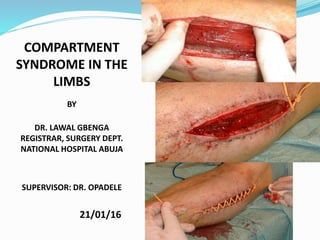
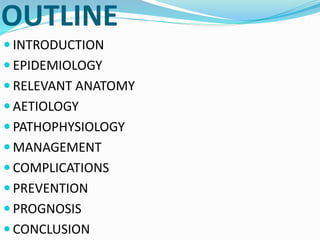
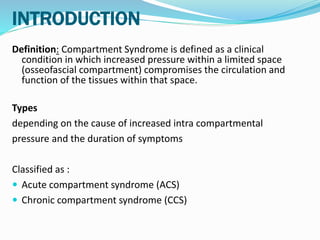
COMPARTMENT
SYNDROME IN THE
LIMBS
BY
DR. LAWAL GBENGA
REGISTRAR, SURGERY DEPT.
NATIONAL HOSPITAL ABUJA
SUPERVISOR: DR. OPADELE
21/01/16
OUTLINE
 INTRODUCTION
 EPIDEMIOLOGY
 RELEVANT ANATOMY
 AETIOLOGY
 PATHOPHYSIOLOGY
 MANAGEMENT
 COMPLICATIONS
 PREVENTION
 PROGNOSIS
 CONCLUSION
INTRODUCTION
Definition: Compartment Syndrome is defined as a clinical
condition in which increased pressure within a limited space
(osseofascial compartment) compromises the circulation and
function of the tissues within that space.
Types
depending on the cause of increased intra compartmental
pressure and the duration of symptoms
Classified as :
 Acute compartment syndrome (ACS)
 Chronic compartment syndrome (CCS)
Acute compartment syndrome (ACS)
 A surgical emergency which if not recognized and treated
early can lead to devastating disabilities, amputation and even
death in some situations.
 Acute compartment syndrome can develop anywhere a
skeletal muscle is surrounded by a substantial fascia.
 ACS may occur in foot, leg, thigh, buttocks, lumbar
paraspinous muscles, hand, forearm, arm and shoulder.
 Commonest sites are the leg and forearm
HISTORICAL PERSPECTIVE
Richard Von Volkmann, 1881
“For many years I have noted on occasion, following the use of
bandages too tightly applied, the occurrence of paralysis and
contraction of the limb, NOT … due to the paralysis of the nerve by
pressure, but as a quick and massive disintegration of the contractile
substance and the effect of the ensuing reaction and degeneration.”
 1881: Richard von Volkmann documented nerve injury &
subsequent contracture severe limb injuries
 Peterson in 1888 recognized that ischaemic contracture
could occur in the absence of bandaging
 50yrs later, Jepson described ischaemic contractures in
dog hind leg following experimentally induced venous
obstruction.
• 1941: Bywaters & Beall reported on the significance of
crush injury while working with victims of the London
Blitz.
• By 2nd world war ,ARTERIAL INJURY THEORY was proposed
(ischaemia is due to injury and spasm)
• Seddon in 1966 challenged it after finding palpable pulses in
up to 50% of cases
• McQuillan & Nolan described a vicious circle of increasing
tension in an enclosed compartment causing venous
obstruction and subsequent arterial
• They concluded that delay fasciotomy is the single most
important cause of treatment failure
• In the 1970s Matson as well as Owen et al, established the
importance of measuring intra compartmental pressure with
the aid of the Wick catheter.
EPIDEMIOLOGY
 Commoner in younger patients (M:F ratio is 10:1) under 35
years of age
 Sites: Leg>Forearm>Thigh>Arm>Abd>Buttocks>Feet in DM
patients
• Incidence of ACS in the West =3.1/100,00/yr
• In the US, 2-12% anterior distal LL injuries result in CS
• 30% of Limbs develop CS following vascular injury
• More in closed injuries
• Tibial diaphyseal fracture is the most common cause- 36%
• Soft tissue injury-23.2%
• Distal radial fracture=9.8%
• CRUSH syndrome & diaphyseal forearm fractures=7.9% each
• Diaphyseal femoral fractures & tibial plateau fractures = 3.0%
• Hand & tibial pilon fractures 2.5% each
• Foot fracture is 1.8%
• Ankle, pelvis, elbow & humeral diaph. Fractures = 0.6%
RELEVANT ANATOMY
Compartments
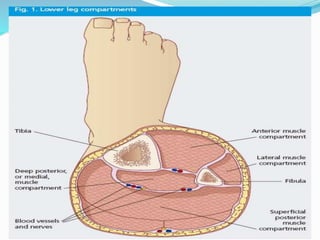
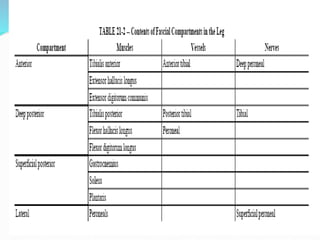
 Leg 4
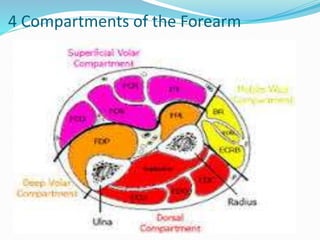
 Forearm 4
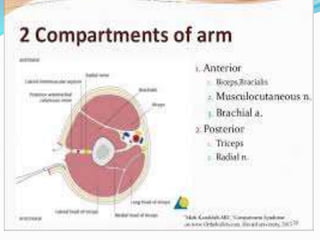
 Arm 2
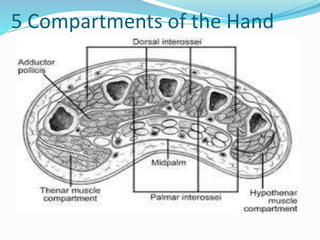
 Hand 5
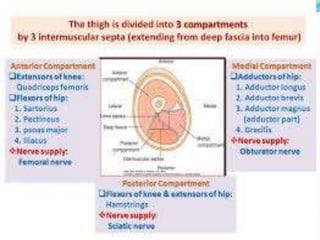
 Thigh 3
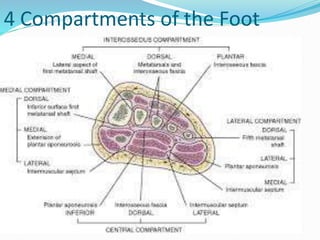
 Foot 4
4 Compartments of the Forearm
4 Compartments of the Foot
5 Compartments of the Hand
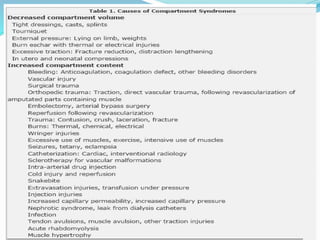
AETIOLOGY
Matson suggested following mechanisms as etiological
Factors:
(a) Factors that cause decrease in compartment
(b) Factors that cause increase in compartmental contents
PATHOPHYSIOLOGY
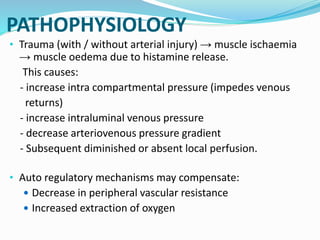
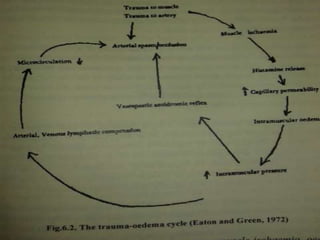
• Trauma (with / without arterial injury) → muscle ischaemia
→ muscle oedema due to histamine release.
This causes:
- increase intra compartmental pressure (impedes venous
returns)
- increase intraluminal venous pressure
- decrease arteriovenous pressure gradient
- Subsequent diminished or absent local perfusion.
• Auto regulatory mechanisms may compensate:
 Decrease in peripheral vascular resistance
 Increased extraction of oxygen
• As system becomes overwhelmed:
 Critical closing pressure is reached
 Oxygen perfusion of muscles and nerves decreases
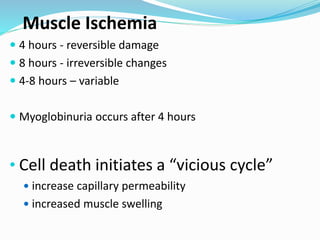
Muscle Ischemia
 4 hours - reversible damage
 8 hours - irreversible changes
 4-8 hours – variable
 Myoglobinuria occurs after 4 hours
• Cell death initiates a “vicious cycle”
 increase capillary permeability
 increased muscle swelling
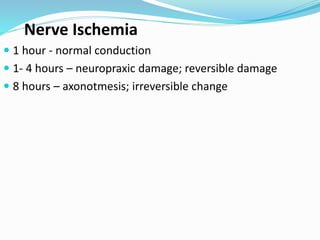
Nerve Ischemia
 1 hour - normal conduction
 1- 4 hours – neuropraxic damage; reversible damage
 8 hours – axonotmesis; irreversible change
MANAGEMENT
ATLS protocol :
 Primary survey and Resuscitation
 Secondary survey; Definitive Care
 Tertiary survey
i. History and examination
ii. Investigations
iii. Treatment
Diagnosis
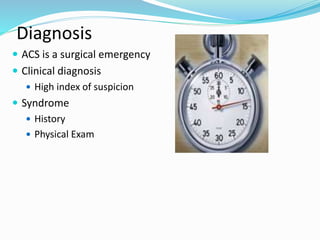
 ACS is a surgical emergency
 Clinical diagnosis
 High index of suspicion
 Syndrome
 History
 Physical Exam
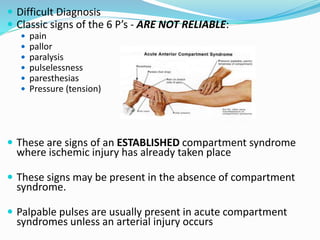
 Difficult Diagnosis
 Classic signs of the 6 P’s - ARE NOT RELIABLE:
 pain
 pallor
 paralysis
 pulselessness
 paresthesias
 Pressure (tension)
 These are signs of an ESTABLISHED compartment syndrome
where ischemic injury has already taken place
 These signs may be present in the absence of compartment
syndrome.
 Palpable pulses are usually present in acute compartment
syndromes unless an arterial injury occurs
Diagnosis (contd)
 Clinical Features
The most important symptom of an impending
compartment syndrome is PAIN DISPROPORTIONATE
TO THAT EXPECTED FOR THE INJURY/STIMULUS
 Compartment pressure
CLINICAL FEATURES
Pain
 Passive muscle stretching
 Out of proportion
 Progressive
 Not relieved by immobilization
 May be worse with elevation
 Patient will not initiate motion on own
Be careful with coexisting nerve injury
Parasthesia / Hypoesthesia
 Secondary to nerve ischemia
 Must be differentiated from nerve injury
Paralysis / Paresis
 Ischemic muscles lose function
 Tense compartment on palpation
INVESTIGATIONS
 LAB STUDIES
Often normal - not helpful in diagnosing or excluding CS
FBC, Creatine phosphokinase , Urine myoglobin, Serum myoglobin, Urinalysis, PT
& APTT, Urine toxicology screen, Complete metabolic Profile, X-RAY of affected
extremity
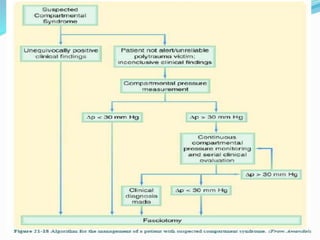
- Definitive diagnosis is compartment pressure measurement
using a tonometer if available.
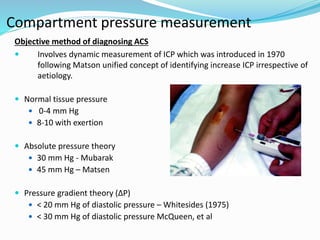
Compartment pressure measurement
Objective method of diagnosing ACS
 Involves dynamic measurement of ICP which was introduced in 1970
following Matson unified concept of identifying increase ICP irrespective of
aetiology.
 Normal tissue pressure
 0-4 mm Hg
 8-10 with exertion
 Absolute pressure theory
 30 mm Hg - Mubarak
 45 mm Hg – Matsen
 Pressure gradient theory (∆P)
 < 20 mm Hg of diastolic pressure – Whitesides (1975)
 < 30 mm Hg of diastolic pressure McQueen, et al
Tissue-Pressure: Principles
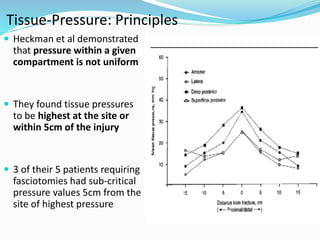
 Heckman et al demonstrated
that pressure within a given
compartment is not uniform
 They found tissue pressures
to be highest at the site or
within 5cm of the injury
 3 of their 5 patients requiring
fasciotomies had sub-critical
pressure values 5cm from the
site of highest pressure
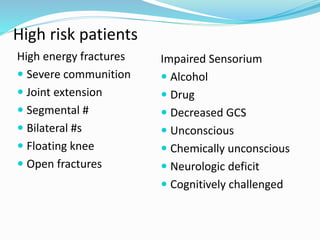
High risk patients
High energy fractures
 Severe communition
 Joint extension
 Segmental #
 Bilateral #s
 Floating knee
 Open fractures
Impaired Sensorium
 Alcohol
 Drug
 Decreased GCS
 Unconscious
 Chemically unconscious
 Neurologic deficit
 Cognitively challenged
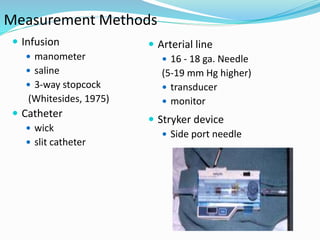
Measurement Methods
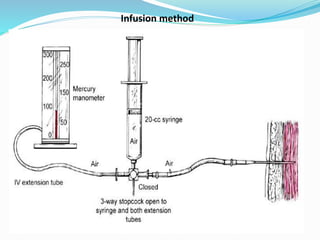
 Infusion
 manometer
 saline
 3-way stopcock
(Whitesides, 1975)
 Catheter
 wick
 slit catheter
 Arterial line
 16 - 18 ga. Needle
(5-19 mm Hg higher)
 transducer
 monitor
 Stryker device
 Side port needle
Infusion method
Most Common Locations
 Leg: deep posterior and the anterior
compartments
 Forearm: volar compartment, especially in the
deep flexor area
TREATMENT
 Remove restricting bandages if any
 Stabilize the patient
 Additional O2 should be given - Ischemic injury is basis for CS
 IV hydration is essential - Hypovolemia worsens ischemia.
 Do not elevate the affected limb-decreases arterial pressure
 Sympathetic blockage – stellate ganglion, paravertebral plexus
 Fasciotomy
 Arterial exploration
Sheridam and Matsen, Rorabeck and Macinat and other
authors concluded that catastrophic clinical results were
inevitable if fasciotomy were delayed for over 12hrs but
full recovery was achieved if decompression was
performed within six hours of making diagnosis.
INDICATIONS FOR FASCIOTOMY
1. Clinical features highly suggestive of ACS
2. Absolute compartment pressure >30-40 mmHg
3. Mean arterial pressure – ICP >40mmHg
4. Diastolic BP – ICP (delta p) <30mmHg
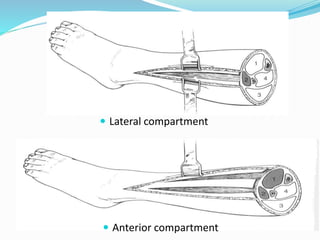
Fasciotomy of the Leg
 One incision - with or without Fibulectomy
 Two incisions
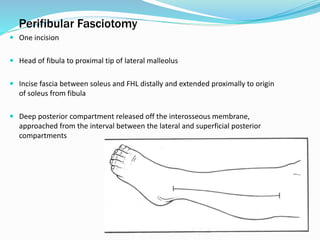
Perifibular Fasciotomy
 One incision
 Head of fibula to proximal tip of lateral malleolus
 Incise fascia between soleus and FHL distally and extended proximally to origin
of soleus from fibula
 Deep posterior compartment released off the interosseous membrane,
approached from the interval between the lateral and superficial posterior
compartments
 Lateral compartment
 Anterior compartment
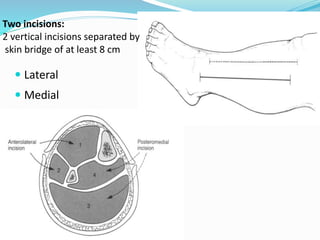
Two incisions:
2 vertical incisions separated by
skin bridge of at least 8 cm
 Lateral
 Medial
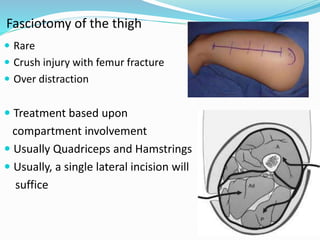
Fasciotomy of the thigh
 Rare
 Crush injury with femur fracture
 Over distraction
 Treatment based upon
compartment involvement
 Usually Quadriceps and Hamstrings
 Usually, a single lateral incision will
suffice
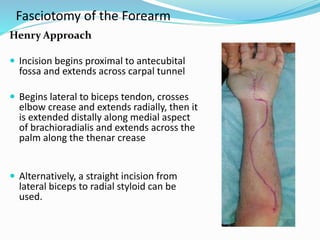
Fasciotomy of the Forearm
Henry Approach
 Incision begins proximal to antecubital
fossa and extends across carpal tunnel
 Begins lateral to biceps tendon, crosses
elbow crease and extends radially, then it
is extended distally along medial aspect
of brachioradialis and extends across the
palm along the thenar crease
 Alternatively, a straight incision from
lateral biceps to radial styloid can be
used.
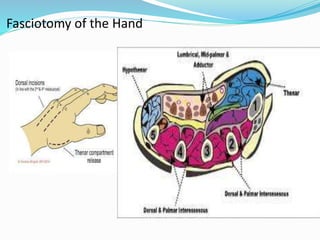
Fasciotomy of the Hand
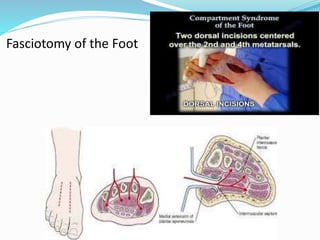
Fasciotomy of the Foot
POST FASCIOTOMY
 Must get bone stability
 Intramedullary level
 External fixation
 ~48hrs after procedure, patient should be brought
back to OR for further debridement
 Delayed skin closure, vacuum dressings or skin-grafting
3-7 days after.
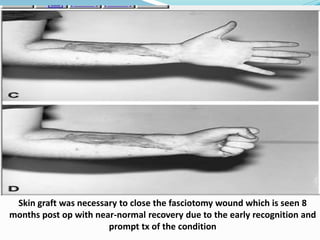
Skin graft was necessary to close the fasciotomy wound which is seen 8
months post op with near-normal recovery due to the early recognition and
prompt tx of the condition
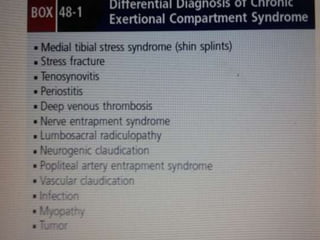
CHRONIC (EXERTIONAL) COMPARTMENT
SYNDROME
 Transient rise in compartmental pressure following
activity
 Symptoms
 Pain
 Weakness
 Neurologic deficits
 Stress Test
 Serial Compartment
Pressure
 Resting >15mm Hg
 5 min post-ex.
>25mm Hg
Treatment
- NSAIDs
- electro stimulation
- massage
- muscle relaxants
- Sympathetic blockage
- modification of activity
- Splinting
- Elective Fasciotomy
COMPLICATIONS
 Muscle necrosis (Rhabdomyonecrosis)
 Ischaemic contracture (Volkmann’s)
 Infection
 Delayed healing of fracture
 Crush syndrome/Renal failure
 Ischaemic - Reperfusion syndrome
 Amputation
 Cosmetic deformity from fasciotomy
 Death
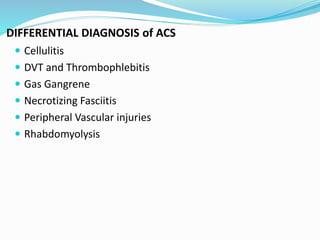
DIFFERENTIAL DIAGNOSIS of ACS
 Cellulitis
 DVT and Thrombophlebitis
 Gas Gangrene
 Necrotizing Fasciitis
 Peripheral Vascular injuries
 Rhabdomyolysis
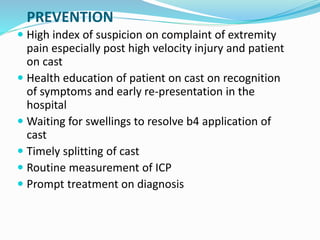
PREVENTION
 High index of suspicion on complaint of extremity
pain especially post high velocity injury and patient
on cast
 Health education of patient on cast on recognition
of symptoms and early re-presentation in the
hospital
 Waiting for swellings to resolve b4 application of
cast
 Timely splitting of cast
 Routine measurement of ICP
 Prompt treatment on diagnosis
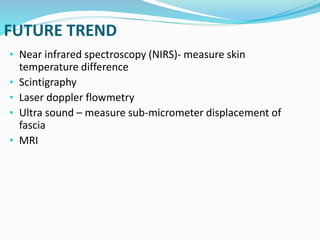
FUTURE TREND
• Near infrared spectroscopy (NIRS)- measure skin
temperature difference
• Scintigraphy
• Laser doppler flowmetry
• Ultra sound – measure sub-micrometer displacement of
fascia
• MRI
PROGNOSIS
• Excellent to poor - depending on how quickly ACS is
diagnosed and treated, and whether or not
complications develop
• Nerve dysfunction maybe reversible with time but
infarcted muscle is damaged permanently.
• Early surgery gives good functional outcome but delay
results in muscle ischaemia & necrosis
CONCLUSION
 Very important to make diagnosis
 There is still no conclusive answer to the critical
threshold of intra compartmental pressure at which
fasciotomy should be performed.
 Prevention and early decompression are emphasized
in the management of ACS as treatment of
complicated cases is unrewarding.
 Missed compartment syndrome is devastating
 Re-examine patient!
REFERENCES
 Apley’s System of Orthopaedics and Fractures, 9th ed.
 Campbell’s Operative Orthopaedics 12th ed.
 Schwartz principles of surgery, 10th ed.
 www.emedicine.medscape.com
 April 2007 By Kumar V Saeed, A Panagopoulos, PJ Parker
 Wheeless’ Textbook of Orthopaedics- Compartment syndrome of the Foot.
 Acute Compartment Syndrome Update on Diagnosis and treatment by TE
Whitesides and MM Heckman Academy of Orthopaedic Surgery July 1996

Compartment syndrome

  • 1.
    COMPARTMENT SYNDROME IN THE LIMBS BY DR.LAWAL GBENGA REGISTRAR, SURGERY DEPT. NATIONAL HOSPITAL ABUJA SUPERVISOR: DR. OPADELE 21/01/16
  • 2.
    OUTLINE  INTRODUCTION  EPIDEMIOLOGY RELEVANT ANATOMY  AETIOLOGY  PATHOPHYSIOLOGY  MANAGEMENT  COMPLICATIONS  PREVENTION  PROGNOSIS  CONCLUSION
  • 3.
    INTRODUCTION Definition: Compartment Syndromeis defined as a clinical condition in which increased pressure within a limited space (osseofascial compartment) compromises the circulation and function of the tissues within that space. Types depending on the cause of increased intra compartmental pressure and the duration of symptoms Classified as :  Acute compartment syndrome (ACS)  Chronic compartment syndrome (CCS)
  • 4.
    Acute compartment syndrome(ACS)  A surgical emergency which if not recognized and treated early can lead to devastating disabilities, amputation and even death in some situations.  Acute compartment syndrome can develop anywhere a skeletal muscle is surrounded by a substantial fascia.  ACS may occur in foot, leg, thigh, buttocks, lumbar paraspinous muscles, hand, forearm, arm and shoulder.  Commonest sites are the leg and forearm
  • 5.
    HISTORICAL PERSPECTIVE Richard VonVolkmann, 1881 “For many years I have noted on occasion, following the use of bandages too tightly applied, the occurrence of paralysis and contraction of the limb, NOT … due to the paralysis of the nerve by pressure, but as a quick and massive disintegration of the contractile substance and the effect of the ensuing reaction and degeneration.”
  • 6.
     1881: Richardvon Volkmann documented nerve injury & subsequent contracture severe limb injuries  Peterson in 1888 recognized that ischaemic contracture could occur in the absence of bandaging  50yrs later, Jepson described ischaemic contractures in dog hind leg following experimentally induced venous obstruction. • 1941: Bywaters & Beall reported on the significance of crush injury while working with victims of the London Blitz.
  • 7.
    • By 2ndworld war ,ARTERIAL INJURY THEORY was proposed (ischaemia is due to injury and spasm) • Seddon in 1966 challenged it after finding palpable pulses in up to 50% of cases • McQuillan & Nolan described a vicious circle of increasing tension in an enclosed compartment causing venous obstruction and subsequent arterial • They concluded that delay fasciotomy is the single most important cause of treatment failure • In the 1970s Matson as well as Owen et al, established the importance of measuring intra compartmental pressure with the aid of the Wick catheter.
  • 8.
    EPIDEMIOLOGY  Commoner inyounger patients (M:F ratio is 10:1) under 35 years of age  Sites: Leg>Forearm>Thigh>Arm>Abd>Buttocks>Feet in DM patients • Incidence of ACS in the West =3.1/100,00/yr • In the US, 2-12% anterior distal LL injuries result in CS • 30% of Limbs develop CS following vascular injury • More in closed injuries
  • 9.
    • Tibial diaphysealfracture is the most common cause- 36% • Soft tissue injury-23.2% • Distal radial fracture=9.8% • CRUSH syndrome & diaphyseal forearm fractures=7.9% each • Diaphyseal femoral fractures & tibial plateau fractures = 3.0% • Hand & tibial pilon fractures 2.5% each • Foot fracture is 1.8% • Ankle, pelvis, elbow & humeral diaph. Fractures = 0.6%
  • 10.
    RELEVANT ANATOMY Compartments  Leg4  Forearm 4  Arm 2  Hand 5  Thigh 3  Foot 4
  • 13.
    4 Compartments ofthe Forearm
  • 15.
  • 17.
  • 18.
    AETIOLOGY Matson suggested followingmechanisms as etiological Factors: (a) Factors that cause decrease in compartment (b) Factors that cause increase in compartmental contents
  • 20.
    PATHOPHYSIOLOGY • Trauma (with/ without arterial injury) → muscle ischaemia → muscle oedema due to histamine release. This causes: - increase intra compartmental pressure (impedes venous returns) - increase intraluminal venous pressure - decrease arteriovenous pressure gradient - Subsequent diminished or absent local perfusion. • Auto regulatory mechanisms may compensate:  Decrease in peripheral vascular resistance  Increased extraction of oxygen
  • 21.
    • As systembecomes overwhelmed:  Critical closing pressure is reached  Oxygen perfusion of muscles and nerves decreases
  • 23.
    Muscle Ischemia  4hours - reversible damage  8 hours - irreversible changes  4-8 hours – variable  Myoglobinuria occurs after 4 hours • Cell death initiates a “vicious cycle”  increase capillary permeability  increased muscle swelling
  • 24.
    Nerve Ischemia  1hour - normal conduction  1- 4 hours – neuropraxic damage; reversible damage  8 hours – axonotmesis; irreversible change
  • 25.
    MANAGEMENT ATLS protocol : Primary survey and Resuscitation  Secondary survey; Definitive Care  Tertiary survey i. History and examination ii. Investigations iii. Treatment
  • 26.
    Diagnosis  ACS isa surgical emergency  Clinical diagnosis  High index of suspicion  Syndrome  History  Physical Exam
  • 27.
     Difficult Diagnosis Classic signs of the 6 P’s - ARE NOT RELIABLE:  pain  pallor  paralysis  pulselessness  paresthesias  Pressure (tension)  These are signs of an ESTABLISHED compartment syndrome where ischemic injury has already taken place  These signs may be present in the absence of compartment syndrome.  Palpable pulses are usually present in acute compartment syndromes unless an arterial injury occurs
  • 28.
    Diagnosis (contd)  ClinicalFeatures The most important symptom of an impending compartment syndrome is PAIN DISPROPORTIONATE TO THAT EXPECTED FOR THE INJURY/STIMULUS  Compartment pressure
  • 29.
    CLINICAL FEATURES Pain  Passivemuscle stretching  Out of proportion  Progressive  Not relieved by immobilization  May be worse with elevation  Patient will not initiate motion on own Be careful with coexisting nerve injury
  • 30.
    Parasthesia / Hypoesthesia Secondary to nerve ischemia  Must be differentiated from nerve injury Paralysis / Paresis  Ischemic muscles lose function  Tense compartment on palpation
  • 31.
    INVESTIGATIONS  LAB STUDIES Oftennormal - not helpful in diagnosing or excluding CS FBC, Creatine phosphokinase , Urine myoglobin, Serum myoglobin, Urinalysis, PT & APTT, Urine toxicology screen, Complete metabolic Profile, X-RAY of affected extremity - Definitive diagnosis is compartment pressure measurement using a tonometer if available.
  • 32.
    Compartment pressure measurement Objectivemethod of diagnosing ACS  Involves dynamic measurement of ICP which was introduced in 1970 following Matson unified concept of identifying increase ICP irrespective of aetiology.  Normal tissue pressure  0-4 mm Hg  8-10 with exertion  Absolute pressure theory  30 mm Hg - Mubarak  45 mm Hg – Matsen  Pressure gradient theory (∆P)  < 20 mm Hg of diastolic pressure – Whitesides (1975)  < 30 mm Hg of diastolic pressure McQueen, et al
  • 33.
    Tissue-Pressure: Principles  Heckmanet al demonstrated that pressure within a given compartment is not uniform  They found tissue pressures to be highest at the site or within 5cm of the injury  3 of their 5 patients requiring fasciotomies had sub-critical pressure values 5cm from the site of highest pressure
  • 34.
    High risk patients Highenergy fractures  Severe communition  Joint extension  Segmental #  Bilateral #s  Floating knee  Open fractures Impaired Sensorium  Alcohol  Drug  Decreased GCS  Unconscious  Chemically unconscious  Neurologic deficit  Cognitively challenged
  • 35.
    Measurement Methods  Infusion manometer  saline  3-way stopcock (Whitesides, 1975)  Catheter  wick  slit catheter  Arterial line  16 - 18 ga. Needle (5-19 mm Hg higher)  transducer  monitor  Stryker device  Side port needle
  • 36.
  • 37.
    Most Common Locations Leg: deep posterior and the anterior compartments  Forearm: volar compartment, especially in the deep flexor area
  • 38.
    TREATMENT  Remove restrictingbandages if any  Stabilize the patient  Additional O2 should be given - Ischemic injury is basis for CS  IV hydration is essential - Hypovolemia worsens ischemia.  Do not elevate the affected limb-decreases arterial pressure  Sympathetic blockage – stellate ganglion, paravertebral plexus  Fasciotomy  Arterial exploration
  • 40.
    Sheridam and Matsen,Rorabeck and Macinat and other authors concluded that catastrophic clinical results were inevitable if fasciotomy were delayed for over 12hrs but full recovery was achieved if decompression was performed within six hours of making diagnosis.
  • 41.
    INDICATIONS FOR FASCIOTOMY 1.Clinical features highly suggestive of ACS 2. Absolute compartment pressure >30-40 mmHg 3. Mean arterial pressure – ICP >40mmHg 4. Diastolic BP – ICP (delta p) <30mmHg
  • 42.
    Fasciotomy of theLeg  One incision - with or without Fibulectomy  Two incisions
  • 43.
    Perifibular Fasciotomy  Oneincision  Head of fibula to proximal tip of lateral malleolus  Incise fascia between soleus and FHL distally and extended proximally to origin of soleus from fibula  Deep posterior compartment released off the interosseous membrane, approached from the interval between the lateral and superficial posterior compartments
  • 44.
     Lateral compartment Anterior compartment
  • 45.
    Two incisions: 2 verticalincisions separated by skin bridge of at least 8 cm  Lateral  Medial
  • 46.
    Fasciotomy of thethigh  Rare  Crush injury with femur fracture  Over distraction  Treatment based upon compartment involvement  Usually Quadriceps and Hamstrings  Usually, a single lateral incision will suffice
  • 47.
    Fasciotomy of theForearm Henry Approach  Incision begins proximal to antecubital fossa and extends across carpal tunnel  Begins lateral to biceps tendon, crosses elbow crease and extends radially, then it is extended distally along medial aspect of brachioradialis and extends across the palm along the thenar crease  Alternatively, a straight incision from lateral biceps to radial styloid can be used.
  • 48.
  • 49.
  • 50.
    POST FASCIOTOMY  Mustget bone stability  Intramedullary level  External fixation  ~48hrs after procedure, patient should be brought back to OR for further debridement  Delayed skin closure, vacuum dressings or skin-grafting 3-7 days after.
  • 51.
    Skin graft wasnecessary to close the fasciotomy wound which is seen 8 months post op with near-normal recovery due to the early recognition and prompt tx of the condition
  • 52.
    CHRONIC (EXERTIONAL) COMPARTMENT SYNDROME Transient rise in compartmental pressure following activity  Symptoms  Pain  Weakness  Neurologic deficits
  • 53.
     Stress Test Serial Compartment Pressure  Resting >15mm Hg  5 min post-ex. >25mm Hg
  • 54.
    Treatment - NSAIDs - electrostimulation - massage - muscle relaxants - Sympathetic blockage - modification of activity - Splinting - Elective Fasciotomy
  • 55.
    COMPLICATIONS  Muscle necrosis(Rhabdomyonecrosis)  Ischaemic contracture (Volkmann’s)  Infection  Delayed healing of fracture  Crush syndrome/Renal failure  Ischaemic - Reperfusion syndrome  Amputation  Cosmetic deformity from fasciotomy  Death
  • 56.
    DIFFERENTIAL DIAGNOSIS ofACS  Cellulitis  DVT and Thrombophlebitis  Gas Gangrene  Necrotizing Fasciitis  Peripheral Vascular injuries  Rhabdomyolysis
  • 58.
    PREVENTION  High indexof suspicion on complaint of extremity pain especially post high velocity injury and patient on cast  Health education of patient on cast on recognition of symptoms and early re-presentation in the hospital  Waiting for swellings to resolve b4 application of cast  Timely splitting of cast  Routine measurement of ICP  Prompt treatment on diagnosis
  • 59.
    FUTURE TREND • Nearinfrared spectroscopy (NIRS)- measure skin temperature difference • Scintigraphy • Laser doppler flowmetry • Ultra sound – measure sub-micrometer displacement of fascia • MRI
  • 60.
    PROGNOSIS • Excellent topoor - depending on how quickly ACS is diagnosed and treated, and whether or not complications develop • Nerve dysfunction maybe reversible with time but infarcted muscle is damaged permanently. • Early surgery gives good functional outcome but delay results in muscle ischaemia & necrosis
  • 61.
    CONCLUSION  Very importantto make diagnosis  There is still no conclusive answer to the critical threshold of intra compartmental pressure at which fasciotomy should be performed.  Prevention and early decompression are emphasized in the management of ACS as treatment of complicated cases is unrewarding.  Missed compartment syndrome is devastating  Re-examine patient!
  • 62.
    REFERENCES  Apley’s Systemof Orthopaedics and Fractures, 9th ed.  Campbell’s Operative Orthopaedics 12th ed.  Schwartz principles of surgery, 10th ed.  www.emedicine.medscape.com  April 2007 By Kumar V Saeed, A Panagopoulos, PJ Parker  Wheeless’ Textbook of Orthopaedics- Compartment syndrome of the Foot.  Acute Compartment Syndrome Update on Diagnosis and treatment by TE Whitesides and MM Heckman Academy of Orthopaedic Surgery July 1996