AOTrauma Principles Course
Forearm fractures
Felix Bonnaire, DE
John Wilber, US
Objectives
• Review the concept of the forearm as a joint
• Discuss the assessment, problems and options for
treatment of forearm fractures
• Review the options for surgical approaches
• Discuss complications and outcomes
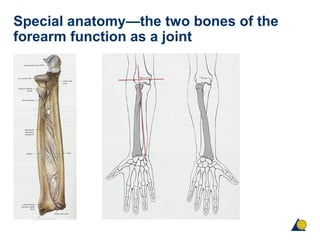
Special anatomy—the two bones of the
forearm function as a joint
Articulations
Six Joints
• Ulna-humeral
• Radial-capitellar
• Proximal radial-ulnar
• Distal radial ulnar
• Radial carpal
• Interosseous membrane
Special anatomy—muscle forces tend to
displace fractures
m. supinator
m. pronator t.
Consequences of deformity
• Shortening
• Angulation
• Loss of radial bow
• Loss of alignment
- loss of motion
- loss of function
Fracture mechanisms
• Axial compression
• Bending
• Rotation
• Direct trauma
Investigations
• X-ray in two planes—must include both joints
• CT—rarely indicated
• MRI—useful for assessing damage to articular cartilage
of distal radioulnar joint
• Angiography—vital in cases involving vascular trauma
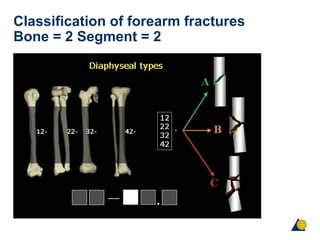
Classification of forearm fractures
Bone = 2 Segment = 2
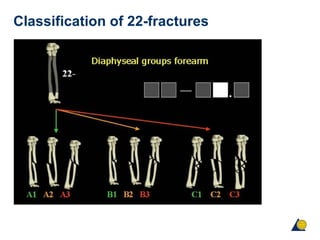
Classification of 22-fractures
Fracture with joint disruption
Monteggia fractures
• Ulnar shaft fracture with
- Dislocation of radial head
- Types I – IV depending on direction of radial head
dislocation
Fracture with joint disruption
Monteggia fractures
Line drawn through radial head
and shaft should line up with the
capitellum in all views
Fracture with joint disruption
Galeazzi fractures
• Radial shaft fracture with:
- Dislocation of distal ulna
- Multiple variants in
location of radius fracture
Personality of fracture
• Soft-tissue damage
• Degree of fracture displacement
• Degree of comminution
• Degree of joint involvement
• Osteoporosis
• Nerve/blood vessel injury
Goals of treatment
• Anatomical reduction
• Restore ulnar & radial length
• Reduce/stabilize joints
• Restore rotational alignment
• Repair soft-tissue injuries
• Restore normal function
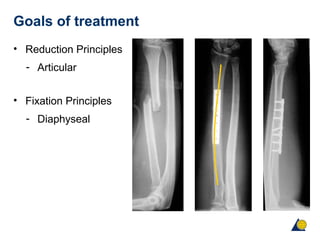
Goals of treatment
• Reduction Principles
- Articular
• Fixation Principles
- Diaphyseal
Evluation
• Usually high-energy (associated trauma)
• Elbow (radial head)
• Wrist (DRUJ)
• Neurological
• Vascular
• Integument
• Swelling
Indications for operative treatment
• Combined fractures of ulna and radius
• Displaced isolated fracture of either bone
• Monteggia and Galeazzi
• Every open fracture
Operative treatment—decision-making
• Surgical approach:
- Henry (palmar)
- Thompson (dorsolateral)
- Boyd (proximal ulnar)
• Ulna/radius first?
• Distractor?
• External fixator?
• Intramedullary splintage?
• Bone graft ?
Subcutaneous approach to ulna
Posterolateral approach to radius
Henry—anterior approach to radius
Operative treatment—implant
• LC-DCP 3.5 (limited-contact dynamic compression plate)
- Anatomical reduction
• LCP 3.5 (locking compression plate)
- Restoration of length, axis, and alignment
• At least 3 screws in each main fragment!
Plate fixation
• The “Gold Standard” treatment for most diaphyseal
forearm fractures
• Stable, strong, anatomical fixation
• Union rates > 95%
Tips for operative surgery
• Begin with easiest fracture
• Look for elbow and wrist joint
• Be aware of rotation of radius
• Test function of forearm joint after fixation
Plate fixation—reduction preserving soft tissue
• Minimize periosteal stripping
• Narrow retractors placed to
- avoid penetration of interosseous
- membrane
• Extreme care with butteryfly
- fragments
Timing of surgery
• Splint application with elective scheduling for
uncomplicated closed fractures
• Immediate fixation for:
- Open fractures
- Impending open fractures
- Compartment syndrome
- Unreducable dislocations
• Easier fracture reduction with early surgery, especially if
shortening is present
Postoperative care
• Avoid prolonged immobilization
• If you fix it internally, do not fix it externally
• Immobilize the minimum time needed to protect the soft
tissues
• Dislocations may require immobilization
• Begin early active ROM
Problems
• Soft-tissue loss
• Infection
• Synostosis 2,6–6,6%
• Nonunion 3,7–10,3%
• Refracture after implant removal up to 25%
Results of plate fixation
MW Chapman et al (1989) J Bone Joint Surg
• Healing 98%
• Excellent to satisfactory 92%
• Infection rate 2.3%
• Refracture rate 2.3%
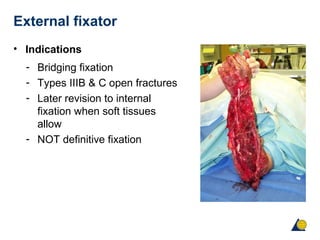
External fixator
• Indications
- Bridging fixation
- Types IIIB & C open fractures
- Later revision to internal
fixation when soft tissues
allow
- NOT definitive fixation
Intramedullary nailing
Indications
• Not routinely used
• Problems of rotational instability, loss of radial bow,
shortening, and nonunion
• May be useful when soft tissues compromised
• Children
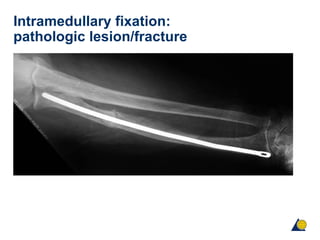
• Pathologic fractures or impending fractures where the
device protects the whole bone
Intramedullary fixation:
pathologic lesion/fracture
Summary
• Analysis of fracture mechanism and associated soft-
tissue lesions are vital to allow adequate treatment
planning
• Complete reconstruction of anatomy is essential to
restore normal function
• Stable fixation with long plates and early movement are
the keys to success
• Plate fixation gives good results

Forearm shaft fractues

  • 1.
    AOTrauma Principles Course Forearmfractures Felix Bonnaire, DE John Wilber, US
  • 2.
    Objectives • Review theconcept of the forearm as a joint • Discuss the assessment, problems and options for treatment of forearm fractures • Review the options for surgical approaches • Discuss complications and outcomes
  • 3.
    Special anatomy—the twobones of the forearm function as a joint
  • 4.
    Articulations Six Joints • Ulna-humeral •Radial-capitellar • Proximal radial-ulnar • Distal radial ulnar • Radial carpal • Interosseous membrane
  • 5.
    Special anatomy—muscle forcestend to displace fractures m. supinator m. pronator t.
  • 6.
    Consequences of deformity •Shortening • Angulation • Loss of radial bow • Loss of alignment - loss of motion - loss of function
  • 7.
    Fracture mechanisms • Axialcompression • Bending • Rotation • Direct trauma
  • 8.
    Investigations • X-ray intwo planes—must include both joints • CT—rarely indicated • MRI—useful for assessing damage to articular cartilage of distal radioulnar joint • Angiography—vital in cases involving vascular trauma
  • 9.
    Classification of forearmfractures Bone = 2 Segment = 2
  • 10.
  • 11.
    Fracture with jointdisruption Monteggia fractures • Ulnar shaft fracture with - Dislocation of radial head - Types I – IV depending on direction of radial head dislocation
  • 12.
    Fracture with jointdisruption Monteggia fractures Line drawn through radial head and shaft should line up with the capitellum in all views
  • 13.
    Fracture with jointdisruption Galeazzi fractures • Radial shaft fracture with: - Dislocation of distal ulna - Multiple variants in location of radius fracture
  • 14.
    Personality of fracture •Soft-tissue damage • Degree of fracture displacement • Degree of comminution • Degree of joint involvement • Osteoporosis • Nerve/blood vessel injury
  • 15.
    Goals of treatment •Anatomical reduction • Restore ulnar & radial length • Reduce/stabilize joints • Restore rotational alignment • Repair soft-tissue injuries • Restore normal function
  • 16.
    Goals of treatment •Reduction Principles - Articular • Fixation Principles - Diaphyseal
  • 17.
    Evluation • Usually high-energy(associated trauma) • Elbow (radial head) • Wrist (DRUJ) • Neurological • Vascular • Integument • Swelling
  • 18.
    Indications for operativetreatment • Combined fractures of ulna and radius • Displaced isolated fracture of either bone • Monteggia and Galeazzi • Every open fracture
  • 19.
    Operative treatment—decision-making • Surgicalapproach: - Henry (palmar) - Thompson (dorsolateral) - Boyd (proximal ulnar) • Ulna/radius first? • Distractor? • External fixator? • Intramedullary splintage? • Bone graft ?
  • 20.
  • 21.
  • 22.
  • 23.
    Operative treatment—implant • LC-DCP3.5 (limited-contact dynamic compression plate) - Anatomical reduction • LCP 3.5 (locking compression plate) - Restoration of length, axis, and alignment • At least 3 screws in each main fragment!
  • 24.
    Plate fixation • The“Gold Standard” treatment for most diaphyseal forearm fractures • Stable, strong, anatomical fixation • Union rates > 95%
  • 25.
    Tips for operativesurgery • Begin with easiest fracture • Look for elbow and wrist joint • Be aware of rotation of radius • Test function of forearm joint after fixation
  • 26.
    Plate fixation—reduction preservingsoft tissue • Minimize periosteal stripping • Narrow retractors placed to - avoid penetration of interosseous - membrane • Extreme care with butteryfly - fragments
  • 27.
    Timing of surgery •Splint application with elective scheduling for uncomplicated closed fractures • Immediate fixation for: - Open fractures - Impending open fractures - Compartment syndrome - Unreducable dislocations • Easier fracture reduction with early surgery, especially if shortening is present
  • 28.
    Postoperative care • Avoidprolonged immobilization • If you fix it internally, do not fix it externally • Immobilize the minimum time needed to protect the soft tissues • Dislocations may require immobilization • Begin early active ROM
  • 29.
    Problems • Soft-tissue loss •Infection • Synostosis 2,6–6,6% • Nonunion 3,7–10,3% • Refracture after implant removal up to 25%
  • 30.
    Results of platefixation MW Chapman et al (1989) J Bone Joint Surg • Healing 98% • Excellent to satisfactory 92% • Infection rate 2.3% • Refracture rate 2.3%
  • 31.
    External fixator • Indications -Bridging fixation - Types IIIB & C open fractures - Later revision to internal fixation when soft tissues allow - NOT definitive fixation
  • 32.
    Intramedullary nailing Indications • Notroutinely used • Problems of rotational instability, loss of radial bow, shortening, and nonunion • May be useful when soft tissues compromised • Children • Pathologic fractures or impending fractures where the device protects the whole bone
  • 33.
  • 34.
    Summary • Analysis offracture mechanism and associated soft- tissue lesions are vital to allow adequate treatment planning • Complete reconstruction of anatomy is essential to restore normal function • Stable fixation with long plates and early movement are the keys to success • Plate fixation gives good results