Compartment Syndrome
Mosheer Ziadi
R1
Objectives
•
•
•
•
•
•
•

What is it
Definition
Pathophysiology
Eitology
Diagnosis
Sign and symptoms
Treatment
What is it ?
• Increase in hydrostatic pressure in closed
osteofascial space resulting in decreased
perfusion of muscle and nerves within
compartment.
What is it?
• RAISED PRESSURE WITHIN A CLOSED SPACE with a
potential to cause irreversible damage to the
contents of the closed space.
Definition

• Symptoms resulting from
increased pressure within a
limited space
– compromising
• circulation
• function
Pathophysiology
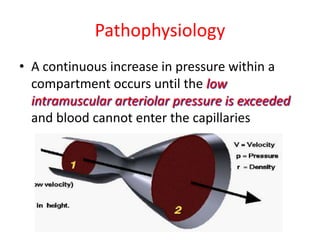
• A continuous increase in pressure within a
compartment occurs until the low
intramuscular arteriolar pressure is exceeded
and blood cannot enter the capillaries
Pathophysiology
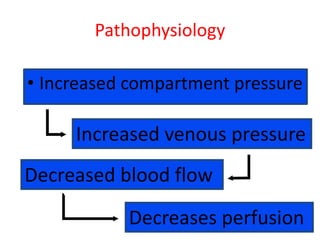
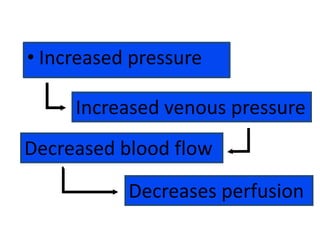
• Increased compartment pressure

Increased venous pressure
Decreased blood flow
Decreases perfusion
Pathophysiology
• Autoregulatory mechanisms may
compensate:
– Decrease in peripheral vascular resistance
– Increased extraction of oxygen

• As system becomes overwhelmed:
– Critical closing pressure is reached
– Oxygen perfusion of muscles and nerves decreases
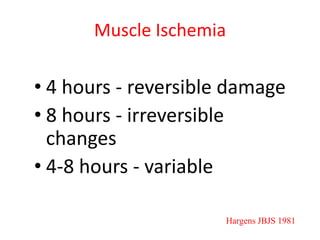
Muscle Ischemia

• 4 hours - reversible damage
• 8 hours - irreversible
changes
• 4-8 hours - variable
Hargens JBJS 1981
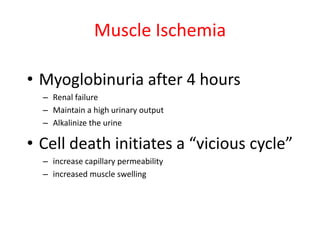
Muscle Ischemia
• Myoglobinuria after 4 hours
– Renal failure
– Maintain a high urinary output
– Alkalinize the urine

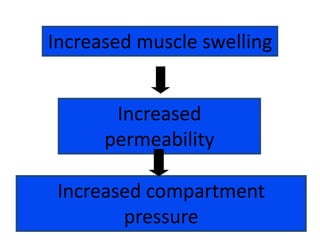
• Cell death initiates a “vicious cycle”
– increase capillary permeability
– increased muscle swelling
Increased muscle swelling
Increased
permeability

Increased compartment
pressure
• Increased pressure

Increased venous pressure
Decreased blood flow

Decreases perfusion
Nerve Ischemia
• 1 hour - normal conduction
• 1- 4 hours - neuropraxic damage
reversible
• 8 hours - axonotmesis and
irreversible change
Hargens et al. JBJS 1979
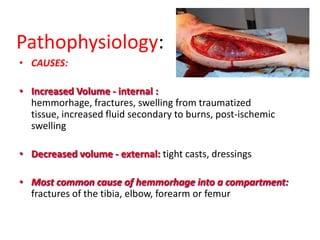
Pathophysiology:
• CAUSES:
• Increased Volume - internal :
hemmorhage, fractures, swelling from traumatized
tissue, increased fluid secondary to burns, post-ischemic
swelling
• Decreased volume - external: tight casts, dressings
• Most common cause of hemmorhage into a compartment:
fractures of the tibia, elbow, forearm or femur
Etiology
• Fractures
• Soft Tissue Injury (Crush)
• Arterial Injury
– Post-ischemic swelling
– Reperfusion injury

• Drug Overdose (limb compression)
• Burns
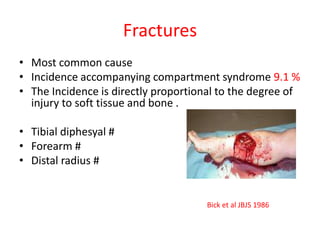
Fractures
• Most common cause
• Incidence accompanying compartment syndrome 9.1 %
• The Incidence is directly proportional to the degree of
injury to soft tissue and bone .
• Tibial diphesyal #
• Forearm #
• Distal radius #

Bick et al JBJS 1986
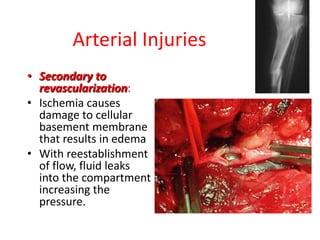
Arterial Injuries
• Secondary to
revascularization:
• Ischemia causes
damage to cellular
basement membrane
that results in edema
• With reestablishment
of flow, fluid leaks
into the compartment
increasing the
pressure.
Diagnosis
• Clinical diagnosis
– High index of suspicion

• Syndrome
– History
– Physical Exam
Difficult Diagnosis
• Classic signs of the 5 P’s - ARE NOT RELIABLE:
–
–
–
–
–

pain
pallor
paralysis
pulselessness
paresthesias

• These are signs of an ESTABLISHED compartment
syndrome where ischemic injury has already
taken place
• These signs may be present in the absence of
compartment syndrome.
Signs & Symptoms
• Pain
–Passive muscle stretching
–Out of proportion
–Progressive
–Not relieved by immobilization
Diagnosis
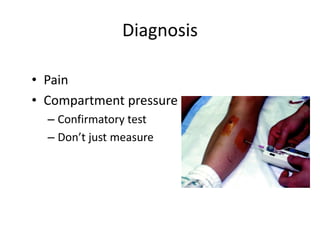
• Pain
• Compartment pressure
– Confirmatory test
– Don’t just measure
Diagnosis
• Palpable pulses are usually present in
acute compartment syndromes unless an
arterial injury occurs.
• Sensory changes and paralysis do not
occur until ischemia has been present for
about 1 hour or more
Diagnosis
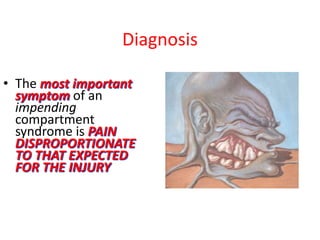
• The most important
symptom of an
impending
compartment
syndrome is PAIN
DISPROPORTIONATE
TO THAT EXPECTED
FOR THE INJURY
Signs & Symptoms

• Pain
–May be worse with elevation
–Patient will not initiate
motion on own

• Be careful with coexisting
nerve injury
Signs & Symptoms

• Parasthesia
–Secondary to nerve ischemia

• Must be differentiated from
nerve injury
Signs & Symptoms
• Paralysis (Weakness)
– Ischemic muscles lose function
Signs & Symptoms
• Tense compartment on palpation
• Elevated compartment pressure
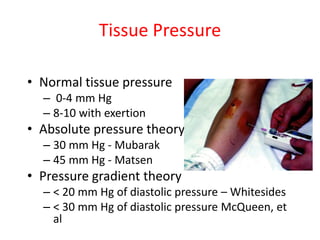
Tissue Pressure
• Normal tissue pressure
– 0-4 mm Hg
– 8-10 with exertion

• Absolute pressure theory
– 30 mm Hg - Mubarak
– 45 mm Hg - Matsen

• Pressure gradient theory
– < 20 mm Hg of diastolic pressure – Whitesides
– < 30 mm Hg of diastolic pressure McQueen, et
al
Who is at high risk?
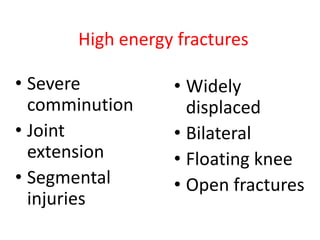
High energy fractures

• Severe
comminution
• Joint
extension
• Segmental
injuries

• Widely
displaced
• Bilateral
• Floating knee
• Open fractures
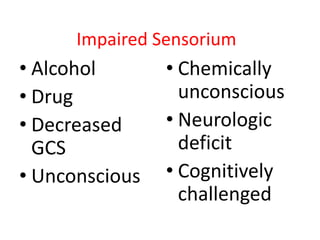
Impaired Sensorium

• Alcohol
• Drug
• Decreased
GCS
• Unconscious

• Chemically
unconscious
• Neurologic
deficit
• Cognitively
challenged
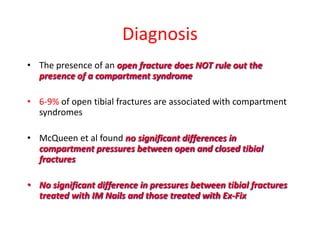
Diagnosis
• The presence of an open fracture does NOT rule out the
presence of a compartment syndrome
• 6-9% of open tibial fractures are associated with compartment
syndromes

• McQueen et al found no significant differences in
compartment pressures between open and closed tibial
fractures
• No significant difference in pressures between tibial fractures
treated with IM Nails and those treated with Ex-Fix
Most Common Locations
• Leg: deep posterior and the
anterior compartments
• Forearm: volar compartment,
especially in the deep flexor
area
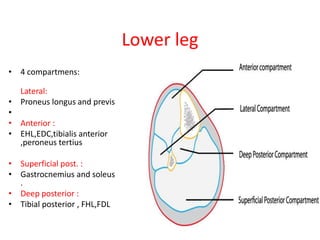
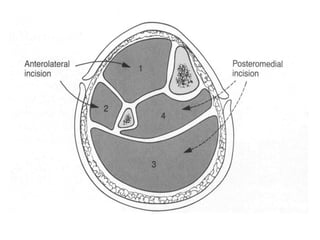
Lower leg
• 4 compartmens:
Lateral:
• Proneus longus and previs
•
• Anterior :
• EHL,EDC,tibialis anterior
,peroneus tertius
• Superficial post. :
• Gastrocnemius and soleus
.
• Deep posterior :
• Tibial posterior , FHL,FDL
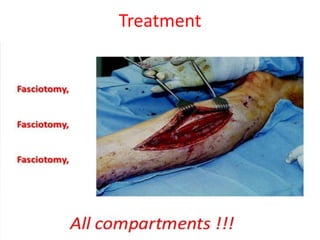
Treatment
•
•
•
•

Remove restricting cast:
*comaprtment pressure falls by 30% is split on one side.
*Falls by 65% when the cast spread after splitting
*Splitting the padding reduces it by further 10 % and
complete removalof cast by another 15%
• Serial exams
• When diagnosis made
– Immediate surgery
• 4 compartment fasciotomy
*Garfin, Mubarak JBJS 1981
Treatment
• Don’t wait so long..!
Treatment
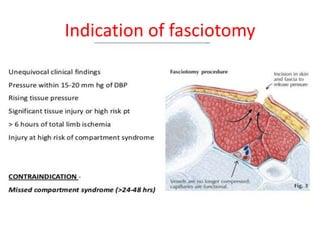
Indication of fasciotomy
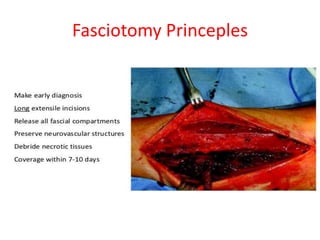
Fasciotomy Princeples
Treatment
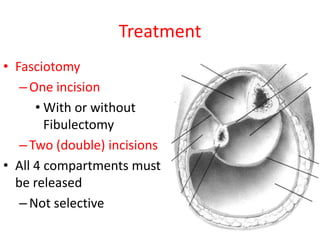
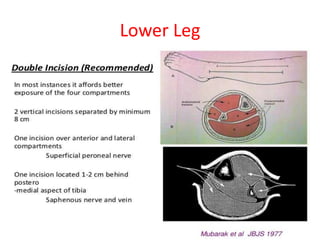
• Fasciotomy
– One incision
• With or without
Fibulectomy
– Two (double) incisions
• All 4 compartments must
be released
– Not selective
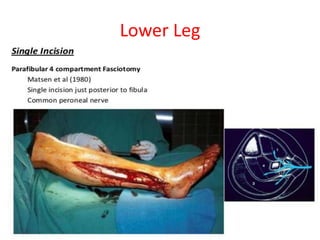
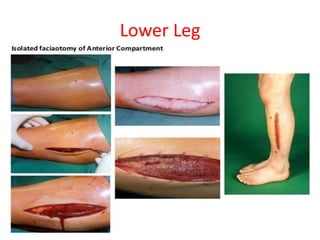
Lower Leg
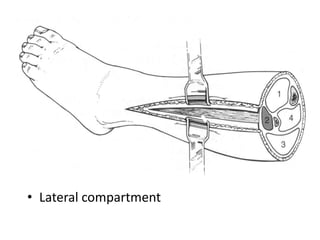
• Lateral compartment
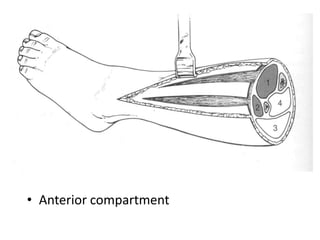
• Anterior compartment
Lower Leg
Lower Leg
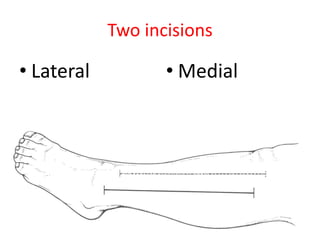
Two incisions

• Lateral

• Medial
Double Incision
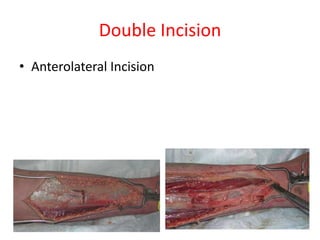
• Anterolateral Incision
Double Incision
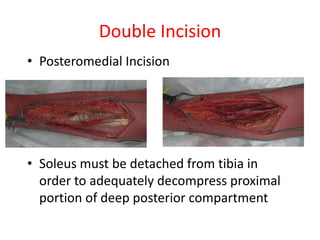
• Posteromedial Incision

• Soleus must be detached from tibia in
order to adequately decompress proximal
portion of deep posterior compartment
Thigh
• Rare
• Crush injury with femur fracture
• Over distraction
– relative under distraction
Thigh
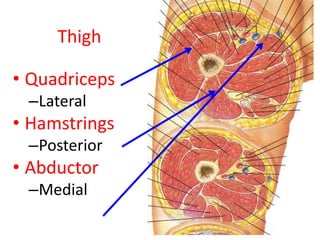
• Quadriceps
–Lateral

• Hamstrings
–Posterior

• Abductor
–Medial
Treatment

• Based upon involvement
• Usually Quadriceps and
Hamstrings
• Usually, a single lateral incision
will suffice
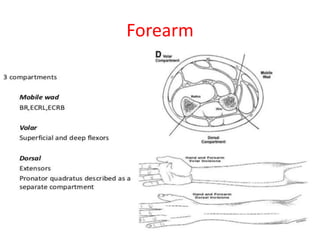
Forearm
Treatment
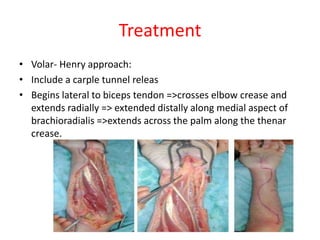
• Volar- Henry approach:
• Include a carple tunnel releas
• Begins lateral to biceps tendon =>crosses elbow crease and
extends radially => extended distally along medial aspect of
brachioradialis =>extends across the palm along the thenar
crease.
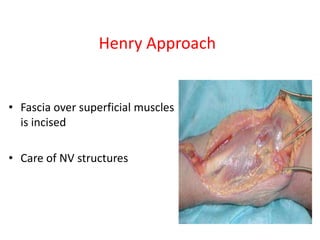
Henry Approach

• Fascia over superficial muscles
is incised
• Care of NV structures
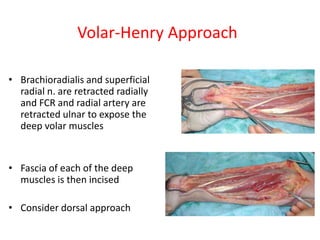
Volar-Henry Approach
• Brachioradialis and superficial
radial n. are retracted radially
and FCR and radial artery are
retracted ulnar to expose the
deep volar muscles

• Fascia of each of the deep
muscles is then incised
• Consider dorsal approach
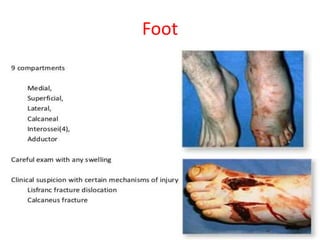
Foot
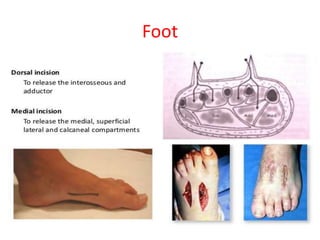
Foot
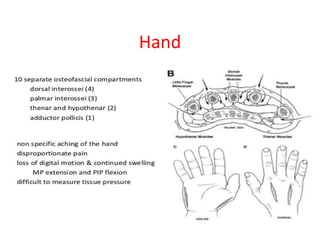
Hand
Post Fasciotomy…
• Must get bone stability
– IMN
– exfix

• ~48hrs after procedure patient should
be brought back to OR for further
debridement
• Delayed skin closure or skin-grafting 37 days after the fasciotomies
Aftercare
• VAC dressings
• Elevation of limb
• Delayed wound closure
– Split thickness skin graft
Remember…
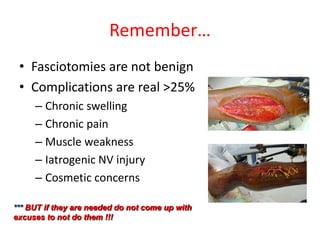
• Fasciotomies are not benign
• Complications are real >25%
– Chronic swelling
– Chronic pain
– Muscle weakness
– Iatrogenic NV injury
– Cosmetic concerns
*** BUT if they are needed do not come up with
excuses to not do them !!!
Take home message
•
•
•
•

Very important to make diagnosis
Missed compartment is devastating
Physical exam
Re-examine patient!
Compartment syndrome

Compartment syndrome