Ionic bonds and ionic compoundsChapter 6.3
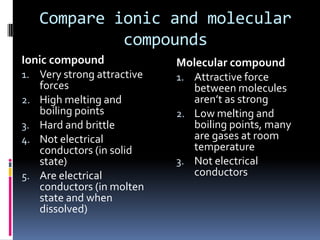
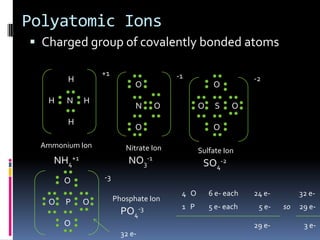
ObjectivesCompare and contrast a chemical formula for a molecular compound with one for an ionic compoundDiscuss the arrangements of ions in crystalsDefine lattice energy and explain its significanceList and compare the distinctive properties of ionic and molecular compoundsWrite the Lewis structure for a polyatomic ion given the identity of the atoms combined and other appropriate information
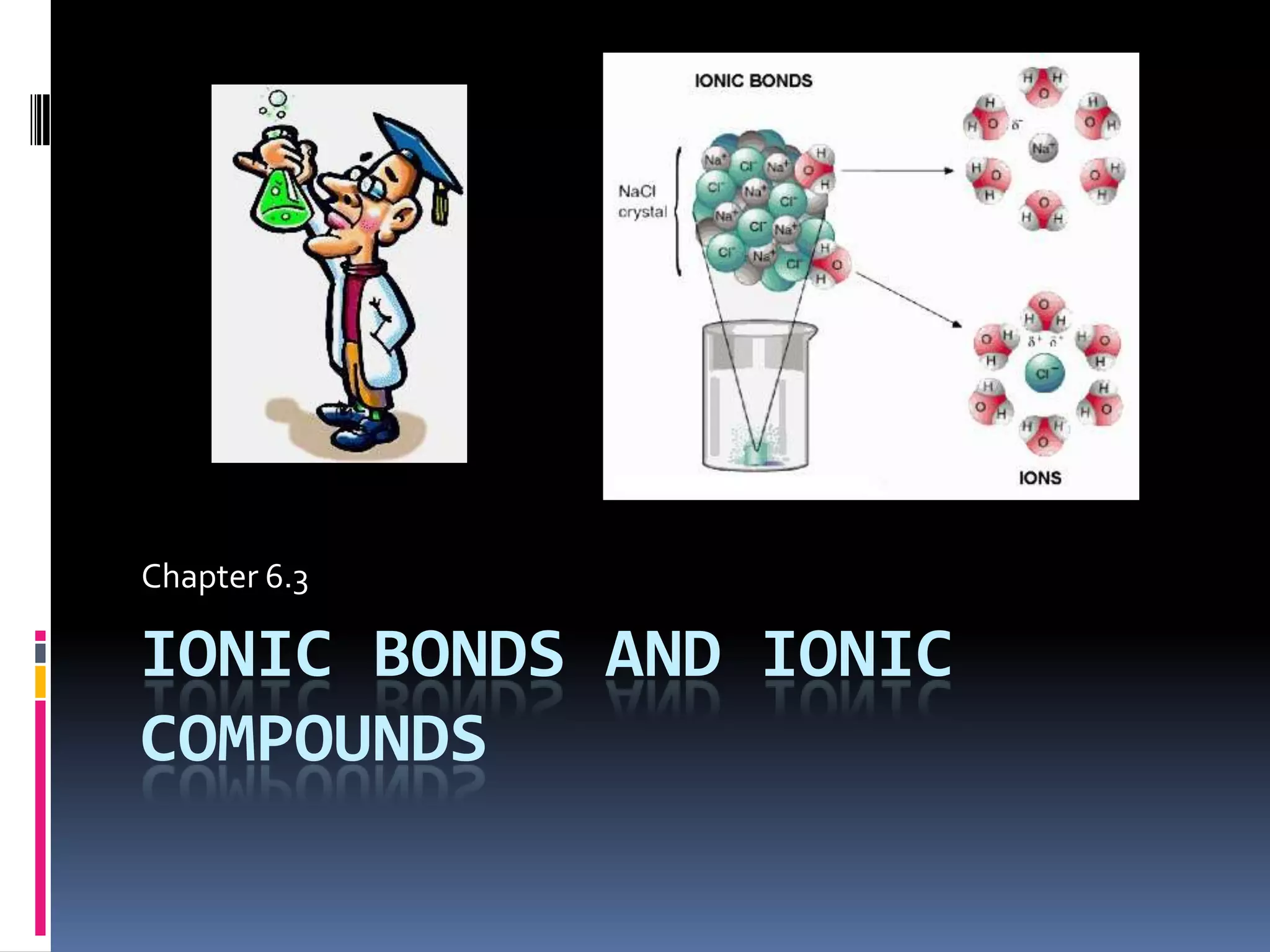
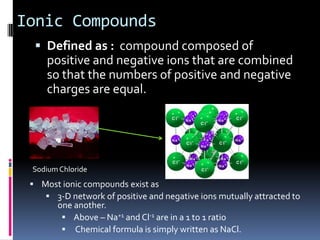
Ionic CompoundsDefined as :  compound composed of positive and negative ions that are combined so that the numbers of positive and negative charges are equal.Sodium ChlorideMost ionic compounds exist as
3-D network of positive and negative ions mutually attracted to one another.
Above – Na+1 and Cl-1 are in a 1 to 1 ratio
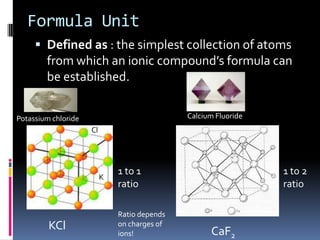
 Chemical formula is simply written as NaCl.Formula UnitDefined as : the simplest collection of atoms from which an ionic compound’s formula can be established.Calcium FluoridePotassium chlorideCl1 to 1 ratio1 to 2 ratioKRatio depends on charges of ions!KClCaF2
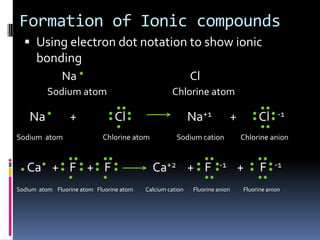
Formation of Ionic compoundsUsing electron dot notation to show ionic bonding		Na				ClSodium atom		       Chlorine atomNa	    +	         Cl		Na+1	    + 	   Cl   -1Sodium  atom	              Chlorine atom	Sodium cation	Chlorine anionCa    +    F    +    F		Ca+2	 +    F   -1    +      F   -1Sodium  atom    Fluorine atom   Fluorine atom 	 Calcium cation        Fluorine anion           Fluorine anion
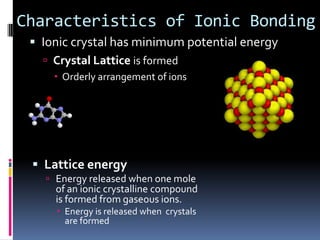
Characteristics of Ionic BondingIonic crystal has minimum potential energyCrystal Latticeis formedOrderly arrangement of ions Lattice energy

Chapter 6.3 : Ionic Bonding and Ionic Compounds

  • 1.
    Ionic bonds andionic compoundsChapter 6.3
  • 2.
    ObjectivesCompare and contrasta chemical formula for a molecular compound with one for an ionic compoundDiscuss the arrangements of ions in crystalsDefine lattice energy and explain its significanceList and compare the distinctive properties of ionic and molecular compoundsWrite the Lewis structure for a polyatomic ion given the identity of the atoms combined and other appropriate information
  • 3.
    Ionic CompoundsDefined as: compound composed of positive and negative ions that are combined so that the numbers of positive and negative charges are equal.Sodium ChlorideMost ionic compounds exist as
  • 4.
    3-D network ofpositive and negative ions mutually attracted to one another.
  • 5.
    Above – Na+1and Cl-1 are in a 1 to 1 ratio
  • 6.
    Chemical formulais simply written as NaCl.Formula UnitDefined as : the simplest collection of atoms from which an ionic compound’s formula can be established.Calcium FluoridePotassium chlorideCl1 to 1 ratio1 to 2 ratioKRatio depends on charges of ions!KClCaF2
  • 7.
    Formation of IoniccompoundsUsing electron dot notation to show ionic bonding Na ClSodium atom Chlorine atomNa + Cl Na+1 + Cl -1Sodium atom Chlorine atom Sodium cation Chlorine anionCa + F + F Ca+2 + F -1 + F -1Sodium atom Fluorine atom Fluorine atom Calcium cation Fluorine anion Fluorine anion
  • 8.
    Characteristics of IonicBondingIonic crystal has minimum potential energyCrystal Latticeis formedOrderly arrangement of ions Lattice energy