Chemical Bonding
Objectives Identify the stable noble gas structure. Explain the formation of ionic and covalent bonds. State the properties of ionic and covalent bonds.
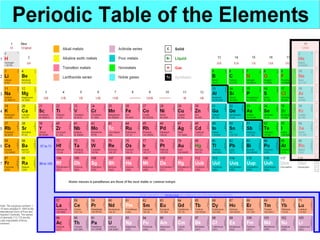
Stable Noble Gas Structure Where can noble gas be found? They are gases found in  Group 0  of the Periodic table. For instance, helium, neon, argon and etc.
 
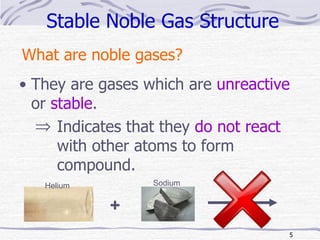
What are noble gases? Stable Noble Gas Structure They are gases which are  unreactive  or  stable . Indicates that they  do not react   with other atoms to form compound. + Helium Sodium
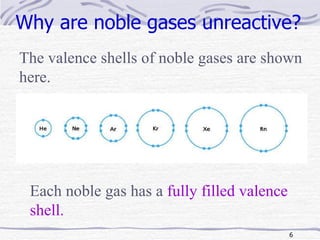
Why are noble gases unreactive?   The valence shells of noble gases are shown here.  Each noble gas has a  fully filled valence shell.
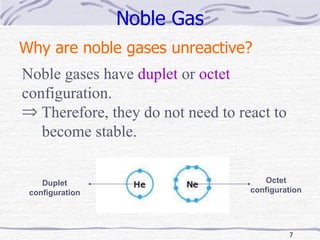
Noble Gas Noble gases have  duplet  or  octet  configuration.  Therefore, they do not need to react to  become stable. Duplet configuration Octet configuration Why are noble gases unreactive?
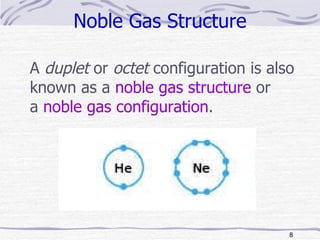
Noble Gas Structure A  duplet  or  octet  configuration is also known as a  noble gas structure  or  a  noble gas configuration .
Noble Gas Structure Other atoms  do not have  a noble gas configuration. Therefore, atoms  react  in order to have the  noble gas structure . Why are the other atoms reactive?
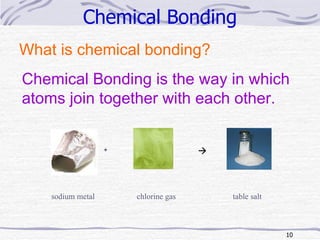
Chemical Bonding What is chemical bonding? Chemical Bonding is the way in which atoms join together with each other.                   +                                                             sodium metal chlorine gas table salt
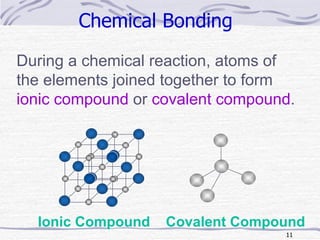
Chemical Bonding During a chemical reaction, atoms of the elements joined together to form  ionic compound  or  covalent compound . Ionic Compound Covalent Compound
Two types of chemical bonding: Ionic bonding- between metals and non- metals Covalent bonding – between non-metals Chemical Bonding
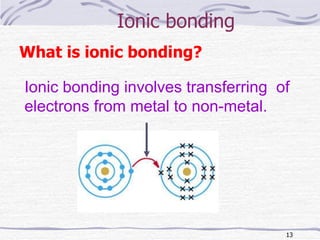
Ionic bonding What is ionic bonding? Ionic bonding involves transferring  of electrons from metal to non-metal.
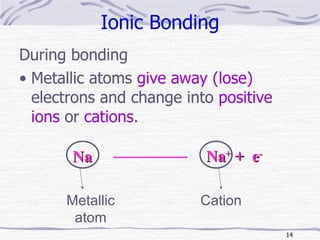
Ionic Bonding During bonding Metallic atoms  give away (lose)  electrons and change into  positive ions  or  cations . Na Na +  +  e - Cation Metallic atom
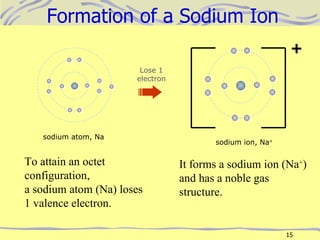
Formation of a Sodium Ion To attain an octet configuration,  a sodium atom (Na) loses  1 valence electron.  It forms a sodium ion (Na + ) and has a noble gas structure. sodium atom, Na Lose 1 electron sodium ion, Na + +
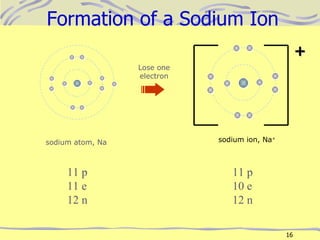
Formation of a Sodium Ion 11 p 11 e 12 n sodium atom, Na Lose one electron sodium ion, Na + + 11 p 10 e 12 n
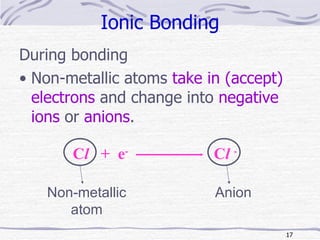
Ionic Bonding During bonding Non-metallic atoms  take in   (accept)   electrons  and change into  negative ions  or  anions . C l  -   C l  +  e - Non-metallic atom Anion
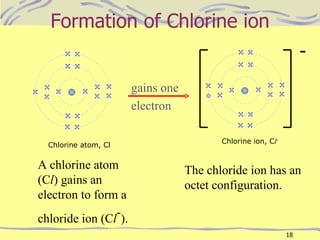
Formation of Chlorine ion A chlorine atom (C l ) gains an electron to form a chloride ion (C l - ).  The chloride ion has an octet configuration. Chlorine ion, C l - - Chlorine atom, Cl gains one electron
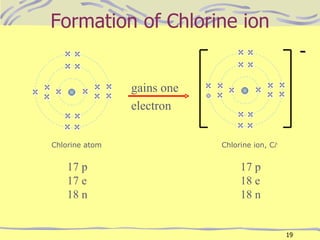
Formation of Chlorine ion Chlorine ion, C l - 17 p 17 e 18 n 17 p 18 e 18 n Chlorine atom gains one electron -
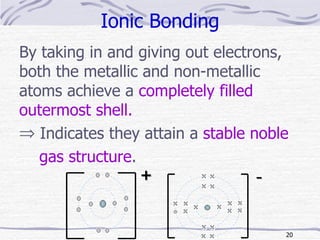
Ionic Bonding By taking in and giving out electrons, both the metallic and non-metallic atoms achieve a  completely filled outermost shell. Indicates they attain a  stable noble gas structure . - +
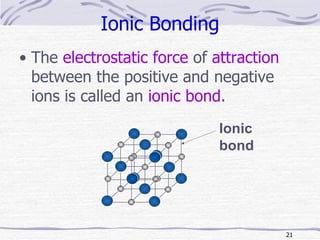
The  electrostatic force  of  attraction  between the positive and negative ions is called an  ionic bond . Ionic Bonding Ionic bond
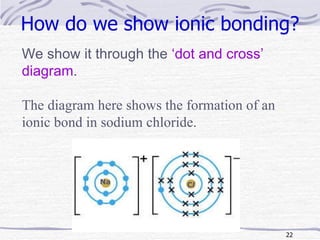
How do we show ionic bonding? We show it through the  ‘dot and cross’ diagram . The diagram here shows the formation of an ionic bond in sodium chloride.  C l Na
Examples Magnesium oxide Calcium fluoride Lithium oxide
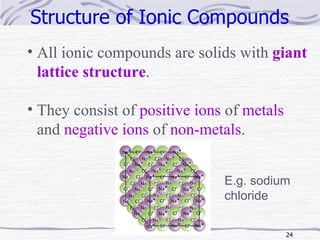
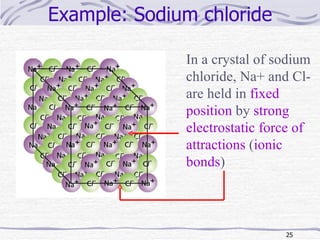
Structure of Ionic Compounds   All ionic compounds are solids with  giant lattice structure . They consist of  positive ions  of  metals  and  negative ions  of  non-metals . E.g. sodium chloride
Example: Sodium chloride In a crystal of sodium chloride, Na+ and Cl- are held in  fixed position  by  strong electrostatic force of attractions  ( ionic bonds )
Characteristics of ionic compounds   High melting and boiling point Ions are held  firmly  to their position  by strong electrostatic force of attraction. A  great amount of energy  is needed to break these forces for the ions to move out of its fixed position to become a liquid.
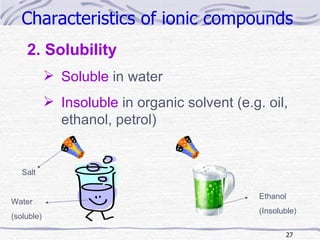
Characteristics of ionic compounds   2. Solubility Soluble  in water Insoluble  in organic solvent (e.g. oil, ethanol, petrol) Ethanol (Insoluble) Salt Water (soluble)
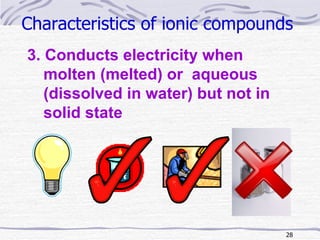
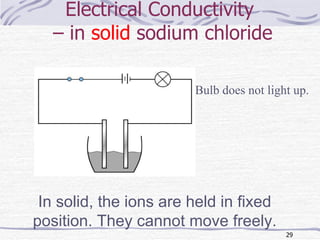
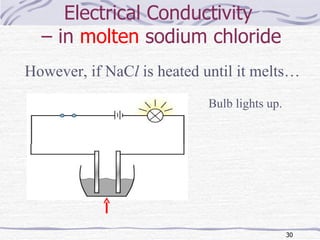
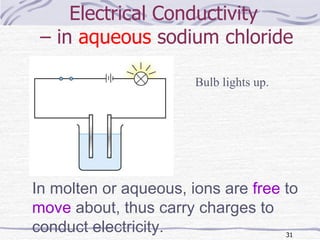
Characteristics of ionic compounds   3. Conducts electricity when  molten (melted) or  aqueous (dissolved in water) but not in solid state
Electrical Conductivity  – in  solid  sodium chloride Bulb does not light up. In solid, the ions are held in fixed position. They cannot move freely.
Electrical Conductivity  – in  molten  sodium chloride However, if NaC l  is heated until it melts… Bulb lights up.
Electrical Conductivity  – in  aqueous  sodium chloride Bulb lights up. In molten or aqueous, ions are  free  to  move  about, thus carry charges to conduct electricity.
Covalent Bonding
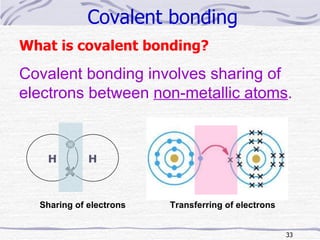
Covalent bonding What is covalent bonding? Covalent bonding involves sharing of electrons between  non-metallic atoms . H H Sharing of electrons Transferring of electrons
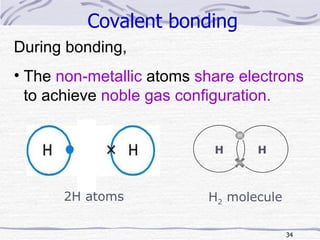
Covalent bonding During bonding, The  non-metallic   atoms   share   electrons  to achieve  noble gas configuration. H 2  molecule H H 2H atoms
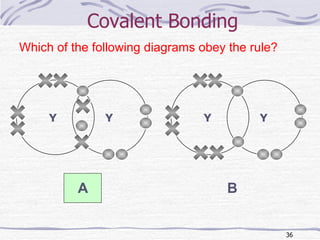
Covalent Bonding Rule 1: Each atom must contribute an  equal  number of electrons for sharing.
Covalent Bonding Y Y Y Y A B Which of the following diagrams obey the rule?
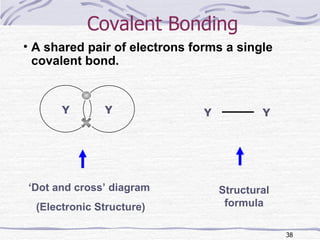
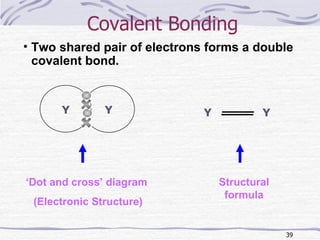
Covalent Bonding Rule 2: A shared pair  of electrons forms  a single covalent bond . 1 pair  of electrons    a  single  bond is formed. 2   pairs  of electrons    a  double  bond is formed. 3 pairs  of electrons    a  triple  bond is formed.
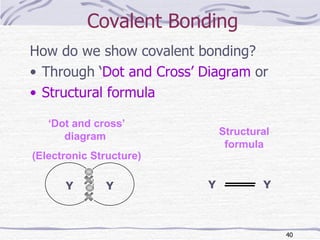
Covalent Bonding Y Y Structural formula ‘ Dot and cross’ diagram  (Electronic Structure) Y Y A shared pair of electrons forms a single covalent bond.
Covalent Bonding Y Y Structural formula ‘ Dot and cross’ diagram  (Electronic Structure) Y Y Two shared pair of electrons forms a double covalent bond.
How do we show covalent bonding? Through ‘ Dot and Cross’ Diagram  or Structural formula Covalent Bonding Structural formula ‘ Dot and cross’ diagram  (Electronic Structure) Y Y Y Y
Covalent Bonding Examples: Hydrogen molecule Oxygen molecule Nitrogen molecule  Methane (CH 4 ) Carbon dioxide  Water Ammonia (NH 3 )
Characteristics of Covalent  Compounds   Low melting and boiling point  ( high volatility) Molecules are held together by  very weak intermolecular forces. Little energy  is required to overcome the forces of attraction.
Characteristics of Covalent  compounds   2. Solubility Soluble  in organic solvent Insoluble  in water.
Characteristics of ionic compounds   3.  Does not conduct electricity in any state. Molecules in covalent compounds  do not  carry charges. No ions  to carry electric current.

Chemical bonding

  • 1.
  • 2.
    Objectives Identify thestable noble gas structure. Explain the formation of ionic and covalent bonds. State the properties of ionic and covalent bonds.
  • 3.
    Stable Noble GasStructure Where can noble gas be found? They are gases found in Group 0 of the Periodic table. For instance, helium, neon, argon and etc.
  • 4.
  • 5.
    What are noblegases? Stable Noble Gas Structure They are gases which are unreactive or stable . Indicates that they do not react with other atoms to form compound. + Helium Sodium
  • 6.
    Why are noblegases unreactive? The valence shells of noble gases are shown here. Each noble gas has a fully filled valence shell.
  • 7.
    Noble Gas Noblegases have duplet or octet configuration. Therefore, they do not need to react to become stable. Duplet configuration Octet configuration Why are noble gases unreactive?
  • 8.
    Noble Gas StructureA duplet or octet configuration is also known as a noble gas structure or a noble gas configuration .
  • 9.
    Noble Gas StructureOther atoms do not have a noble gas configuration. Therefore, atoms react in order to have the noble gas structure . Why are the other atoms reactive?
  • 10.
    Chemical Bonding Whatis chemical bonding? Chemical Bonding is the way in which atoms join together with each other.                  +                                                         sodium metal chlorine gas table salt
  • 11.
    Chemical Bonding Duringa chemical reaction, atoms of the elements joined together to form ionic compound or covalent compound . Ionic Compound Covalent Compound
  • 12.
    Two types ofchemical bonding: Ionic bonding- between metals and non- metals Covalent bonding – between non-metals Chemical Bonding
  • 13.
    Ionic bonding Whatis ionic bonding? Ionic bonding involves transferring of electrons from metal to non-metal.
  • 14.
    Ionic Bonding Duringbonding Metallic atoms give away (lose) electrons and change into positive ions or cations . Na Na + + e - Cation Metallic atom
  • 15.
    Formation of aSodium Ion To attain an octet configuration, a sodium atom (Na) loses 1 valence electron. It forms a sodium ion (Na + ) and has a noble gas structure. sodium atom, Na Lose 1 electron sodium ion, Na + +
  • 16.
    Formation of aSodium Ion 11 p 11 e 12 n sodium atom, Na Lose one electron sodium ion, Na + + 11 p 10 e 12 n
  • 17.
    Ionic Bonding Duringbonding Non-metallic atoms take in (accept) electrons and change into negative ions or anions . C l - C l + e - Non-metallic atom Anion
  • 18.
    Formation of Chlorineion A chlorine atom (C l ) gains an electron to form a chloride ion (C l - ). The chloride ion has an octet configuration. Chlorine ion, C l - - Chlorine atom, Cl gains one electron
  • 19.
    Formation of Chlorineion Chlorine ion, C l - 17 p 17 e 18 n 17 p 18 e 18 n Chlorine atom gains one electron -
  • 20.
    Ionic Bonding Bytaking in and giving out electrons, both the metallic and non-metallic atoms achieve a completely filled outermost shell. Indicates they attain a stable noble gas structure . - +
  • 21.
    The electrostaticforce of attraction between the positive and negative ions is called an ionic bond . Ionic Bonding Ionic bond
  • 22.
    How do weshow ionic bonding? We show it through the ‘dot and cross’ diagram . The diagram here shows the formation of an ionic bond in sodium chloride. C l Na
  • 23.
    Examples Magnesium oxideCalcium fluoride Lithium oxide
  • 24.
    Structure of IonicCompounds All ionic compounds are solids with giant lattice structure . They consist of positive ions of metals and negative ions of non-metals . E.g. sodium chloride
  • 25.
    Example: Sodium chlorideIn a crystal of sodium chloride, Na+ and Cl- are held in fixed position by strong electrostatic force of attractions ( ionic bonds )
  • 26.
    Characteristics of ioniccompounds High melting and boiling point Ions are held firmly to their position by strong electrostatic force of attraction. A great amount of energy is needed to break these forces for the ions to move out of its fixed position to become a liquid.
  • 27.
    Characteristics of ioniccompounds 2. Solubility Soluble in water Insoluble in organic solvent (e.g. oil, ethanol, petrol) Ethanol (Insoluble) Salt Water (soluble)
  • 28.
    Characteristics of ioniccompounds 3. Conducts electricity when molten (melted) or aqueous (dissolved in water) but not in solid state
  • 29.
    Electrical Conductivity – in solid sodium chloride Bulb does not light up. In solid, the ions are held in fixed position. They cannot move freely.
  • 30.
    Electrical Conductivity – in molten sodium chloride However, if NaC l is heated until it melts… Bulb lights up.
  • 31.
    Electrical Conductivity – in aqueous sodium chloride Bulb lights up. In molten or aqueous, ions are free to move about, thus carry charges to conduct electricity.
  • 32.
  • 33.
    Covalent bonding Whatis covalent bonding? Covalent bonding involves sharing of electrons between non-metallic atoms . H H Sharing of electrons Transferring of electrons
  • 34.
    Covalent bonding Duringbonding, The non-metallic atoms share electrons to achieve noble gas configuration. H 2 molecule H H 2H atoms
  • 35.
    Covalent Bonding Rule1: Each atom must contribute an equal number of electrons for sharing.
  • 36.
    Covalent Bonding YY Y Y A B Which of the following diagrams obey the rule?
  • 37.
    Covalent Bonding Rule2: A shared pair of electrons forms a single covalent bond . 1 pair of electrons  a single bond is formed. 2 pairs of electrons  a double bond is formed. 3 pairs of electrons  a triple bond is formed.
  • 38.
    Covalent Bonding YY Structural formula ‘ Dot and cross’ diagram (Electronic Structure) Y Y A shared pair of electrons forms a single covalent bond.
  • 39.
    Covalent Bonding YY Structural formula ‘ Dot and cross’ diagram (Electronic Structure) Y Y Two shared pair of electrons forms a double covalent bond.
  • 40.
    How do weshow covalent bonding? Through ‘ Dot and Cross’ Diagram or Structural formula Covalent Bonding Structural formula ‘ Dot and cross’ diagram (Electronic Structure) Y Y Y Y
  • 41.
    Covalent Bonding Examples:Hydrogen molecule Oxygen molecule Nitrogen molecule Methane (CH 4 ) Carbon dioxide Water Ammonia (NH 3 )
  • 42.
    Characteristics of Covalent Compounds Low melting and boiling point ( high volatility) Molecules are held together by very weak intermolecular forces. Little energy is required to overcome the forces of attraction.
  • 43.
    Characteristics of Covalent compounds 2. Solubility Soluble in organic solvent Insoluble in water.
  • 44.
    Characteristics of ioniccompounds 3. Does not conduct electricity in any state. Molecules in covalent compounds do not carry charges. No ions to carry electric current.